Garlinghouse Says Ripple Remains ‘Extremely Committed’ To XRP

bitcoinistPublished on 2026-05-01Last updated on 2026-05-01

Ripple CEO Brad Garlinghouse used an appearance at XRP Las Vegas on April 30 to push back against doubts about the company’s alignment with XRP, arguing that the firm remains economically and strategically tied to the asset even as it expands deeper into institutional finance, stablecoins and regulated US infrastructure.

Speaking on stage, Garlinghouse said he has long found criticism of Ripple’s commitment to XRP “funny and strange,” given the company’s direct exposure to the asset and its role in building products around liquidity, utility and trust.

“Today, Ripple is still the largest holder of XRP on the planet. We are the most interested party in seeing XRP be successful. We will continue to be the most interested party in seeing XRP be successful,” Garlinghouse said. “And so whenever I read people kind of question that, I just think, like, it doesn’t make sense logically.”

The comments came during a wide-ranging panel that moved from Ripple’s advertising push in Las Vegas to US policy, the Clarity Act, stablecoin regulation, Ripple’s private-market valuation and the company’s relationship with the XRP community.

Ripple’s Institutional Push Still Runs Through XRP

Garlinghouse framed Ripple’s current strategy around making XRP “the most useful digital asset,” “the most liquid digital asset” and “the most trusted digital asset.” He tied that directly to Ripple’s enterprise business, including products and services for financial institutions and capital markets under what he referred to as Ripple Prime, as well as Ripple Treasury.

The CEO also addressed a recurring concern among XRP holders: whether Ripple’s stablecoin work, including RLUSD, could reduce XRP’s importance inside the company’s broader product stack. Garlinghouse said Ripple does not always publicly explain every strategic step, partly because doing so would disclose too much to competitors. But he argued that even moves that appear indirect are still designed to support XRP’s long-term role.

“We’re going to do things that may not at first blush make crystal clear sense,” he said. “But I swear to you, even if it doesn’t have a direct line from point A to point B, point B being good for XRP, it may be point A to point B to point C. It’s all in service of how do we do things that expand, grow, and drive in liquidity, utility, and trust in XRP.”

That formulation is important because it captures Ripple’s current balancing act. The company is no longer only defending XRP in court or selling a single payments narrative. It is building across custody, treasury, stablecoins, prime brokerage-style services and institutional market infrastructure, while asking the XRP community to view those efforts as connected to the same liquidity network.

Garlinghouse said Ripple now has around 1,500 employees and is having a record year across multiple areas. He also pointed to tokenization as a major area where the XRP Ledger could matter, even when Ripple itself is not the direct operator of every use case.

He cited bond settlement as one example of a market still burdened by slow and outdated processes. “Bond settlement is slow, it is arcane, and it is absurd to think about how that works in a world of the internet,” Garlinghouse said, adding that he believes it is “only a matter of time” before assets like bonds move on-chain.

Clarity Act Deadline Looms

The policy section of the interview centered on the Clarity Act and whether US market structure legislation can still move before the midterm election cycle disrupts the process. Garlinghouse said Ripple had been close to the finish line months earlier, but that the legislative process slowed after Coinbase, led by Brian Armstrong, urged caution.

His frustration was less about Ripple’s own regulatory status than about the broader industry. Garlinghouse argued that XRP already has the legal clarity others are still seeking because of the court ruling in Ripple’s fight with the SEC.

“XRP has clarity. XRP fought a very painful fight to get clarity. It’s a big deal,” he said. “We have a federal judge said in her opinion, XRP in and of itself is not a security. Boom. We have clarity. That’s what we care about.”

That distinction shaped much of Garlinghouse’s message. Ripple supports the Clarity Act, he said, because it would help the US crypto industry and give large financial institutions more confidence to engage. But he repeatedly separated that broader policy objective from XRP’s own status.

“If it doesn’t pass, I think that’s unfortunate for a lot of other players in the industry in the United States,” Garlinghouse said. “XRP is going to be okay no matter what.”

Still, he warned that the window is narrow. Garlinghouse said that if the bill does not move out of the Senate Banking Committee by the end of the third week of May, “we’re in real trouble.” If it clears committee, he said, he believes it can pass the Senate because bipartisan support exists at that level.

Ripple Looks Toward US Banking Rails

Garlinghouse also said Ripple’s conditional OCC trust charter approval is tied to its stablecoin strategy, particularly RLUSD, and described dual oversight from the New York Department of Financial Services and the OCC as a “belt and suspenders” approach. He said Ripple wants to be “the most white hat around stablecoins as possible” because of its institutional customer base.

He also confirmed that a Federal Reserve master account is “very much on our radar,” calling it a potential “big unlock” for Ripple and arguing that better financial services infrastructure would benefit the United States.

At press time, XRP traded at $1.37.
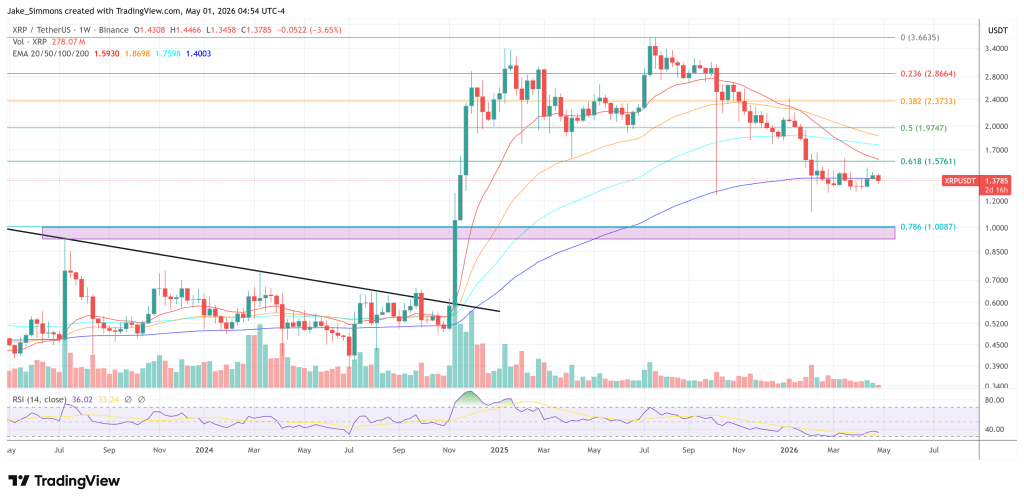
XRP trades below the 200-week EMA again, 1-week chart | Source: XRPUSDT on TradingView.com

Related Reads

Trading

Spot
Futures

Hot Articles

What is XRP 2.0

XRP 2.0: A New Frontier in the Cryptocurrency Landscape Introduction to XRP 2.0 In the ever-evolving realm of cryptocurrency, new projects continuously emerge, vying for attention and adoption. One such promising initiative is XRP 2.0, a novel cryptocurrency project designed to leverage advanced blockchain technology and robust encryption methodologies. While the name draws parallels with Ripple’s XRP, it’s crucial to note that XRP 2.0 operates independently, focusing on enhancing transaction security, privacy, and scalability. As the digital financial landscape increasingly embraces decentralized solutions, XRP 2.0 aims to contribute meaningfully to web3 and the overall expansion of crypto projects. What is XRP 2.0? At its core, XRP 2.0 is a cryptocurrency project that aims to create a secure and decentralized digital currency ecosystem. Its foundational technology integrates sophisticated blockchain principles with cutting-edge encryption techniques. The overarching goal of XRP 2.0 is to establish itself as a reliable and efficient platform enabling swift transaction execution while prioritizing enhanced privacy protections for its users. The project is promoted as a solution to many limitations faced by existing cryptocurrencies, proposing a system that can handle a higher volume of transactions with improved speed and privacy. This versatility positions XRP 2.0 as a significant contender in a marketplace riddled with various digital currencies. Who is the Creator of XRP 2.0? The identity of the creator behind XRP 2.0 has been flagged as ‘Wilbur.’ However, comprehensive details regarding Wilbur or their associated entity remain elusive. The anonymity of many cryptocurrency creators is not an uncommon phenomenon in the industry, often designed to maintain a degree of privacy and security. Who are the Investors of XRP 2.0? As of now, specific information related to the investment foundations or organizations supporting XRP 2.0 is not publicly available. In the cryptocurrency sector, the backing by reputed investors can significantly influence a project's credibility and success, yet the transparency regarding the financial supporters of XRP 2.0 has not been established. How Does XRP 2.0 Work? XRP 2.0 stands out by employing a combination of blockchain technology and advanced encryption algorithms that ensures secure and decentralized transactions. Its innovative structure includes unique features designed to foster user engagement and broaden functionalities beyond conventional cryptocurrency transactions. Among these features, XRP 2.0 incorporates AI-powered capabilities, such as text-to-image and text-to-speech functionalities. These additions are designed to enhance the interactive experience for users, promoting broader applicability across various sectors. By bridging technological advancements with user-centered design, XRP 2.0 aims to capture the attention of a diverse range of individuals and enterprises looking to integrate cryptocurrency solutions into their operational frameworks. Timeline of XRP 2.0 Understanding XRP 2.0 requires examining the milestones that have defined its journey thus far: July 23, 2023: XRP 2.0 is introduced as a novel cryptocurrency project, aiming to revolutionize secure and decentralized transaction capabilities in the blockchain domain. September 8, 2023: The launching of another project, XRP20, occurs, marking the emergence of an ERC-20 token on the Ethereum blockchain that remains unrelated to XRP 2.0. November 13, 2023: The XRP Ledger undergoes a significant update with the release of rippled server software version 2.0.0. It is essential to note that this development is disconnected from the XRP 2.0 cryptocurrency project. Key Points About XRP 2.0 To distill the essence of XRP 2.0, several critical factors emerge: Unique Features: The inclusion of features like AI-powered text-to-image and text-to-speech further diversifies the potential applications of XRP 2.0. Blockchain Technology: The framework utilizes advanced blockchain mechanisms and encryption protocols, ensuring a secure and decentralized environment for transactions. Scalability and Privacy: XRP 2.0 prioritizes enhanced privacy protections in transaction processes and the scalability necessary to accommodate a growing user base. No Affiliation with Ripple: Importantly, despite its name, XRP 2.0 does not have any allegiance or collaboration with Ripple’s XRP, distinguishing its operational framework and objectives within the cryptocurrency ecosystem. Conclusion XRP 2.0 represents an ambitious venture into the cryptocurrency sphere, aiming to offer a combination of security, privacy, and efficiency in digital transactions. By integrating sophisticated technologies and user-friendly features, the project sets out to broaden the horizons of what cryptocurrency can achieve in today's digital economy. While the anonymity of its creator and lack of disclosed investors might raise questions for some, XRP 2.0's focus on advanced functionalities and decentralisation enhances its appeal amidst an increasingly crowded crypto market. As the cryptocurrency landscape continues to evolve, XRP 2.0 may yet emerge as a pivotal player in the expansion of secure and scalable blockchain solutions.

941 Total ViewsPublished 2024.04.01Updated 2024.12.03

What is XRP 2.0

Discussions

Welcome to the HTX Community. Here, you can stay informed about the latest platform developments and gain access to professional market insights. Users' opinions on the price of XRP (XRP) are presented below.

活动图片