Garlinghouse Reveals Why Ripple Really Pivoted To Its Own Stablecoin

bitcoinistPublished on 2026-03-27Last updated on 2026-03-27

Abstract

Ripple CEO Brad Garlinghouse explained that the company launched its own stablecoin, RLUSD, to internalize a role it was already playing at scale—having previously minted 20% of all USDC due to its large payment flows. The decision was driven by Ripple's substantial balance sheet strength, which positions it to offer a compliant, institutionally-focused stablecoin, especially after observing vulnerabilities like USDC's depeg during the Silicon Valley Bank collapse. Garlinghouse emphasized that trust, licensing, and transparency will differentiate stablecoins as the market matures, and he expects regulatory progress in the U.S. to continue, with further clarity anticipated by the end of May.

Ripple’s decision to launch RLUSD was not a sudden expansion beyond XRP so much as a move to internalize a business it was already helping power at scale. Speaking at FII Priority Miami 2026, Ripple CEO Brad Garlinghouse said the company’s role in stablecoin flows had grown large enough that building its own product became the logical next step.

Why Ripple Entered the Stablecoin Market

Garlinghouse said the turning point came well before RLUSD’s launch 13 months ago. “Two years ago, we were minting 20% of all USDC,” he said, tying that activity directly to Ripple’s payments business. With more than $100 billion in payment flows already processed, Ripple concluded that if it was already a major engine behind stablecoin usage, it made sense to bring that function in-house.

He also linked the decision to a moment of stress in the stablecoin market. Garlinghouse pointed to USDC’s temporary depeg during the Silicon Valley Bank collapse as a reminder that institutional users care about balance-sheet strength as much as blockchain rails.

“Circle came out and said, hey, we’ll stand in the gap. We’ll guarantee the peg. And it didn’t move because at that point, Circle didn’t have a balance sheet,” he said. “Ripple has on our balance sheet, you know, 60, 70 billion dollars of crypto. We have about four billion dollars of US dollars. And so I think we’re in a position to really have a very compliant, very institutional focused stablecoin.”

According to Garlinghouse, stablecoins are increasingly adopted not because companies want exposure to crypto branding, but because they want a better way to solve treasury, settlement and cross-border transfer problems. That broader shift, he argued, is already reshaping how the sector is perceived.

Garlinghouse compared the current state of crypto to the internet industry in the late 1990s, when companies led with the technology rather than the use case. “We don’t talk about anything as an internet company now because it’s just prevalent in the background,” he said. “And I think that’s where some of the blockchain and crypto based solutions are heading”. Companies, he added, “just want to solve a payments problem. They want to solve a custody problem.”

On market structure, Garlinghouse expects the stablecoin field to get more crowded before it gets smaller. He said the biggest banks are already evaluating whether they should issue their own stablecoins, but questioned whether the market benefits from too many dollar-backed instruments that ultimately serve the same economic function. “We don’t need, you know, 50 US dollar stablecoins. Like, why? Like, they’re all, it’s still, at the end of the day, a U.S. dollar,” he said.

That does not mean he sees no room for differentiation. Instead, he argued that trust, licensing and reserve transparency will become the real competitive variables as the market matures. Ripple, he said, has deliberately taken a compliance-first route, pursuing not just a New York Department of Financial Services license but also an OCC license.

He added that the sector as a whole needs more regulatory verification and disclosure, pointing even to Tether’s renewed push for an audit as evidence that transparency is becoming harder to avoid.

Garlinghouse was similarly upbeat on the US policy backdrop. He described passage of the Genius Act as a major unlock for demand and said corporate executives are now actively asking whether stablecoins should be part of their operations. While he said follow-on legislation around asset classification has been slower, he argued the tone in Washington has already shifted sharply, citing recent coordination between the SEC and CFTC and predicting further progress by the end of May.

“So I think we already have made huge progress in this administration to provide some of that structure and Clarity [Act]. I think clarity will still pass. I was in Washington two days ago, and I think we’ll still get something. [...] I’ll predict by the end of May we’ll get something across,” Garlinghouse said.

At press time, XRP traded at $1.36.
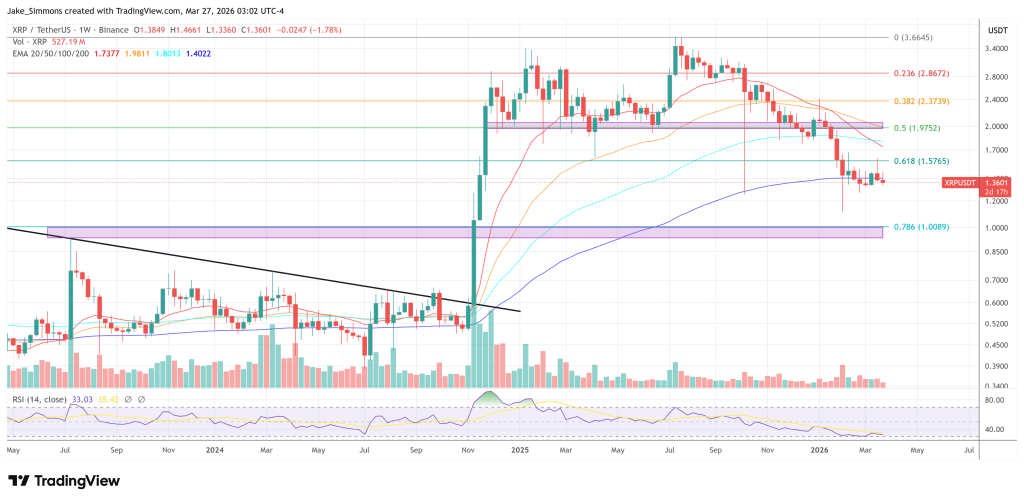
XRP drops below the 200-week EMA again, 1-week chart | Source: XRPUSDT on TradingView.com

Related Questions

QWhat was the main reason Ripple decided to launch its own stablecoin, RLUSD?

ARipple decided to launch RLUSD because its role in stablecoin flows had grown so large that building its own product became the logical next step. The company was already minting 20% of all USDC and processing over $100 billion in payment flows, making it a major engine behind stablecoin usage.

QAccording to Brad Garlinghouse, what event in the stablecoin market highlighted the importance of a strong balance sheet for institutional users?

AGarlinghouse pointed to USDC's temporary depeg during the Silicon Valley Bank collapse as the event that highlighted the importance of balance-sheet strength for institutional users, noting that Circle lacked the balance sheet to guarantee the peg at that time.

QHow does Garlinghouse compare the current state of the crypto industry to the internet in the 1990s?

AGarlinghouse compared the current state of crypto to the internet industry in the late 1990s, where companies led with the technology rather than the use case. He stated that just as we no longer talk about 'internet companies' because the technology is now prevalent in the background, blockchain and crypto-based solutions are heading in the same direction.

QWhat does Garlinghouse believe will be the key competitive differentiators in the mature stablecoin market?

AGarlinghouse believes that trust, licensing, and reserve transparency will become the real competitive variables as the stablecoin market matures.

QWhat positive developments in US policy and regulation did Garlinghouse highlight?

AGarlinghouse was upbeat on US policy, citing the passage of the Genius Act as a major unlock for demand. He also mentioned improved coordination between the SEC and CFTC and predicted that further legislative clarity would be achieved by the end of May.

Related Reads

The Verdict in Choi Tae-won's Divorce Case: Revealing the Inheritance Undercurrent Behind SK Hynix's Trillion-Won Empire

SK Group Chairman Chey Tae-won's high-profile divorce case, involving a record 1.38 trillion won settlement, has drawn attention to the succession plans for Korea's second-largest conglomerate, especially its crown jewel, SK hynix. Unlike traditional chaebol scripts centered on the eldest son, Chey's three children from his marriage to former President Roh Tae-woo's daughter, Roh Soh-yeong, are carving distinct, non-traditional paths. Eldest daughter Chey Yun-jung (b. 1989) is seen as the most evident successor. With a scientific and consulting background, she holds executive roles at SK bioscience and SK Inc.'s growth support department, focusing on future strategy and biopharma. Her marriage is to an AI infrastructure entrepreneur, not a traditional business alliance. Second daughter Chey Min-jung (b. 1991) took a unique route, voluntarily serving as a South Korean naval officer, including an anti-piracy deployment. She later worked on policy and strategy for SK hynix in Washington D.C. before co-founding an AI-driven healthcare startup. She married a former U.S. Marine Corps officer, connecting her to U.S. defense and policy circles—networks crucial for a global semiconductor giant. The only son, Chey In-geun (b. 1995), who studied physics like his father, worked briefly at SK E&S before joining McKinsey. Despite fitting the traditional "heir" profile as the eldest son, he remains silent and holds no public position or shares in SK, suggesting the old succession playbook is obsolete. As SK hynix's valuation soars, becoming a geopolitical asset in the AI era, the heirs' legitimacy is no longer automatic. They must prove themselves in fields like AI biotech, global policy, and strategic consulting. Their marriages also reflect new elite networks in tech and defense, not old political alliances. Their inheritance is the complex challenge of navigating a globalized, tech-driven world, not just a corporate throne.

marsbit11h ago

The Verdict in Choi Tae-won's Divorce Case: Revealing the Inheritance Undercurrent Behind SK Hynix's Trillion-Won Empire

marsbit11h ago

From OpenSea to OpenRouter: Is Alex Atallah Repeating His 'Exit at the Peak' Playbook?

From OpenSea to OpenRouter: Is Alex Atallah Repeating His "Exit at the Peak" Playbook? According to the Wall Street Journal, payments giant Stripe is in talks to acquire the AI model aggregation platform OpenRouter in a potential deal valuing the company near $100 billion. This would mark founder Alex Atallah's second creation of a company reaching a $100 billion valuation, following his co-founding of NFT marketplace OpenSea. OpenRouter, founded just over three years ago, has grown rapidly by acting as a unified gateway for developers to access over 400 AI models. It currently has about 10 million users and processes over 200 trillion tokens monthly. While the platform's annualized revenue is around $50 million, its valuation has skyrocketed from $1.3 billion in March 2026. The potential acquisition by Stripe, a company OpenRouter's founder once likened it to, represents a major expansion into AI infrastructure for the payments leader. This move echoes Atallah's previous timing with OpenSea, where he departed before the NFT market's significant downturn. For OpenRouter, selling now may be strategic. Despite its scale, its business model—charging a 5-5.5% fee on AI inference calls—faces pressure from competition, open-source models, and potential price wars among model providers, limiting its profitability narrative for an IPO. A key asset for potential acquirers like Stripe is OpenRouter's vast repository of real-world AI usage data, which offers unique insights into model performance and developer preferences that are difficult to replicate. Whether this potential deal signifies a new valuation benchmark for AI infrastructure or another market peak signal remains to be seen.

链捕手11h ago

From OpenSea to OpenRouter: Is Alex Atallah Repeating His 'Exit at the Peak' Playbook?

链捕手11h ago

Trading

Spot
活动图片





