Fundstrat’s circulating 2026 crypto outlook warns of pullback, contrasting Tom Lee

cointelegraphPublished on 2025-12-20Last updated on 2025-12-20

Abstract

A reportedly internal 2026 crypto outlook from Fundstrat Global Advisors warns of a potential "meaningful drawdown" in the first half of 2026, setting downside targets for major cryptocurrencies. The document, attributed to the firm's head of digital asset strategy Sean Farrell, suggests Bitcoin (BTC) could fall to $60,000–$65,000, Ether (ETH) to $1,800–$2,000, and Solana (SOL) to $50–$75, viewing these levels as potential buying opportunities later in the year. This contrasts with recent public comments from Fundstrat's head of research Tom Lee, who called ETH "grossly undervalued" at around $3,000 and suggested it could reach up to $60,000 based on historical ratios. The report's authenticity has not been confirmed by Fundstrat or Cointelegraph.

A circulating report attributed to Fundstrat Global Advisors has outlined a bearish outlook for cryptocurrencies that appears to clash with Tom Lee’s recent public comments.

According to screenshots shared on X, the document, which appears to be Fundstrat’s internal 2026 crypto strategy guidance, warns of a “meaningful drawdown” in the first half of 2026. The report sets downside targets of Bitcoin (BTC) falling to $60,000–$65,000, Ether (ETH) dropping to $1,800–$2,000, and Solana (SOL) declining to $50–$75 before potentially presenting buying opportunities later in the year.

The material has not been publicly released by Fundstrat, and its authenticity has not been independently confirmed by Cointelegraph at the time of publication. However, multiple crypto-focused accounts, including Wu Blockchain, claim the document was distributed to internal clients.

Lee is a managing partner and the head of research at Fundstrat. The circulating 2026 crypto outline has been apparently written by Sean Farrell, head of digital asset strategy at the firm.
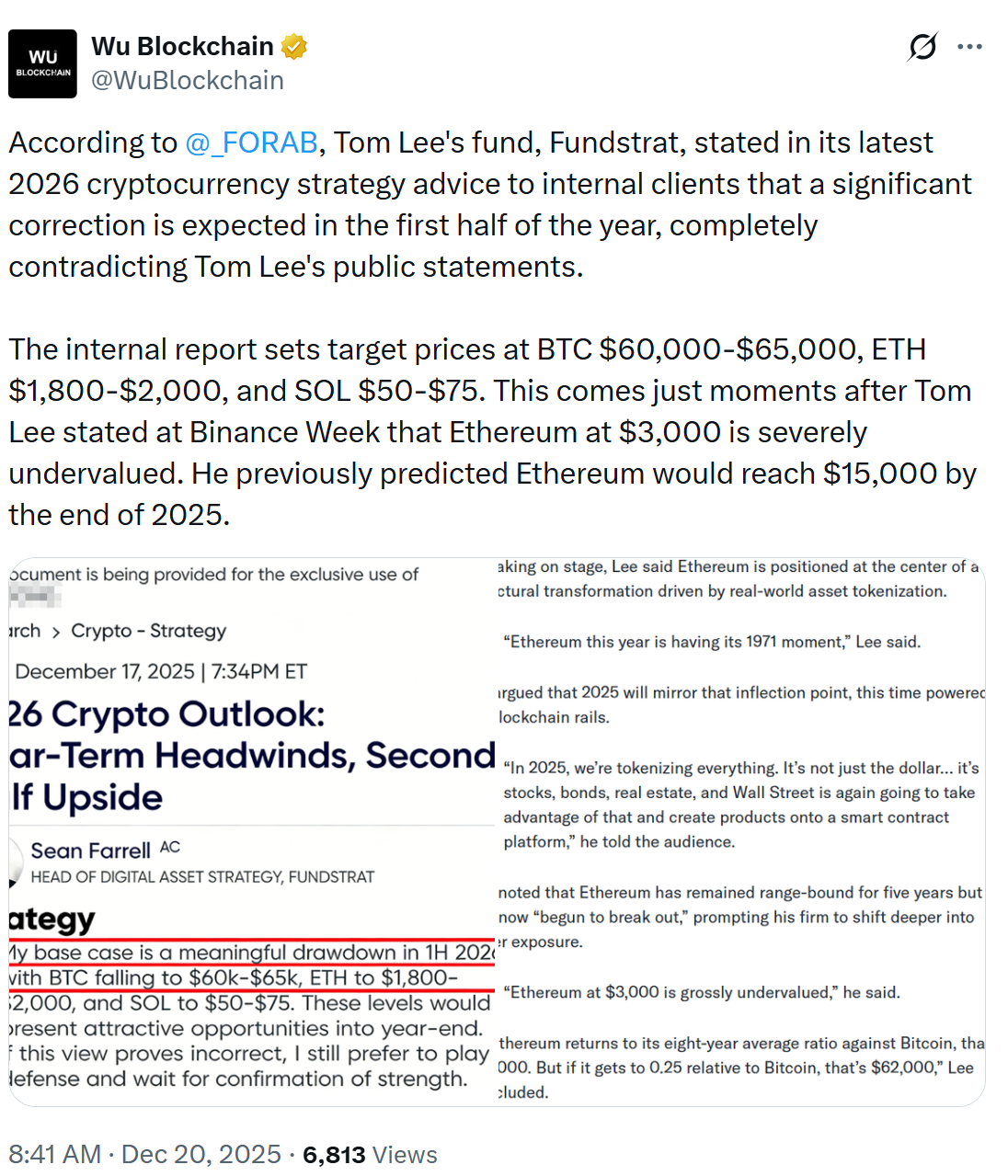
Fundstrat’s 2026 crypto outlook. Source: Wu Blockchain

Related: Ether down 42% from all-time high: Where will ETH price bottom?

Tom Lee calls ETH “grossly undervalued”

The circulating outlook stands in contrast to statements Lee made on stage at Binance Blockchain Week in Dubai earlier this month. Speaking publicly, Lee said Bitcoin could reach $250,000 within months and called Ether at around $3,000 “grossly undervalued.”

Lee argued that if Ether were to return to its eight-year average ratio against Bitcoin, its price could approach $12,000. A revisit of 2021 relative levels would imply prices near $22,000, while an ETH/BTC ratio of 0.25 would suggest valuations north of $60,000, according to Lee’s presentation.

In November, Lee also claimed Ether is starting on the same path that saw Bitcoin’s price multiply over 100 times since 2017. “We believe ETH is embarking on that same Supercycle,” he said.

Cointelegraph reached out to Fundstrat for comment, but had not received a response at the time of publication.

Related: Ethereum could get faster in January with gas limit rise to 80M

BitMine ramps up Ether buying

As Cointelegraph reported, Lee’s BitMine has continued to aggressively accumulate Ether despite a weakening market backdrop.

In a Dec. 8 disclosure, the company said it held nearly 3.9 million ETH as of Dec. 7, after adding more than 138,000 ETH in a single week. The firm claimed its holdings now represent over 3.2% of Ether’s total supply.

Magazine: 2026 is the year of pragmatic privacy in crypto — Canton, Zcash and more

Related Questions

QWhat is the bearish outlook for cryptocurrencies in the first half of 2026, according to the circulating Fundstrat report?

AThe report warns of a 'meaningful drawdown' with downside targets of Bitcoin falling to $60,000–$65,000, Ether dropping to $1,800–$2,000, and Solana declining to $50–$75.

QHow does the circulating Fundstrat report contrast with Tom Lee's recent public comments on cryptocurrency valuations?

AWhile the report predicts a significant price pullback, Tom Lee publicly stated that Bitcoin could reach $250,000 within months and called Ether 'grossly undervalued' at around $3,000, suggesting it could potentially reach prices as high as $12,000 to $60,000.

QWho is identified as the author of the circulating 2026 crypto outlook document from Fundstrat?

AThe document was apparently written by Sean Farrell, the head of digital asset strategy at Fundstrat.

QWhat evidence is provided in the article to suggest that the Fundstrat document is authentic, even though it hasn't been publicly released?

AThe article states that multiple crypto-focused accounts, including Wu Blockchain, claim the document was distributed to Fundstrat's internal clients, and screenshots of it were shared on social media platform X.

QWhat action has Tom Lee's company, BitMine, taken regarding Ether accumulation according to the article?

ABitMine has continued to aggressively accumulate Ether, adding more than 138,000 ETH in a single week and holding nearly 3.9 million ETH as of Dec. 7, which represents over 3.2% of Ether's total supply.

Related Reads

Bankless Co-founder: Why I Sold All My ETH

Author David Hoffman, founder of Bankless, explains his decision to sell all his ETH, despite being a prominent figure in the Ethereum ecosystem. He clarifies that his move is not a bearish take on Ethereum itself, which he remains highly optimistic about as a network. His core argument is that the "ETH is money" thesis, which he helped popularize, has largely played out. Hoffman argues that ETH has achieved the market valuation it deserves based on Ethereum's current success and competitive position. He details several reasons for this view. First, the path for ETH to become global money required nearly flawless execution and sustained dominance across Ethereum's entire technical and social stack—a coordination challenge he now believes had a narrower window for success than anticipated. Second, market data shows a strong correlation between L1 chain activity/fees and the price of its native asset; Ethereum's fee dominance has been challenged by competitors like Solana. Third, the "strong version" of crypto (decentralized, native crypto economies) that ETH's monetary thesis relied upon has struggled to maintain a positive mainstream narrative and stable adoption beyond a brief period. Finally, Ethereum's architecture as a "giver"—providing secure block space and tokenization capabilities at cost to L2s and applications—means it doesn't capture premium value directly. Its rollup-centric roadmap further directs most profits to L2s and applications ("fat app theory"). In conclusion, Hoffman believes the opportunity for ETH to be revalued significantly upward as money has diminished. He sold not because ETH will fail, but because its monetary thesis has matured, and he seeks to allocate capital to other opportunities he finds more compelling.

链捕手2h ago

Bankless Co-founder: Why I Sold All My ETH

链捕手2h ago

From Issuer to Infrastructure Owner: Circle's Arc Strategy and the Fatal Gap in the GENIUS Act

Circle raised $222 million for its proprietary Layer-1 blockchain, Arc, positioning itself not just as a stablecoin issuer but as the owner of the settlement infrastructure USDC relies on. This move, backed by investors like BlackRock and Apollo, highlights a significant structural conflict unaddressed by the GENIUS Act of 2025. While the act focuses on stablecoin reserves and issuer oversight, it remains silent on the market structure implications of an issuer controlling the underlying network—a scenario akin to a currency issuer also owning the payment rails. Traditionally, financial regulations separate issuers from settlement infrastructure to ensure neutrality. With Arc, Circle gains control over transaction ordering, fees, and network rules, potentially favoring USDC over competitors. The article argues that this creates a permanent structural temptation, even if no abuse occurs. The solution lies in applying established market infrastructure principles: mandating neutral transaction ordering, transparent fee schedules, and governance separated from Circle’s commercial interests. The current pre-mainnet phase offers a critical window for regulators to establish these rules before Arc becomes entrenched. Once operational, enforcing changes would be costly and disruptive. The core question remains: should a regulated stablecoin issuer be allowed to own the settlement network its competitors must use? The GENIUS Act doesn’t answer this, but Circle’s Arc strategy makes it urgent.

marsbit2h ago

From Issuer to Infrastructure Owner: Circle's Arc Strategy and the Fatal Gap in the GENIUS Act

marsbit2h ago

Trading

Spot
Futures

Hot Articles

Discussions

Welcome to the HTX Community. Here, you can stay informed about the latest platform developments and gain access to professional market insights. Users' opinions on the price of S (S) are presented below.

活动图片