From Polymarket to U.S. Stock Trading: How Events Map to Asset Prices

marsbitPublished on 2026-08-12Last updated on 2026-08-12

Abstract

From Polymarket to Stock Trading: How Events Map to Asset Prices Polymarket, a prediction market platform, lists numerous contracts tied to financial events like CPI reports, nonfarm payrolls, FOMC decisions, regulatory policies, and major corporate earnings—all of which influence US stock prices. Instead of relying solely on static analyst forecasts, Polymarket converts expectations of different event outcomes into real-time prices, allowing traders to observe what the market is currently pricing in. The core mechanism can be summarized as: Event Probability → Market Expectations → Changes in Interest Rates, Earnings, or Risk Appetite → Repricing of US Stocks. The primary use of Polymarket is to identify the market's current "anchor" of expectations and the direction in which those expectations are shifting. For traders, the key isn't trading the event itself, but the deviation of the actual outcome from these pre-event expectations. Polymarket helps pinpoint which outcomes are already heavily priced in and which low-probability results could cause significant market shocks if they occur. Furthermore, traders can use Polymarket for cross-market validation. A divergence—for instance, rising inflation probabilities on Polymarket without a corresponding move in Treasury yields or the US dollar—may signal a mispricing or that other markets are discounting the risk. Conversely, if asset prices move sharply while Polymarket probabilities remain stable, it suggests the market is...

Polymarket features a significant number of finance-related prediction events: CPI, Non-Farm Payrolls, FOMC meetings, regulatory policies, and major company earnings reports. All these events influence the pricing of U.S. stocks; however, before an event occurs, traders usually only see analyst forecasts or media opinions, which they often reference as guidance.

But, are they necessarily correct?

In trading markets, shifts in trend direction are very common. Therefore, the prevailing view one moment may not apply at the next juncture. Polymarket fills this temporal gap. Its unique mechanism converts different outcomes into real-time prices, enabling traders to observe which scenarios the market is pricing. Its function can be summarized as:

Event Probability → Market Expectations → Changes in Interest Rates, Earnings, or Risk Appetite → Repricing of U.S. Stocks

By using event probability expectations to pierce through asset prices and sort out the entire logical chain, we might discover something.

I. Observing What the Market Is Pricing

Polymarket contract prices range from $0 to $1. Under good liquidity conditions, the price can be approximately understood as the market's implied probability for a specific outcome. For example, a YES price of $0.60 means the market roughly assigns a 60% probability to that outcome occurring.

This number is not an objective forecast, nor is it guaranteed to be accurate. It more reflects the trading price formed by participants based on current information, liquidity, and risk appetite. For U.S. stock traders, both the level of probability and changes in probability are meaningful references:

  • Probability level reflects the market's current baseline expectation;

  • Probability changes reflect how new information is altering market judgment;

  • Depth reflects whether this expectation is supported by real money.

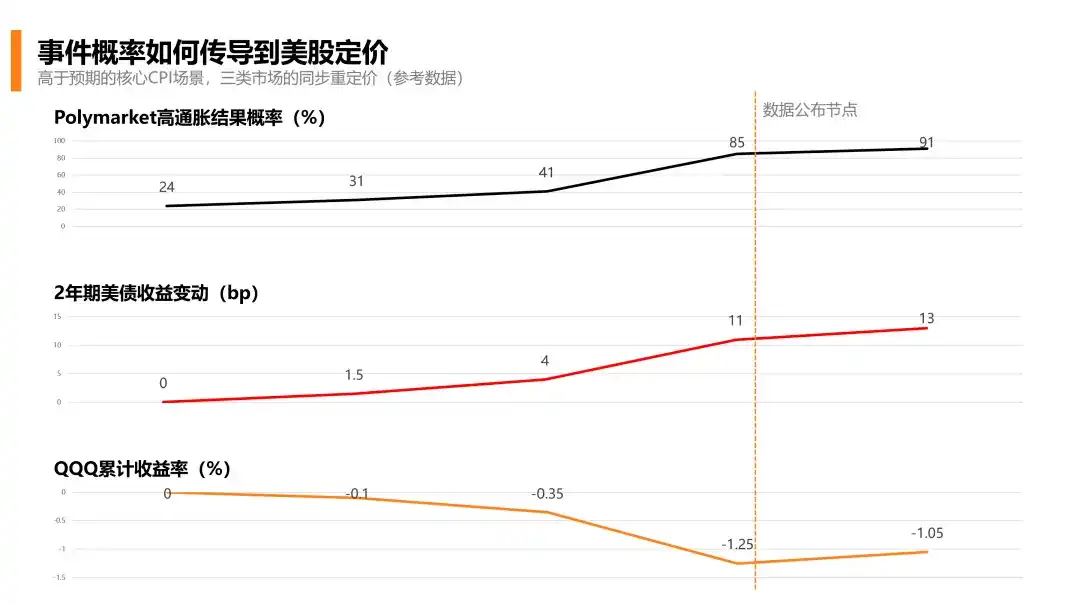
For example, before a CPI release, if the probability of "core inflation higher than expected" rises from 25% to 45%, it indicates the market is increasing its pricing of inflation risk. Even though the data hasn't been released yet, U.S. Treasury yields, the dollar, and high-valuation tech stocks might react in advance.
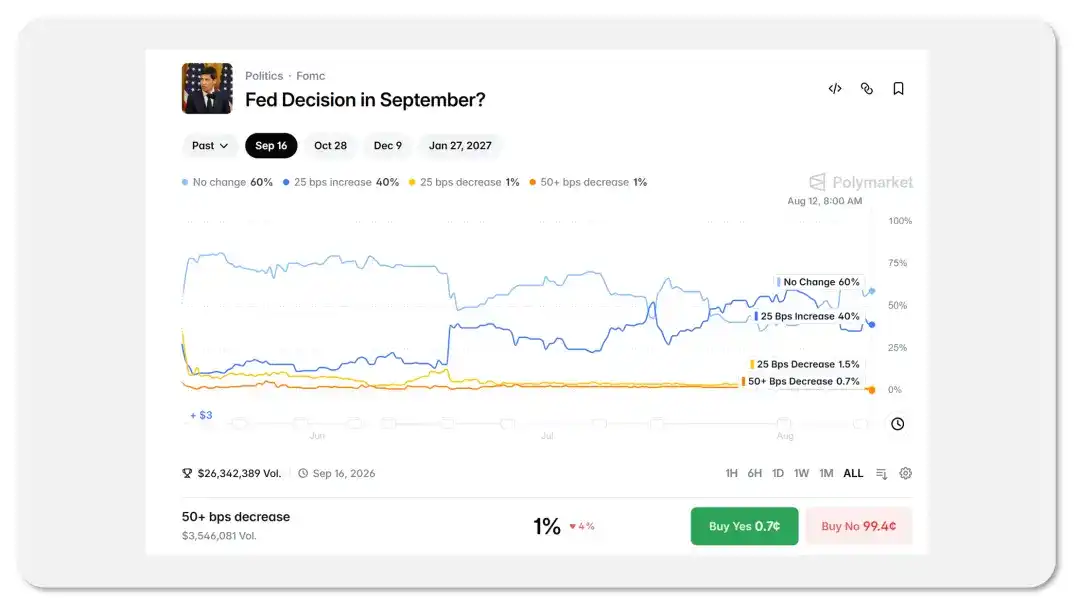
Therefore, the first use of Polymarket is to help traders identify the market's current expectation anchor, and which direction expectations are moving.

II. Identifying Deviations Between Event Expectations and Asset Prices

For news trading, what is traded is not the event headline, but the deviation of the event outcome relative to pre-event expectations.

Suppose the market has already assigned a 70% probability to CPI exceeding expectations. In that case, data ultimately coming in slightly above expectations might not cause tech stocks to plummet, as this outcome may already be fully priced in. Conversely, if the market only assigns it a 20% probability and the data significantly beats expectations, U.S. Treasury yields and growth stock valuations might experience more substantial adjustments.

Therefore, PM can quickly help traders identify two questions:

  1. Which outcome is already fully priced in by the market?

  2. Which outcome, if it occurs, might cause an impact beyond current pricing?

If we dig deeper, traders can also compare event probabilities with the performance of related assets:

If the probability of inflation rising significantly increases, but U.S. Treasury yields and the dollar do not rise in tandem, it might mean the bond market doesn't agree with this change, or that assets haven't finished repricing.

Conversely, if Polymarket probabilities hardly change, but yields and VIX rise rapidly, it indicates the market might be trading other risks not yet reflected by Polymarket.

Therefore, PM and the U.S. stock market can provide mutual validation. Under real-time monitoring, brief pricing inconsistencies may arise between the two markets, and opportunities emerge from this.

III. Mapping Events to Related Assets

Event probabilities only become meaningful for trading when mapped to specific pricing variables.
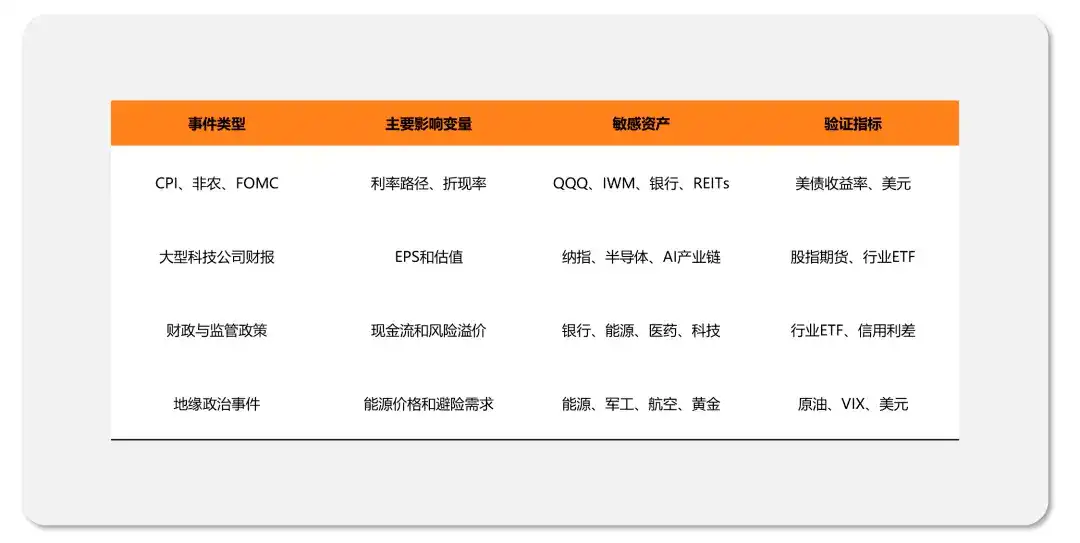
For U.S. stocks, the most common impact path of macro events is through interest rates.

When inflation or employment data is strong, the market may increase the probability that interest rates will remain high, causing U.S. Treasury yields to rise and pressuring high-valuation growth stocks. When data softens moderately without triggering recession fears, expectations for rate cuts may rise, supporting valuations for growth and small-cap stocks.

But this relationship is not fixed. Weak employment can lead to expectations for rate cuts or raise recession concerns. The final direction depends on whether the market is more focused on inflation, growth, or liquidity at that time. Therefore, Polymarket can only provide scenario probabilities; it cannot replace judgment on the market's main narrative.
IV. Practical Usage Workflow

Before major events occur, traders can analyze in the following order:

  1. Clarify the event's settlement rules and release time;

  2. Observe Polymarket's probability level, rate of change, and order book depth;

  3. Determine whether the event primarily impacts interest rates, earnings, or risk appetite first;

  4. Identify the indices, sectors, or individual stocks most sensitive to this impact;

  5. Use U.S. Treasury yields, the dollar, VIX, and options markets for validation;

  6. Choose to trade, hedge, or abstain based on pricing deviations.

The truly valuable signals are usually not "the high probability of an event," but inconsistencies between event probabilities, related assets, and other markets.

V. Conclusion

The most appropriate positioning for Polymarket is as an event expectation observer, a cross-market validation tool, and a tail risk reference.

It genuinely helps traders solve three problems: what the market has currently priced in, which low-probability outcomes might bring greater price shocks, and whether there's a noteworthy reaction gap between event probabilities and related assets worthy of study.

The key to professional use of Polymarket is not to trade immediately upon seeing probability changes, but to place those changes within the asset pricing framework of interest rates, earnings, and risk premiums, and then complete the validation using real market prices.

After all, don't listen to what experts and big players say; watch what the market does.

Related Questions

QWhat is the primary function of Polymarket according to the article, and how does it bridge the time gap in market expectations?

APolymarket's primary function is to convert different outcomes of events into real-time prices, effectively bridging the time gap in market expectations. Its unique mechanism allows traders to observe which scenarios the market is currently pricing in before the event occurs, moving from static analyst predictions to dynamic market consensus.

QHow does a Polymarket contract price relate to the probability of an event outcome, and what key factors does this probability reflect?

AA Polymarket contract price, ranging from $0 to $1, can be approximated as the market's implied probability for a specific outcome in liquid markets. For example, a 'YES' price of $0.60 implies a roughly 60% chance. This probability reflects the collective trading price formed by participants based on current information, liquidity, and risk appetite, indicating the baseline market expectation rather than an objective forecast.

QWhat valuable trading signals can be identified by comparing event probabilities on Polymarket with the movements of related financial assets like Treasury yields?

AValuable trading signals are identified through discrepancies or inconsistencies. For instance, if the probability of higher inflation rises significantly on Polymarket but Treasury yields and the US dollar do not increase correspondingly, it may indicate that the bond market disagrees or that the pricing is incomplete. Conversely, if yields rise sharply without a change in Polymarket probabilities, it suggests the market is pricing in risks not captured by the prediction market.

QWhat is the most common impact pathway through which macroeconomic events on Polymarket affect US stock prices, and why is this relationship not fixed?

AThe most common impact pathway is through interest rates. Strong data (like inflation or employment) can increase expectations for higher rates, raising Treasury yields and pressuring high-valuation growth stocks. However, this relationship is not fixed because the same data (e.g., weak employment) can trigger either rate-cut expectations (bullish) or recession fears (bearish). The final market direction depends on whether the market's primary focus is on inflation, growth, or liquidity at that time.

QWhat is the recommended step-by-step process for a trader to use Polymarket in conjunction with other markets before a major event?

AThe recommended process is: 1. Clarify the event's settlement rules and release time. 2. Observe the probability level, rate of change, and order book depth on Polymarket. 3. Determine whether the event primarily affects interest rates, corporate earnings, or risk appetite. 4. Identify the stock indices, sectors, or individual stocks most sensitive to that impact. 5. Validate findings using Treasury yields, the US dollar, VIX, and options markets. 6. Decide on a trade, hedge, or non-participation based on identified pricing discrepancies.

Related Reads

Shutting Down 8 ETFs, Laying Off 14% of Staff: Why is Bitwise Still Launching New Products?

Cryptocurrency asset management firm Bitwise reduced its workforce by approximately 14%, cutting around 25 positions, bringing total employees from about 180 to 155. The company did not disclose specific reasons for the layoffs or link them to AI efficiency, a trend cited by other crypto firms like Coinbase and Dune earlier in the year. Prior to the staff reduction, Bitwise's reported client assets fell by at least $40 billion between February and April, though the exact causes—market price changes, client redemptions, or shifts in product scope—remain unclear. Concurrently, Bitwise liquidated eight ETFs over roughly three months. These included a Web3-themed fund, a BTC/ETH/Treasuries rotation strategy ETF, and six single-stock or Ethereum-linked options income ETFs. Despite these cuts, Bitwise continues to launch new products. Recent additions include an Avalanche ETP with staking in Europe, the Hyperliquid ETF, and the acquisition of Superstate’s tokenized Crypto Carry Fund, valued over $267 million. This indicates a strategic shift away from certain thematic and complex options strategies toward products focused on direct crypto asset exposure, staking rewards, and tokenization. The company now manages 70 investment products for over 5,500 advisory teams and institutions. The simultaneous workforce reduction and product expansion create a more complex operational environment for the smaller remaining team, though Bitwise has not detailed how specific roles or costs are affected by these changes.

marsbit15m ago

Shutting Down 8 ETFs, Laying Off 14% of Staff: Why is Bitwise Still Launching New Products?

marsbit15m ago

Coinbase Secures Key License in Abu Dhabi as the Middle East Becomes a New Hub for Tokenized Assets

Coinbase has secured a key Financial Services Permission (FSP) from Abu Dhabi's Financial Services Regulatory Authority (FSRA), enabling it to establish an International Tokenization Hub within the Abu Dhabi Global Market (ADGM). This license permits Coinbase to conduct investment trading arrangements and offer custody services, with the core aim of launching tokenized securities. This move is positioned as a significant step toward building a more open and accessible global financial system, particularly for the estimated 4 billion individuals currently excluded from traditional capital markets. Tokenized securities issued on this platform will be fully backed by underlying stocks and regulated by the FSRA. Verified token holders will possess full shareholder rights, including dividends and voting rights, requiring only a digital wallet for participation—eliminating the need for traditional securities accounts. The framework incorporates ongoing sanctions screening and allows for asset freezing at the wallet level, aiming to reconcile DeFi functionalities with regulatory compliance. Coinbase executives and ADGM officials highlighted the pioneering nature of ADGM's virtual asset regulatory framework, established in 2018, which treats tokenized assets simultaneously as securities, blockchain-native tokens, and composable DeFi assets. This development in Abu Dhabi, alongside Coinbase's investments in Dubai, underscores the company's commitment to establishing the UAE as a hub for next-generation financial infrastructure, specifically for tokenized securities and on-chain capital markets.

marsbit35m ago

Coinbase Secures Key License in Abu Dhabi as the Middle East Becomes a New Hub for Tokenized Assets

marsbit35m ago

Trading

Spot
活动图片