From Parallel Finance to Mainstream Finance: The On-Chain Securities Era Ushers in a Historic Window

marsbitPublished on 2026-06-01Last updated on 2026-06-01

Abstract

From Parallel Finance to Mainstream: The Dawn of On-Chain Securities For over a decade, the crypto industry has operated as a parallel financial system with its own currencies, markets, and assets—from Bitcoin and ICOs to DeFi, NFTs, and memecoins. Despite building a robust internal ecosystem, a wall has separated it from the traditional financial world. That barrier is now crumbling. The industry's first act was one of internal evolution: ICOs streamlined fundraising, DeFi recreated financial services on-chain, and layer-2 networks competed for scalability—all within the crypto bubble. While innovative, this cycle remained closed, with capital and users circulating internally, leading to volatile boom-bust cycles. Even Bitcoin ETFs, while attracting Wall Street capital, merely provided a channel to buy crypto assets without bridging the systems. The next, larger narrative is Real-World Assets (RWA) moving on-chain. This involves tokenizing stocks, bonds, funds, and future cash flows. Blockchain can compress the complex traditional processes of trading, settlement, clearing, and custody into a seamless, automated network operating in seconds. This shift is creating a new financial gateway: the native crypto securities broker. This entity will combine functions of an exchange, broker, bank, and custodian into a unified global financial operating system. Consequently, the next major battleground won't be the "public chain wars" focused on speed and cost, but the competition ...

Author: Climber, CryptoPulse Labs

For over a decade, the crypto industry has been like a financial experiment operating independently from the real world. It has its own monetary system, its own trading markets, its own logic for asset pricing, and its own set of beliefs and narratives.

From the birth of Bitcoin, through the ICO boom, to the explosion of DeFi, NFTs, Layer 2s, meme coins, and on-chain derivatives, the crypto world has gradually built an almost complete financial ecosystem.

But no matter how it has developed, one question has always remained. That is, a wall still separates the crypto world and the real-world financial system. Now, this wall is being dismantled. In the next decade, an era of native crypto securities brokerage that integrates with the global financial system is opening up.

I: The First Half of the Crypto Industry: The Self-Evolution of a Closed Ecosystem

In recent years, the U.S. CFTC has been gradually promoting a regulatory framework for compliant perpetual contracts, and the U.S. SEC has also begun to consistently signal policy support for tokenizing securities. The recent news about SpaceX's upcoming super IPO event has also made the market realize that the world's highest-quality assets in the future may be seeking new ways to circulate.

Scenarios that once sounded like science fiction are now step by step becoming reality. This means the crypto industry is about to enter a new stage.

However, looking back at the history of the crypto industry, it becomes clear that the past decade-plus has actually been an ongoing, escalating internal financial experiment.

The 2017 ICO frenzy essentially solved the fundraising problem. For the first time, startup projects didn't need traditional VCs or IPO approvals; with just a whitepaper and a token model, they could raise funds globally. The market saw for the first time the immense efficiency gains blockchain could bring to capital formation.

The subsequent DeFi Summer then began to address the issue of financial services. Lending, trading, market-making, yield aggregation began to move on-chain. Functions originally performed by banks, brokerages, and financial institutions were gradually replaced by smart contracts. The most important change during this period was not the emergence of a particular killer protocol, but the fact that the entire financial infrastructure began to be reconstructed.

Next, the industry entered the era of the public chain war. Due to Ethereum's performance limitations, numerous high-performance public chains began competing for developers, users, and liquidity. Faster speeds, lower costs, and higher TPS became the focus of market competition. However, looking back, this competition was still essentially internal.

Because the participants didn't change—users were still crypto users, capital was still crypto capital, and assets were still crypto assets.

Later, the NFT boom shifted the industry narrative from finance to culture and social interaction. Digital collectibles, on-chain identity, and gaming assets entered the market. This was followed by the meme coin frenzy, decentralized perpetual contracts, DAT, and other new models continuously emerging.

While the industry seems to have been evolving, most of these changes occurred within the same circle. The crypto world has been more like an ever-expanding closed economy, with capital flowing internally, users circulating internally, new assets constantly being created, and then being bought up by new capital.

This is also why every cycle has seen obvious bubbles and pullbacks—because truly massive external capital had never fully entered.

Even with Bitcoin ETFs starting to attract Wall Street capital, the crypto industry has still not truly connected with the real-world financial system. Because ETFs only allow traditional capital to buy crypto assets; real-world assets have not yet truly moved on-chain.

II. A Bigger Story than ETFs: Real-World Assets Begin Moving On-Chain

Many believe that Bitcoin ETFs opened the door for traditional finance to embrace crypto. But in reality, ETFs are only the first step.

Because they merely add a channel for the traditional financial system to purchase crypto assets. What could truly change the industry's structure is another matter—securities assets beginning to enter the on-chain world.
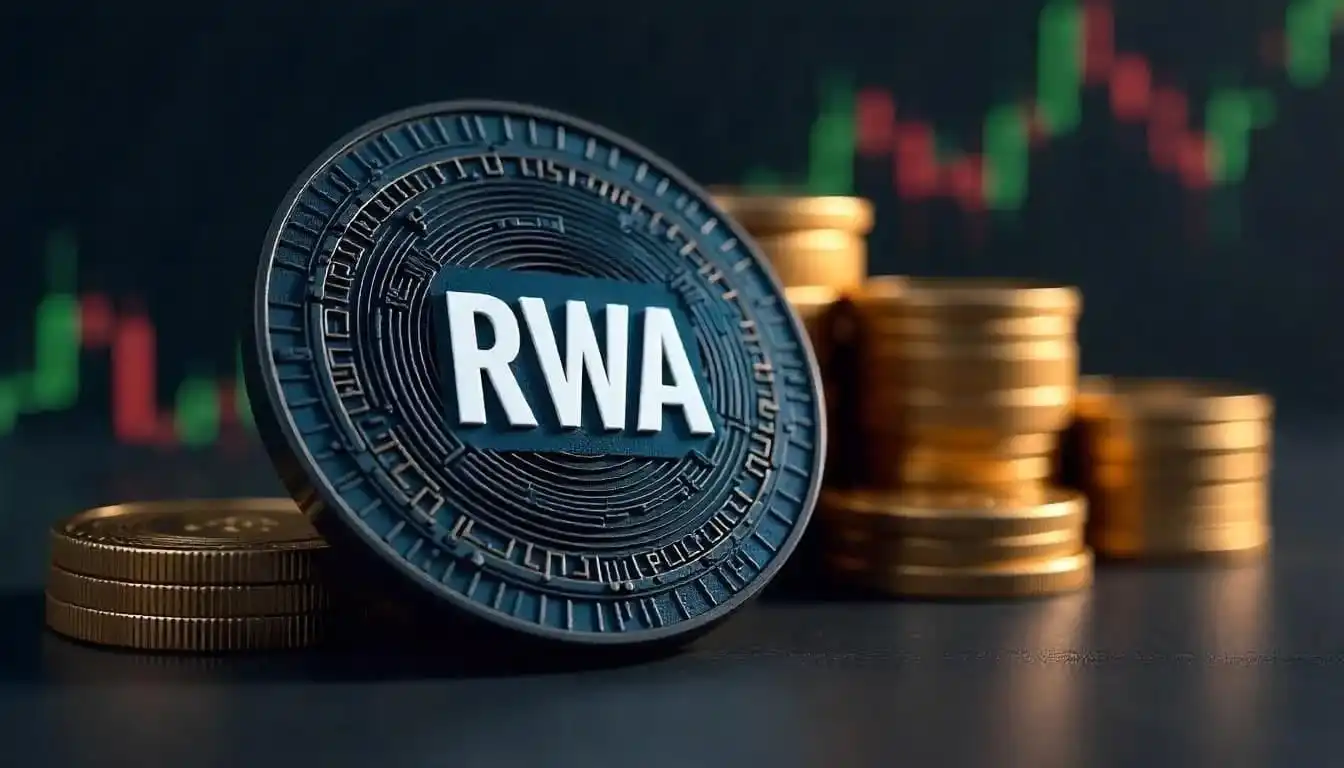
This means stocks, bonds, funds, income rights, and even future cash flows could all be digitized.

In the past, buying a stock required a securities account, cross-border trading required a broker, asset custody required a bank, and after trading, a clearinghouse was needed for final settlement—the entire system was extremely complex.

But blockchain offers a new perspective. If assets natively exist on-chain, then trading, settlement, clearing, custody, and even identity verification could all be completed within the same network.

Processes that used to take days to complete could end in seconds in the future. Work that previously relied on multiple institutions could potentially be executed automatically by smart contracts. This is actually changing the financial infrastructure itself.

What makes Wall Street truly powerful has never been just the scale of its capital. More importantly, it controls the underlying financial network. Exchanges, brokerages, banks, custodians, clearinghouses together constitute a vast system. And blockchain is gradually compressing these links.

In the future, many financial services may no longer be performed by multiple institutions, but run directly within a unified network.

Therefore, the protagonists of the crypto industry's next phase may no longer be trading platforms. They will be new financial gateways.

The so-called native crypto securities brokerage is essentially this new gateway. It not only handles trading functions but also assumes the roles of wallet, asset management, custody, clearing, and financial services.

It might be like an exchange, and also like a broker. Like a bank, and also like a payment system—even more like a global financial operating system.

III. The Next War: Not Public Chain Competition, but Financial System Competition

In recent years, the crypto market has been debating who will become the next king of public chains. The market compares TPS, gas fees, number of ecosystems, and developer size. But in the future, the importance of these metrics may gradually decline.

Because what truly matters in financial markets is not speed, but assets. Even if a chain has a million TPS, it's hard to create long-term value without high-quality assets entering.

What is truly valuable is liquidity. And the core of liquidity is asset quality.

If in the future, users can buy global stocks, index funds, bonds, and even shares in top-tier tech companies like SpaceX on-chain, the entire industry logic will change.

Because the boundary between the on-chain world and the real world will gradually disappear.

In the past, the crypto industry competed for the internal market; in the future, it will compete for the global capital market. These are two completely different stories.

Currently, the global crypto market remains in the multi-trillion dollar range, while the global stock market is close to a hundred trillion dollars, and the bond market is even larger. They are not on the same order of magnitude.

In the past, the industry discussed the next billion-dollar project; in the future, it may discuss how to accommodate the flow of tens of trillions of dollars in assets. The ICO era solved the fundraising problem; the DeFi era solved the on-chain finance problem; the ETF era solved the capital gateway problem; and the native crypto securities brokerage era may solve the problem of integrating real-world finance with crypto finance.

Conclusion

For over a decade, the crypto industry has been trying to create a new world. In the next decade, it may no longer need to recreate the world.

Because it will directly connect to the original world.

When traditional finance and the crypto ecosystem truly converge, the industry's biggest growth story may just be beginning.

Related Questions

QAccording to the article, what is the fundamental problem that the crypto industry has faced despite its development over the past decade?

AThe fundamental problem is that there has been a 'wall' separating the crypto world from the traditional real-world financial system. The crypto ecosystem developed independently with its own currency, markets, and logic, but remained largely disconnected from mainstream global finance.

QWhat event does the author suggest is an even bigger development than the introduction of Bitcoin ETFs?

AThe author suggests that the migration of traditional securities (like stocks, bonds, and funds) onto the blockchain is an even bigger story. This process of real-world asset tokenization has the potential to fundamentally change the industry's structure by blurring the lines between crypto and traditional finance.

QWhat new type of entity does the article predict will be a key player in the next phase of the crypto industry?

AThe article predicts that 'native crypto securities brokerages' will be key players. These entities will act as new financial gateways, combining functions of exchanges, brokers, banks, custodians, and payment systems, essentially serving as a global financial operating system.

QWhat does the author argue will be the primary focus of competition in the future, replacing the past focus on 'public chain wars'?

AThe author argues that future competition will shift from 'public chain wars' (focusing on TPS, fees, etc.) to a competition over financial systems. The true value will lie in attracting high-quality assets and liquidity, with the ultimate prize being a share of the global capital markets, which are orders of magnitude larger than the current crypto market.

QWhat is the core thesis of the article regarding the future relationship between crypto and traditional finance?

AThe article's core thesis is that the crypto industry is transitioning from being a parallel, closed financial experiment to becoming integrated into the mainstream global financial system. The next decade will be defined not by creating a separate new world, but by directly connecting to and reshaping the existing world of finance through the tokenization of real-world assets.

Related Reads

Promised Year of Crypto IPOs? Only One Went Public in Six Months, Down 70%

The much-anticipated wave of crypto IPOs in 2026 has failed to materialize, with market conditions worsening dramatically. While SpaceX prepares for the largest IPO in history, raising $75 billion at a $1.75 trillion valuation, the crypto sector faces a frozen pipeline. The sole crypto IPO success this year, BitGo, serves as a cautionary tale. After launching on the NYSE in January at $18, its stock has plummeted approximately 70%. Other major contenders have stalled or delayed. Kraken, which secretly filed in late 2025, has put its plans on ice, seeing its valuation drop 33% to $13.3 billion. Consensys has postponed its filing until autumn at the earliest, and Bitpanda is poised to miss its self-imposed H1 deadline for a Frankfurt listing. This widespread retreat is driven by a severe liquidity crunch. Bitcoin has fallen below $60,000, with capital being diverted to AI stocks and the massive SpaceX offering. The poor performance of earlier crypto listings like Gemini and the stagnant price of Coinbase further dampen investor appetite. A key underlying pressure is the impending US midterm elections in November, which could alter the currently favorable regulatory landscape. Companies had hoped to go public during this window of policy certainty, but challenging market dynamics have overridden those plans. The transparency that comes with being a public company is now seen as a potential liability rather than a benefit in a down market. The industry's fate now hinges on a few critical watchpoints: whether Kraken restarts its process in H2, if Consensys files in the fall, and if SpaceX's debut can revitalize market liquidity. Otherwise, the promised "crypto IPO year" will likely be pushed beyond the election.

marsbit7m ago

Promised Year of Crypto IPOs? Only One Went Public in Six Months, Down 70%

marsbit7m ago

Behind Musk and Huang Jen-hsun's 'AI Factories', an Unseen Battle for Freshwater Has Begun

Behind the "AI factories" of Elon Musk and Jensen Huang lies a hidden battle for a critical resource: fresh water. As AI models like ChatGPT and Claude process billions of prompts daily, they consume vast amounts of water for cooling. By 2030, global AI infrastructure is projected to use 9.3 trillion liters annually—enough to meet the basic needs of 1.3 billion people. This "water grab" stems from the massive heat generated by high-powered GPUs. Over 70% of data centers use evaporative cooling systems, where water absorbs heat and evaporates into the atmosphere, depleting local groundwater. Training models like GPT-4 can consume over 600 million liters of water. Tech giants like Google and Microsoft report skyrocketing water usage, sparking conflicts with local communities over resources. A flashpoint occurred in Memphis, Tennessee, where Musk's xAI built the Colossus supercomputer. It draws nearly 3.8 million liters of drinking water daily from local aquifers, leading to public outrage and legal action. In response, xAI is building an $80 million water recycling plant to use treated wastewater instead. Facing pressure, companies like Microsoft promote "waterless" closed-loop cooling systems. However, these systems increase electricity consumption by 20-30%, shifting the water burden to power plants, which require immense cooling water themselves—a case of indirect water footprint transfer. For China's AI industry, this crisis offers a strategic warning and opportunity. Instead of replicating the West's resource-intensive model, China can leverage its "East Data, West Computing" policy to locate data centers in cooler, water-rich regions like Guizhou. Furthermore, developing lightweight edge computing for smart homes and embodied AI robots can drastically reduce the need for constant cloud queries, cutting both water and energy consumption at the source. The freshwater war underscores a fundamental question: Will AI be a tool for human advancement or a silicon-based monster competing for our planet's last drops of clean water? The answer is becoming clearer as the water vapor rises.

marsbit53m ago

Behind Musk and Huang Jen-hsun's 'AI Factories', an Unseen Battle for Freshwater Has Begun

marsbit53m ago

AGI is Just One Step Away

The article discusses Anthropic's release of the Fable 5 model, a heavily restricted version of its powerful Mythos model. Initially unveiled in April, Mythos reportedly identified over 10,000 high-risk vulnerabilities for 50 enterprise clients, causing significant concern. Due to its dangerous capabilities in areas like autonomous cyber-attacks and biochemical weapons design guidance (classified as CB-1 level), the unaltered Mythos 5 remains limited to about 200 vetted entities like government agencies. Fable 5, released with a safety classifier, demonstrates extraordinary performance, leading benchmarks in coding (SWE-Bench Pro), software engineering, and research. It exhibits true "long-horizon agency," autonomously planning and executing complex, multi-step tasks like migrating 50 million lines of code in a day, moving beyond simple question-answering. The article positions Fable 5 at OpenAI's Level 3 ("Agent") and progressing toward Level 4 ("Innovator"), suggesting AGI (Artificial General Intelligence) is within reach, potentially 18-24 months away. To mitigate risks, Anthropic implemented a two-layer safety "cage": a silent routing system that redirects dangerous queries to a weaker model, and a mandatory 30-day data retention policy for all Mythos traffic to detect patterns of malicious use. Despite its high cost ($10/$50 per million input/output tokens), the model targets the enterprise market, where its unparalleled productivity and defensive capabilities against AI-powered cyber threats justify the premium. This signals a market maturation where top-tier AI becomes a strategic, high-value tool for businesses, potentially widening the gap with consumer-focused models and accelerating the rise of "one-person companies" while disrupting labor markets.

marsbit1h ago

AGI is Just One Step Away

marsbit1h ago

Trading

Spot
Futures

Hot Articles

Ethena: Building a New Era of Web3‑Native Digital Dollars

Ethena is an Ethereum‑based synthetic dollar protocol that delivers crypto‑native monetary solutions, including USDe, a synthetic dollar, and sUSDe, a globally accessible U.S. dollar savings asset.

53.2k Total ViewsPublished 2026.03.16Updated 2026.03.16

Ethena: Building a New Era of Web3‑Native Digital Dollars

Discussions

Welcome to the HTX Community. Here, you can stay informed about the latest platform developments and gain access to professional market insights. Users' opinions on the price of ERA (ERA) are presented below.

活动图片