From Mayor to Cryptocurrency Salesman: A Clash of Politics and Business

比推Published on 2026-01-13Last updated on 2026-01-13

Abstract

Former New York City Mayor Eric Adams has swiftly transitioned from public office to promoting a New York City-themed cryptocurrency just weeks after leaving his position. Smiling and enthusiastic, Adams advocated for blockchain technology and claimed he would not initially profit from the venture. He criticized his successor, Zohran Mamdani, for policy reversals and highlighted his plans to leverage his municipal experience—including expertise in areas like garbage collection—as marketable "professional capital" abroad. Adams, known for his unorthodox style, has been active internationally, meeting with foreign leaders and business figures in Dubai, the Democratic Republic of Congo, and Senegal. His post-mayoral activities appear focused on rehabilitating his reputation, attacking his political opponents, and addressing personal legal debts. The cryptocurrency project, named NYC Token, is framed as a philanthropic effort to combat antisemitism and anti-Americanism while promoting blockchain education. However, the token’s website faced technical issues, with purchase links non-functional at launch. Adams also expressed interest in exporting New York’s public services expertise globally but affirmed he has no plans to leave the city permanently.

Author: Nicholas Fandos, Debra Kamin

Compiled by: Chopper, Foresight News

Original Title: After Stepping Down as New York Mayor, He Turned to Selling Cryptocurrency


Two weeks ago, Eric Adams held one of the most powerful positions in the U.S. government system; today, he stands under the neon billboards of Times Square, promoting a New York City-themed cryptocurrency.

For anyone else, such a shift in identity might be embarrassing, but the former mayor of New York was all smiles, enthusiastically discussing the advantages of blockchain technology and promising not to profit from it for the time being.

"I've missed you all so much, ladies and gentlemen," he said to a group of reporters, before shifting gears to criticize his successor's "major mistakes," talk about business opportunities in foreign capitals, and admit that his experience in municipal services like garbage collection has now become monetizable "expert capital."
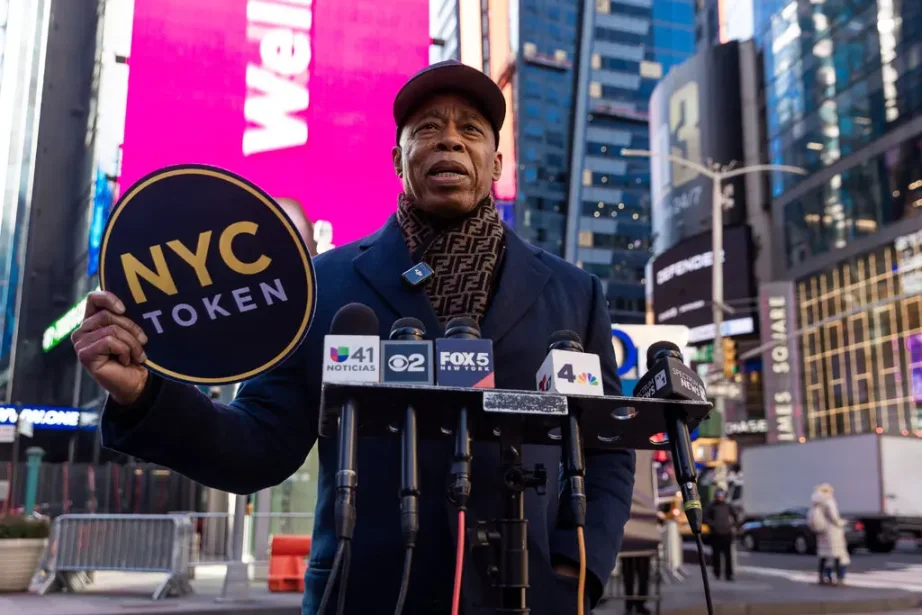
This was his first public appearance since leaving office on January 1, but it was cut short because he had to catch a flight. He was headed first to Dallas, then to Senegal, claiming more opportunities awaited him there.

The 65-year-old Adams is one of the most unconventional mayors in New York City's history: from a working-class background, a former police officer, yet federally indicted for his pursuit of a luxurious lifestyle. All signs indicate that his post-mayoral career will continue this "unconventional" approach.

Just in the past two weeks, he met with a Saudi prince in Dubai, visited the President of the Democratic Republic of the Congo, and repeatedly attacked his successor, Zohran Mamdani, accusing him of overturning some of the pro-Israel policies implemented during his term. This move broke the unwritten tradition of former mayors showing respect to their successors.

Many details of Adams's business dealings remain shrouded in mystery, including his partnership in the cryptocurrency project. But his core post-mayoral agenda is becoming increasingly clear: restoring his personal reputation, attacking his successor, and repaying the massive debts incurred from legal battles. The priority among these three remains unclear.

"I won't be taking a nine-to-five salaried job," Adams said. "I only work for myself."

Adams isn't the only one planning his post-office livelihood while targeting Mamdani. Former New York Governor Andrew Cuomo is finalizing a deal to host a weekly show on the conservative talk radio station WABC, where he was a frequent guest during his unsuccessful campaign.

According to the New York Post, the show will provide Cuomo with a platform to promote his centrist Democratic political views, and he will likely use it to criticize Mamdani, whom he previously called a "far-left radical."

The station's owner, Republican billionaire John Catsimatidis, said he does not plan to pay Cuomo, but simply wants to help him after his electoral defeat. The broadcast time slot has not been finalized. "We feel sorry for what happened to him, and we love New York deeply," Catsimatidis said. "He wants to maintain public visibility and stay connected with New Yorkers."

But so far, Adams's post-mayoral performance is undoubtedly more eye-catching.

Just hours after attending Mamdani's inauguration, he boarded an Emirates flight to Dubai with his long-time partner, Tracey Collins. Besides the Saudi prince, he was photographed meeting with several wealthy Israeli and Uzbek businessmen.
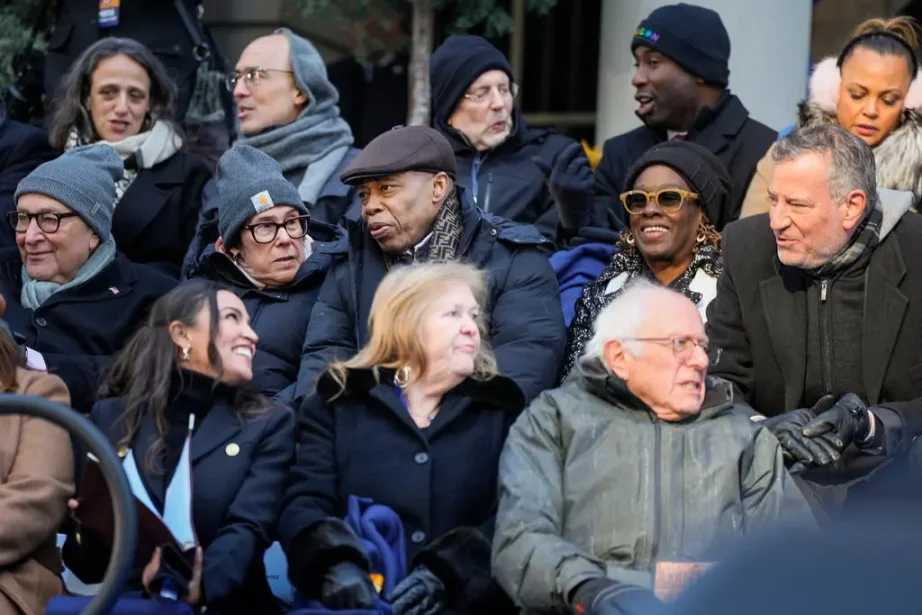
Numerous current and former political figures attended Zohran Mamdani's mayoral inauguration, with Adams among them

He dined with real estate agent and reality TV star Eleonora Srugo and posted a photo on social media with Amir Marashi. Marashi, born in Iran, is a New York gynecologist and women's health advocate specializing in procedures like vaginal rejuvenation.

Meanwhile, Adams has kept a close eye on developments in New York City. He frequently posts on social media to express dissatisfaction with Mamdani's policies: for example, Mamdani's reversal of the expanded definition of antisemitism previously adopted by the city, and质疑 (questioning) some of his personnel appointments.

"Everyone deserves a grace period, but hate doesn't allow grace for anyone," Adams said at Monday's event.

Mamdani, at another event, declined to respond to Adams's criticism.

Adams's interest in cryptocurrency is not new. During his tenure as mayor, he chose to receive his first paycheck in cryptocurrency; he is close friends with cryptocurrency billionaire Brock Pierce, who, along with other crypto industry figures, funded his campaign last fall before he dropped his re-election bid.

Adams made "support for Israel and combating antisemitism" a core part of his administration, and he has packaged this new token as a public welfare project, claiming its proceeds will be used to fight antisemitism, anti-Americanism, and "teaching children to embrace blockchain technology."

The token's official website states its total supply will be 1 billion tokens. Adams said he would donate the proceeds from some of these tokens to non-profit organizations dedicated to the aforementioned causes and stated that he would not receive a salary or any compensation, at least initially.

"NYC Token is a new generation cryptocurrency inspired by the relentless energy and innovative spirit of New York City," the project's website reads. "Leveraging cutting-edge blockchain technology, we are building a decentralized financial ecosystem with ambitions matching those of the city itself."

Nevertheless, Adams seemed somewhat struggling when describing the project's details on multiple occasions. During Monday's event and in an interview with Fox News, he repeatedly misnamed the new product as "New York City Coin."

Adams's image is prominently featured on the token's website, which invites visitors to "Buy Now," but as of Monday evening, all purchase links on the site were non-functional.

The former mayor said he is also exploring other business areas, including plans to be advanced during this week's trip to Africa.

"I realized that many services New York City has, even garbage collection, are hard to find in many parts of the world," Adams said. "I plan to provide such assistance to other cities and countries."

All these actions raise questions about whether Adams will continue to reside in New York in the future. He previously stated his desire to retire in an overseas city rather than return to his home in Brooklyn's Bedford-Stuyvesant neighborhood.

But two people familiar with the matter revealed that the former mayor plans to keep New York City as his base and intends to rent an apartment in Manhattan, preferably with a view. Adams himself tried to dispel doubts during Monday's event. "I'm not going anywhere," he said.


Twitter:https://twitter.com/BitpushNewsCN

Bitpush TG Discussion Group:https://t.me/BitPushCommunity

Bitpush TG Subscription: https://t.me/bitpush

Original article link:https://www.bitpush.news/articles/7602300

Related Questions

QWhat is the main focus of Eric Adams' new venture after leaving office as mayor of New York City?

AEric Adams is promoting a New York City-themed cryptocurrency called NYC Token, with proceeds aimed at combating anti-Semitism, anti-Americanism, and teaching children about blockchain technology.

QHow does Eric Adams plan to fund his post-mayoral activities and address his legal debts?

AAdams intends to work for himself through various business ventures, including the cryptocurrency project and offering municipal service expertise globally, rather than taking a salaried job, to repay legal debts and maintain his reputation.

QWhat criticisms has Eric Adams leveled against his successor, Zohran Mamdani?

AAdams has criticized Mamdani for reversing some pro-Israel policies, such as overturning an expanded definition of anti-Semitism, and has questioned certain personnel appointments, breaking the tradition of respecting successors.

QWhat international engagements has Eric Adams pursued since leaving office?

AAdams has met with a Saudi prince in Dubai, visited the president of the Democratic Republic of Congo, and plans to travel to Senegal and other countries to explore business opportunities, leveraging his experience in services like garbage collection.

QWhat are the details and current status of the NYC Token cryptocurrency project promoted by Eric Adams?

AThe NYC Token has a total supply of 1 billion coins, with Adams donating some proceeds to non-profits and not taking initial salary or compensation. However, as of the article, purchase links on the website were non-functional, and Adams occasionally misrefers to it as 'New York City Coin'.

Related Reads

Must-Watch Events Next Week|CLARITY Act Could Face Senate Vote; SpaceX, Circle to Report Earnings (8.3-8.9)

**Summary: Key Events and Developments to Watch (August 3-9)** The upcoming week is marked by significant financial disclosures, key legislative deadlines, and notable product updates. **Major Financial Events:** Several companies are scheduled to release their Q2 2026 earnings. American Bitcoin (ABTC) will report on August 3, followed by SpaceX and Hut 8 Mining Corp. on August 4, and Circle on August 5. Notably, a significant portion of SpaceX shares (up to 12% of total shares) will be unlocked on August 6 following their earnings release. **Key Legislative Deadline:** The U.S. Senate faces an August 7 deadline to secure 60 votes for the CLARITY Act, a bipartisan bill aiming to establish a federal regulatory framework for cryptocurrencies. The Senate may hold a full vote on the bill during the week. **Economic Data:** The U.S. July Non-Farm Payrolls report will be released on August 7, providing crucial labor market data. **Technology & Product Updates:** * **Shutdowns:** DeFi portfolio tracker Zapper and wallet app Ctrl Wallet will cease operations on August 3. * **Upgrades:** LayerZero will deprecate its v1 relayers on August 3. XRP Ledger's new version 3.3.0, featuring five new functions, is expected next week. * **AI:** Elon Musk announced that the advanced Grok 4.6 AI model is set for release around August 7. * **Bitcoin:** The BIP-110 forced signaling for a potential Bitcoin network change is scheduled to begin around August 8. **Other Notable Events:** Chinese robotics firm Unitree Tech has set its preliminary price inquiry for its IPO for August 5. South Korean exchange Upbit will delist AQT and AERGO tokens on August 3.

marsbit7m ago

Must-Watch Events Next Week|CLARITY Act Could Face Senate Vote; SpaceX, Circle to Report Earnings (8.3-8.9)

marsbit7m ago

Stocks Are Plummeting More Sharply Than Cryptocurrencies. Where Has the Money Gone?

Stock Markets Plunge Deeper Than Cryptocurrencies: Where Did the Money Go? In late July, Seoul's Kospi index triggered circuit breakers for two consecutive days, plummeting over 40% from its June high. The collapse was led by heavyweight stocks like SK Hynix, whose record profits still disappointed investors, and devastating leveraged ETFs, with one major product losing over 83% of its value. This signaled a global, forced deleveraging targeting the most crowded trades. Interestingly, while stocks exhibited extreme volatility akin to crypto markets, Bitcoin rose nearly 15% in July after a prior steep drop. Analysis shows the money fleeing equities did not flow into Bitcoin. Instead, Bitcoin had already absorbed its sell-off in May-June, when U.S. spot Bitcoin ETFs saw historic outflows. The true safe-haven beneficiary was gold, whose price rose over 20% year-on-year, highlighting a decoupling between Bitcoin and gold as "digital gold." The sell-off was a targeted unwinding of leveraged positions in tech and semiconductors, accelerated by broker-dealer risk management and shifts in the AI narrative, including new competition from Chinese memory chipmakers. The retreat path was clear: from high-valuation tech stocks to cash and U.S. Treasuries, then to gold. For Bitcoin to attract sustained institutional inflows, conditions like eased global liquidity pressure, a "soft-landing" Fed rate cut, and U.S. regulatory clarity via legislation like the stalled CLARITY Act are needed. Currently, Bitcoin is not a safe haven but an already-cleared asset. Its low correlation with tech stocks, however, makes it a potential diversification play for institutional portfolios once the storm passes. The money isn't here yet, but the positioning is underway.

marsbit7m ago

Stocks Are Plummeting More Sharply Than Cryptocurrencies. Where Has the Money Gone?

marsbit7m ago

In Conversation with Ray Dalio: We Are Currently in an AI Bubble, with 1% of My Portfolio in Bitcoin

Ray Dalio, founder of Bridgewater Associates, warns in an interview that the current AI boom shows classic bubble characteristics, which could lead to significant economic downturns as seen in past cycles like 1929 or 2000. He explains that speculative enthusiasm, fueled by debt and overvaluation, often precedes a crash when rising rates or taxation force asset sales, causing widespread losses and recession. Dalio also outlines his "Big Cycle" theory, describing an approximate 80-year pattern where widening wealth gaps, massive government deficits, and shifting geopolitical power (like China's rise) create internal conflict and global instability. He emphasizes that we are in a late-cycle, transitional phase where traditional powers like the US and UK face decline. For personal wealth protection, Dalio advises diversification beyond cash into assets like stocks, bonds, real estate, and particularly gold, which he prefers over Bitcoin. While he holds about 1% of his portfolio in Bitcoin as a non-printable hard asset, he views gold as more secure from technological or governmental threats. Regarding AI's impact, Dalio believes it will disproportionately benefit capital owners, worsening inequality by replacing both physical and cognitive labor. He suggests that human intuition and emotional intelligence, combined with AI, will be key for future workers. On taxation, Dalio argues that wealth taxes are impractical and risk triggering asset sell-offs, reducing productive investment. He points to the UK as a cautionary example of debt, low productivity, and political strife. Geopolitically, Dalio foresees a more regionalized world, with the US showing weakness in prolonged conflicts like with Iran, akin to past imperial declines. The ideal outcome, he suggests, is coexisting powerful blocs (e.g., Americas, China-Asia Pacific) without major war.

marsbit4h ago

In Conversation with Ray Dalio: We Are Currently in an AI Bubble, with 1% of My Portfolio in Bitcoin

marsbit4h ago

Daily 7.2 Trillion KRW: Foreign Capital's Record Net Buying on Friday! Wall Street Says Headwinds for Korean Stock Fund Flows Have Subsided

South Korean stock market sees a dramatic shift in fund flows. On July 31, foreign investors made a record net purchase of approximately KRW 7.2 trillion in KOSPI stocks, marking a fundamental reversal from the persistent large-scale net outflows seen in previous months. This contributed to a significant narrowing of foreign net selling in July to KRW 9.8 trillion, down sharply from KRW 48.4 trillion in June and KRW 44.5 trillion in May. Simultaneously, domestic institutional pressure eased. South Korean pension funds and asset managers turned to a net buying position in July, purchasing KRW 1.0 trillion worth of KOSPI shares, contrasting with net sales in May and June. Market volatility is expected to be dampened by new financial regulations. Effective July 31, the Financial Services Commission tightened access for retail investors to single-stock leveraged ETFs by raising the minimum cash deposit requirement. Trading volumes for these products subsequently dropped to about 50% of their monthly average. Citigroup Research maintains its year-end KOSPI target of 10,000 points. The firm cites several supportive factors: the substantial easing of headwinds from capital outflows, a robust fundamental outlook for the semiconductor sector, historically low market valuations, strong economic fundamentals, and the potential for policy support from financial authorities if needed.

marsbit4h ago

Daily 7.2 Trillion KRW: Foreign Capital's Record Net Buying on Friday! Wall Street Says Headwinds for Korean Stock Fund Flows Have Subsided

marsbit4h ago

Trading

Spot
活动图片





