From "Heaven-Sent Public Chain" to "Heaven-Forsaken Public Chain": What Led to the Collapse of Berachain?

比推Published on 2026-01-15Last updated on 2026-01-15

Abstract

Once hailed as a "top-tier public chain," Berachain has seen a dramatic decline, with its new nickname "doomed chain" reflecting its severe downturn. Launched in February 2025 with an innovative Proof-of-Liquidity (PoL) consensus mechanism aimed at boosting DeFi efficiency, the project initially attracted significant interest. Its TVL surged to $3.3 billion, with over 140,000 active addresses. However, the ecosystem quickly deteriorated. TVL has since collapsed to $180 million, and the chain’s daily revenue dropped to just $84. The sharp decline is attributed to several critical issues. The tokenomics heavily favored venture capitalists (VCs), who received 34.31% of the total token supply, while retail participants received minimal allocations. This high Fully Diluted Valuation (FDV) and low circulating supply model led to artificial price spikes followed by a steep crash—BERA fell from a high of $9 to around $0.7, a drop of over 90%. Internal challenges also mounted. The foundation cut most of its retail-focused marketing team and saw key developers, including the chief developer, leave. Community trust eroded further when a Balancer protocol vulnerability forced a network halt in November 2025. Additionally, major token unlocks are scheduled starting February 2026, with 12.16% of supply—including significant VC holdings—set to be released, likely increasing selling pressure. Despite attempts at strategic shifts, including a partnership to use BERA as a reserve asset, the...

Author: Ma He, Foresight News

Original Title: Token Price Crash, Layoffs, Developers Fleeing—Is Berachain Becoming a Heaven-Forsaken Public Chain?


On January 14, BERA experienced a sudden surge, rising from $0.5 to $0.9, a rare occurrence amid a previous 12-week consecutive decline. That day, the Berachain Foundation released its year-end summary for 2025, highlighting ecosystem expansion, technical optimization, and community engagement after the mainnet launch, but also candidly acknowledging the pressures brought by market volatility.

After the Berachain mainnet launch, both TVL and token price experienced severe fluctuations. This may not only be due to market cycles but also the combined result of internal strategies and external pressures.

TVL Drops from $3 Billion to $180 Million, Chain Revenue $84 in 24 Hours

In February 2025, Berachain officially launched its mainnet, introducing an innovative Proof of Liquidity (PoL) consensus mechanism. This mechanism aims to incentivize application and user participation through liquidity proof rather than traditional Proof of Stake, making Berachain a Layer 1 chain designed specifically for DeFi applications, intended to enhance capital efficiency and user adoption. Initially, the ecosystem expanded rapidly, attracting hundreds of dApps, including DEXs like BEX, lending protocols, and NFT markets.

TVL once soared to $3.3 billion, with over 140,000 active addresses and 9.59 million transactions. The Foundation also supported multiple ecosystem projects through the RFA (Request for Application) and RFC (Request for Comment) programs and collaborated with institutions like BitGo to provide custody services, enhancing the project's professionalism. Additionally, Berachain's community building and marketing strategies were outstanding in the early stages. Bear-themed NFT series (such as Bong Bears) attracted a large number of users, and airdrops and incentive programs further stimulated participation. These initiatives helped Berachain become a hotspot in the DeFi space in the first half of 2025, ranking as the sixth-largest DeFi chain.
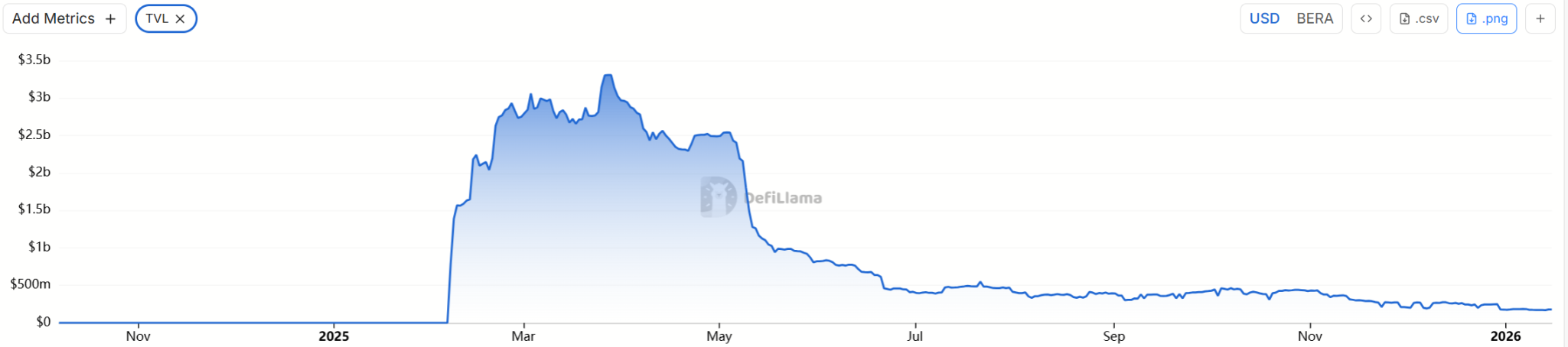
However, as the token price continued to decline, data from DefiLlama shows that its TVL has fallen to $180 million, with 24-hour chain revenue at $84, and the total stablecoin supply on the chain is $153.5 million.

Retail First? Majority of Tokens Allocated to VCs, Major Unlock in February

In its year-end update, the Berachain Foundation admitted that the "retail first" strategy in the crypto market had generally underperformed, leading to a reallocation of resources. This directly triggered a series of issues. First, layoffs and team changes. As part of the strategic adjustment, the Berachain Foundation cut most of its retail marketing team, shifting focus to foundational development. Berachain's lead developer, Alberto, is also leaving to co-found a Web2 company with former banking colleagues.

The Foundation emphasized that the departure was amicable, but this undoubtedly weakens the project's core technical strength. In the community, some developers have already moved to other chains like Monad, further exacerbating the talent drain.

Perhaps the "retail first" strategy promoted by the Berachain Foundation never truly took off.

The project initially emphasized community-driven approaches, but in practice, the incentive mechanisms failed to consistently attract users, and token allocation left retail investors out in the cold.

Although the PoL mechanism is innovative, its complexity (such as the multi-token model, including BERA and BGT) deterred users, leading to a sharp decline in network activity. In November 2025, the project paused the network due to a Balancer protocol vulnerability, fortunately without affecting user funds.

The BERA token price has fallen from a high of $9 to the current $0.7, a drop of over 10 times in just one year for the once so-called "heaven-sent" public chain token.
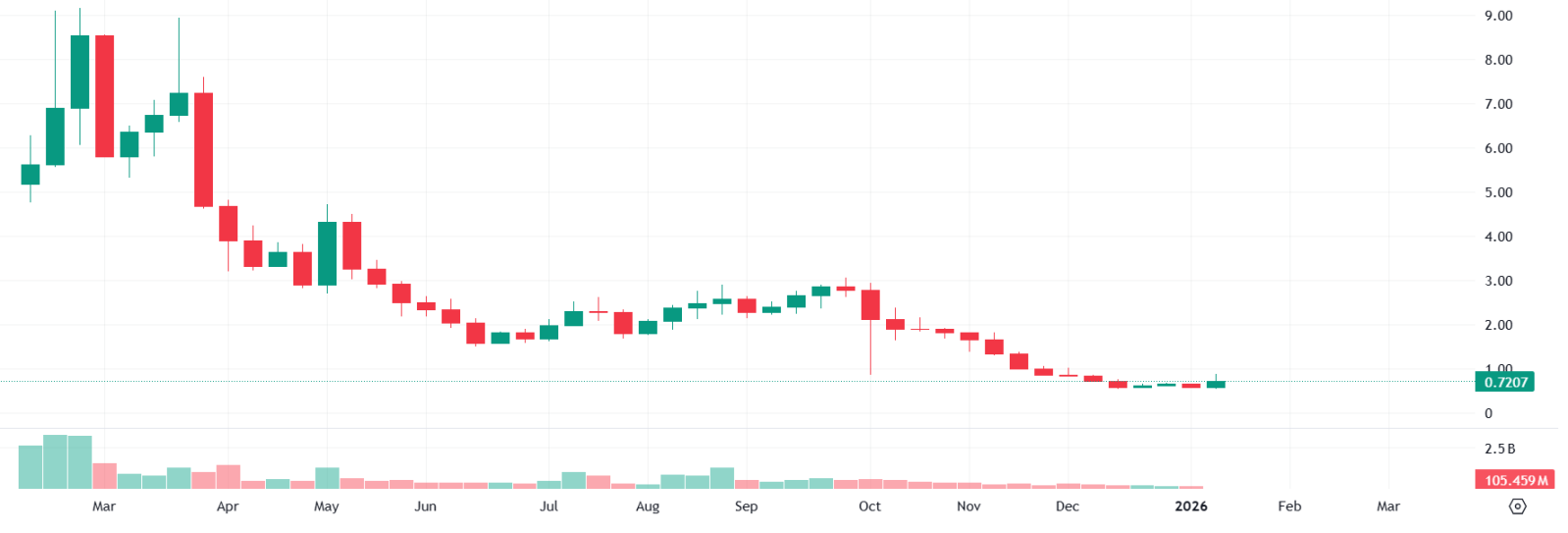
This collapse stems from a low circulation and high FDV model, leading to artificially inflated prices followed by a rapid crash, and these issues are rooted in Berachain's token distribution mechanism. Early contributors received 16.82% of the total supply, while private sale investors received a staggering 34.31% of the token share, typical of a VC coin. Additionally, NFT holders could receive tens of millions of dollars in tokens, while testnet users received only $60 in airdrops, sparking controversy over "wealth disparity" and marginalizing some loyal users.
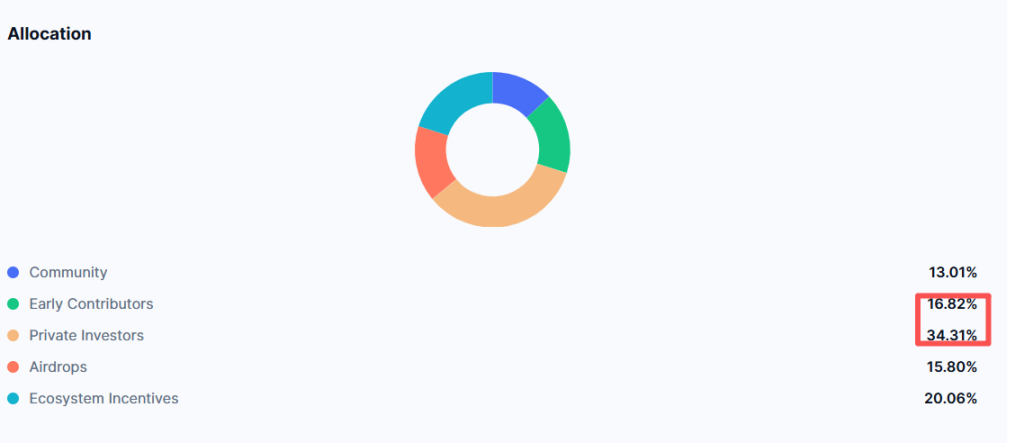
This runs counter to the "retail first" slogan; the project is essentially a VC-dominated low-circulation, high-FDV model: early investors entered at $0.82, achieving 10-15x returns, while retail investors bear the crash. Foundation founder Smokey admitted that if done over, he would not sell so many tokens to VCs and has repurchased some to reduce dilution. In October 2025, the Berachain Foundation partnered with Greenlane Holdings to launch BeraStrategy, making BERA a reserve asset, but this failed to reverse the token's decline.

Furthermore, VCs like Brevan Howard's Nova fund hold refund rights, allowing them to request a full refund of $25 million before February 2026, further highlighting Berachain's tilt toward VCs.

Community dissatisfaction is high, with many users calling it the "ultimate fraudulent L1."
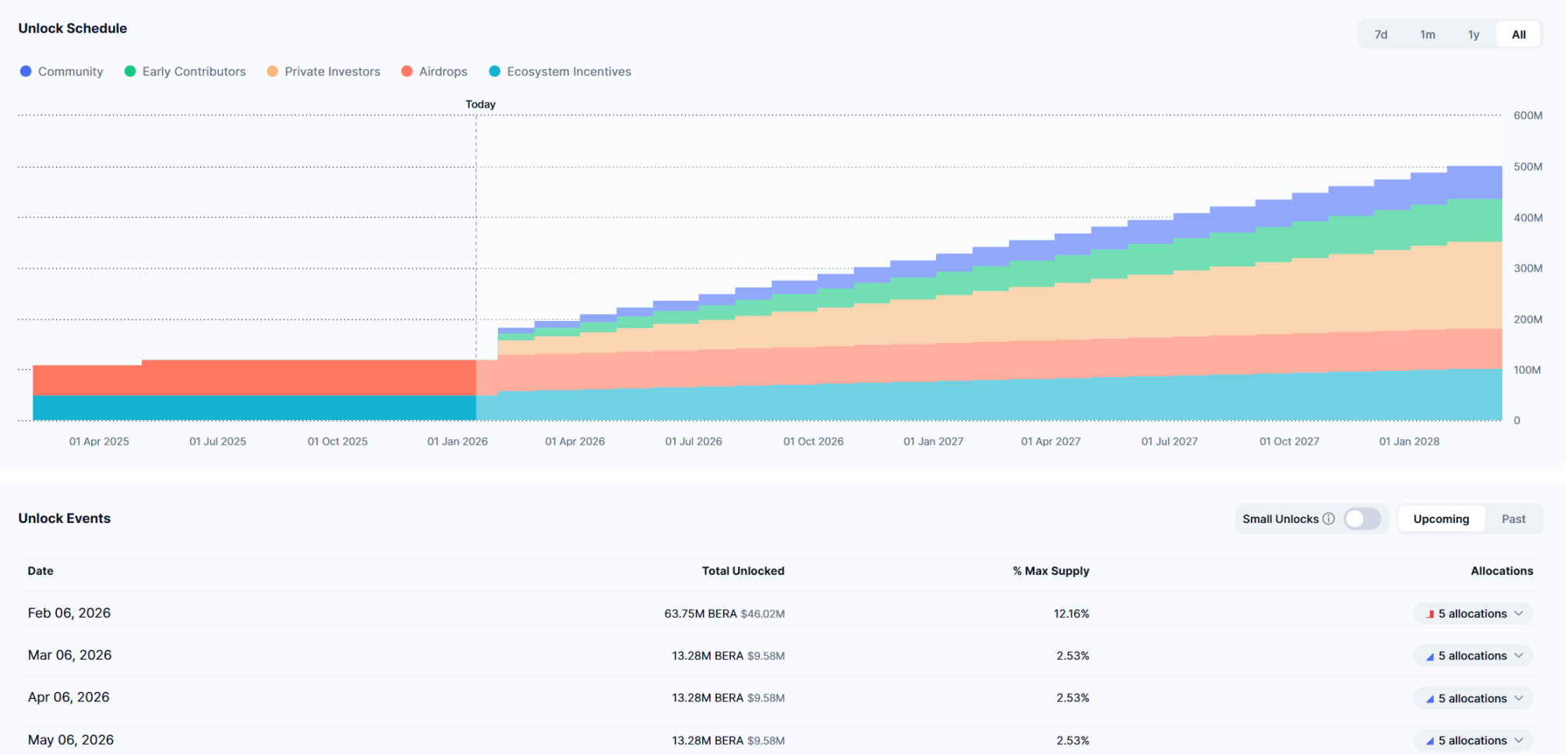
On February 6 this year, Berachain will unlock 63.75 million BERA, approximately 12.16% of the total supply. Of the unlocked portion, private sale investors account for 28.58 million. Starting from March this year, BERA will unlock 2.53% of the total supply each month. Given the current liquidity drought, the continuous large unlocks this year may trigger significant selling pressure.


Twitter:https://twitter.com/BitpushNewsCN

BitPush TG Discussion Group:https://t.me/BitPushCommunity

BitPush TG Subscription: https://t.me/bitpush

Original Link:https://www.bitpush.news/articles/7603193

Related Questions

QWhat were the main factors that led to the collapse of Berachain's token price and TVL?

AThe collapse was driven by a combination of internal strategy flaws and external market pressures. Key factors included the project's high Fully Diluted Valuation (FDV) with low initial circulation, significant token allocations to venture capitalists (VCs) rather than retail users, the complexity of its Proof-of-Liquidity (PoL) mechanism, loss of key developers, and upcoming large token unlocks that created selling pressure.

QHow did Berachain's token distribution model contribute to its problems?

ABerachain's token distribution was heavily skewed towards VCs and early contributors, with 34.31% allocated to private sale investors and 16.82% to early contributors. This left retail users with minimal allocations, contradicting the project's 'retail-first' marketing. The low circulation and high FDV model artificially inflated the price initially, leading to a sharp decline when early investors began selling.

QWhat was the significance of the upcoming token unlocks in February for Berachain?

AOn February 6, Berachain was scheduled to unlock 63.75 million BERA tokens, representing 12.16% of the total supply. This included 28.58 million tokens for private sale investors. Given the already low liquidity and declining price, these unlocks were expected to create substantial selling pressure, further depressing the token value.

QWhy did Berachain's innovative Proof-of-Liquidity (PoL) consensus mechanism fail to sustain user engagement?

AThe PoL mechanism, while innovative, was complex and involved a multi-token system (BERA and BGT) that confused users. This complexity reduced network activity and participation, as users found it difficult to engage with the ecosystem effectively, leading to a decline in TVL and overall chain activity.

QWhat internal challenges did Berachain face regarding its development team and community?

ABerachain experienced significant internal challenges, including the departure of key developers such as Chief Developer Alberto, who left to start a Web2 company. The foundation also cut most of its retail marketing team, shifting focus to core development. Additionally, community developers migrated to other chains like Monad, exacerbating talent loss and reducing project momentum.

Related Reads

Apple Also Has to Pay Rent Now

Apple Pays Rent Too: The Two-Way Flow of "Traffic Tax" and "AI Capability Rent" Between Tech Giants For over two decades, Google has paid Apple an estimated $20 billion annually to remain the default search engine on Safari, a "traffic tax" for a critical user entry point. However, in 2026, the direction of this cash flow partially reversed. Apple agreed to pay Google roughly $1 billion per year to license its Gemini AI models, as Apple's own models reportedly struggled with complex tasks. This creates a unique dynamic: Apple acts as the "landlord" in the established search ecosystem, collecting rent from Google for access. Simultaneously, in the emerging AI arena, Apple becomes the "tenant," paying Google for access to cutting-edge AI capabilities it cannot currently match internally. While Apple claims its new models are "distilled" from Gemini outputs and contain "not a drop" of Google's original code, core dependencies remain. Its knowledge base is refined using Gemini's outputs, and its most powerful cloud model runs on Google's infrastructure. Apple has structured the deal as non-exclusive, allowing it to theoretically switch AI suppliers—a hedge against over-reliance. The future hinges on whether advanced AI models become a commodity (cheap and abundant) or remain a concentrated, scarce resource (expensive and controlled by few). Apple is betting on the former, leveraging its massive device ecosystem to be a powerful, choosy customer. If the latter proves true, its bargaining power could erode. This power dynamic is extending to developers. Apple, Google, and WeChat are all pushing for apps to expose their core functions as standardized "actions" or "intents" that their respective AI assistants (Siri, Gemini, WeChat AI) can directly call. The new scarce resource is no longer just app store visibility, but "being selected by the AI." The currency of "rent" has changed from a 30% revenue share to ceding control over how users interact with an app's functions.

marsbit41m ago

Apple Also Has to Pay Rent Now

marsbit41m ago

Missed the SpaceX IPO? WEEX's "First Trade Protection" Lets You Experience US Stock Trading Risk-Free.

With the excitement around SpaceX's recent public listing reigniting interest in the US stock market, Chinese investors face significant challenges accessing compliant and convenient trading channels following regulatory actions against major online brokers. This article explores the available options, highlighting their risks and limitations. Traditional paths for US stock investments remain problematic. Qualified Domestic Institutional Investor (QDII) and Listed Open-Ended Fund (LOF) products, while compliant, suffer from high fees, significant purchase premiums, and a very limited selection of assets. Small, unregulated offshore brokers pose substantial risks, including potential insolvency. While secure, VIP accounts at banks in Hong Kong or Singapore require high minimum deposits (often 1-2 million RMB) and in-person visits, placing them out of reach for most retail investors. The article positions cryptocurrency exchanges, specifically their TradFi (traditional finance on-chain) offerings, as a compelling alternative. Platforms like WEEX are noted for providing access to a wide range of US stocks and ETFs, including SpaceX (SPCXON), through tokenized assets. This method offers advantages such as a single account for both crypto and traditional assets, USDT-based settlement avoiding fiat complexities, flexible leverage, and robust risk management. To attract users, WEEX is promoting a "First Trade Guarantee" campaign. Running from June 15 to July 8 (UTC+8), it features a $30,000 prize pool. Users who trade $500 worth of US stock contracts can qualify for a guarantee on their first eligible trade: 100% loss coverage up to $30 or a 20% bonus on profits up to $30. The campaign is presented as a low-risk opportunity for both crypto natives and traditional investors to experience US stock trading.

marsbit42m ago

Missed the SpaceX IPO? WEEX's "First Trade Protection" Lets You Experience US Stock Trading Risk-Free.

marsbit42m ago

How Difficult is Chip Making? A Division Error Costs 475 Million Dollars

How Hard Is It to Make a Chip? A Division Error Cost $475 Million Chip expert Shi Kan, a researcher at the Chinese Academy of Sciences and a popular tech creator, explains the immense challenges of chip development. Chips are foundational to modern technology, but their creation is extraordinarily difficult. The journey from sand to a functional chip involves complex design and manufacturing, but a critical bottleneck is verification—ensuring the design works flawlessly before costly production. A single, undetected bug can have catastrophic consequences, as illustrated by the infamous 1994 Intel Pentium FDIV bug. A flaw in the floating-point division unit forced a recall costing $475 million. Unlike software, chips cannot be easily patched after manufacture, making "first-time success" paramount. However, industry surveys show only 24% of chip projects achieve this; over three-quarters require at least one costly re-spin due to design flaws. Verification has thus become the dominant phase, consuming up to 70% of the design cycle. The core challenge is a "verification impossible triangle" between high performance, good debuggability, and low cost. Exhaustively verifying a modern CPU core could take 15,000 years with software simulation, or 30 years with advanced hardware emulation—timeframes utterly impractical for development. Despite being essential, verification is often seen as unglamorous "dirty work," receiving less academic attention than fields like AI. Shi and his team are tackling this by developing an agile verification research framework called ENCORE, based on FPGA technology, to improve verification efficiency and debug capability. Beyond research, Shi engages in public science communication through long-form video content, aiming to demystify chip technology, AI, and computer science. He argues for the value of pursuing "hard and long-term" endeavors, whether in the meticulous world of chip verification or in creating substantive educational content, believing such sustained effort is likely the right path forward.

marsbit52m ago

How Difficult is Chip Making? A Division Error Costs 475 Million Dollars

marsbit52m ago

Trading

Spot
Futures
活动图片





