For Web3, This Time Cai Wensheng Is Determined to Get His Hands Dirty

marsbitPublished on 2026-03-16Last updated on 2026-03-16

Abstract

Cai Wenshou, a prominent Chinese internet entrepreneur and investor, is making a significant push into the Web3 space with a hands-on approach, moving beyond his previous role as a financial backer. Despite early successes in domains and internet companies like Meitu, his advocacy for Meitu's $100 million cryptocurrency investment in 2021 led to substantial paper losses and public criticism, eventually resulting in his departure as chairman. After stepping down, he reduced his stake in Meitu and invested personal funds into Web3 initiatives. He purchased a 25-story commercial building in Hong Kong, renamed it "CAI Tower" (representing Crypto and AI), offering free rent to Web3 and AI startups in exchange for first investment rights. He also acquired two Hong Kong-listed companies, rebranding them as CAI Holdings and LONG Investment Group, to build a Web3 and AI asset management platform. Additionally, he integrated a licensed virtual asset exchange, EXIO, into his ecosystem, creating a full-cycle support system from incubation to trading. Cai believes in the long-term potential of Web3, comparing its growth trajectory to AI's gradual rise. He remains optimistic about Bitcoin's future, predicting it could reach $1.1 million. Unlike some early crypto figures who have exited the industry, Cai is deepening his involvement, aiming to foster tangible projects and ecosystems. His commitment reflects a broader need for established leaders to drive real-world adoption and achieve a ...

Author:Zhou, ChainCatcher

If there are still any investors in the current crypto industry worth looking forward to, Cai Wensheng should be one of them.

Starting from the early domain name business, to the successive successes of 58.com, Storm Player, and Meitu, then to strongly advocating for Meitu to hoard cryptocurrencies, facing billions in floating losses and being criticized for speculative trading, stepping down as chairman, cashing out to buy buildings, and betting on Hong Kong Web3.

He is a person who has been repeatedly misunderstood by the times, yet repeatedly validated by the times.

Only this time, he decided to "get his hands dirty."

Last Time, Didn't Get a Good Result

2021 年, Cai Wensheng strongly advocated for Meitu to buy Bitcoin and Ethereum, with a total investment of about $100 million.

When buying, Cai Wensheng once said in his WeChat Moments: "Someone has to be the first to eat the crab. This should be the first Hong Kong-listed company to purchase BTC digital currency, and also the world's first listed company to use ETH Ethereum as a monetary value reserve."

However, as a Hong Kong-listed company, any major asset allocation by Meitu needed to be approved by the board of directors. Although he held over 25% of the shares at the time and, as chairman, could push for the purchase, he could not prevent the sale.

2022 年, the crypto market plummeted, and Meitu's paper losses exceeded 280 million RMB, with accusations of "speculative crypto trading" flooding in. The stock price of Meitu in Hong Kong also hit a historic low.
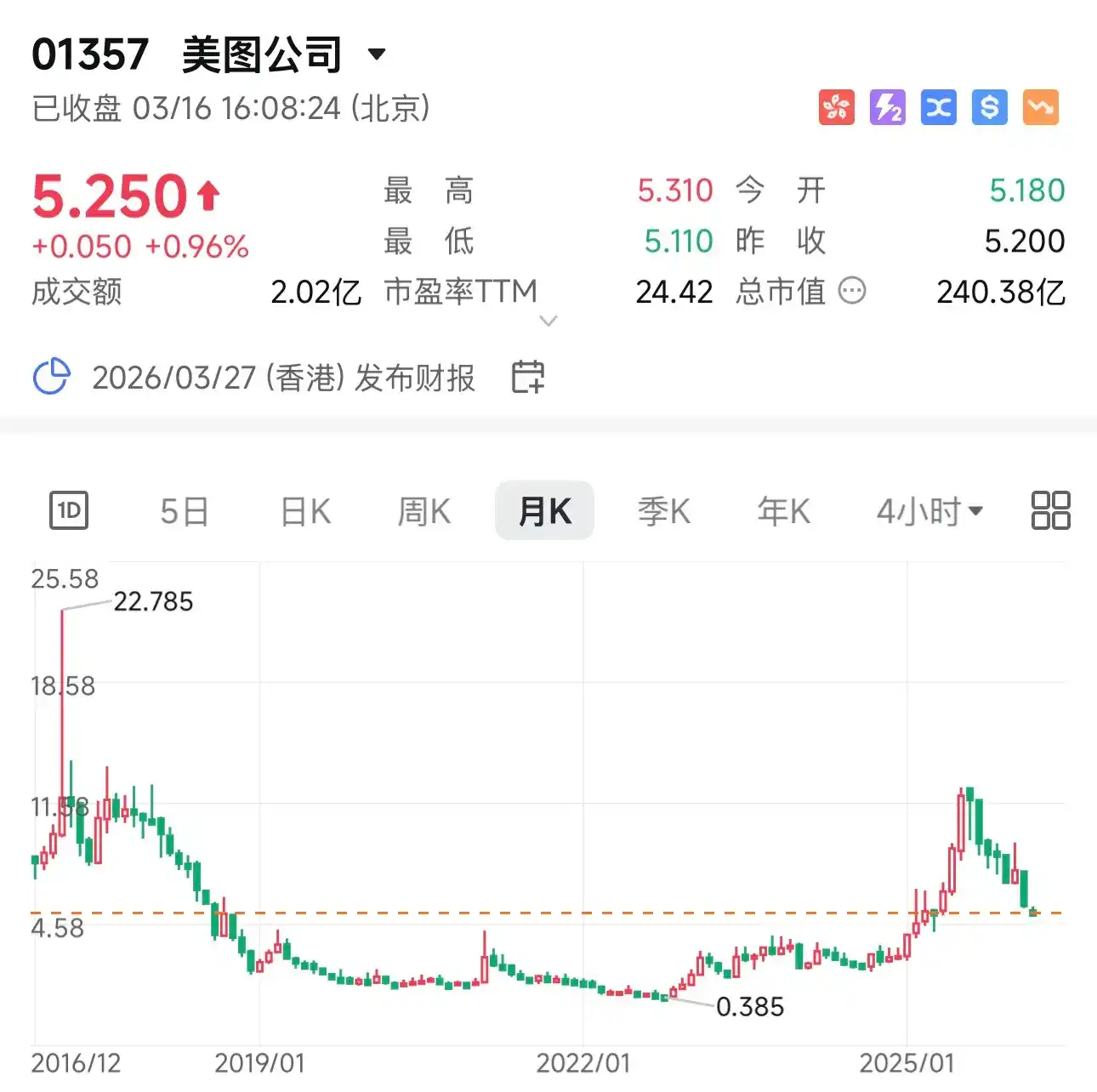

Publicly listed companies sometimes have less tolerance for floating losses than individual investors—stock price pressure, shareholder doubts, media siege—these were external pressures that anyone at the time could not withstand.

2023 年, he stepped down as chairman amid skepticism, and Wu Xinhong returned to take charge, immediately beginning to "tear off the Cai Wensheng label," with the strategic focus fully shifting to AI.

The ending of the story is quite ironic. Meitu issued an announcement in early December 2024, stating that as of that date, it had sold all its cryptocurrency, with a total cash consideration of approximately $180 million, realizing a gain of about $79.63 million, equivalent to approximately RMB 571 million.

If they had held on back then, Meitu would have been one of the first batch of DAT companies in Hong Kong.

The trend was validated, but it was no longer related to him.

Getting Involved, Getting Hands Dirty

From domain names, mobile internet, to Web3, people in each era said he was gambling.

He once said in an interview that what Web3 entrepreneurs do is often not understood, especially by traditional investors.

At the same time, he expressed firm belief in the explosion of Web3, though the timing is hard to predict, just like AI went through many years of dormancy before迎来 the ChatGPT explosion.

According to RootData显示, Cai Wensheng's Longling Capital早年 invested in the crypto exchange OKX (formerly OKCoin). In 2018, he revealed publicly that he had invested in over 10 blockchain projects, including Theta, Ontology, Zipper, etc.

<极好的, I will continue the translation from where it left off, ensuring all HTML tags are preserved and the structure is maintained.

img style="max-width:100%;overflow:hidden;" src="https://d1x7dwosqaosdj.cloudfront.net/images/2026-03/ba38047c3f24461f9b57e864d3fc5780.jpg" alt="">


This time, he simply increased his bet.

After stepping down, Cai Wensheng chose to reduce his stake in Meitu, with his shareholding比例 dropping from a peak of about 25% to less than 10%.

650 million Hong Kong dollars to buy a 25-story commercial building in Tin Hau, Hong Kong, renamed CAI Building. He specifically stated: "CAI is the abbreviation of Crypto and AI, not my surname."

It is reported that CAI Building does not charge rent, only asks for the优先 investment right in the first round of financing, no discount, no controlling stake. He publicly stated that the goal is to incubate 5 unicorns within three years.

Last November, Cai Wensheng said at Hong Kong Fintechweek that buying this building was to "set an example." Now this building is fully occupied by AI and Web3 companies.

Capital operations also followed. He successively acquired two Hong Kong-listed companies—China New Economy Investment and China Financial Leasing, renamed them CAI Holdings and LONG Investment Group respectively,打造 a Web3+AI asset management platform.

In early 2026, CAI Holdings又 acquired the equity of two early-stage projects, Forestheaven and EXIO, by issuing new shares. The seller was precisely Longling Capital, wholly owned by Cai Wensheng.

Among them, EXIO is a licensed virtual asset trading platform in Hong Kong, holding SFC Type 1 and Type 7 licenses. It is the first compliant exchange in Hong Kong with a securities background. Longling Capital was one of its early investors.

Incorporating this piece into CAI Holdings means his ecosystem extends from incubation to circulation—projects cultivated in the CAI Building can be directly listed for compliant trading on a licensed exchange.

Crypto OGs Need a Decent Victory

Among the crypto OGs we know, Cai Wensheng is not the one who has benefited the most.

The fates of early crypto OGs vary.

Some achieved financial freedom and completely faded out—Babbitt founder Chang Jia was once the most powerful spokesperson for long-termism in the crypto industry. Since 2023, he has turned to AI entrepreneurship.

Multicoin Capital co-founder Kyle Samani became famous for early bets on Solana. When leaving the圈, he publicly stated that "cryptocurrency is not as interesting as many people think."

Some stay in the圈, but their focus has shifted—Shenyu was a representative figure in the mining圈 early on. Now, content about AI tools占了大半 on his social accounts.

And those who, like Cai Wensheng, choose to stay include Xiao Feng and Feng Bo, etc.

Xiao Feng turned from traditional finance, leading HashKey on an institutionalized compliance path, operating with licenses, and connecting with traditional capital; Feng Bo布局 in a professional crypto VC manner, closer to the standard institutional investor approach.

They are同样 optimistic about this industry, but their paths are截然不同.

Cai Wensheng chose a "dirtier" path: not taking the institutional route, not making pure financial bets, personally putting down roots in Hong Kong, getting involved hands-on.

At the 2023 Hong Kong Web3 Carnival, Cai Wensheng said: "People who have worked from Web1 to Web3, this seems like a compliment, but it actually means that we have not been successful from Web1 to Web3, we have always been on the road. But many people from Web1 to Web3 are no longer here, but we are still here,说明 we are veterans. Old soldiers never die, they just fade away."

In early 2026, he predicted that Bitcoin would rise to $1.1 million, which means the total market capitalization of Bitcoin would be about $21 trillion. Previously, he publicly stated that he held about 10,000 Bitcoins. There is no news yet showing that he has exited.

Of course, the controversy has not disappeared. Continuously endorsing during a bear market, whether it is坚守 against the market or having to tell stories after being trapped, is still difficult for outsiders to distinguish.

But the ammunition from cashing out, the buildings bought, the companies acquired—these are all actions with real money.

This industry has experienced too many indecent endings. Project方 running away, whales dumping and fleeing, OGs quietly leaving the scene. What remains in the public eye are often only those news about changes in whale addresses.

This industry does not lack people who喊单, it lacks people who truly stay and get their hands dirty.

A bull market unlocking cannot solve the industry's root problems. In the end, it still relies on projects that truly succeed and ecosystems that truly land to win a decent victory for crypto OGs.


Related Questions

QWhat was the outcome of Cai Wensheng's push for Meitu to invest in Bitcoin and Ethereum in 2021?

AMeitu invested approximately $100 million in Bitcoin and Ethereum in 2021, but faced a paper loss of over 280 million RMB in 2022 due to the crypto market crash. Cai Wensheng stepped down as chairman amid criticism, and Meitu later sold all its cryptocurrency holdings in 2024 for about $180 million, realizing a profit of approximately $79.63 million.

QWhat does 'CAI' stand for in the name of the building Cai Wensheng purchased in Hong Kong?

ACAI stands for 'Crypto and AI', not Cai Wensheng's surname. The building, named CAI Mansion, is intended to incubate AI and Web3 startups.

QHow is Cai Wensheng currently involved in the Web3 and crypto industry after leaving Meitu?

ACai Wensheng is deeply involved by purchasing a 25-story commercial building in Hong Kong (CAI Mansion) to incubate Web3 and AI startups, acquiring and renaming two Hong Kong-listed companies to create Web3+AI asset management platforms, and integrating a licensed virtual asset trading platform (EXIO) into his ecosystem.

QWhat is Cai Wensheng's prediction for the future price of Bitcoin?

ACai Wensheng predicted that Bitcoin would rise to $1.1 million, which would imply a total market capitalization of approximately $21 trillion.

QWhich early blockchain projects did Cai Wensheng's Longling Capital invest in?

ALongling Capital invested in early blockchain projects including Theta, Ontology, Zipper, and the crypto exchange OKX (formerly OKCoin).

Related Reads

Analyzing the Impact of AI on Economic Growth and Productivity

**Title: Analyzing AI's Impact on Economic Growth and Productivity** This article examines three contrasting views on AI's influence on economic growth and productivity. **The Optimistic View** posits that AI, especially through automating R&D ("recursive self-improvement"), could dramatically accelerate growth, even triggering a technological "singularity" with explosive, potentially infinite, economic expansion. **The Moderate/Mainstream View** acknowledges AI's productivity benefits but emphasizes significant real-world constraints that could limit its impact. These include: limited cost savings per task, structural ceilings on which jobs and industries are "exposed" to AI, adoption bottlenecks (e.g., compute, energy, regulatory hurdles), and the "weak link" effect where non-automatable tasks cap overall gains. Consequently, the realized AI dividend may be far lower than optimistic projections, with estimates typically ranging from 0.1% to 1.3% annual productivity growth. **The Pessimistic View** stems from two strands. The first aligns with the moderate view but applies extremely conservative assumptions about task exposure and efficiency gains, yielding minimal projected impact. The second introduces a demand-side critique: if AI primarily replaces rather than augments labor, it could depress labor's share of income, weaken consumer demand, and create a "demand trap" that ultimately stifles growth, unless offset by redistribution policies. **The authors' assessment** is nuanced: * **Short-term (1-2 years):** AI will support growth primarily through investment spending, not significant productivity gains. * **Medium-term (3-5 years):** Three potential paths emerge based on AI demand and bottleneck severity: 1. **"Optimistic Path":** High demand, few bottlenecks. Rapid productivity gains but risk of major job displacement and social conflict without redistribution. 2. **"Moderate Path" (most likely):** High demand but significant, surmountable bottlenecks. Leads to moderate productivity gains, financial market volatility (K-shaped returns), and sectoral job losses. 3. **"Pessimistic Path":** Low demand or severe bottlenecks. Minimal productivity and growth impact, triggering financial market corrections but allowing a smoother societal transition with less labor disruption. * **Long-term:** AI holds potential for a major productivity revolution and prosperity. The conclusion stresses that no path is smooth. Technologically "optimistic" outcomes could be socially detrimental, while "pessimistic" technological diffusion might be more socially stable. Policymakers must monitor developments and prepare balanced responses to manage economic, financial, and social sustainability.

marsbit2m ago

Analyzing the Impact of AI on Economic Growth and Productivity

marsbit2m ago

The New Cold War is a Tech Stock War

The New Cold War is a Tech Stock War The article argues that the contemporary geopolitical and economic rivalry between the US and China represents a "New Cold War," but one fundamentally fought through technology and financial markets, not physical barriers or conventional trade. Historically, US dominance was secured through financial systems. The Soviet Union, reliant on the rigid "Transferable Ruble," was ultimately undermined by its dependency on the US dollar for oil trade. Later, Japan's semiconductor challenge was countered not just by tariffs (e.g., Plaza Accord, 301 investigations) but by binding it to US Treasury bonds. China presents a more complex, "embedded" challenger. While it holds vast dollar reserves and US debt like Japan, its industrial base is stronger and more diversified than the Soviet Union's. Surviving the initial 2018 trade war phase, the conflict has evolved into a "tech-financial war." The core battlefield is now the stock market. US tech stocks (AI, semiconductors) are treated as sovereign assets, buoyed by bipartisan national will. China is pushing to strengthen its own financial markets to convert industrial strength into financial power and fund its tech ambitions. Companies like ChangXin (semiconductors), Moonshot AI, and DJI compete not just for market share but as financial proxies for their respective systems. The new paradigm is moving from globally efficient monopolies (Apple, Google) towards companies that achieve monopolistic profits within their respective geopolitical spheres. This competition over "pricing power" and financial valuation in segmented markets defines the current era, making the stock market the primary arena for this tech-centric struggle.

marsbit11m ago

The New Cold War is a Tech Stock War

marsbit11m ago

RWA Weekly: Ten European Financial Institutions Establish Tokenized Asset Cooperative; Ondo Launches New Execution Network Ondo Network

RWA Weekly: European Banks Form Tokenized Asset Cooperative; Ondo Launches New Execution Network Ondo Network Covering July 24-31, 2026, the RWA sector saw a steady on-chain total value locked (TVL) of $36.8 billion, with holder count hitting a record high. However, stablecoin transfer volumes fell sharply (~30%), indicating low on-chain settlement demand. Key regulatory moves include South Korea advancing stablecoin legislation and a push to scrap crypto taxes, Kenya lowering capital requirements for stablecoin issuers, and Zimbabwe approving seven projects for its crypto sandbox. In project developments, BIS-led Project Agorá successfully tested cross-border payments with tokenized funds across six currencies. Ten major European financial institutions formed the RL1 blockchain cooperative to build tokenized asset infrastructure. Other notable updates: Aviva launched a tokenized dollar liquidity fund on XRPL, POSCO International tokenized commercial invoices on Injective, and a Brazilian farmer used tokenized cattle as collateral for a loan. Additional progress includes BNY Mellon migrating its core transfer agent operations to blockchain, Securitize gaining SEC investment advisor registration, and Tether’s compliant stablecoin USA₮ launching on Celo. Ondo Finance introduced Ondo Network, a new execution layer focused on speed and privacy, moving away from its initial chain plans. An analysis highlights that despite the growing scale of on-chain RWAs (~$32B), approximately 90% remain underutilized in DeFi, pointing to a critical challenge in unlocking liquidity and fostering real-world application beyond mere issuance.

marsbit11m ago

RWA Weekly: Ten European Financial Institutions Establish Tokenized Asset Cooperative; Ondo Launches New Execution Network Ondo Network

marsbit11m ago

South Korean Stock Market Sees Sharp Rebound After Forceful De-leveraging, SK Hynix Rises 30%

On July 31, South Korean stocks staged a historic rebound. The benchmark KOSPI index surged 18.27%, with chipmaker SK Hynix hitting a 30% gain limit. This followed a brutal, near-40% decline in the KOSPI over the previous month, driven largely by a deleveraging spiral involving leveraged ETFs. Analysts attributed the sharp sell-off to structural liquidity issues rather than deteriorating corporate fundamentals. The rally was triggered by a confluence of positive catalysts. Firstly, strong earnings from U.S. cloud giants Microsoft and Amazon alleviated fears of an "AI bubble burst," boosting global tech sentiment. Secondly, SK Group Chairman Chey Tae-won made a rare personal purchase of SK Hynix shares, seen as a strong vote of confidence. Thirdly, the South Korean government announced a 20 trillion won ($139 billion) AI investment fund. In response to the market turmoil, South Korean regulators are tightening controls on leveraged ETFs, admitting oversight shortcomings. Measures include raising minimum cash保证金 requirements for散户 investors and suspending new product launches. While the rebound signals eased liquidity pressure, analysts note deep structural issues remain. The market's future stability is seen as dependent on global tech capital expenditure trends and memory chip price cycles, with some viewing the surge as a technical correction rather than a definitive trend reversal.

marsbit32m ago

South Korean Stock Market Sees Sharp Rebound After Forceful De-leveraging, SK Hynix Rises 30%

marsbit32m ago

Trading

Spot
活动图片