Exodus, MoonPay to roll out stablecoin in early 2026, joining gold rush

cointelegraphPublished on 2025-12-17Last updated on 2025-12-17

Abstract

Digital asset platform Exodus has partnered with payments infrastructure company MoonPay to launch a U.S. dollar-backed stablecoin, planned for release in early 2026. The yet-unnamed stablecoin will be issued and managed by MoonPay using the M0 infrastructure platform. It aims to simplify digital dollar transactions for everyday consumers by integrating with Exodus Pay, allowing users to spend and send money without needing deep crypto knowledge while maintaining self-custody. This move is part of a broader industry trend, as banks and crypto firms rush to offer stablecoins following the passage of the GENIUS Act in July, which established a clear U.S. regulatory framework for fiat-backed stablecoins. The new entrant will compete in a market currently dominated by Tether (USDT), which holds a 60% market share, and Circle's USDC, which holds 25%. Together, these two stablecoins represent 85% of the total $310 billion market.

Digital asset platform Exodus has partnered with MoonPay to launch a US dollar-backed stablecoin for everyday payments.

The Exodus Movement, which is also behind a popular crypto wallet, announced on Tuesday that its fully reserved dollar stablecoin is planned for launch in early 2026. The stablecoin will be issued and managed by MoonPay and developed using M0.

M0 is a stablecoin infrastructure platform that allows companies to build, issue, and manage their own custom stablecoins, and MoonPay is a leading crypto payments platform and fiat on-ramp.

The new stablecoin, which was not named, aims to make digital dollar transactions simple for consumers without requiring crypto knowledge, as it will integrate into Exodus Pay, allowing users to spend and send money while maintaining self-custody.

“Stablecoins are quickly becoming the simplest way for people to hold and move dollars onchain, but the experience still needs to meet the expectations set by today’s consumer apps,” said JP Richardson, co-founder and CEO of Exodus.

The stablecoin gold rush continues

MoonPay launched its enterprise stablecoin business in November to issue and manage digital dollars across multiple blockchains while integrating with M0’s open infrastructure.

“Enterprises want stablecoins that are programmable, interoperable and tailored to a specific product experience,” said Luca Prosperi, co-founder and CEO of M0.

Related: US banks could soon issue stablecoins under FDIC plan to implement GENIUS Act

Banks and crypto firms have rushed to offer their own stablecoins this year, spurred by the passage of the GENIUS Act in July, which introduced a clear federal regulatory framework for fiat-backed stablecoins in the United States.

The Trump family DeFi platform, World Liberty Financial, launched the USD1 stablecoin in March, global payments platform Stripe introduced stablecoin-based accounts to clients in over 100 countries in May, and Tether announced a regulatory-compliant stablecoin called USAT in September.

Two stablecoin players dominate the sector

The new Exodus and MoonPay stablecoin is entering a crowded market still dominated by two primary players.

Tether (USDT) remains the biggest stablecoin issuer with a market share of around 60% and a circulating supply of $186 billion, while Circle’s USDC is second with a 25% share and $78 billion market cap.

These two alone comprise 85% of the total stablecoin market capitalization, which is over $310 billion, according to CoinGecko.
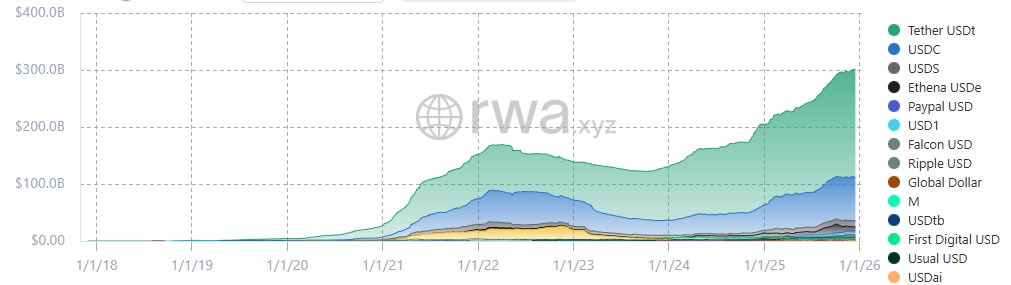
USDT and USDC still dominate stablecoin markets. Source: RWA.xyz

Magazine: Do Kwon sentenced to 15 years, Bitcoin’s ‘choppy dance’: Hodler’s Digest

Related Reads

Huang Renxun Dramatically 'Saves' South Korean Stock Market

In early June, South Korea's stock market experienced a sharp decline, with the KOSPI index dropping over 5% and triggering a trading halt. Amid this volatility, NVIDIA CEO Jensen Huang's visit to Seoul provided a dramatic boost to market sentiment. During his trip, Huang held a dinner meeting with SK Group Chairman Chey Tae-won and SK Hynix CEO Kwak Noh-Jung. He announced that NVIDIA's new Vera CPU would utilize SK Hynix DRAM and confirmed a multi-year technical collaboration between the two companies. This partnership aims to co-develop next-generation memory for NVIDIA's AI infrastructure roadmap, covering products from data center supercomputers to personal AI devices. Huang also publicly commented that AI company stocks were attractively priced. A key announcement was that NVIDIA's upcoming Vera Rubin AI supercomputer systems will use HBM4 memory, with supply qualifications granted to all three major suppliers: SK Hynix, Samsung Electronics, and Micron Technology. Despite this multi-sourcing strategy, Huang warned that the industry-wide chip shortage, affecting everything from wafers to packaging, is expected to persist for several years due to relentless demand from global AI factory construction. The collaboration extends beyond memory supply. SK Hynix will employ NVIDIA's AI platforms and Omniverse digital twin technology to enhance its own semiconductor design, simulation, and manufacturing processes, aiming for more autonomous factory operations. This visit builds upon a prior October 2025 agreement for SK Group to build a large-scale AI data center using over 50,000 NVIDIA GPUs. Huang's itinerary also included meetings with other Korean giants like Hyundai, LG, and Samsung, indicating NVIDIA's broader strategy to deepen ties with South Korea's tech industry.

链捕手5h ago

Huang Renxun Dramatically 'Saves' South Korean Stock Market

链捕手5h ago

When Inference Becomes a Scarce Resource, Who Captures the Value?

When Inference Becomes the Scarce Resource, Who Captures the Value? The core AI bottleneck has shifted from model training to inference (runtime execution). While concerns persisted about an "AI compute gap"—initially a $200B, now a $600B problem—the market is now recognizing that the solution and value lie in the inference layer. Nvidia's financial restructuring around "serving tokens" and Cerebras's successful IPO highlight this shift. Inference is a recurring, usage-based cost, estimated to be 10-50x larger than the one-time training market, especially with the rise of agentic AI. The inference stack spans six layers: silicon (e.g., Nvidia), bare metal (e.g., CoreWeave), GPU rental/aggregation, deployment/optimization, model APIs, and end applications. Most companies operate in one layer. However, Hyperbolic uniquely spans three layers (GPU rental, deployment, and model APIs) without owning any hardware. It aggregates fragmented GPU supply from multiple cloud providers into a standardized pool, offering developers the cheapest available compute through intelligent routing. Its multi-cloud aggregation creates a data moat and a flywheel: more supply leads to better pricing data and liquidity, attracting more developers and providers. In contrast, applications like Venice operate at the top of the stack, reselling privacy-wrapped inference but remaining dependent on and constrained by the underlying compute costs they purchase. As inference demand explodes, value accrues not just to consumer applications but increasingly to the aggregation and routing layer that captures their cost of revenue. The coming potential GPU oversupply reinforces this dynamic. While hardware owners may suffer from depreciation, asset-light aggregators like Hyperbolic benefit from price arbitrage, routing workloads to the cheapest available capacity. The ultimate winner in the inference economy may not be the entity with the most GPUs, but the one that can most efficiently discover, aggregate, and route the world's fragmented compute.

链捕手5h ago

When Inference Becomes a Scarce Resource, Who Captures the Value?

链捕手5h ago

Trading

Spot
Futures
活动图片