Ethereum – Why $69B remains locked in DeFi despite weak ETH prices

ambcryptoPublished on 2025-12-24Last updated on 2025-12-24

Abstract

Despite weak ETH prices and technical pressure trading below key resistance levels, Ethereum's foundation remains strong with over $69 billion locked in its DeFi ecosystem—representing 68.2% of the global DeFi TVL. This dominance extends beyond DeFi, as Ethereum also supports over $191 billion in stablecoins and half of the tokenized euro market, reinforcing its role as the preferred settlement layer for institutions due to its security and reliability. Institutional players are actively increasing their exposure, with significant purchases such as Bitmine's acquisition of 68,000 ETH (worth over $200 million) in 24 hours and Fasanara Capital using DeFi protocols to leverage further buying. Concurrently, ETH exchange supply has hit multi-month lows, reducing sell-side pressure. This combination of strong fundamental usage, institutional accumulation, and declining available supply could soon trigger a supply-driven rebound in price.

Ethereum’s [ETH] price looks shaky, but its foundation remains strong.

Behind the short-term pressure, the network is dominating DeFi. ETH is leaving exchanges, so the available supply is decreasing.

What makes this moment stand out, however, is who is stepping in. Institutional players are increasing exposure, even during times of caution.

Price and investor behavior are moving apart. However, that gap may close soon.

Ethereum is hard to ignore

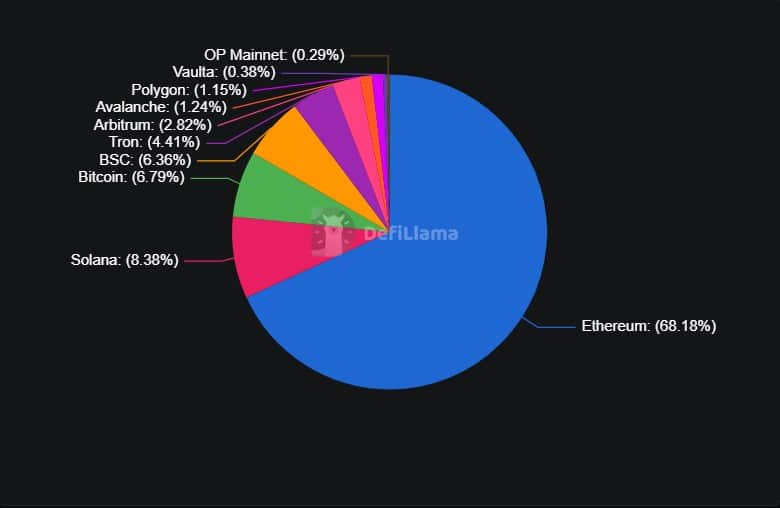
The network now holds nearly 68.2% of global DeFi TVL, with over $69 billion deployed on its smart contracts.

That is more capital than Solana [SOL], Tron [TRX], BNB Smart Chain [BNB], Bitcoin [BTC], Avalanche [AVAX], and every other chain combined.

Source: DeFiLlama

The network’s edge goes beyond DeFi alone. It also hosts more than $191 billion in stablecoins and controls half of the tokenized euro market.

For institutions, this matters because stablecoins are issued where security and reliability are strongest, and Ethereum remains the preferred settlement layer.

Big hands are in!

Source: X

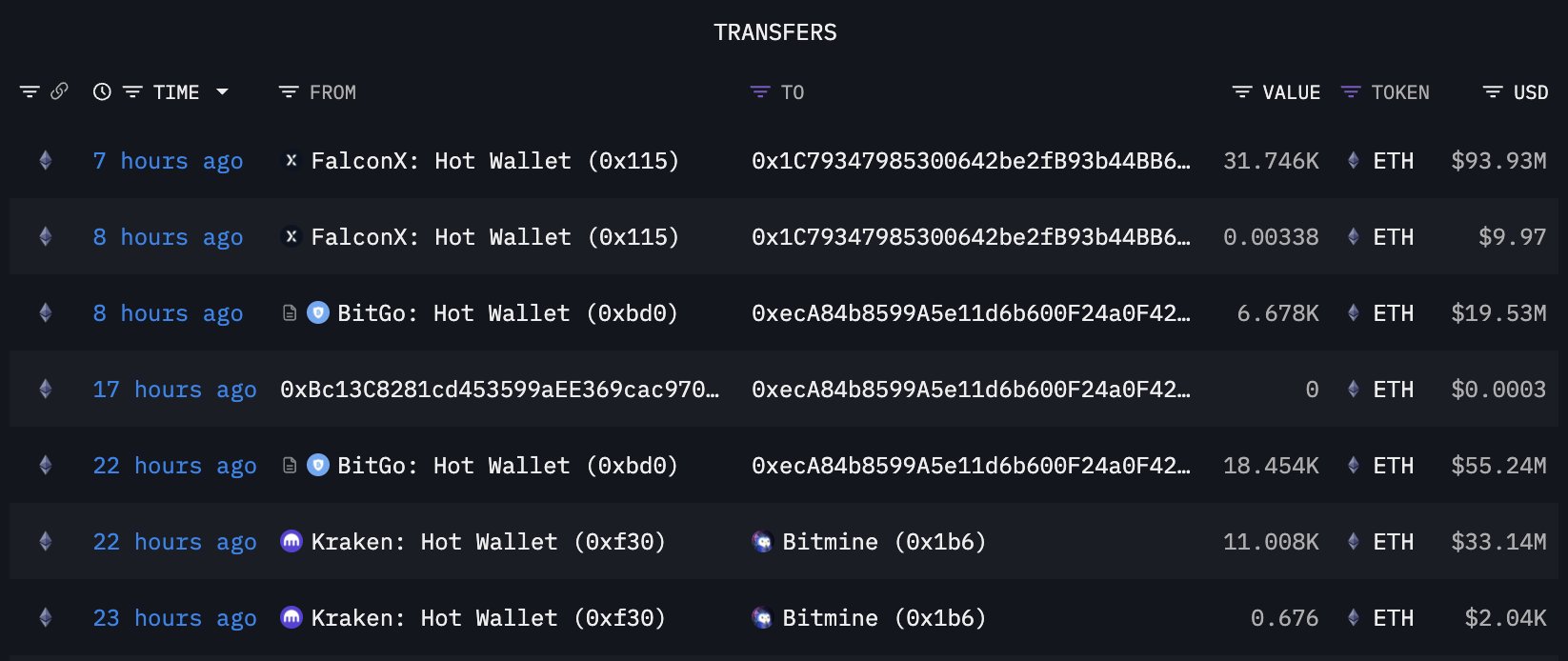
That dominance is translating into real buying, with institutions moving fast to increase exposure. In the past 24 hours alone, Tom Lee’s Bitmine purchased nearly 68,000 ETH, worth over $200 million.

Source: X

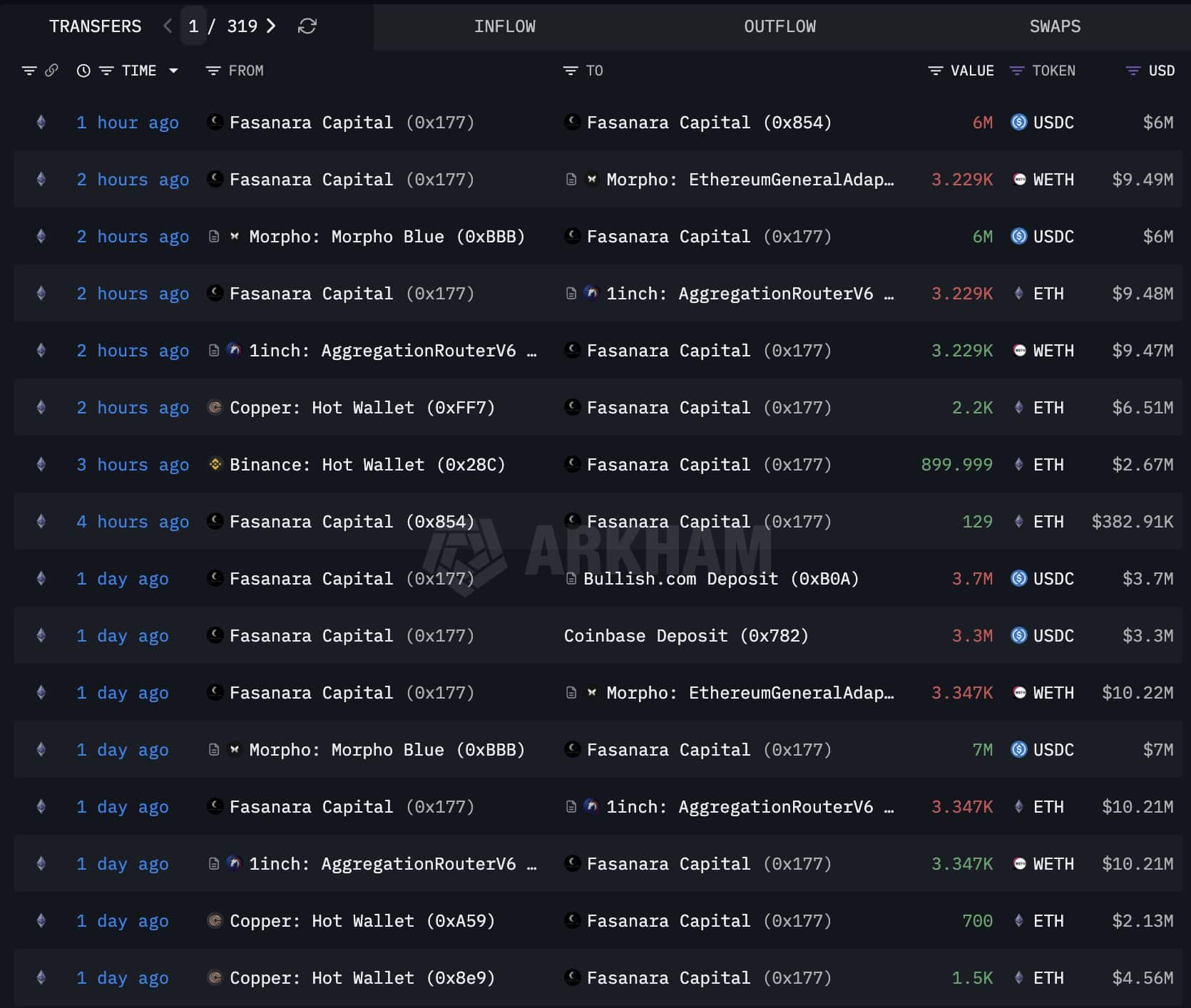
Fasanara Capital followed a similar path, buying ETH, depositing it into DeFi protocols, and borrowing against it to buy even more. This is active positioning.

A supply shock is taking shape

Source: CryptoQuant

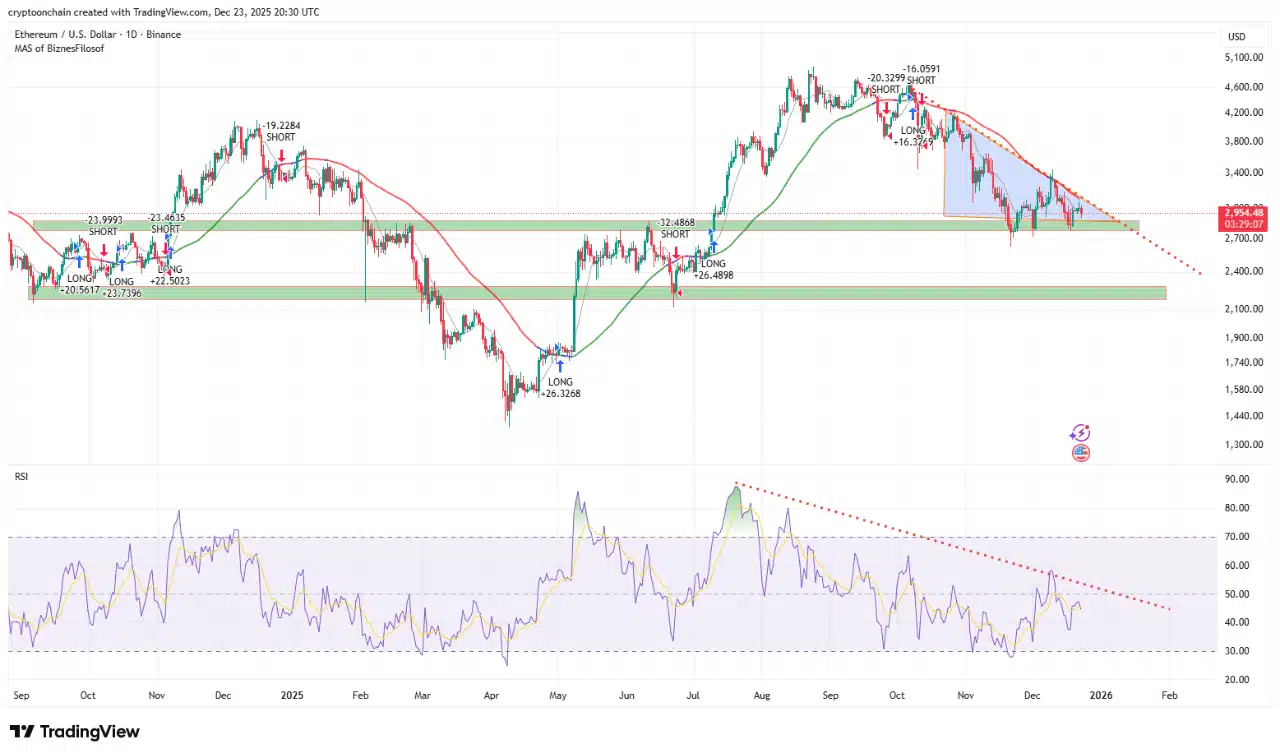
All this buying is happening at a delicate moment for ETH’s price. Ethereum is trading under technical pressure, stuck below key resistance levels with support near $2,800. On its own, it looks fragile, too.

Source: CryptoQuant

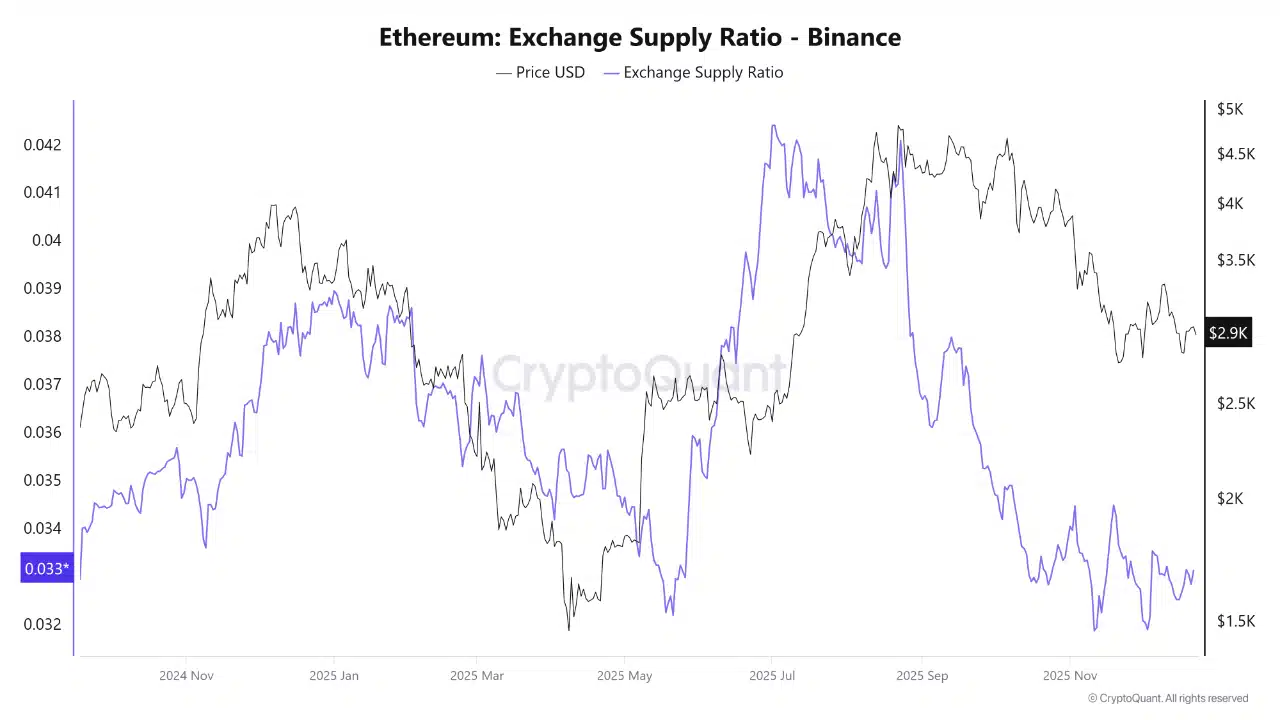
But, Ethereum’s exchange supply ratio on Binance has fallen to 0.032, the lowest since September 2024. Simply put, less ETH is sitting on exchanges ready to be sold.

With this clash, if buyers continue to defend support, a tight supply could quickly flip the narrative.


Final Thoughts

  • Ethereum controls 68%+ of DeFi TVL. Institutions buy even while price struggles.
  • Falling exchange supply and $200M+ ETH buys could cause a supply-driven rebound
Next: Why ‘fear’ right now doesn’t mean ‘buy the dip’
Share
  • Share
  • Tweet

Trending Cryptos

Related Questions

QWhat percentage of global DeFi TVL does Ethereum currently hold, and how much capital is deployed on its smart contracts?

AEthereum currently holds 68.2% of global DeFi TVL, with over $69 billion deployed on its smart contracts.

QWhy are institutional players increasing their exposure to Ethereum despite its current price weakness?

AInstitutions are increasing exposure because Ethereum remains the dominant DeFi platform with strong security and reliability, serving as the preferred settlement layer for stablecoins and tokenized assets.

QHow much ETH did Tom Lee's Bitmine purchase in the past 24 hours, and what was its approximate value?

ATom Lee's Bitmine purchased nearly 68,000 ETH in the past 24 hours, worth over $200 million.

QWhat is significant about Ethereum's exchange supply ratio on Binance falling to 0.032?

AEthereum's exchange supply ratio on Binance falling to 0.032 (the lowest since September 2024) indicates less ETH is available on exchanges for selling, potentially creating a supply shock.

QWhat strategy did Fasanara Capital use to increase their Ethereum exposure?

AFasanara Capital bought ETH, deposited it into DeFi protocols, and borrowed against it to purchase even more ETH, demonstrating active positioning.

Related Reads

Besu Patches Vulnerabilities in 5 Components: What Node Operators Need to Know

The Ethereum client Besu, developed by the Hyperledger community, has patched five security vulnerabilities discovered by blockchain security firm CertiK. These vulnerabilities, detailed in four security advisories on August 14, were all addressed in version 26.7.1, an urgent security update initially released on July 27. The intentional delay between the patch release and the public disclosure of details gave node operators a crucial window to update. JiaLiang Chang, CertiK's Director of Security Engineering, explained this "patch first, details later" model provides defenders a time advantage, allowing them to identify affected systems, test the update, and coordinate deployments—particularly important for institutional or permissioned blockchain networks requiring formal change management. The vulnerabilities, found through CertiK's "Chain Scan" attack methodology, involved issues in block announcement handling, consensus proposal buffering, WebSocket subscription limits, and JSON-RPC filter creation. If exploited, they could have allowed an attacker to exhaust a node's memory or thread resources, compromising its availability and the consensus process. Chang highlighted that while the open-source ecosystem is moving toward more formalized security testing (like differential fuzzing and bug bounty programs), coverage remains uneven. Testing often focuses more on protocol compliance than on continuous resource exhaustion, race conditions, or deployment-specific failures. He emphasized that third-party research remains vital for uncovering attack vectors beyond routine development, advocating for a mature, cumulative security model combining continuous integration, multi-node attack testing, independent audits, and regression testing for each confirmed vulnerability.

cryptonews.ru25m ago
Besu Patches Vulnerabilities in 5 Components: What Node Operators Need to Know

cryptonews.ru25m ago

Trading

Spot

Hot Articles

Discussions

Welcome to the HTX Community. Here, you can stay informed about the latest platform developments and gain access to professional market insights. Users' opinions on the price of ETH (ETH) are presented below.

活动图片