Ethereum Supply Vanishes From Market As Staking Surges – Here’s How Much ETH Is Staked

bitcoinistPublished on 2026-03-28Last updated on 2026-03-28

Abstract

Ethereum staking activity has reached an all-time high, with over 30% of its total supply—approximately 35 million ETH—now locked in staking contracts. This significant removal of coins from the liquid supply is tightening market liquidity and reflects growing investor confidence. Major firms like Bitmine Immersion Technologies and Fundstrat Capital are leading this trend, actively accumulating and staking ETH, which may lead to a supply squeeze. Despite Ethereum's recent sideways price movement, Bitmine continues its substantial purchases, acquiring an additional 117,111 ETH worth $253.3 million over two days, reinforcing a bullish long-term outlook for the asset.

Ethereum, the leading altcoin, is in the spotlight again, not because of its recent price action, but its staking activity. Currently, ETH staking activity is at its highest rate ever, with millions of supply being locked away in staking contracts.

Rising Staking Trends Shrink Ethereum’s Supply

In light of the ongoing waning market performance, a significant shift is emerging within the supply dynamics of Ethereum. This shift in supply dynamics is due to the substantial growth in ETH staking over the past few months.

As an increasing amount of ETH is being locked away through staking, the circulating supply is starting to disappear at a fast rate. This development is likely to lead to the tightening of overall market liquidity. A period like this reflects a growing confidence among ETH investors in addition to changing the equilibrium between supply and demand.

In the report shared by BMNR Bullz, a tech enthusiast and investor on X, more than 30% of the entire ETH supply is now being locked in staking contracts, and this trend does not seem to be slowing down. The 30% represents approximately 35 million ETH effectively removed from the liquid supply.

With the trend still increasing, liquidity tightening is expanding. This is a classic recurrence since every market cycle has seen more ETH being staked. When Ethereum’s liquid supply steadily declines, it implies more investors, both retail and institutional, are demanding the leading altcoin.
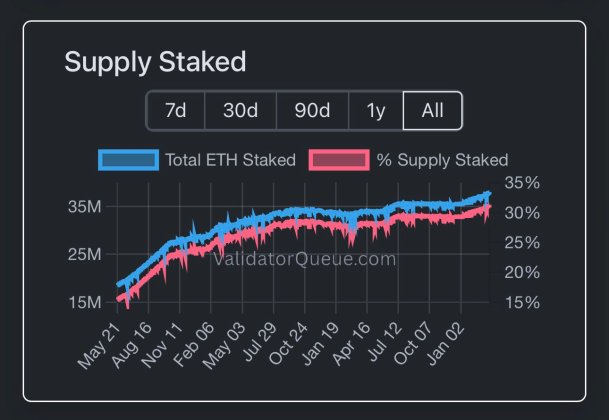
Source: Chart from BMNR Bullz on X

At the forefront of this rising demand are Bitmine Immersion Technologies and Fundstrat Capital. These large firms are actively accumulating and staking ETH, fueling the potential for a supply squeeze; a clear indication of what supply shock looks like.

It is important to note that Bitmine is currently building the largest ETH yield platform in the market, with the launch of MAVAN (the made-in-America Validator Network). With millions of ETH already staked, the company has turned the altcoin into a scalable yield business.

Bitmine ETH Buying Activity Continues

Despite the sideways price action of Ethereum, Bitmine is still doubling down on the asset, indicating its robust confidence in ETH in the long term. Lookonchain, a popular on-chain data platform, has detected several transactions from wallets linked to the company.

According to the platform, Tom Lee’s Bitmine purchased another 50,000 ETH valued at $108.3 million from FalconX in the early hours of Thursday. Within a 2-day period, about 3 wallet addresses, which are believed to be owned by Bitmine, were detected by Lookonchain, stacking up a total of 117,111 ETH worth approximately $253.3 million.

These buys come after Tom Lee’s recent bullish remarks on the asset’s outlook, whose bullish stance has fueled optimism among retail and institutional investors across the market. As these investors steadily acquire ETH, this action strengthens the narrative that the altcoin’s current bearish phase could be temporary.

ETH trading at $2,068 on the 1D chart | Source: ETHUSDT on Tradingview.com

Related Questions

QWhat percentage of the total Ethereum supply is currently locked in staking contracts according to the report?

AMore than 30% of the entire ETH supply, representing approximately 35 million ETH, is currently locked in staking contracts.

QWhich two large firms are mentioned as being at the forefront of the rising demand for Ethereum through accumulation and staking?

ABitmine Immersion Technologies and Fundstrat Capital are the two large firms at the forefront of this rising demand.

QHow much ETH did Bitmine purchase from FalconX in the early hours of Thursday, as detected by Lookonchain?

ABitmine purchased 50,000 ETH valued at $108.3 million from FalconX in the early hours of Thursday.

QWhat is the name of the Validator Network that Bitmine is building, as mentioned in the article?

ABitmine is building MAVAN, which stands for the made-in-America Validator Network.

QWhat is the primary consequence of the increasing amount of ETH being locked away through staking, as described in the article?

AThe primary consequence is the tightening of overall market liquidity, as the circulating supply of ETH is disappearing at a fast rate, potentially leading to a supply squeeze.

Related Reads

$9.4 Billion: The Largest Robotics Funding This Year Has Emerged

Munich-based humanoid robotics company Neura has completed a $1.4 billion (approximately RMB 94.9 billion) Series C funding round, valuing the company at around $7 billion and positioning it among the global leaders in the sector. The investment round is notable not just for its size—reportedly the largest in robotics this year—but also for its strategic backers, which include tech giants like NVIDIA and Amazon, alongside established industrial players such as German engineering firms Bosch and Schaeffler. This mix of investors signals a significant shift in the industry's focus from technological demonstrations and general-purpose narratives toward practical, industrial deployment and commercialization. Neura's approach centers on developing humanoid robots for defined, high-value industrial tasks rather than pursuing a general-purpose model. Its early validation comes from a partnership with BMW, where its robots are being tested on actual production lines. The involvement of Bosch and Schaeffler, companies deeply embedded in global manufacturing, underscores a growing belief that humanoid robots are transitioning from labs to viable factory-floor solutions. The article highlights two converging trends driving investment: advancements in AI and large language models, which enhance robots' perception and decision-making in unstructured environments, and mounting pressure from labor shortages and rising costs in major manufacturing regions. The funding landscape is now bifurcating between companies like Figure AI, focusing on versatile general-purpose robots, and firms like Neura, targeting specific vertical industrial applications with clearer, shorter paths to ROI. While technical hurdles remain, the core challenges for widespread adoption are increasingly seen as engineering and commercial in nature: managing the high integration and customization costs for different factory environments and establishing robust, localized maintenance and service networks. The record investment in Neura, particularly from industrial capital, indicates the industry's growing confidence in moving from proving feasibility to solving the practical problems of scalability, reliability, and building sustainable business models around humanoid robots in real-world settings like automotive manufacturing and hazardous labor environments.

marsbit10h ago

$9.4 Billion: The Largest Robotics Funding This Year Has Emerged

marsbit10h ago

Trading

Spot
Futures

Hot Articles

Discussions

Welcome to the HTX Community. Here, you can stay informed about the latest platform developments and gain access to professional market insights. Users' opinions on the price of ETH (ETH) are presented below.

活动图片














