Ethereum Derivatives See Heavy Unwind As Open Interest Falls Hard – A Leveraged Flush?

bitcoinistPublished on 2025-12-22Last updated on 2025-12-22

Abstract

Amidst a volatile market, Ethereum's price briefly reclaimed $3,000, but its derivatives market is signaling a significant shift. Open Interest (OI) has plummeted by 50% since August, indicating a massive unwind of leveraged positions and a sharp decline in trader risk appetite. This drop, observed across major exchanges like Binance (-31%), suggests robust market deleveraging and a lower probability of explosive short-term price moves. Concurrently, ETH withdrawals from exchanges have spiked to multi-year lows, reducing immediate sell pressure. While this points to a more cautious, consolidating market, such a flush of leverage has historically preceded major structural shifts.

On Sunday, the Ethereum price retested the $3,000 mark after trading below the level for the past few days due to a volatile market environment. ETH’s price may be gradually regaining upside momentum, but other aspects are still experiencing downward pressure, such as the Open Interest (OI).

Sharp Drop In Ethereum Open Interest

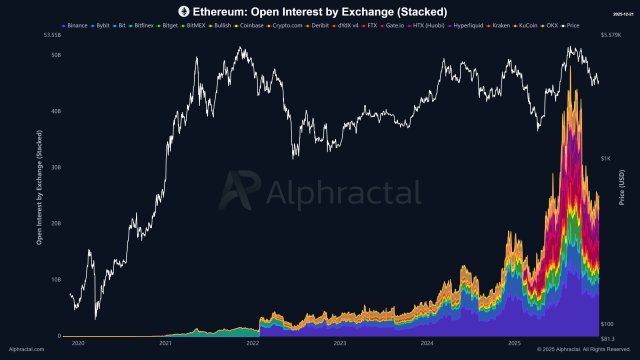
In the current volatile state of the cryptocurrency landscape, the Ethereum derivatives market is signaling a key indicator. This crucial signal is coming from the ETH Open interest, which has witnessed a significant pullback in the past few months. According to the research from the advanced investment and on-chain data analytics platform Alphractal, the metric has dropped by half or 50% since August this year.

A significant drop in this metric is a clear indication that trader positioning and risk appetite have shifted notably. Following a period of high leverage and aggressive speculation, the sharp collapse indicates that positions are being unwound, exposure is being decreased, and momentum is cooling across futures markets.

Alphractal highlighted that the Ethereum open interest is valued at roughly half of what it was in August 2025, suggesting a drastic decline in market risk. Such a move points to institutions and large whale holders who have closed leveraged ETH positions. The exiting of positions by big investors shows that they are reducing exposure and speculative pressure.
Source: Chart from Alphractal on X

ETH’s open interest has also fallen sharply on cryptocurrency exchanges. After examining the Ethereum Open Interest distribution by exchange, Alphractal unveiled a 31% decline to $7.64 billion on the world’s largest exchange, Binance.

On Gateio, open interest is at $3.72 billion, indicating a 15% decrease, while HTX (formerly known as House) has fallen by 12.65% to $3.12 million. Furthermore, Bybit has $2.53 billion with a 10.25% drop, HyperLiquid has $2.51 billion with a 10.18%, and Bitget has $1.79 billion with a 7.25% decline.

With exchanges’ open interest dropping, this tells a compelling story of the current market structure. This outlines robust deleveraging across the Ethereum market and a lower probability of explosive moves in the short term.

Typically, an atmosphere that is more cautious and protective implies stages of consolidation or preparation for the next trend leg. However, deep declines in open interest have historically frequently preceded significant structural changes, either a healthier reversal or a downward continuation with less leverage.

ETH Withdrawals From Crypto Exchanges Have Spiked

Ethereum’s open interest drop comes at a time of a massive drop in ETH supply on crypto exchanges. Currently, ETH withdrawals have reached their lowest levels since 2016, reflecting growing trader caution and dampened short-term sell pressure.

As more ETH is taken out of exchanges and placed in long-term holding locations, the liquid supply keeps decreasing. While the supply decrease bolsters ETH’s volatility, it also encourages price pressure to rise.

ETH trading at $3,048 on the 1D chart | Source: ETHUSDT on Tradingview.com

Trending Cryptos

Related Questions

QWhat has happened to Ethereum's Open Interest (OI) since August this year, according to the article?

AEthereum's Open Interest has dropped by 50% since August this year, indicating a significant unwind of leveraged positions and a decrease in market risk.

QWhich cryptocurrency exchange saw the largest decline in Ethereum Open Interest, and by how much?

ABinance, the world's largest exchange, saw the largest decline in Ethereum Open Interest, with a 31% drop to $7.64 billion.

QWhat does a sharp drop in Open Interest typically signal about trader behavior and market conditions?

AA sharp drop in Open Interest signals that traders are unwinding positions, decreasing their exposure, and reducing leverage. It indicates a shift to a more cautious and protective atmosphere, often leading to market consolidation or preparation for the next trend.

QAlongside the drop in Open Interest, what other on-chain activity suggests growing trader caution?

AAlongside the drop in Open Interest, the supply of ETH on cryptocurrency exchanges has reached its lowest level since 2016, as more ETH is being withdrawn to long-term holding locations, which dampens short-term sell pressure.

QWhat is the potential implication of a decreasing liquid supply of ETH on exchanges for its price?

AA decreasing liquid supply of ETH on exchanges reduces the available coins for immediate selling, which can bolster ETH's volatility and create upward price pressure.

Related Reads

BIS Report Compliance Observations: The True Risks of Stablecoins Go Beyond 'De-pegging'

The BIS report, "Anchoring trust in money: innovation beyond stablecoins," highlights that the primary risks of stablecoins extend beyond potential de-pegging. It argues that the core challenge is whether stablecoins can be integrated into a financial system that is identifiable, monitorable, accountable, and regulatable. While acknowledging efficiency gains like faster payments and programmability, BIS emphasizes that money requires an institutional framework—including legal certainty, liquidity support, and financial integrity controls—which many stablecoins currently lack. The report details compliance risks, noting that while blockchain transactions are transparent, address visibility does not equate to identity or purpose clarity. This creates a systemic risk as pseudonymity, non-custodial wallets, and cross-chain bridges can undermine AML/CFT controls. Furthermore, these risks can spill over into the traditional financial system through on- and off-ramps. The future direction, per BIS, is not to prohibit innovation but to embed regulatory rules—such as identity verification and transaction screening—directly into the technological infrastructure of tokenized finance. The key takeaway for compliance is that any new financial instrument must clearly address questions of customer identification, transaction monitoring, accountability, and cross-border rule consistency to be viable as a mainstream payment tool.

marsbit2h ago

BIS Report Compliance Observations: The True Risks of Stablecoins Go Beyond 'De-pegging'

marsbit2h ago

Trading

Spot

Hot Articles

What is NES

I. Project IntroductionNesa is the largest decentralized AI platform and ecosystem backed by a privacy-first AI Layer 1. Its proprietary encrypted inference technology supports a broad range of workloads and serves Fortune 500 enterprise customers in industries like retail, healthcare, and IT.II. Token InformationToken name: NES(Nesa)III. Related LinksWebsite:https://nesa.ai/Explorers:https://bscscan.com/address/0x3131f6B80C26936aB03F7d9D29Eb4Ddf36AC3FB5Twitter:https://x.com/nesaorgNote: The project introduction comes from the materials published or provided by the official project team, which is for reference only and does not constitute investment advice. HTX does not take responsibility for any resulting direct or indirect losses.

346 Total ViewsPublished 2026.06.24Updated 2026.06.24

What is NES

How to Buy NES

Welcome to HTX.com! We've made purchasing Nesa (NES) simple and convenient. Follow our step-by-step guide to embark on your crypto journey.Step 1: Create Your HTX AccountUse your email or phone number to sign up for a free account on HTX. Experience a hassle-free registration journey and unlock all features.Get My AccountStep 2: Go to Buy Crypto and Choose Your Payment MethodCredit/Debit Card: Use your Visa or Mastercard to buy Nesa (NES) instantly.Balance: Use funds from your HTX account balance to trade seamlessly.Third Parties: We've added popular payment methods such as Google Pay and Apple Pay to enhance convenience.P2P: Trade directly with other users on HTX.Over-the-Counter (OTC): We offer tailor-made services and competitive exchange rates for traders.Step 3: Store Your Nesa (NES)After purchasing your Nesa (NES), store it in your HTX account. Alternatively, you can send it elsewhere via blockchain transfer or use it to trade other cryptocurrencies.Step 4: Trade Nesa (NES)Easily trade Nesa (NES) on HTX's spot market. Simply access your account, select your trading pair, execute your trades, and monitor in real-time. We offer a user-friendly experience for both beginners and seasoned traders.

219 Total ViewsPublished 2026.06.24Updated 2026.06.24

How to Buy NES

Discussions

Welcome to the HTX Community. Here, you can stay informed about the latest platform developments and gain access to professional market insights. Users' opinions on the price of A (A) are presented below.

活动图片