Ethereum And Solana Are Topping Developer Activity Again, But Why Are Their Prices Struggling?

bitcoinistPublished on 2026-03-14Last updated on 2026-03-14

Abstract

Despite leading in crypto developer activity, Ethereum and Solana are experiencing significant price struggles. Data from Artemis shows Ethereum’s ecosystem, particularly its EVM, leads with 31,620 weekly commits, followed by Solana’s SVM with 7,056. However, both networks have seen sharp declines: Ethereum’s weekly commits dropped 54% and developer activity fell 34% over three months, while Solana saw declines of 43% and 40%, respectively. The broader crypto ecosystem has also suffered, with weekly commits plummeting from 870,900 in March last year to 217,500 in February. Analysts attribute the price weakness to an ongoing bear market. CryptoQuant’s Julio Moreno suggests Ethereum could fall to $1,500 by late 2024 if the downturn continues, citing an “adoption paradox” where network activity rises while prices fall. Market experts predict further declines, with Bitcoin potentially bottoming between September and October.

Ethereum and Solana are currently leading developer activity in the crypto space, while developer activity in the broader ecosystem declines. This comes as prices continue to struggle with the ongoing war between the U.S. and Iran, which is sparking rising oil prices.

Ethereum And Solana Lead Developer Activity Amid Broad Decline

Artemis data show that the Ethereum and Solana ecosystems are leading in developer activity amid declines in weekly commits and weekly active developers in crypto. In the Ethereum ecosystem, the Ethereum Virtual Machine (EVM) is seeing the most activity, with 31,620 weekly commits.

It is worth noting that several sectors in the Ethereum ecosystem currently rank among the top seven in developer activity. Meanwhile, the Solana ecosystem comes next, with the Solana Virtual Machine (SVM) Layer 1 and Layer 2 seeing the most activity, at 7,056 weekly commits. However, there has been a significant decline in the crypto ecosystem as a whole.

Further data from Artemis shows that weekly commits have dropped from a yearly high of around 870,900 in March last year to as low as 217,500 in February. Notably, weekly commits crashed around the time of the crypto market’s infamous ‘October 10’ crash, which led to the largest liquidation event in crypto history.
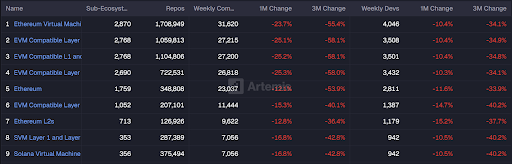
Source: Chart from Artemis

Similarly, the weekly active developers have also declined from a yearly high of 10,600 in May last year to as low as 4,000. This metric has been declining since the October 10 crypto market crash, suggesting that current price action is affecting developer sentiment. Ethereum and Solana have also seen declines in their weekly commits and developer activity despite leading in these metrics.

The Ethereum network has seen a 54% decline in weekly commits over the last three months and a 34% decline in developer activity over this same period. Meanwhile, the Solana network has seen 43% decline in weekly commits over the last three months and a 40% decline in developer activity over the same period.

Why Prices Continue To Struggle

Ethereum and Solana prices continue to struggle, as experts note that the crypto market is in a bear market. CryptoQuant’s Head of Research, Julio Moreno, recently reiterated this, stating that the bear market is still on despite the relief rally that Bitcoin saw this week, which pushed ETH and SOL higher.

Market analyst Doctor Profit recently stated that Bitcoin is likely to bottom between September and October, suggesting that Ethereum and Solana could still see larger declines. Meanwhile, Moreno told The Block that ETH could decline to $1,500 by the third quarter of this year or the early part of the fourth quarter if the bear market persists. The analyst also noted that Ethereum is facing an “adoption paradox,” with network activity rising while the ETH price falls.

ETH trading at $2,077 on the 1D chart | Source: ETHUSDT on Tradingview.com

Related Questions

QAccording to the article, which two ecosystems are leading in developer activity despite a broad decline in the crypto space?

AEthereum and Solana are leading in developer activity.

QWhat major external event is mentioned as a reason for the struggling crypto prices?

AThe ongoing war between the U.S. and Iran, which is sparking rising oil prices.

QWhat was the largest liquidation event in crypto history, as referenced in the article?

AThe 'October 10' crash.

QWhat specific 'paradox' is Ethereum facing, according to CryptoQuant's Head of Research?

AAn 'adoption paradox,' where network activity is rising while the ETH price falls.

QWhat price level did analyst Julio Moreno suggest ETH could decline to if the bear market persists?

A$1,500 by the third quarter of this year or the early part of the fourth quarter.

Related Reads

$9.4 Billion: The Largest Robotics Funding This Year Has Emerged

Munich-based humanoid robotics company Neura has completed a $1.4 billion (approximately RMB 94.9 billion) Series C funding round, valuing the company at around $7 billion and positioning it among the global leaders in the sector. The investment round is notable not just for its size—reportedly the largest in robotics this year—but also for its strategic backers, which include tech giants like NVIDIA and Amazon, alongside established industrial players such as German engineering firms Bosch and Schaeffler. This mix of investors signals a significant shift in the industry's focus from technological demonstrations and general-purpose narratives toward practical, industrial deployment and commercialization. Neura's approach centers on developing humanoid robots for defined, high-value industrial tasks rather than pursuing a general-purpose model. Its early validation comes from a partnership with BMW, where its robots are being tested on actual production lines. The involvement of Bosch and Schaeffler, companies deeply embedded in global manufacturing, underscores a growing belief that humanoid robots are transitioning from labs to viable factory-floor solutions. The article highlights two converging trends driving investment: advancements in AI and large language models, which enhance robots' perception and decision-making in unstructured environments, and mounting pressure from labor shortages and rising costs in major manufacturing regions. The funding landscape is now bifurcating between companies like Figure AI, focusing on versatile general-purpose robots, and firms like Neura, targeting specific vertical industrial applications with clearer, shorter paths to ROI. While technical hurdles remain, the core challenges for widespread adoption are increasingly seen as engineering and commercial in nature: managing the high integration and customization costs for different factory environments and establishing robust, localized maintenance and service networks. The record investment in Neura, particularly from industrial capital, indicates the industry's growing confidence in moving from proving feasibility to solving the practical problems of scalability, reliability, and building sustainable business models around humanoid robots in real-world settings like automotive manufacturing and hazardous labor environments.

marsbit13h ago

$9.4 Billion: The Largest Robotics Funding This Year Has Emerged

marsbit13h ago

Trading

Spot
Futures

Hot Articles

Discussions

Welcome to the HTX Community. Here, you can stay informed about the latest platform developments and gain access to professional market insights. Users' opinions on the price of ETH (ETH) are presented below.

活动图片