Emirates Airlines Begins Accepting Cryptocurrency for Flight Tickets

cryptonews.ruPublished on 2026-07-28Last updated on 2026-07-28

Abstract

Emirates airline has launched a service for purchasing flight tickets using cryptocurrency via Crypto.com Pay. The new payment method is available to residents of the United Arab Emirates through Emirates' official website and mobile app. Transactions are settled in UAE dirhams (AED). This initiative, stemming from a July 2025 memorandum of understanding, offers two payment methods: via the Emirates app, which redirects users to their crypto wallet for confirmation, or by scanning a QR code on the Emirates website with the Crypto.com app. The integration is facilitated through Crypto.com's Dubai unit, which holds a license from the UAE Central Bank. Emirates leadership stated the move expands customer payment options and caters to digitally savvy, younger generations. It also aligns with Dubai's Cashless Strategy, aiming to digitize 90% of all financial transactions by year-end as part of the D33 economic program. The article further notes regulatory context, referencing a framework issued in April by Dubai's Virtual Assets Regulatory Authority (VARA) that categorizes token issuance, requiring full licensing and 100% reserves for fiat-backed stablecoins.

Emirates Airlines has launched the Crypto.com Pay service for purchasing flight tickets with cryptocurrency. According to a statement from Emirates management, the new payment method is now available to residents of the United Arab Emirates on the company's official website and mobile app.

Transactions are processed in UAE dirhams (AED). This step is the practical implementation of a memorandum of understanding signed by the partners in July 2025.

Transaction Mechanics

The integration operates through the Dubai subsidiary of Crypto.com, as the first structure among Virtual Asset Service Providers (VASP) to receive a Stored Value Facilities (SVF) license from the Central Bank of the UAE.
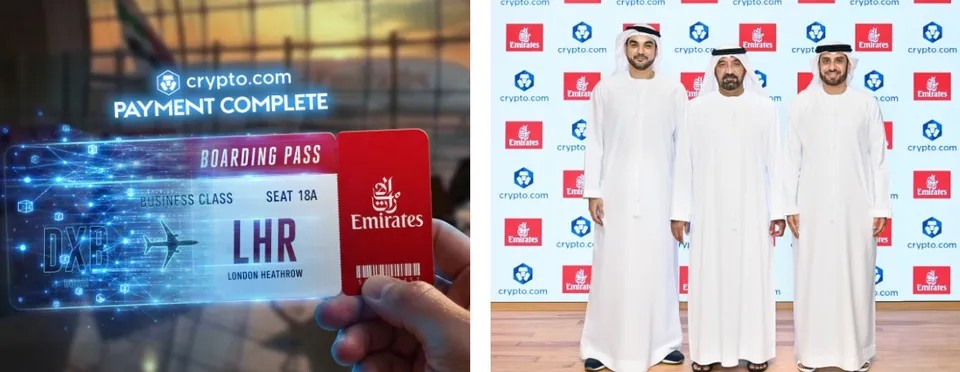
Source: Emirates.

The payment process depends on the device used:

  • Mobile devices: When booking through the Emirates app, the user selects Crypto.com Pay, is automatically redirected to the wallet app for confirmation of the debit, and returns to receive the receipt;
  • Desktop computers: The customer scans a QR code on emirates.com using the Crypto.com mobile app, confirms the transfer, and receives an e-ticket.
"The implementation of this initiative fulfills our commitment to expanding payment options for our customers' travel. It also reflects the rapidly changing preferences of a younger, digitally-savvy generation that manages their money from their phones," emphasized Adnan Kazim, Deputy President and Chief Commercial Officer of Emirates.

The introduction of the service supports the Dubai Cashless Strategy within the D33 economic program, which aims to shift 90% of all financial transactions to a digital format by the end of the year.

Related: UAE telecom giant launches pilot for integrating regulated dirham stablecoin

Regulation of Issuance

In April, the Dubai Virtual Assets Regulatory Authority (VARA) issued a roadmap regulating asset issuance.

According to VARA's guidelines, all tokens issued are divided into three categories:

  • Category 1: Fiat-referenced stablecoins (FRVA) and assets backed by physical resources or revenue (ARVA/RWA). Issuers must obtain a full VARA license and hold 100% reserves;
  • Category 2: Other virtual assets not falling into the first group. A license for issuance is not required, but sales must go through licensed distributors;
  • Excluded Assets (Exempt VAs): Non-transferable tokens and closed-loop loyalty points without a secondary market.

Related: Dubai regulator penalizes 19 crypto companies for operating without licenses

end-content

Related Questions

QWhich airline has started accepting cryptocurrency for ticket payments?

AEmirates has started accepting cryptocurrency for ticket payments.

QWhat payment service did Emirates launch to enable cryptocurrency payments?

AEmirates launched the Crypto.com Pay service to enable cryptocurrency payments.

QThrough which entities is the Crypto.com Pay transaction processing facilitated in the UAE?

ATransactions are processed through Crypto.com's Dubai subsidiary, which is licensed as a Virtual Asset Service Provider (VASP) and holds a Store of Value Funds (SVF) license from the UAE Central Bank.

QWhat is the strategic goal of Dubai's Cashless Strategy mentioned in the article?

AThe strategic goal of Dubai's Cashless Strategy, part of the D33 economic program, is to convert 90% of all financial transactions into digital format by the end of the year.

QHow did Dubai's Virtual Assets Regulatory Authority (VARA) categorize tokens in its issued roadmap?

AVARA categorized tokens into three groups: Category 1 (Fiat-Referenced Virtual Assets and Asset-Referenced Virtual Assets), Category 2 (other virtual assets not in Category 1), and Exempt Virtual Assets (non-transferable tokens and closed-loop loyalty points).

Related Reads

Luno Cuts 20% of Global Workforce as Cryptocurrency Exchange Shifts Priorities Towards Automation

Luno, a global cryptocurrency exchange owned by Digital Currency Group, is reducing its global workforce by 20% as part of a major operational restructuring driven by a downturn in retail crypto activity and increased automation. CEO James Lanigan announced the layoffs on July 28, stating it was a difficult but necessary decision to build a more sustainable structure for the long term. The company did not disclose the total number of affected employees, though South African staff are among those impacted, with formal consultations initiated there in line with local labor laws. This marks the second major round of layoffs in three and a half years, following a 35% staff reduction in January 2023. The company cites cyclical declines in retail user activity and ongoing investment in automated tools as key factors behind the restructuring, which has fundamentally changed the firm's resource needs. Concurrently, Luno is reorganizing into three unified divisions built on a single core platform: 1) a consolidated consumer and API platform serving over 16 million users in Africa and Asia-Pacific, 2) a stablecoin solutions unit focused on the zar-backed 'Zaru' stablecoin launched in February 2026, and 3) an institutional arm offering OTC services and cross-border settlement networks. This restructuring follows recent market withdrawals, with Luno discontinuing services in certain markets from September 1, 2026.

cryptonews.ru35m ago

Luno Cuts 20% of Global Workforce as Cryptocurrency Exchange Shifts Priorities Towards Automation

cryptonews.ru35m ago

Turkey blocked 47,493 illegal betting sites amid expanded measures targeting cryptocurrency accounts

Turkey has blocked access to 47,493 illegal betting websites since January 1st as part of a nationwide crackdown on online gambling operators and their payment networks. Police and gendarmerie conducted 680 operations, detaining 5,629 suspects, with 3,231 placed in pre-trial detention and 1,515 placed under judicial supervision. Cybercrime units are conducting 24/7 monitoring of illegal betting sites, social media ads, and digital payment channels. Investigators are tracking bank accounts, e-money services, and crypto asset wallets suspected of facilitating betting operations or laundering criminal proceeds. The actions follow earlier raids in May targeting over 670 suspects, with one investigation in Adana uncovering cryptocurrency platforms used for laundering betting revenues. Authorities highlighted a specific case involving a network allegedly coordinated by a suspect with initials İ.Ö.Ö., which reportedly generated revenue from illegal betting and match-fixing. Prosecutors identified seven overseas crypto wallets that received transfers from this network, estimating total transaction volume at $4 billion. All related bank and crypto accounts were frozen. The network allegedly recruited individuals to act as "common accounts" for processing bets in exchange for a 1% commission. In separate operations, authorities blocked 4,742 bank accounts and six crypto accounts in Adana, and identified transactional activity worth approximately $104 million across 47 suspects. Assets including companies, vehicles, and properties were seized. The crackdown includes real-time disruption. During the 2022 World Cup final, prosecutors identified and ordered the freezing of 6,314 bank accounts used for illegal betting, aided by an AI analysis system called AVCI. They project illegal betting volume for the 2026 World Cup could reach $50 billion. Justice Minister Yılmaz Tunç stated that 19 offshore "financial companies" managing panel systems for illegal betting sites were identified, with legal proceedings initiated against 23 suspects. He emphasized a strategic shift towards "draining the swamp" through coordinated asset seizures and digital evidence collection, rather than relying on individual prosecutions.

cryptonews.ru41m ago

Turkey blocked 47,493 illegal betting sites amid expanded measures targeting cryptocurrency accounts

cryptonews.ru41m ago

Trading

Spot
活动图片