Dogecoin Recovery: How Much Can The Leading Meme Coin Rise Again?

bitcoinistPublished on 2026-02-16Last updated on 2026-02-16

Abstract

Dogecoin has been declining, recently dropping 10% in 24 hours and trading around the $0.10-$0.11 support level. Analysts suggest this range is a key psychological battleground. According to BitGuru, if buyers support the price here, DOGE could rebound toward $0.13, $0.15, or even $0.19. Another analyst, Charting Guy, notes a significant technical signal on the weekly chart: the 20-week EMA has crossed below the 200-week EMA, a pattern that has historically marked cycle lows before major uptrends. If support holds, a recovery could target the $0.20-$0.25 range, with higher resistances near $0.30 dependent on broader market strength, particularly from Bitcoin.

Dogecoin has spent the past few weeks grinding lower, testing the patience of bullish traders. The past 24 hours, for instance, were spent with sell-offs, with the meme coin king now down by 10% in the last trading day.

Dogecoin is now perambulating around the $0.10 to $0.11 range, a level that has repeatedly acted as a psychological battleground in past cycles. Recent technical analyses shared on X suggest that this range could determine whether Dogecoin stages another rebound or drifts deeper into weakness in the coming weeks.

Bullish Phase, Liquidity Sweep, And Consolidation

Crypto analyst BitGuru recently outlined a structure that many traders may recognize from previous market cycles. According to his view, Dogecoin initially formed what he described as a bullish phase before entering a liquidity sweep and an extended consolidation period. The daily candlestick chart he shared shows price pushing higher earlier in the cycle, followed by a clear downside move that has been playing out since October 2025.

After that sweep, Dogecoin settled into a tightening channel of lower lows and lower highs, creating a prolonged correction range through late 2025 and into early 2026. The daily candlestick chart, which is shown below, highlights an important horizontal support region around $0.10, where price has recently reacted. From a technical perspective, this region acted as a bottom during the early February crash.
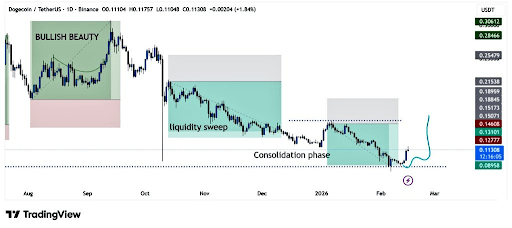
Source: Chart from BitGuru on X

According to BitGuru, if buyers were to step in here, Dogecoin could attempt a move back toward higher resistance levels around $0.13, $0.15, and $0.19. These are all short-term price levels that can be achieved within a few hours of buying pressure.

The Weekly EMA Signal That Points To Bottoms

Another category of analysis came from Charting Guy, who approached the setup from a broader, long-term angle on the weekly timeframe. He pointed to the relationship between the 20-week exponential moving average and the 200-week exponential moving average on the weekly candlestick price chart.

Dogecoin has tended to form major cycle lows around the period when the 20-week EMA crosses below the 200-week EMA. The interesting thing is that this crossover has just appeared again. Similar crossovers in previous cycles appeared towards the end of extended bearish phases before Dogecoin transitioned into multi-month uptrends.

The weekly price chart spans from 2017 through 2026, showing how previous crosses preceded strong upward expansions. This time, Dogecoin’s price dipped to around $0.09 to $0.10 as the crossover took place.

The most important thing now is how much upside is realistic if this support truly holds. Looking at the weekly structure, a recovery above the 20-week EMA could open the door to a retest of the $0.20 to $0.25 range. Above that, Dogecoin would need better market strength, particularly from Bitcoin, to challenge the higher resistance bands around $0.30 and above.

DOGE trading at $0.10 on the 1D chart | Source: DOGEUSDT on Tradingview.com

Related Questions

QAccording to the article, what is the current key price range that Dogecoin is trading in and why is it significant?

ADogecoin is currently trading in the $0.10 to $0.11 range. This level is significant because it has repeatedly acted as a psychological battleground in past cycles and is a crucial horizontal support region that could determine the coin's next major price direction.

QWhich two analysts are cited in the article and what type of analysis did each provide?

AThe two analysts cited are BitGuru and Charting Guy. BitGuru provided a technical analysis on the daily timeframe, outlining a structure involving a bullish phase, liquidity sweep, and consolidation. Charting Guy provided a long-term analysis on the weekly timeframe, focusing on the relationship between the 20-week and 200-week Exponential Moving Averages (EMAs).

QWhat specific technical event on the weekly chart does Charting Guy suggest has historically signaled a major cycle low for Dogecoin?

ACharting Guy points out that Dogecoin has historically formed major cycle lows around the period when the 20-week Exponential Moving Average (EMA) crosses below the 200-week EMA.

QBased on BitGuru's analysis, what are the three short-term resistance levels Dogecoin could attempt to reach if buying pressure increases?

AAccording to BitGuru, if buying pressure increases, Dogecoin could attempt to move toward the short-term resistance levels of $0.13, $0.15, and $0.19.

QWhat broader market factor does the article mention as necessary for Dogecoin to challenge resistance levels above $0.30?

AThe article states that for Dogecoin to challenge higher resistance bands around $0.30 and above, it would need better overall market strength, particularly from Bitcoin.

Related Reads

WeChat Agent Issues a 'Heroic Summons,' Half of the Internet Responds

WeChat AI Agent is on the horizon. The WeChat Open Platform has issued a guide for developers, offering them ways to integrate into the WeChat AI ecosystem. This will enable mini-programs to be discovered and invoked by the AI. Meituan has already announced its integration, allowing users to access services like food delivery through WeChat AI. Other platforms like Ctrip and Tongcheng have followed suit. Furthermore, WeChat is collaborating with major smartphone manufacturers to enable their native AI assistants to perform actions within WeChat, such as initiating calls or sending messages, through a controlled protocol called Agent-to-Agent (A2A). Reports indicate the WeChat AI Agent will be accessible by swiping right on the main interface. It aims to understand user intent within the rich context of chats, groups, and past interactions, then automatically call upon relevant mini-programs to complete tasks like ordering coffee or booking restaurants. This positions it as a potential "super app" with direct access to WeChat's vast ecosystem of services, social connections, and payment systems. Technically, this is a complex endeavor. It requires advanced natural language understanding, a "world model" to predict interactions within mini-programs (UI-Oceanus), multi-model orchestration for cost efficiency, and careful coordination with millions of third-party service providers. Tencent's development follows a "Co-Design" approach, where product teams and the Hunyuan model team collaborate closely, allowing capabilities honed in other AI products (like Yuanbao for chat, ima for search, WorkBuddy for office tasks) to be transferred to the WeChat Agent. Tencent is strategically opting for the A2A protocol over GUI-based automation (which it has blocked in the past), maintaining control over its ecosystem. To manage the immense scale and cost of serving 1.4 billion monthly active users, Tencent is deepening its ties with DeepSeek, known for its cost-effective training, to secure a low-cost inference backbone. The ultimate goal is to solve practical, everyday problems for users within the WeChat ecosystem, moving beyond technical benchmarks to deliver real utility, which Tencent sees as the key to winning in the long-term AI game.

marsbit33m ago

WeChat Agent Issues a 'Heroic Summons,' Half of the Internet Responds

marsbit33m ago

Humanity Loses $31 Million in Attack, Token Price Plummets 90% Due to a Single Private Key

On June 9th, the digital identity project Humanity Protocol suffered a major security breach resulting in over $31 million in losses. According to on-chain analyst Specter, hundreds of wallets holding the project's H token were drained. The attack was confirmed by founder Terence Kwok to be caused by the compromise of a foundation member's private key. As a precaution, users are advised to avoid interacting with Humanity's cross-chain bridge or liquidity pools. The incident caused the H token price to crash over 90%, from around $0.70 to a low of $0.052, wiping its market cap from $2 billion to approximately $35.7 million. The attacker allegedly minted 100 million new H tokens and is selling them for BNB. This breach adds to existing controversies surrounding Humanity Protocol. Founded in 2024, it aimed to verify human users via palm-print biometrics and zero-knowledge proofs. However, a leaked conversation in 2025 revealed that only about 1 million of its 9 million claimed Human IDs had completed biometric verification, suggesting 88% might be bots. Furthermore, the project has faced allegations of being a repackaged product from a Chinese access control vendor, raising privacy and authenticity concerns. Founder Terence Kwok's previous venture, Tink Labs, a hotel smartphone startup that raised $170 million, failed and entered bankruptcy in 2020 after burning through its funding. The current attack highlights the persistent critical issue of private key management in crypto. Unlike smart contract exploits, a private key compromise bypasses all on-chain security mechanisms. With no user compensation plan announced yet, this $31 million breach may be a final blow to the project's credibility, already weakened by previous controversies and a heavily depreciated token.

marsbit1h ago

Humanity Loses $31 Million in Attack, Token Price Plummets 90% Due to a Single Private Key

marsbit1h ago

MicroStrategy Will Not Die in This Downturn: Reflexivity, STRC Anchoring Back to Par, and the Self-Rescue Logic of "Sell Stock, Not Bitcoin"

This article analyzes the recent sharp decline in Bitcoin and MicroStrategy (MSTR), framing it as a targeted "reflexivity" attack. The trigger was MSTR using its cash reserves to buy back convertible notes, raising market concerns about a liquidity crisis. The playbook follows George Soros's principle: market expectations can shape reality. Fears that MSTR might be forced to sell BTC caused panic selling, lowering BTC's price and worsening MSTR's financial ratios, thus reinforcing the negative narrative. The author argues that MSTR's Structured Convertible (STRC), while falling in price, is a floating-rate security that will eventually return to par value (100). The price drop reflects the market demanding a higher yield due to perceived risk, but as a floating-rate instrument, its coupon can adjust, naturally pulling the price back to par over time. This is crucial for MSTR's continued ability to raise funds. The core thesis is that MSTR's best move to counter the attack is to **issue new equity (sell shares)**, not sell its Bitcoin holdings. While selling BTC would solve the immediate cash crunch, it would destroy the company's core investment thesis and premium. It would dilute the BTC per share, likely erase the market premium over its net asset value (mNAV > 1), and worsen its debt-to-asset ratio. Issuing shares while mNAV is high (e.g., 1.25x) allows MSTR to raise cash for reserves without harming shareholder value or the "perpetual accumulation" narrative. It improves the debt ratio and reassures STRC holders, breaking the negative reflexivity cycle. In conclusion, while MSTR could survive this episode even by selling BTC, doing so would fundamentally alter its investment proposition and weaken it for future cycles. The optimal, value-preserving strategy is to sell equity to rebuild reserves and maintain the long-term growth flywheel.

marsbit1h ago

MicroStrategy Will Not Die in This Downturn: Reflexivity, STRC Anchoring Back to Par, and the Self-Rescue Logic of "Sell Stock, Not Bitcoin"

marsbit1h ago

Trading

Spot
Futures

Hot Articles

Discussions

Welcome to the HTX Community. Here, you can stay informed about the latest platform developments and gain access to professional market insights. Users' opinions on the price of MEME (MEME) are presented below.

活动图片














