Dogecoin: Examining how traders can react to DOGE’s $0.08 move

ambcryptoPublished on 2026-07-03Last updated on 2026-07-03

Abstract

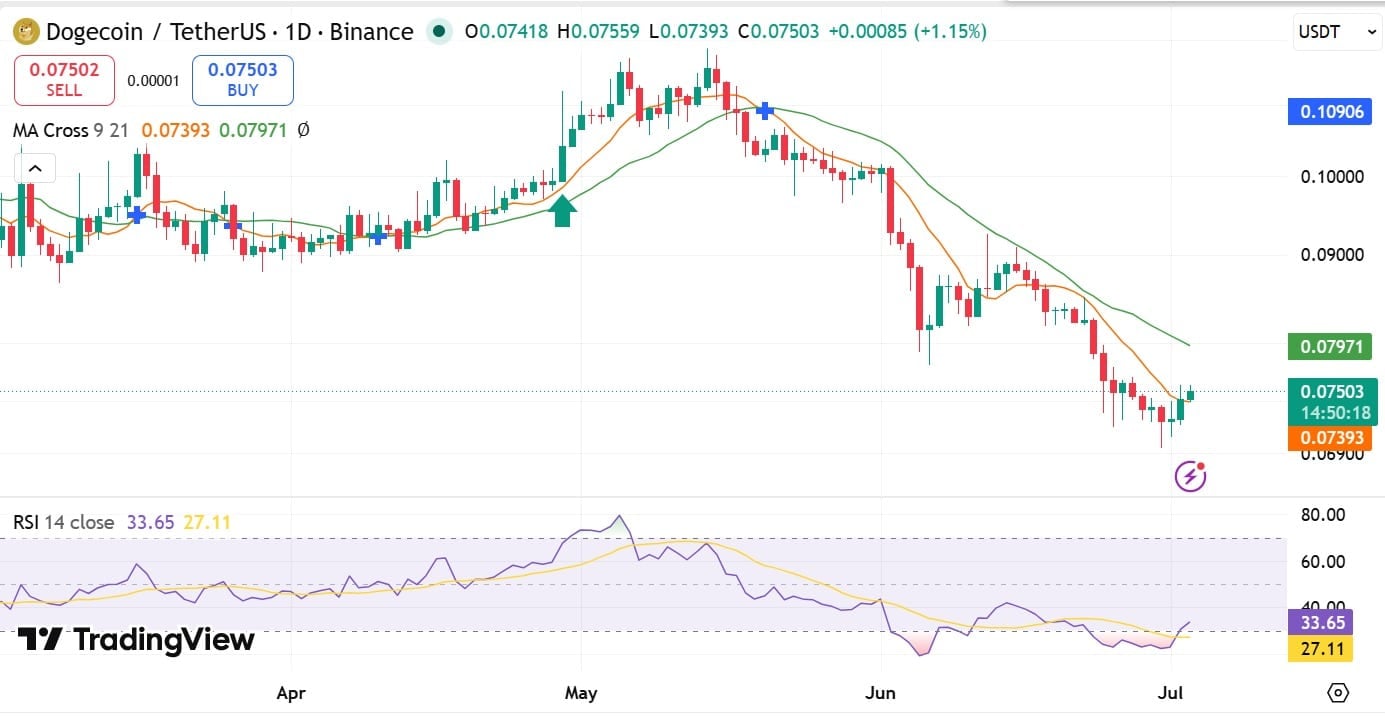
Dogecoin (DOGE) shows signs of recovery, reclaiming the $0.075 level after defending key support at $0.07 with three consecutive days of gains. Increased buying activity is evident, with spot market accumulation and a rise in futures inflows suggesting improved trader sentiment and a potential trend reversal. Key momentum indicators like the RSI have turned upward from oversold territory, and DOGE has reclaimed its 9-day moving average. For the recovery to continue, sustained buying pressure is needed to challenge resistance near $0.079 and $0.08. However, a decline in demand risks triggering futures liquidations, which could push the price back below $0.07.

Is Dogecoin’s bottom already in? Since defending the $0.07 support days ago, the memecoin has shown relative strength.

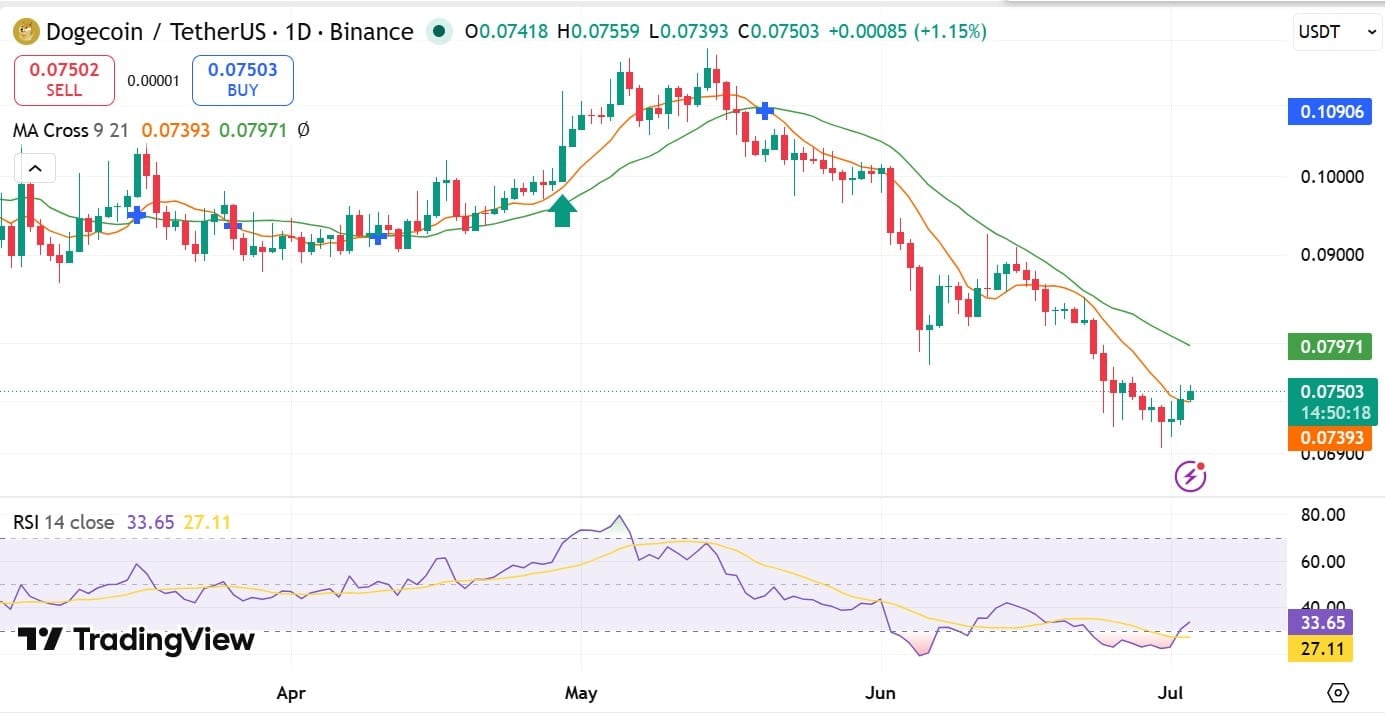
Dogecoin [DOGE] printed three consecutive green candles, closing at higher highs each day. As a result, it reclaimed the $0.075 resistance level.

At press time, DOGE traded at $0.075, up 3.85% over the past 24 hours. Spot Volume also rose 11% to $717 million.

Why are Dogecoin buyers returning?

After Dogecoin slipped below $0.07, buyers stepped back into the market. As a result, demand recovered sharply.

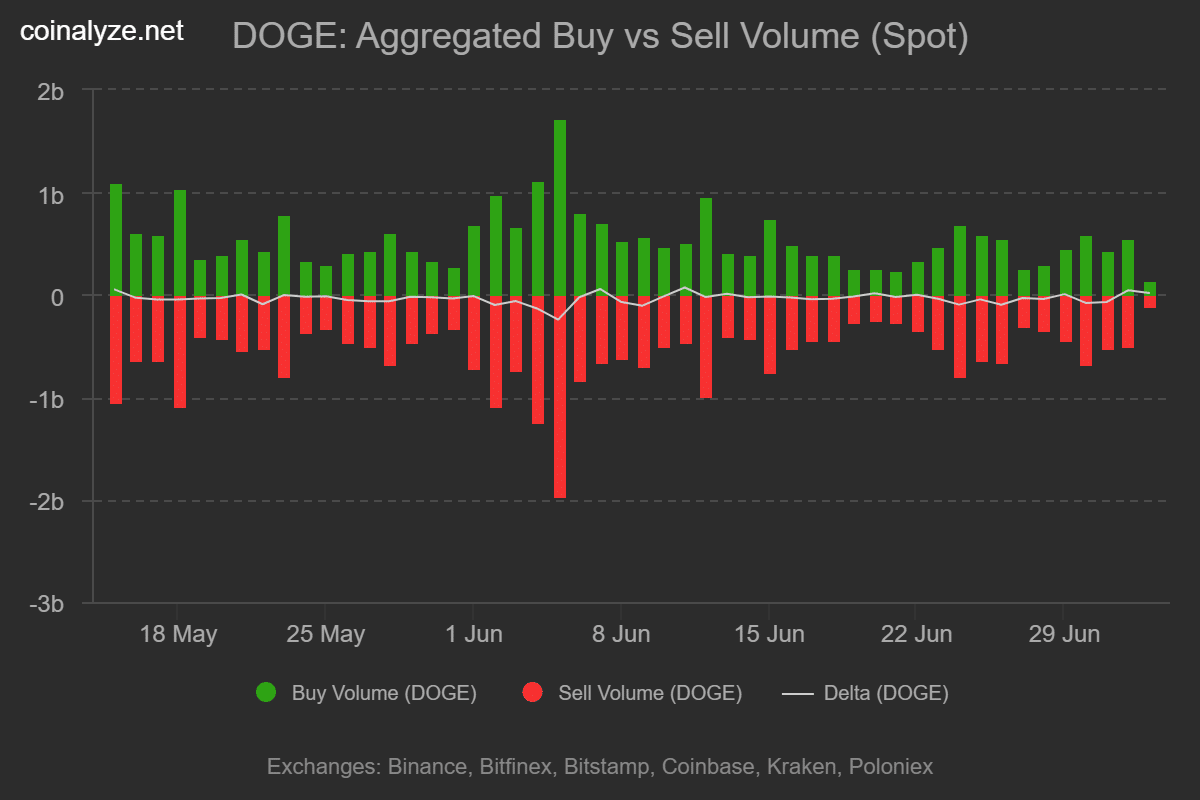
Over the past 24 hours, Buy Volume climbed to 681 million, according to Coinalyze. Sell Volume also increased to 619 million.
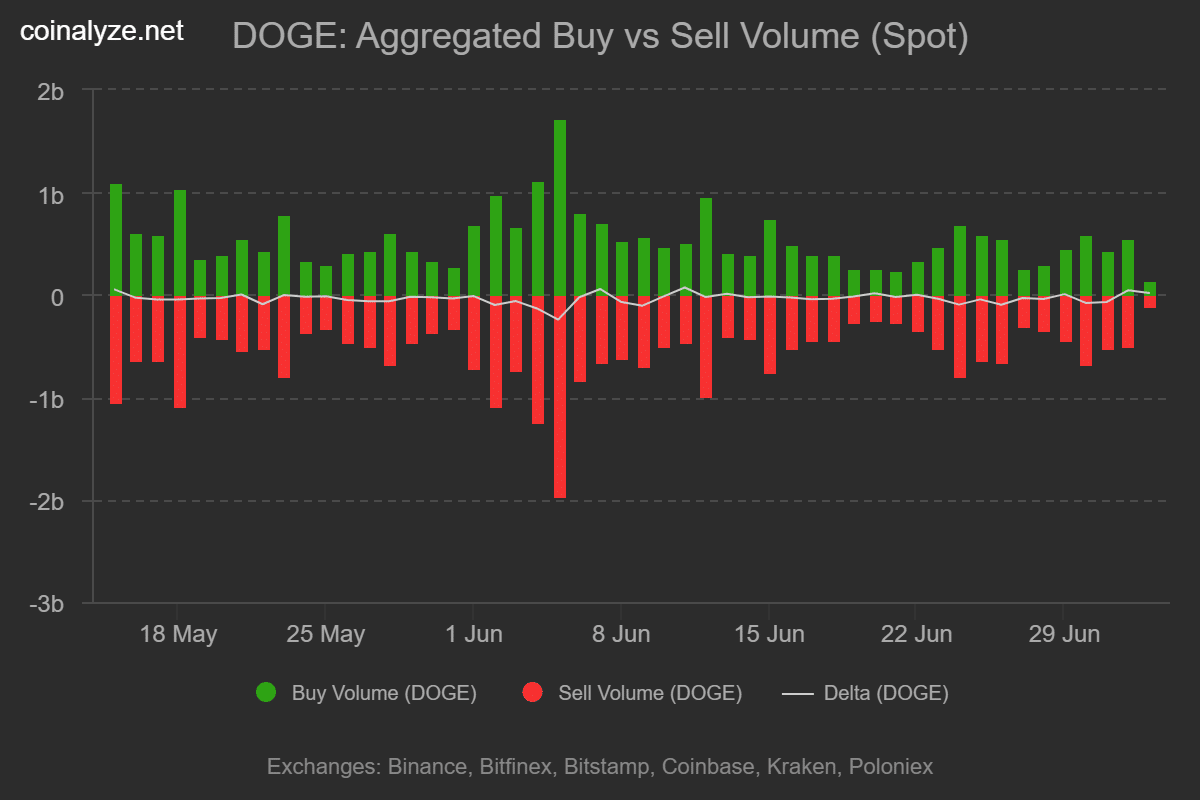
Source: Coinalyze

As a result, DOGE recorded a positive Buy/Sell Delta of 62 million, signaling aggressive Spot accumulation.

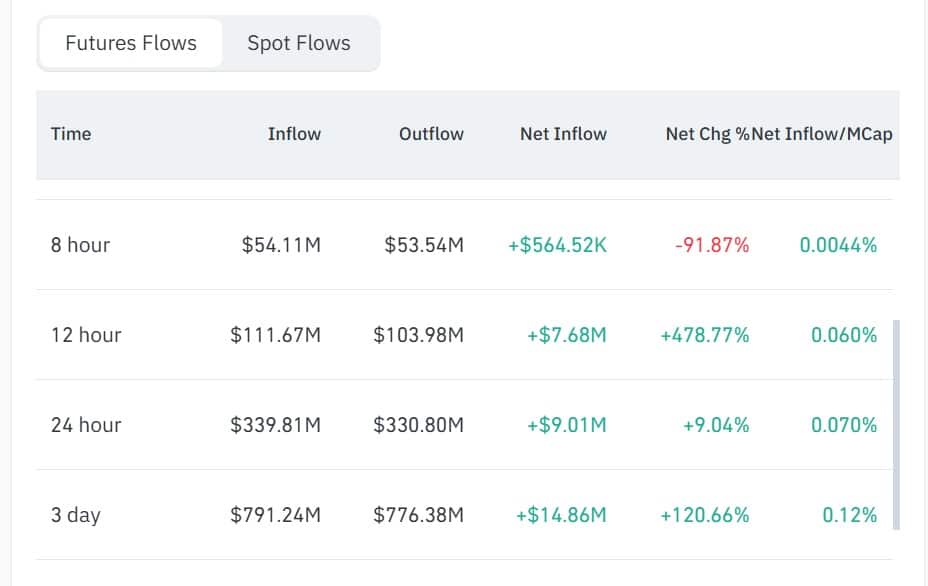
On the derivatives side, a similar trend emerged. According to CoinGlass, Futures Inflows reached $339.8 million, while Futures Outflows fell to $330.8 million.

As a result, Netflow increased 9% to $9 million. Since DOGE signaled a potential trend reversal three days ago, cumulative Futures Inflows have totaled $791 million.
Source: CoinGlass

The rise in Futures Inflows suggested traders opened more positions, regardless of direction. With buyers returning to both the Spot and Futures markets, sentiment improved. Traders now appear to view the recent low as a potential bottom.

Can the demand hold for DOGE?

Renewed demand also strengthened Dogecoin’s momentum. Relative Strength Index (RSI) reflected that shift.

The RSI formed a bullish crossover, climbed above the oversold zone, and reached 33 at press time. Although it remained below neutral, the steady rise suggested improving momentum.
Source: TradingView

Buyers have gradually regained control and attempted to overpower sellers. On top of that, DOGE reclaimed its 9-day Moving Average (MA), reinforcing short-term strength.

Together, these signals suggested market conditions had improved. If buying pressure persists, DOGE could reclaim the 21-day Moving Average at $0.079 before challenging $0.08.

However, fading demand could weaken the recovery. If leveraged positions unwind, increased Futures activity may trigger liquidations, opening the door for another move below $0.07.


Final Summary

  • DOGE reclaimed $0.075 after defending the $0.07 support, posting three consecutive daily gains.
  • A drop in demand could trigger Dogecoin’s Futures liquidations, increasing the risk of another move below the $0.07 support.


Trending Cryptos

Related Questions

QWhat recent price movement and key level did Dogecoin reclaim according to the article?

ADogecoin reclaimed the $0.075 resistance level after posting three consecutive green candles, having defended the $0.07 support days earlier.

QWhat does the positive Buy/Sell Delta of 62 million indicate for Dogecoin?

AThe positive Buy/Sell Delta of 62 million signals aggressive spot accumulation, meaning more coins were bought than sold on the spot market, reflecting strong buyer demand.

QAccording to the analysis, what are two positive technical signals suggesting Dogecoin's momentum is improving?

ATwo positive technical signals are: 1) The Relative Strength Index (RSI) formed a bullish crossover, rose from the oversold zone to 33, and is trending upward. 2) Dogecoin reclaimed its 9-day Moving Average (MA), indicating short-term strength.

QWhat are the potential next price targets for DOGE if buying pressure continues?

AIf buying pressure persists, DOGE could first reclaim the 21-day Moving Average at $0.079 before challenging the $0.08 price level.

QWhat main risk does the article highlight that could cause Dogecoin's price to drop below $0.07 again?

AThe main risk is that if demand fades, it could lead to the unwinding of leveraged positions. This increased futures activity might trigger liquidations, potentially pushing the price back below the $0.07 support level.

Related Reads

BIS Report Compliance Observations: The True Risks of Stablecoins Go Beyond 'De-pegging'

The BIS report, "Anchoring trust in money: innovation beyond stablecoins," highlights that the primary risks of stablecoins extend beyond potential de-pegging. It argues that the core challenge is whether stablecoins can be integrated into a financial system that is identifiable, monitorable, accountable, and regulatable. While acknowledging efficiency gains like faster payments and programmability, BIS emphasizes that money requires an institutional framework—including legal certainty, liquidity support, and financial integrity controls—which many stablecoins currently lack. The report details compliance risks, noting that while blockchain transactions are transparent, address visibility does not equate to identity or purpose clarity. This creates a systemic risk as pseudonymity, non-custodial wallets, and cross-chain bridges can undermine AML/CFT controls. Furthermore, these risks can spill over into the traditional financial system through on- and off-ramps. The future direction, per BIS, is not to prohibit innovation but to embed regulatory rules—such as identity verification and transaction screening—directly into the technological infrastructure of tokenized finance. The key takeaway for compliance is that any new financial instrument must clearly address questions of customer identification, transaction monitoring, accountability, and cross-border rule consistency to be viable as a mainstream payment tool.

marsbit1m ago

BIS Report Compliance Observations: The True Risks of Stablecoins Go Beyond 'De-pegging'

marsbit1m ago

When US Giants Collectively "Defect" to Chinese AI Models

When Silicon Valley Giants Turn to Chinese AI Models to Cut Costs A surprising trend is emerging: major U.S. tech companies are significantly reducing AI costs by switching to Chinese models. Coinbase, the largest U.S. cryptocurrency exchange, reportedly halved its AI spending after migrating to China's GLM-5.2 and Kimi 2.7 models, despite increasing usage. They achieved this through a sophisticated three-part strategy: implementing an automatic routing system to select the most cost-effective model per task, boosting cache hit rates from 5% to 60% to reuse computations, and employing "context engineering" to provide AI with more precise, less cluttered information. They are not alone. AI startup Lindy switched from Claude to DeepSeek, saving millions, while Snowflake's tests found GLM-5.2 solved 66% of coding tasks compared to Claude Opus's 67%—but at a fraction of the cost (output pricing is 5-7 times lower). While the top Western models may offer slightly better stability, the massive price differential is leading many businesses to reconsider their value proposition. This shift signals a deeper change in the AI industry, moving beyond pure performance benchmarks to a fierce cost competition. As pressure mounts, even OpenAI and Anthropic have begun slashing prices. For users, this means more choices, lower costs, and a crucial lesson: using multiple models based on task complexity, optimizing with caching, and keeping contexts lean are now key to leveraging AI efficiently and affordably.

marsbit8m ago

When US Giants Collectively "Defect" to Chinese AI Models

marsbit8m ago

BIS Report Compliance Watch: The Real Risks of Stablecoins Are Not Just 'De-pegging'

BIS Report Compliance Observations: The real risks of stablecoins go beyond "depegging" The BIS report "Anchoring trust in money: innovation beyond stablecoins" argues that while stablecoins and tokenization offer efficiency gains, their primary risk lies in fitting into an identifiable, monitorable, accountable, and regulatable financial system. Money's trust stems not just from technology but from institutional arrangements: a common unit of account, guaranteed redemption at par, liquidity support, regulatory frameworks, and financial integrity requirements. Stablecoins, operating on permissionless blockchains with pseudo-anonymity and non-custodial wallets, create systemic compliance gaps: unclear customer identity, incomplete fund origins, unexplained transaction purposes, fragmented cross-chain paths, and ambiguous liability. On-chain transparency does not equal compliance transparency. Public addresses don't reveal identity or intent. While blockchain analytics aid law enforcement, they cannot replace routine, large-scale AML/CFT controls. Effective compliance requires a closed-loop process encompassing customer onboarding, transaction monitoring, investigation, reporting, and audit. Stablecoin risks are not confined to the blockchain; they re-enter the traditional financial system via on/off-ramps, exchanges, and payment institutions. This forces banks to monitor client accounts for activity linked to virtual assets. The future direction is not to prohibit innovation but to embed rules into the technology. Tokenized finance should integrate with the existing two-tier monetary system, embedding compliance—like customer identification, pre-transaction screening, and auditable data trails—directly into the transaction flow. For compliance professionals, the key takeaway is that any new financial instrument must answer core questions: Who identifies the customer? Who monitors transactions? Who handles exceptions? Who is liable? Compliance is not the antithesis of innovation but the essential infrastructure for its sustainable growth.

链捕手9m ago

BIS Report Compliance Watch: The Real Risks of Stablecoins Are Not Just 'De-pegging'

链捕手9m ago

When American Giants 'Defect' to Chinese AI Models

Summary: The trend of major U.S. technology firms adopting more cost-effective Chinese AI models is gaining momentum. A prime example is Coinbase, the largest U.S. cryptocurrency exchange, which reportedly halved its AI expenditure by switching to Chinese models GLM-5.2 and Kimi 2.7, while its usage volume increased. This was achieved through a sophisticated cost-saving system featuring intelligent model routing (selecting the most suitable model per task), dramatically improving cache hit rates from 5% to 60%, and implementing "Context Engineering" to streamline prompts. This shift is not isolated. Other companies like the AI startup Lindy and data cloud firm Snowflake are making similar moves, drawn by the significant price disparity. For instance, GLM-5.2 costs $1.40/$4.40 per million tokens (input/output), compared to $5/$25 for Claude Opus 4.7. While top Western models may offer slightly higher stability or speed in complex tasks, the performance gap is narrowing, making the price difference harder to justify for many enterprise use cases. The implications are significant for both businesses and individual users. It highlights the importance of a multi-model strategy based on task requirements, the value of caching and reusing outputs, and the effectiveness of providing concise context. Ultimately, this migration signals a potential reshaping of the AI industry's pricing model, moving competition from pure performance benchmarks to practical cost-effectiveness, with increased choice and downward price pressure benefiting end-users.

链捕手16m ago

When American Giants 'Defect' to Chinese AI Models

链捕手16m ago

Trading

Spot

Hot Articles

How to Buy MOVE

Welcome to HTX.com! We've made purchasing Movement (MOVE) simple and convenient. Follow our step-by-step guide to embark on your crypto journey.Step 1: Create Your HTX AccountUse your email or phone number to sign up for a free account on HTX. Experience a hassle-free registration journey and unlock all features.Get My AccountStep 2: Go to Buy Crypto and Choose Your Payment MethodCredit/Debit Card: Use your Visa or Mastercard to buy Movement (MOVE) instantly.Balance: Use funds from your HTX account balance to trade seamlessly.Third Parties: We've added popular payment methods such as Google Pay and Apple Pay to enhance convenience.P2P: Trade directly with other users on HTX.Over-the-Counter (OTC): We offer tailor-made services and competitive exchange rates for traders.Step 3: Store Your Movement (MOVE)After purchasing your Movement (MOVE), store it in your HTX account. Alternatively, you can send it elsewhere via blockchain transfer or use it to trade other cryptocurrencies.Step 4: Trade Movement (MOVE)Easily trade Movement (MOVE) on HTX's spot market. Simply access your account, select your trading pair, execute your trades, and monitor in real-time. We offer a user-friendly experience for both beginners and seasoned traders.

4.6k Total ViewsPublished 2024.12.10Updated 2026.06.02

How to Buy MOVE

Discussions

Welcome to the HTX Community. Here, you can stay informed about the latest platform developments and gain access to professional market insights. Users' opinions on the price of MOVE (MOVE) are presented below.

活动图片