Deribit Obtains Broker-Dealer License in Dubai via Coinbase

cryptonews.ruPublished on 2026-08-18Last updated on 2026-08-18

Abstract

Deribit has secured a broker-dealer license in Dubai from the Virtual Assets Regulatory Authority (VARA), enabling its spot orders for buying, selling, and trading to be routed directly to Coinbase for execution. This integration provides Deribit's primarily professional trader base with access to Coinbase's deeper centralized order book liquidity. It also paves the way for Deribit to expand beyond its traditional Bitcoin and Ether derivatives, potentially adding hundreds of new assets. Coinbase CEO Brian Armstrong hailed the license as a sign of the UAE embracing modern finance. This marks Deribit's second VARA approval, following its 2025 headquarters establishment in Dubai. The integration follows Coinbase's completed acquisition of Deribit in August 2025 for approximately $2.9 billion, positioning Coinbase as a leader in the crypto derivatives market. The move highlights the UAE's progressive regulatory framework, which is attracting crypto firms and stands in contrast to slower developments in the US and Europe. While not affecting US operations, the deal strengthens Coinbase's "universal exchange" model and boosts its reported trading volumes.

The broker-dealer license issued to Deribit by the Dubai Virtual Assets Regulatory Authority (VARA) means that the exchange's spot orders to buy, sell, and trade are now routed directly to the Coinbase exchange for execution. This integration provides Deribit's predominantly professional trader base with access to Coinbase's centralized order book—a significantly deeper pool of liquidity than the platform had on its own.

Furthermore, it opens up possibilities for expansion far beyond Deribit's traditional domain (that is, bitcoin and ether derivatives), with the new integration expected to eventually bring hundreds of additional assets onto the platform. Client funds can remain within Deribit's own ecosystem, even when being used as collateral for derivative trading.

Coinbase co-founder and CEO Brian Armstrong called this a "significant moment for both Deribit and Coinbase," adding that the clearance demonstrates that "the UAE is truly embracing modern finance and digital assets."
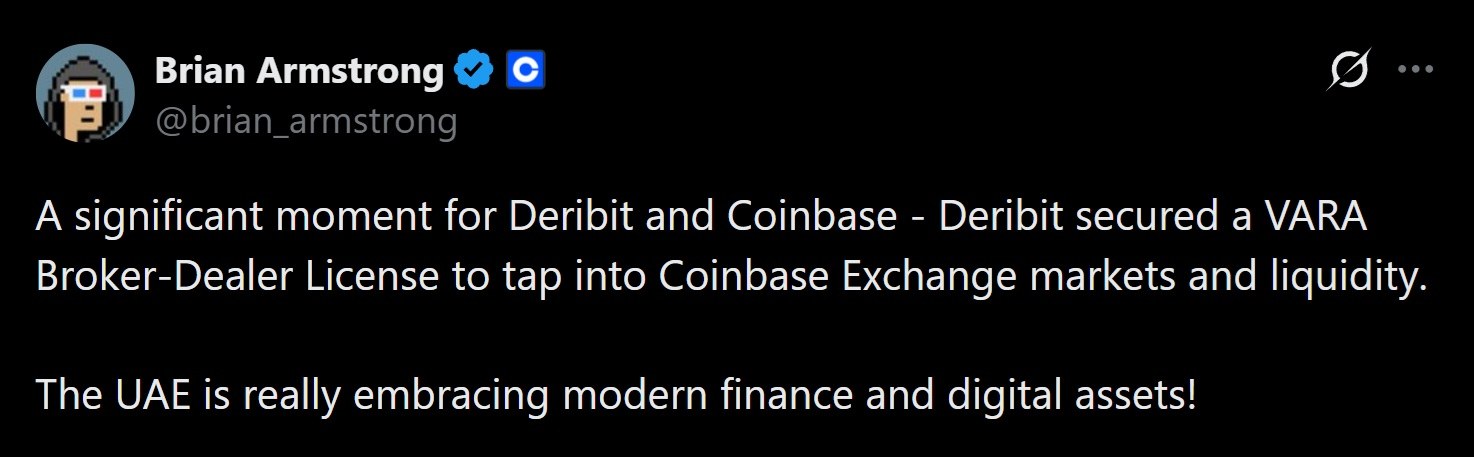
Image source: X

This marks the second clearance Deribit has received from VARA in less than two years. The exchange became the first cryptocurrency derivatives platform to receive VARA approval when it opened its global headquarters in Dubai in early 2025, and it had already been offering spot trading since January of that year under a separate VARA exchange license.

Bitcoin.com News reported on Coinbase's initial agreement to acquire Deribit for roughly $2.9 billion, a deal structured as approximately $700 million in cash plus 11 million shares of Coinbase class A common stock, and later reported that Coinbase completed the deal in August 2025, becoming the undisputed leader in the global cryptocurrency derivatives market.

At the deal's close, Deribit was seeing a monthly trading volume of $185 billion and held an open interest of roughly $60 billion—figures that made the company a clear prize in the derivatives market, which Coinbase had been trying to enter for years.

A Big Bet on the UAE

VARA's approval comes as several other exchanges are also eyeing Dubai as a testing ground for regulated cryptocurrency derivatives and spot trading, significantly outpacing the adoption of similar comprehensive regulatory frameworks in the U.S. or Europe.

For Coinbase, connecting Deribit's liquidity directly to its own order book is also a step towards the "universal exchange" model the company has been building since completing the acquisition, bringing spot trading, futures, options, and now deeper access to offshore liquidity under one roof.

However, this integration does not change how Deribit operates in the U.S. market, as the VARA license is exclusively for activity regulated in Dubai. But it clearly signals where Coinbase sees its near-term growth, which is not in obtaining new U.S. clearances—a process still moving slowly and fraught with political debate—but in accumulating regulatory wins in jurisdictions like the UAE, which have already established clear digital asset licensing frameworks.

Every additional Deribit client connected to Coinbase liquidity also bolsters Coinbase's own trading volume metrics—a figure closely watched by investors as the company reports quarterly derivatives trading volume growth alongside its more mature spot business.

Related Questions

QWhat is the significance of Deribit obtaining a broker-dealer license from Dubai's VARA?

AThe license allows Deribit's spot orders to be routed directly to Coinbase for execution, giving Deribit's user base access to Coinbase's deep centralized order book and liquidity pool.

QWhat key benefit does the Coinbase-Deribit integration provide to Deribit's clients?

AClients' funds can remain within Deribit's own ecosystem, even when being used as collateral for trading derivatives on the platform.

QHow much was the Coinbase acquisition of Deribit valued at, and what was the deal structure?

AThe acquisition was valued at approximately $2.9 billion, structured as around $700 million in cash plus 11 million shares of Coinbase's Class A common stock.

QAccording to the article, what does Dubai's regulatory advancement signal compared to the US and Europe?

AIt indicates that the UAE is significantly outpacing the US and Europe in adopting comprehensive regulatory frameworks for digital assets and embracing modern finance.

QWhy is the integration strategically important for Coinbase's business model and growth?

AIt is a step towards Coinbase's 'universal exchange' model, expands its reach into regulated offshore liquidity (like the UAE), and boosts its reported trading volume metrics, which are closely watched by investors.

Related Reads

South Korean Crypto Exchange Revenue Halved: Even the Most Profitable Business Can't Escape the Ebb of Liquidity

The revenues of South Korea's two largest cryptocurrency exchanges, Dunamu (parent company of Upbit) and Bithumb, were nearly halved in the first half of 2026. Dunamu's consolidated revenue fell 49.1% to 408.1 billion KRW, with operating profit plunging 79.7%. Bithumb's revenue dropped 48.7% to 168.8 billion KRW, turning from a net profit to a net loss of 108.7 billion KRW. The synchronized revenue crash is attributed to a 49.5% year-over-year decline in trading volume across South Korea's five licensed KRW exchanges. Both companies remain heavily reliant on transaction fees (Upbit 97%, Bithumb nearly 100%), making them highly vulnerable to market cycles. Their profitability diverged due to differences in cost control and one-time factors like asset impairment losses for Bithumb. A key driver of the trading slump is a shift in Korean retail capital from cryptocurrencies to AI and semiconductor stocks like Samsung Electronics and SK Hynix. Additionally, the upcoming 22% capital gains tax on crypto assets effective 2027 may be dampening investor sentiment. Despite the downturn, both firms are pursuing IPOs. Dunamu is collaborating with Naver Financial, aiming to diversify beyond trading and transform into a broader fintech platform. Bithumb, with its three-phase IPO roadmap targeting 2028, faces significant valuation pressure due to its current losses and low single-digit operating margin. The financials underscore a fundamental question: are crypto exchanges cyclical brokerages or stable infrastructure platforms? Their extreme profit volatility—Dunamu's operating margin collapsed from 88% in 2021 to 14% in Q2 2026—mirrors traditional finance's boom-and-bust cycles. The core challenge for their public listings is convincing investors that their business models can withstand the next market downturn without catastrophic profit erosion.

marsbit18m ago

South Korean Crypto Exchange Revenue Halved: Even the Most Profitable Business Can't Escape the Ebb of Liquidity

marsbit18m ago

Trading

Spot
活动图片