Crypto Treasury Firms Face $15B Selling Pressure From MSCI Decision

bitcoinistОпубліковано о 2025-12-19Востаннє оновлено о 2025-12-19

Анотація

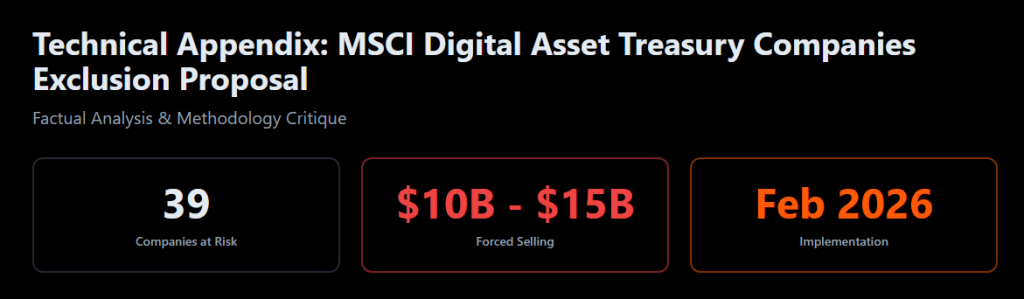
Analysts estimate that passive funds could pull between $10 billion and $15 billion from companies holding significant crypto assets if MSCI proceeds with a proposed rule change. The index provider is reviewing a policy to exclude firms holding over 50% of their assets in digital currencies from its benchmarks, a decision expected by January 2026. If enacted, index-tracking funds would be forced to sell shares of affected companies. JPMorgan analysis singles out MicroStrategy as the most impacted, potentially facing $2.8 billion in outflows. Beyond stock sales, there is a risk the companies themselves might liquidate crypto holdings, adding direct selling pressure to both equity and crypto markets. Industry groups are pushing back against the proposal, arguing for an operations-based classification instead.

Analysts have calculated that passive funds could pull as much as $11.6 billion from companies that treat large crypto holdings as corporate treasuries if MSCI removes them from its indexes, a move that would force index-tracking vehicles to sell shares.

Reports say that number comes from adding direct MSCI-tracked outflows to possible follow-on selling by other index providers.

Estimated Outflows Range

The figure sits inside a wider band of estimates. Some analysts and press pieces put the possible damage anywhere between $10 billion and $15 billion, depending on whether other major index providers copy MSCI’s decision and how much passive money is forced to move.

The analysis that produced these numbers looked at roughly 39 listed companies that meet MSCI’s proposed definition of a digital-asset treasury firm.

BTCUSD now trading at $87,105. Chart: TradingView

MSCI’s Proposal And The Mechanics

According to MSCI’s own consultation documents, the index provider is reviewing a rule that would treat companies holding more than 50% of their assets in digital assets as non-constituents of its broad equity indexes.

MSCI extended the consultation through December and said it expects to announce conclusions by January 15, 2026, with any changes applied in the February 2026 index review. If a firm is removed, funds that track MSCI benchmarks typically must reduce or sell their stakes automatically.

Strategy Stands Out

JPMorgan’s work has been singled out in multiple reports. According to that note, Strategy alone could face about $2.8 billion in passive outflows if removed from MSCI indexes, and larger losses if other index families follow.

Analysts say Strategy’s unique position — with a very high share of its balance sheet in Bitcoin — makes it the single biggest driver of the total outflow math.

Risk To Crypto Holdings

Some sectors warn that, beyond stock selling, the companies themselves might liquidate crypto positions to meet margin or liquidity needs, which could push crypto asset sales toward a figure as high as $15 billion in the worst scenarios. That would add direct selling pressure to both the equities and crypto markets.
Source: Bitcoin for Corporations

Industry Pushback

Based on reports, a group named Bitcoin For Corporations, along with several affected firms, pushed back, saying the MSCI test relies on a single balance-sheet threshold that doesn’t reflect how these companies actually operate.

The campaign has drawn public comments and petitions; several reports put the signature count at about 1,200 to 1,300. Companies have filed feedback with MSCI and have argued for an operations-based classification instead of a holdings-based cut-off.

Featured image from Unsplash, chart from TradingView

Пов'язані питання

QWhat is the estimated amount of selling pressure that crypto treasury firms could face due to MSCI's proposed rule change?

AAnalysts estimate that crypto treasury firms could face selling pressure ranging from $10 billion to $15 billion.

QWhat is the specific threshold in MSCI's proposal that would cause a company to be excluded from its indexes?

AMSCI's proposal would treat companies holding more than 50% of their assets in digital assets as non-constituents of its broad equity indexes.

QWhich company is singled out as the single biggest driver of the total outflow math and why?

AMicroStrategy is singled out as the biggest driver due to its unique position with a very high share of its balance sheet in Bitcoin, potentially facing about $2.8 billion in passive outflows.

QBeyond stock selling, what additional risk to the crypto market is highlighted in the article?

AThe article warns that the companies themselves might be forced to liquidate their crypto positions to meet margin or liquidity needs, which could add direct selling pressure to the crypto market.

QWhat is the main argument made by the industry group 'Bitcoin For Corporations' against MSCI's proposal?

AThe group argues that the MSCI test relies on a single balance-sheet threshold that doesn't reflect how these companies actually operate, and they have advocated for an operations-based classification instead.

Пов'язані матеріали

More and More 'Model Supermarkets' Are Opening: ByteDance, Alibaba, and Tencent Compete to Integrate

Chinese tech giants like ByteDance, Alibaba, and Tencent are accelerating the rollout of integrated AI model subscription services—dubbed “model supermarkets”—to provide developers with bundled access to multiple leading domestic large language models (LLMs). ByteDance’s Volcengine recently upgraded its "Coding Plan" by adding newer models like GLM-5.1, Minimax M2.7, and Kimi k2.6, allowing subscribers to use various top models under a single monthly fee starting at ¥40. However, user feedback reveals significant issues, including rapid consumption of usage limits (e.g., hitting caps within hours), frequent server errors (like HTTP 429), and slow response times during peak hours. Complaints about misleading deduction rates—where calls to advanced models consume more quota—are also common. The trend is industry-wide: Alibaba, Tencent, and Baidu have all launched similar multi-model coding plans. While these platforms reduce trial costs for developers, they also expose challenges in balancing affordability with service quality and computational stability. Amid this shift, independent AI companies like Zhipu, MiniMax, and Moonlight Face (Kimi) are developing strategies to avoid becoming mere “pipes” in this ecosystem—focusing on vertical applications, autonomous agents, and long-context models to retain competitiveness. Analysts suggest that, while platform aggregation may pressure model firms in the short term, specialized and vertical AI capabilities will remain differentiated in the long run.

marsbit1 хв тому

More and More 'Model Supermarkets' Are Opening: ByteDance, Alibaba, and Tencent Compete to Integrate

marsbit1 хв тому

Торгівля

Спот
Ф'ючерси
活动图片