Crypto Stablecoin Liquidity Shifts As Bear Market Deepens – What The Data Reveal

bitcoinistPublished on 2026-02-18Last updated on 2026-02-18

Abstract

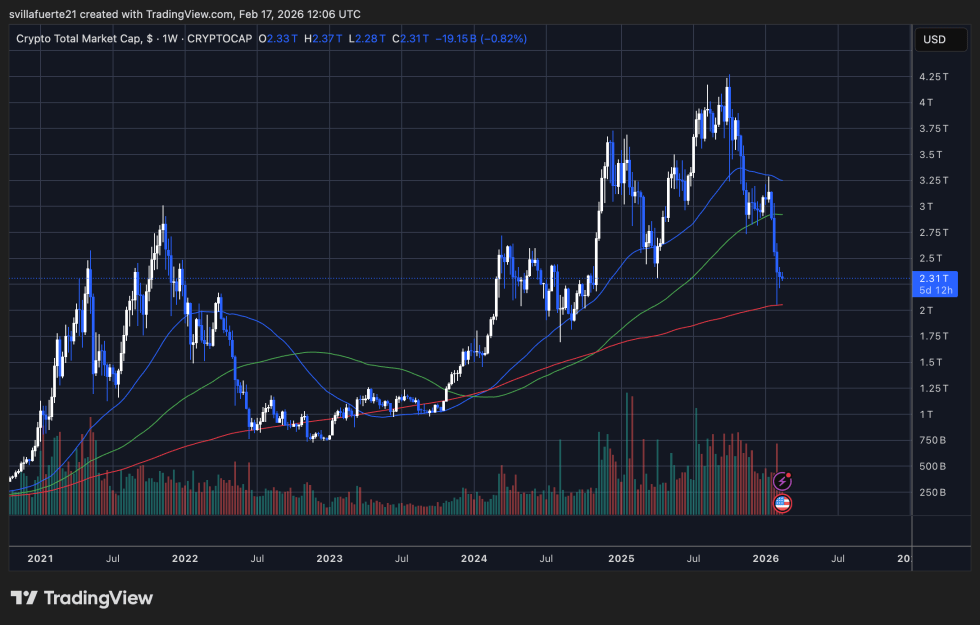
The crypto market faces intense selling pressure as Bitcoin and Ethereum struggle to reclaim key levels, with on-chain data revealing significant shifts in stablecoin liquidity. Stablecoin reserves grew by $11.4 billion in the 30 days before November 5, 2025, but fell $8.4 billion by December 23 as bearish conditions intensified. Outflows have recently slowed to about $2 billion, suggesting potential stabilization, though recovery remains uncertain. Binance dominates stablecoin liquidity, holding $47.5 billion in USDT and USDC—a 31% annual increase—accounting for 65% of all exchange reserves. USDT represents $42.3 billion of Binance’s holdings, while USDC reserves remain flat at $5.2 billion. Other exchanges like OKX ($9.5 billion) and Coinbase ($5.9 billion) lag significantly. The total crypto market cap has retraced from late-2025 peaks near $4 trillion, testing support around $2.3 trillion. Trend indicators show a shift from expansion to consolidation, with subdued buying pressure and elevated selling volume indicating ongoing distribution. The broader uptrend depends on holding long-term support, with a breakdown risking a deeper correction.

Trusted Editorial content, reviewed by leading industry experts and seasoned editors. Ad Disclosure

The crypto market continues to face intense selling pressure as both Bitcoin and Ethereum struggle to reclaim key psychological levels. Repeated rejection near resistance zones has reinforced cautious sentiment across the sector, with investors increasingly defensive after months of declining liquidity and volatile price action. While corrective phases are typical following strong bull market advances, the persistence of downside pressure suggests a more prolonged adjustment period may be unfolding.

On-chain data provides additional context for this shift in market dynamics. According to recent analysis, stablecoin reserve growth peaked shortly before the late-2025 price decline. In the 30 days leading up to November 5, reserves expanded by approximately $11.4 billion, reflecting strong liquidity availability and risk appetite at the time. However, this trend reversed quickly as market conditions deteriorated, with reserves falling roughly $8.4 billion by December 23 as the bear phase began to take shape.

More recently, the pace of outflows has moderated, with reserves declining by about $2 billion over the past month. This slowdown may indicate stabilization in liquidity conditions, though it does not yet confirm a sustained recovery. For now, the market remains sensitive to macro conditions, capital flows, and investor confidence.
Stablecoin Liquidity Concentration Highlights Binance’s Dominant Market Role

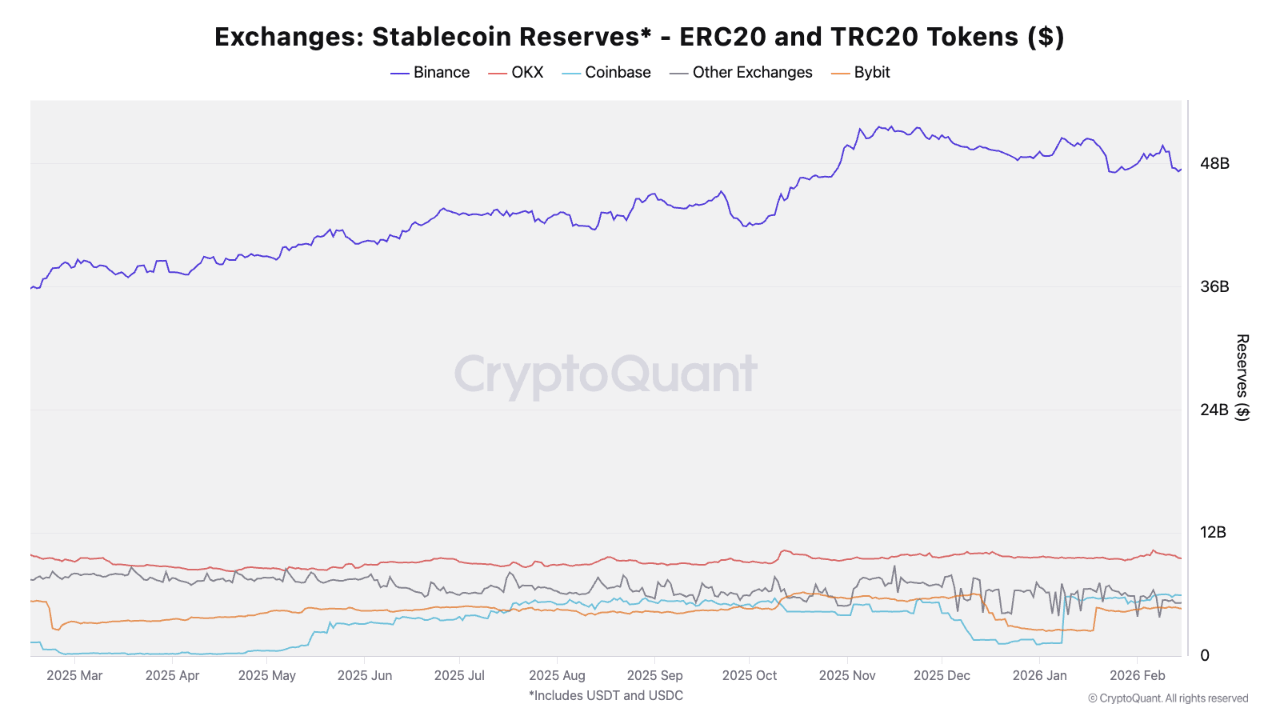
The data further shows that stablecoin liquidity remains heavily concentrated on Binance, reinforcing its role as the primary hub for crypto market liquidity. Current figures indicate the exchange holds roughly $47.5 billion in combined USDT and USDC reserves, marking a 31% year-over-year increase from about $35.9 billion. This concentration is significant, as Binance alone accounts for approximately 65% of all USDT and USDC held across centralized exchanges, highlighting its dominant position in facilitating trading flows and liquidity provisioning.
Crypto Exchanges Stablecoin Reserves | Source: CryptoQuant

Other major exchanges lag considerably behind in stablecoin reserves. OKX holds around $9.5 billion, representing roughly a 13% share, while Coinbase maintains approximately $5.9 billion, or about 8%. Bybit follows with close to $4 billion, equivalent to roughly 6% of exchange stablecoin liquidity. These balances are distributed mainly across Ethereum and TRON networks, which continue to serve as the primary infrastructure layers for stablecoin settlement.

Within Binance itself, liquidity remains overwhelmingly USDT-driven. About $42.3 billion of its reserves are held in USDT, reflecting a 36% year-over-year increase from approximately $31 billion. In contrast, USDC reserves stand near $5.2 billion and have remained broadly flat over the same period, suggesting stable but limited growth compared with USDT dominance.

Editorial Process for bitcoinist is centered on delivering thoroughly researched, accurate, and unbiased content. We uphold strict sourcing standards, and each page undergoes diligent review by our team of top technology experts and seasoned editors. This process ensures the integrity, relevance, and value of our content for our readers.

Sebastian Villafuerte

Follow

Sebastian's journey into the world of crypto began four years ago, driven by a fascination with the potential of blockchain technology to revolutionize financial systems. His initial exploration focused on understanding the intricacies of various crypto projects, particularly those focused on building innovative financial solutions. Through countless hours of research and learning, Sebastian developed a deep understanding of the underlying technologies, market dynamics, and potential applications of cryptocurrencies. As his knowledge grew, Sebastian felt compelled to share his insights with others. He began actively contributing to online discussions on platforms like X and LinkedIn, focusing on fintech and crypto-related content. His goal was to expose valuable trends and insights to a wider audience, fostering a deeper understanding of the rapidly evolving crypto landscape. Sebastian's contributions quickly gained recognition, and he became a trusted voice in the online crypto community. To further enhance his expertise, Sebastian pursued a UC Berkeley Fintech: Frameworks, Applications, and Strategies certification. This rigorous program equipped him with valuable skills and knowledge regarding Financial Technology, bridging the gap between traditional finance (TradFi) and decentralized finance (DeFi). The certification deepened his understanding of the broader financial landscape and its intersection with blockchain technology. Sebastian's passion for finance and writing is evident in his work. He enjoys delving into financial research, analyzing market trends, and exploring the latest developments in the crypto space. In his spare time, Sebastian can often be found immersed in charts, studying 10-K forms, or engaging in thought-provoking discussions about the future of finance. Sebastian's journey as a crypto analyst and investor has been marked by a relentless pursuit of knowledge and a dedication to sharing his insights. His ability to navigate the complex world of crypto, combined with his passion for financial research and communication, makes him a valuable asset to the industry. As the crypto landscape continues to evolve, Sebastian remains at the forefront, providing valuable insights and contributing to the growth of this revolutionary technology.

Full Profile

Related Posts

CFTC Chair Says Crypto Market Structure Bill Nears Final Approval

Why Kraken Is Backing Wyoming ‘Trump Accounts’, A Crypto Policy Gamble?

Polygon supera a Ethereum en tarifas diarias: la señal definitiva del auge de las L2

Zashi Becomes Zodl: Zcash Wallet Rebrands Following Internal Split

Kraken Backs Trump Accounts, Points To Shared Crypto Vision

Crypto And The 2026 Elections: By The Numbers And What Lies Ahead

Related Questions

QWhat does the data reveal about the shift in stablecoin reserves leading up to and during the crypto bear market?

AThe data shows that stablecoin reserve growth peaked shortly before the late-2025 price decline, expanding by approximately $11.4 billion in the 30 days leading up to November 5. However, this trend reversed as the bear market took hold, with reserves falling roughly $8.4 billion by December 23. More recently, the pace of outflows has moderated, declining by about $2 billion over the past month, which may indicate a stabilization in liquidity conditions.

QWhich exchange holds the dominant share of stablecoin liquidity, and what are the specific figures?

ABinance holds the dominant share of stablecoin liquidity, with approximately $47.5 billion in combined USDT and USDC reserves. This represents a 31% year-over-year increase and accounts for roughly 65% of all USDT and USDC held across centralized exchanges.

QHow does the distribution of stablecoin reserves on Binance compare between USDT and USDC?

AOn Binance, liquidity is overwhelmingly dominated by USDT. About $42.3 billion of its reserves are held in USDT, reflecting a 36% year-over-year increase. In contrast, USDC reserves stand near $5.2 billion and have remained broadly flat over the same period.

QWhat is the current state of the total crypto market capitalization and its key support level?

AThe total crypto market capitalization has retraced significantly from its late-2025 peak near $4 trillion and has recently stabilized around the $2.3 trillion level. This area is functioning as an interim key support zone, though price action remains fragile with reduced upside momentum.

QWhat do the volume dynamics during the market decline indicate about investor behavior?

AThe volume dynamics indicate that elevated selling volume accompanied the most recent decline, which suggests active distribution by sellers rather than a passive price drift. However, the subsequent moderation in volume hints that panic selling may be easing, even though conviction buying has not yet returned decisively.

Related Reads

ZEC Co-Founder Responds to Orchard Vulnerability: No Signs of Theft, Orchard Pool to Be Sealed

ZEC Co-Founder Addresses Orchard Vulnerability: No Signs of Theft, Plans to Sunset Orchard Pool A security vulnerability was recently discovered in Zcash's Orchard shielded pool, raising key concerns. The primary questions are whether the flaw was exploited, if user funds are safe, whether users can verify the total ZEC supply, and if other similar vulnerabilities exist. Analysis suggests the vulnerability was likely not exploited prior to its discovery. It was found proactively by a researcher using specialized tools, not due to an active breach. The development team and mining pools acted quickly to contain the issue. Typical financially-motivated attacks would likely have left visible on-chain evidence, which has not been observed. User funds in Orchard are considered safe and should be recoverable, assuming no prior exploitation. If the flaw was never used, all legitimate funds can be withdrawn. The article outlines risks associated with moving funds to transparent addresses or other pools, but concludes that leaving assets in place is a reasonable option. Currently, users cannot independently verify that the total ZEC supply hasn't been inflated due to this bug. However, the planned Ironwood network upgrade is designed to resolve this. It will permanently close the Orchard pool to new deposits and internal transfers, allowing only withdrawals. This mechanism will cap total withdrawals at the amount of legitimately deposited funds, enabling anyone to cryptographically verify the supply post-upgrade. Multiple teams, including Shielded Labs, have conducted extensive audits focused on counterfeiting vulnerabilities, assisted by advanced AI tools. No additional flaws of this type have been found so far, increasing confidence that no other similar undisclosed vulnerabilities exist. In summary, evidence indicates the Orchard bug was probably not used, user funds are secure, and no other counterfeiting flaws are currently known. The upcoming Ironwood upgrade will restore users' ability to independently verify the total ZEC supply, closing this chapter.

Foresight News5m ago

ZEC Co-Founder Responds to Orchard Vulnerability: No Signs of Theft, Orchard Pool to Be Sealed

Foresight News5m ago

Microsoft Announces Commercial-Grade Quantum Computer to be Completed in Three Years: Will the Boots Land?

Microsoft announces plans to build a commercially viable quantum computer by 2029, a significant acceleration from the previous industry consensus of a decade. The breakthrough is fueled by their new Majorana 2 quantum chip, which boasts a record-breaking average qubit lifetime of 20 seconds—a 1,000-fold reliability improvement over its predecessor. This leap was achieved by leveraging topological qubits, a theoretically more stable technology using Majorana zero modes, and switching the core superconducting material from aluminum to lead. Crucially, Microsoft's "Discovery" agentic AI platform accelerated the R&D process. AI agents autonomously analyzed vast experimental data, optimized manufacturing parameters (like the lead alloy composition), and solved issues like "ghost noise," dramatically speeding up experimentation. While the 20-second coherence time is a landmark, challenges remain: scaling from 12 qubits to the millions needed for practical applications, managing compilation costs, and verifying quantum results. Skeptics call for peer-reviewed data, and questions persist about whether even 20 seconds is sufficient for complex algorithms like breaking RSA encryption. The race is on with other approaches (superconducting, trapped ions), but Microsoft's confidence in its topological roadmap signals a potential shortcut to a scalable quantum future.

marsbit24m ago

Microsoft Announces Commercial-Grade Quantum Computer to be Completed in Three Years: Will the Boots Land?

marsbit24m ago

Is There Really a "World Cup Curse" in the Market?

Is there really a "World Cup Curse" affecting markets? Historical data shows global equity markets often underperform during the tournament. The S&P 500 has averaged negative returns of -1.5% to -2.11% across 19 World Cups since 1950, with declines in 58% of events. China's Shanghai Composite fell in 71% of tournaments since 1994. Studies confirm reduced trading activity during matches, with volumes dropping significantly, especially when a home nation plays. A team's loss can also lead to negative sentiment and selling pressure in its domestic market the next day. However, the "curse" may be partly attributed to seasonal weakness. Many tournaments are held in June-July, a historically weaker period for stocks ("Sell in May and go away"). The 2022 Qatar World Cup, held in November-December, saw a smaller drop in trading volume compared to summer events, suggesting timing plays a role. The cryptocurrency market's performance during World Cups has been mixed and largely driven by its own major catalysts (e.g., Mt. Gox hack, FTX collapse, halving cycles) rather than the tournament. Investment opportunities have shifted over time. Traditional beneficiaries like TV manufacturers have seen fading returns as streaming platforms become the core viewing channel. Classic consumer plays like beer and sportswear face challenges from changing consumption trends. Newer digital assets, like fractionalized collectible player cards on blockchain, have seen explosive growth. While gambling is a traditional sector, prediction markets are emerging. In conclusion, while a statistical correlation exists, the World Cup's direct impact on markets is likely limited and intertwined with seasonal patterns. With lower liquidity during the event, the simplest strategy for many might be to step back from trading and enjoy the games.

marsbit31m ago

Is There Really a "World Cup Curse" in the Market?

marsbit31m ago

Trading

Spot
Futures
活动图片