Crypto Giant Bitmain Faces Scrutiny As US Senator Flags Trump Family Ties

bitcoinistPublished on 2026-03-29Last updated on 2026-03-29

Abstract

A federal investigation into Chinese bitcoin mining hardware manufacturer Bitmain is facing scrutiny from US Senator Elizabeth Warren. The probe, known as "Operation Red Sunset" and led by the Department of Homeland Security, is examining whether Bitmain's mining rigs could be remotely manipulated for espionage or to disrupt the US power grid. Senator Warren has written to the Commerce Secretary, demanding internal documents and communications related to the investigation. She is seeking to understand what actions have been taken to address these potential national security concerns and whether business ties to the Trump family have influenced any decisions. This follows reports that a company co-founded by Eric Trump and Donald Trump Jr. signed a $314 million contract to acquire thousands of Bitmain machines in 2025.

A federal investigation into Chinese hardware maker Bitmain sits unresolved, its outcome unknown to the public. That uncertainty is now drawing fire from Capitol Hill — and putting US President Donald Trump’s family in the middle of it.

Security Probe Stretches Back To Biden White House

Senator Elizabeth Warren wrote to Commerce Secretary Howard Lutnick Thursday, asking for internal documents and communications tied to Bitmain Technologies, the Beijing-based company that makes a dominant share of the world’s bitcoin mining machines.

According to Bloomberg, which first reported the letter, Warren wants to know what the department has done to address what she called “potential national security concerns” — and whether business ties to the Trump family have shaped any of those decisions.

Bitcoin is now trading at $66,507. Chart: TradingView

The federal probe Warren is pressing on is reportedly known as “Operation Red Sunset,” though details about the investigation have not been publicly disclosed. Led by the Department of Homeland Security, it examined whether Bitmain’s ASIC mining rigs could be remotely manipulated for espionage or used to knock out parts of the US power grid.

The investigation was launched under the Biden administration and carried into the opening months of Trump’s current term. Based on Bloomberg’s November 2025 reporting, its status remains unresolved.

The security questions around Bitmain did not start with Operation Red Sunset. A Senate Intelligence Committee report from July 2025 concluded that Bitmain hardware “can be forced by the PRC to turn over data” under China’s national security law.

A year earlier, a federal review ordered the divestment of a mining operation near Wyoming’s Francis E. Warren Air Force Base over what officials described as significant national security concerns tied to foreign-made equipment.
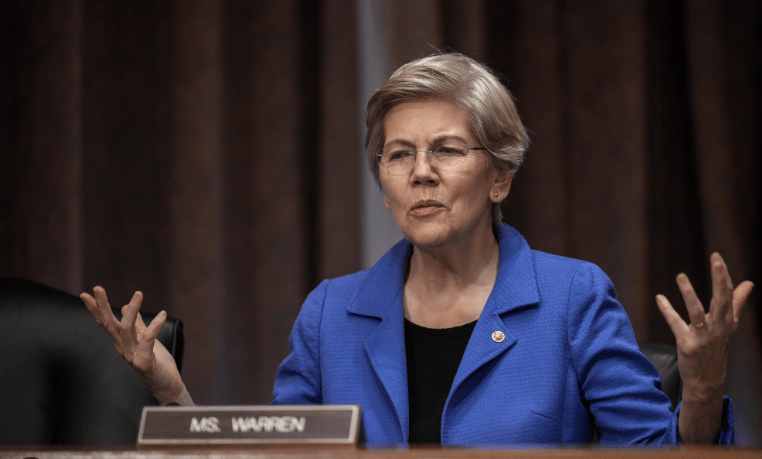
Sen. Elizabeth Warren. Image: Drew Angerer/Getty Images

Trump Sons Spent $314 Million On The Same Rigs Under Scrutiny

What sharpens the political edge of Warren’s letter is who has been buying Bitmain hardware in bulk. American Bitcoin Corp., co-founded by Eric Trump and Donald Trump Jr. in a joint venture with mining company Hut 8, reportedly signed a contract in August 2025 to acquire 16,000 Bitmain machines for $314 million, paid in pledged bitcoin rather than cash. That deal came from SEC filings cited by Bloomberg.

The company has since grown its fleet considerably. Reports indicate American Bitcoin added another 11,298 machines earlier this month, bringing its total to roughly 89,000 rigs producing about 28.1 exahashes per second of mining power. Its bitcoin treasury has reached around 6,900 BTC — worth approximately $462 million at current prices.

Warren’s letter asks Lutnick directly what steps his department has taken to keep national security decisions clear of influence from firms with Trump family business connections.

Featured image from Quartz, chart from TradingView

Related Questions

QWhat is the name of the federal investigation into Bitmain Technologies mentioned in the article?

AThe federal probe is reportedly known as 'Operation Red Sunset'.

QWhich U.S. Senator wrote a letter to the Commerce Secretary regarding Bitmain and potential national security concerns?

ASenator Elizabeth Warren wrote the letter to Commerce Secretary Howard Lutnick.

QWhat specific concern did the Senate Intelligence Committee report from July 2025 have about Bitmain hardware?

AThe report concluded that Bitmain hardware 'can be forced by the PRC to turn over data' under China's national security law.

QWhich company, co-founded by Eric Trump and Donald Trump Jr., purchased a large quantity of Bitmain mining machines?

AAmerican Bitcoin Corp., co-founded by Eric Trump and Donald Trump Jr. in a joint venture with Hut 8, purchased the machines.

QWhat was the value of the contract signed in August 2025 for 16,000 Bitmain machines, and how was it paid?

AThe contract was valued at $314 million and was paid in pledged bitcoin rather than cash.

Related Reads

Worried about AI's Self-Evolution, Anthropic Intends to Stop Training?

In early 2026, Anthropic signaled a significant shift in its public narrative regarding AI development timelines and safety. In June, its Anthropic Institute published a detailed article, "When AI builds itself," presenting internal data suggesting accelerating AI self-improvement. Key figures included over 80% of merged code being written by Claude and a 52x speedup in certain optimization tasks. The article outlined three future scenarios, with the most speculative being full recursive self-improvement (RSI), where AI autonomously builds better successors. Anthropic stated RSI is "possible" and may arrive faster than most institutions are prepared for. This narrative pivot followed a series of strategic moves. In January, CEO Dario Amodei wrote about a powerful self-improvement feedback loop. In February, Anthropic revised its Responsible Scaling Policy, removing a core commitment to pause training if capabilities outstripped safety controls, citing the risk of falling behind competitors. This change coincided with reported pressure from the US Department of Defense. By May, Anthropic's valuation had soared to $965 billion. Anthropic's stance was mirrored by other industry leaders. DeepMind CEO Demis Hassabis adjusted his AGI timeline to "by 2029" and admitted to using provocative language like "foothills of the singularity" to create urgency. OpenAI also released a model claiming a key role in its own creation process. The article's carefully calibrated tone—presenting dramatic data alongside qualifying footnotes—exemplifies a balancing act between signaling technological acceleration and managing commercial, regulatory, and safety imperatives. External experts offered contrasting interpretations of the same data, from warnings of catastrophic risk akin to Chernobyl to skepticism that current automation merely handles "grunt work," not genius. The coordinated narrative shift among top labs highlights the complex interplay between perceived technical inflection points and strategic communication aimed at investors, regulators, and the public.

marsbit1m ago

Worried about AI's Self-Evolution, Anthropic Intends to Stop Training?

marsbit1m ago

The Macroeconomic Underpinnings of Africa's Payment Market Landscape

The African payments market, characterized by the world's highest mobile money penetration and fastest-growing cryptocurrency adoption, is not a coincidence but a macroeconomic necessity driven by deep structural factors. Two key drivers create this landscape: (1) Africa's heavy reliance on commodity exports, trade, and remittances, generating massive cross-border settlement and remittance demand; and (2) chronically underdeveloped financial infrastructure, exacerbated by international bank de-risking, foreign exchange mismanagement, and persistent inflation. This vacuum has allowed mobile money and crypto to thrive. Mobile money platforms replace banks for domestic payments, while cryptocurrencies serve as a store of value against local currency depreciation and a low-cost medium for cross-border exchange. A crucial division lies along the Sahara Desert. North Africa is integrated into the oil-anchored MENA framework, while Sub-Saharan Africa (SSA), plagued by dollar shortages and fragmented currencies, has become a natural, massive market for mobile money and crypto. Nigeria, Kenya, and South Africa are global leaders in adoption. The SSA economy is deeply dollarized due to currency instability, yet suffers from a severe "dollar shortage" caused by trade deficits and limited export capacity. This creates parallel forex markets and high remittance costs. Cryptocurrencies, particularly stablecoins, fill this gap by providing access to dollar liquidity, cheaper cross-border transfers, and an inflation-resistant store of value, primarily driven by retail users for small-value transactions. While regional initiatives like PAPSS aim to reduce dollar dependence, the fundamental constraints of commodity reliance, trade imbalances, and shallow financial markets persist. Therefore, mobile money and cryptocurrencies are not niche trends but essential financial infrastructure filling a structural void, and they are likely to remain central to Africa's economic landscape for the foreseeable future.

链捕手11m ago

The Macroeconomic Underpinnings of Africa's Payment Market Landscape

链捕手11m ago

Is the Sharp Decline Over? Let the Data Speak

**Has the Sharp Decline Ended? Let Data Speak** Bitcoin's recent significant drop has placed short sellers in a precarious position. Three concurrent pressures—sustained outflows from ETFs, miners offloading coins to exchanges, and short-term holders capitulating—pushed the price near $63k. The asset fell 13% this week and 21% this month, roughly halving from its all-time high. A critical data point is the extremely crowded short positioning, with a short-to-long ratio reaching 8:1, representing nearly $100 billion in short interest overhead. This creates conditions for a potential short squeeze if selling pressure merely pauses, similar to the event in November 2022 which triggered a 24% rally. The selling pressures are real: spot Bitcoin ETFs have seen a record $5.4 billion outflow over 20 days. Short-term holders moved 53k loss-held BTC to exchanges in a day, and miners sent 24k BTC to Binance, a six-month high. Capital is also rotating towards AI and tech stocks like SpaceX, with $400 billion invested in AI infrastructure recently. However, on-chain data shows accumulation by long-term holders, who added 200k BTC in a month, and institutions/miners have absorbed 1.24 million BTC since 2023. This indicates strong buying beneath the surface. Key levels to watch are the $67k-$70k zone (2021 high & 2024 breakout point). A swift recovery above it suggests a leverage washout; failure could test $60k-$55k. The direction also hinges on ETF flow reversal. Currently, the S&P 500 hits new highs driven by AI, while Bitcoin and DeFi (TVL down from $173b to $73.9b) lag. The most probable path is a grinding basing process between $60k-$58k with continued ETF outflows. A less likely but explosive scenario involves a sudden flow reversal, a surge above $70k triggering a short squeeze, and a rally back above $76k. The immediate trigger depends on when the relentless selling pauses. A final cautionary note questions Bitcoin's correlation: if the high-flying U.S. stock market corrects, will Bitcoin once again miss the rally but not the decline?

foresightnews_api25m ago

Is the Sharp Decline Over? Let the Data Speak

foresightnews_api25m ago

Trading

Spot
Futures
活动图片