Crypto Funds See Six Consecutive Weeks of Net Inflows, CLARITY Act Drives $858 Million Influx

marsbitPublished on 2026-05-11Last updated on 2026-05-11

Abstract

Global cryptocurrency investment products recorded a net inflow of $857.9 million last week, marking the sixth consecutive week of positive flows and the largest single-week inflow since April 24, according to CoinShares' latest report. The primary catalyst was legislative progress on the U.S. CLARITY Act, specifically the final compromise text for stablecoin yield provisions, alongside Bitcoin's price breaking above $80,000. U.S.-listed products dominated with $776.6 million in inflows, a significant jump from the prior week's $47.5 million. European markets also saw increased participation. Bitcoin products led with $706.1 million in inflows, while short-Bitcoin products experienced their largest weekly outflow of 2026, indicating unwinding bearish positions. Major altcoins like Ethereum, Solana, and XRP all saw renewed positive flows, with Ethereum reversing its prior week's outflow to attract $77.1 million. Total assets under management (AUM) climbed to $160 billion.

Author: James Butterfill (Head of Research, CoinShares)

Compiled by: Deep Tide TechFlow

Deep Tide Introduction: The latest weekly report from CoinShares shows that global crypto investment products recorded net inflows of $857.9 million last week, marking the sixth consecutive week of positive flows and the highest single-week inflow since April 24. The direct catalysts were the release of the compromise text for the stablecoin yield provisions in the CLARITY Act and Bitcoin's return above $80,000. Funds from the US market surged to $776.6 million from $47.5 million the previous week. Altcoin participation also expanded simultaneously, with ETH, SOL, and XRP all recording net inflows.

Progress on CLARITY Act Was the Core Variable Driving Fund Flows This Week

Global crypto investment products saw net inflows of $857.9 million last week, marking six consecutive weeks of positive flows and the largest single-week inflow since April 24. James Butterfill, Head of Research at CoinShares, directly attributed this acceleration to legislative progress on the CLARITY Act.

The timeline is clear: On May 1, Senators Tillis and Alsobrooks released the final compromise text for the stablecoin yield provisions; on May 4, the two lawmakers resisted lobbying pressure from the banking industry and maintained the compromise unchanged. A formal markup by the Senate Banking Committee is expected this week.

Bitcoin broke above $80,000 on Monday, reaching a new high since the February pullback. Total Assets Under Management (AUM) rose to $160 billion.
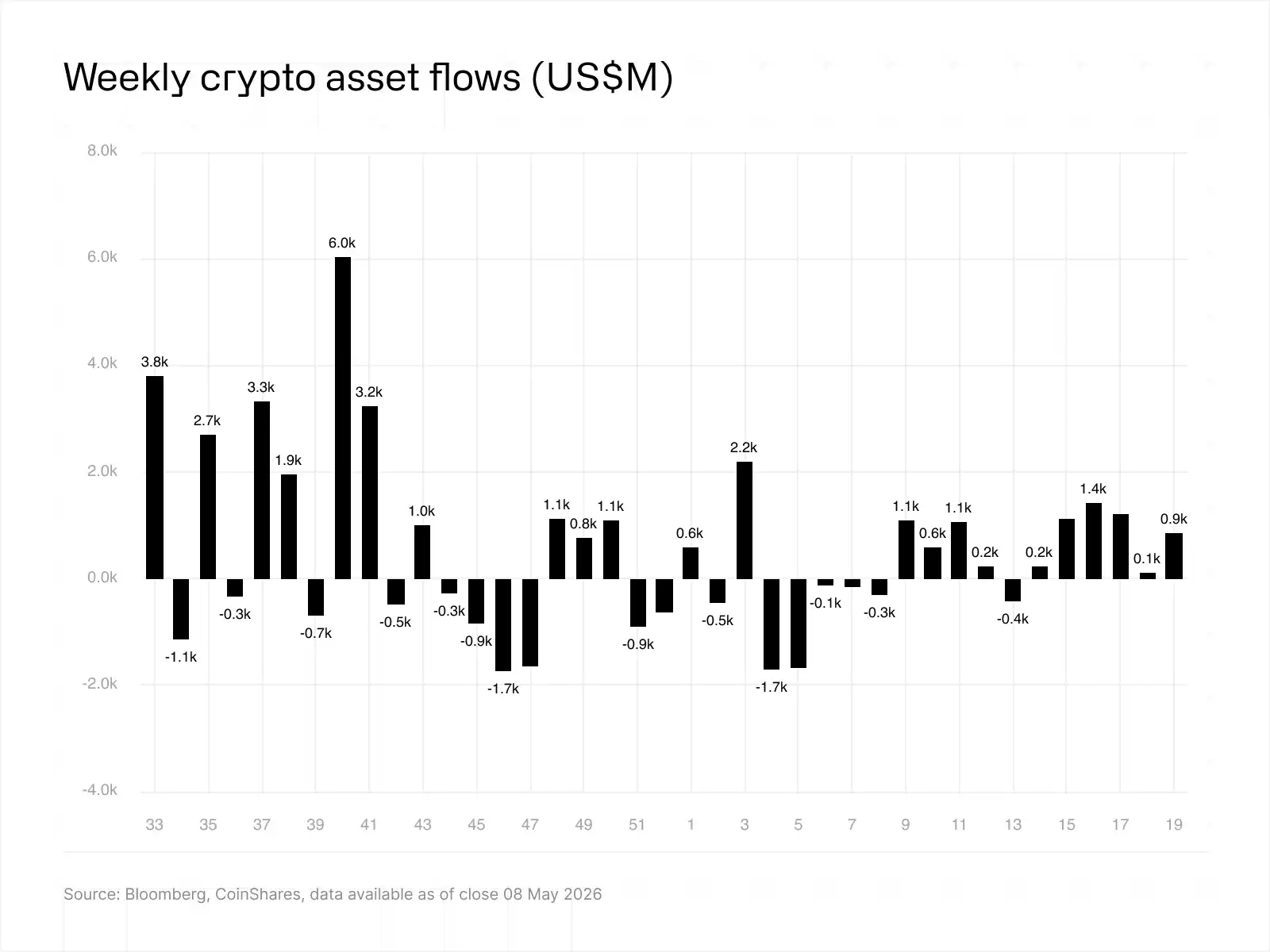
Caption: Weekly Global Crypto Asset Fund Flows, Source: CoinShares

US Fund Rebound Far Exceeds Previous Week

In terms of regional distribution, the United States dominated with net inflows of $776.6 million, showing a sharp rebound compared to the $47.5 million from the previous week.

Europe also showed improvement. Germany recorded $50.6 million, slightly higher than the previous week; Switzerland saw $21.1 million, and the Netherlands $5 million. Butterfill believes this indicates that while the buying momentum has returned to the US, there is also broader participation emerging in Europe.
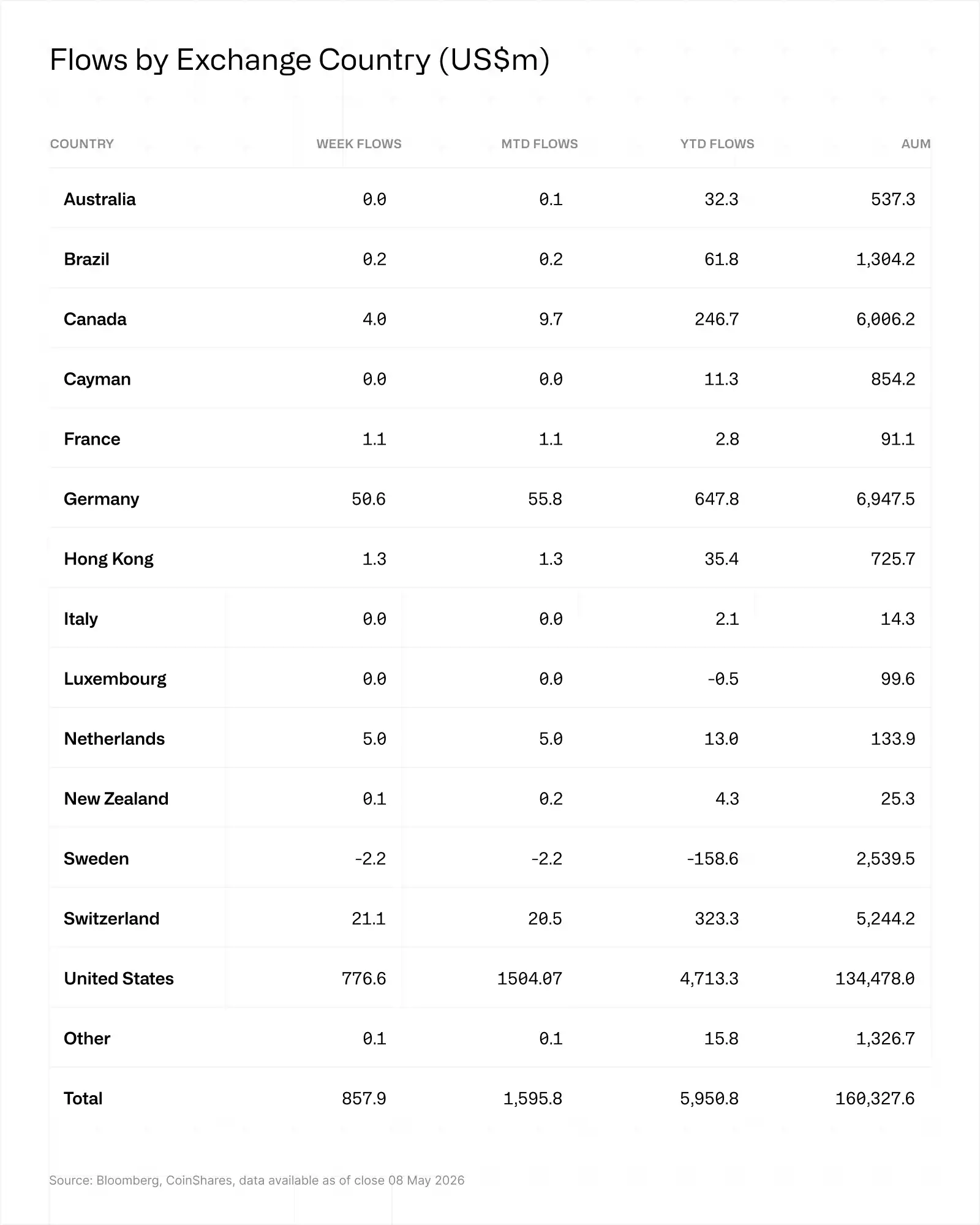
Caption: Fund Flows by Listing Country, Source: CoinShares

BTC Leads, Short Positions Accelerate Unwinding

Bitcoin products absorbed $706.1 million last week, bringing year-to-date cumulative inflows to $4.9 billion.

A noteworthy signal to unpack: Short-bitcoin products saw net outflows of $14.4 million last week, the largest single-week outflow in 2026. This suggests hedge positions are being unwound, indicating growing institutional confidence in the rebound.

Altcoins Rebound Across the Board, ETH Reverses Previous Week's Outflow

Ethereum products saw net inflows of $77.1 million, completely reversing the net outflow of $81.6 million from the previous week. Solana recorded $47.6 million, and XRP saw $39.6 million, both showing a significant acceleration compared to recent activity levels.

The only category with noticeable outflows was multi-asset products, with a net outflow of $5.5 million.
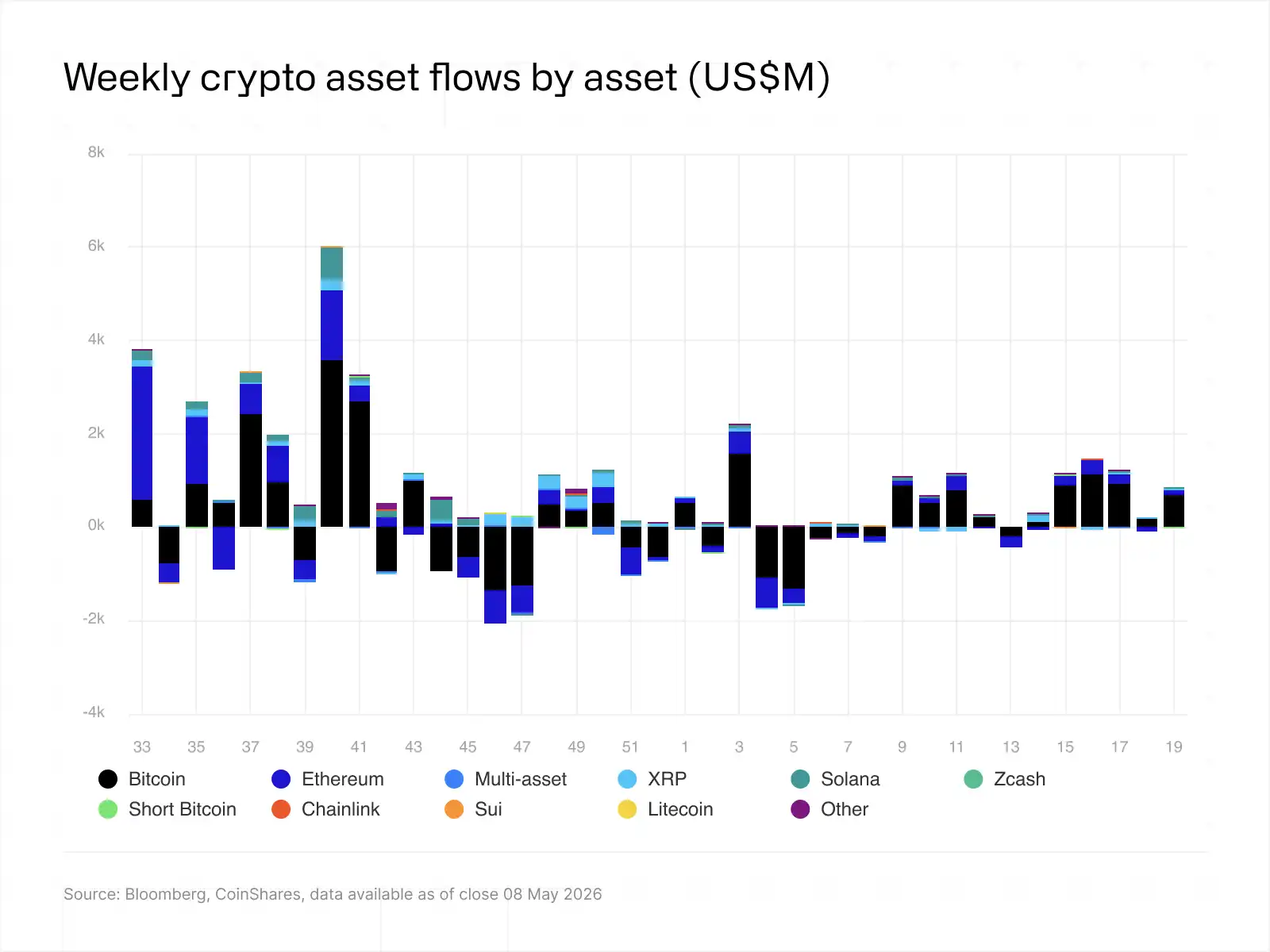
Caption: Weekly Fund Flows by Asset Class, Source: CoinShares
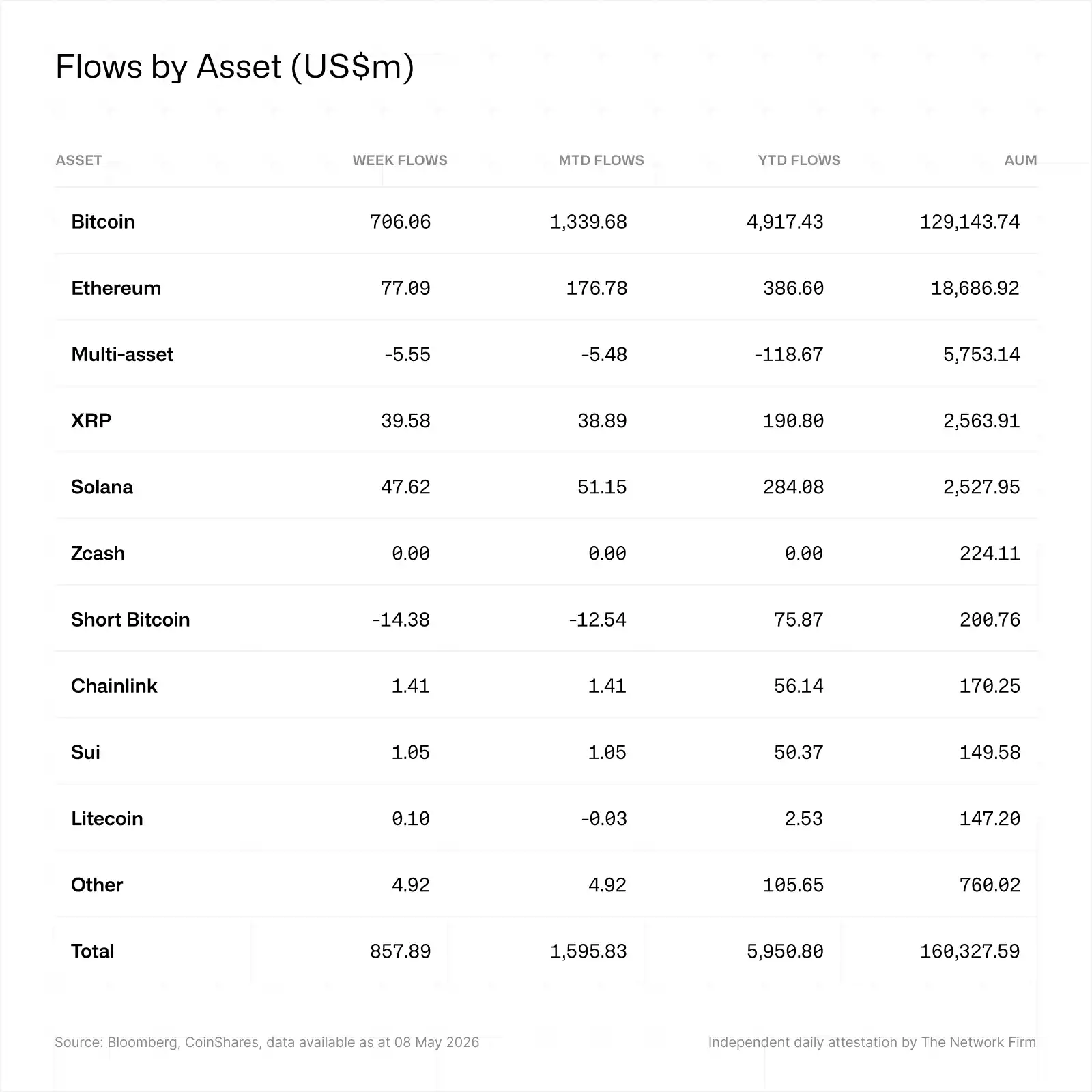
Caption: Detailed Fund Flows by Asset, Source: CoinShares
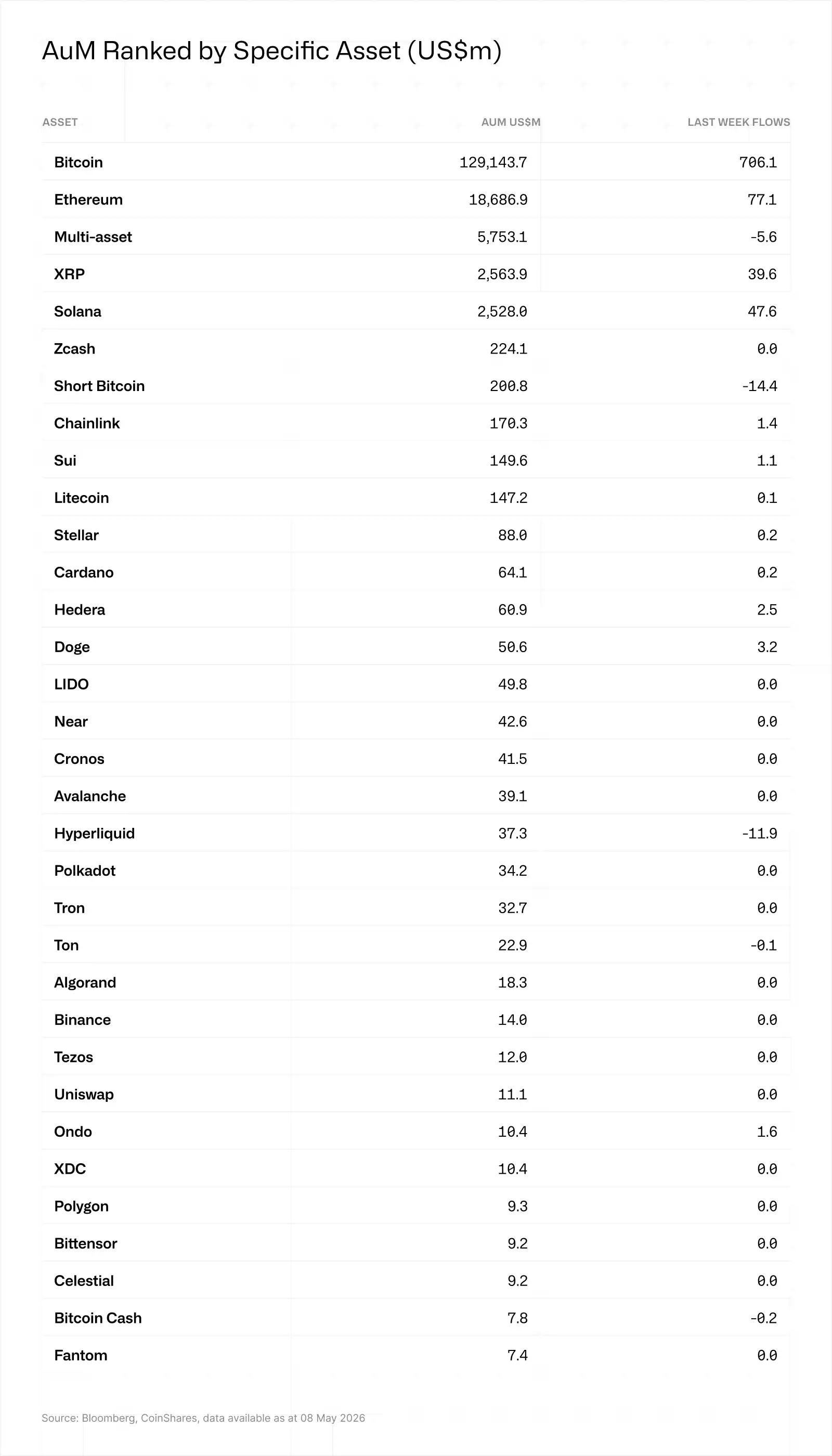
Caption: Assets Under Management Ranked by Specific Asset, Source: CoinShares


Related Questions

QWhat was the main catalyst behind the record $857.9 million weekly inflow into crypto investment products, according to CoinShares?

AThe main catalyst was legislative progress on the CLARITY Act, specifically the release of a final compromise text for the stablecoin yield provision on May 1 and the sponsors' resistance to banking lobbying pressure to keep the compromise intact.

QWhich region saw the most significant week-over-week increase in net inflows for crypto investment products, and by how much?

AThe United States saw the most significant increase, with net inflows surging from $47.5 million the previous week to $776.6 million.

QWhat does the $14.4 million net outflow from short-bitcoin products signal about market sentiment, according to the article?

AThe largest weekly outflow for short-bitcoin products in 2026 signals that hedge positions are being unwound, indicating growing institutional confidence in the market's rebound.

QWhich three altcoin investment products saw notable net inflows alongside Bitcoin?

AEthereum (ETH), Solana (SOL), and XRP investment products all saw notable net inflows of $77.1 million, $47.6 million, and $39.6 million, respectively.

QWhat was the total Assets Under Management (AUM) for global crypto investment products mentioned in the report, and what was Bitcoin's price milestone?

AThe total Assets Under Management (AUM) reached $160 billion, while Bitcoin's price broke above $80,000, marking a new high since its correction in February.

Related Reads

Huawei Cloud Rejects Token Price War, Zhou Yuefeng Seeks a New Winning Formula for AI Cloud

At the 2026 Huawei Cloud INSPIRE Creator Conference, CEO Zhou Yuefeng outlined Huawei Cloud's distinct strategy in the competitive AI cloud market. Instead of engaging in price wars based on token volume or Maas revenue—a common focus for rivals like Alibaba Cloud and ByteDance's Volcano Engine—Huawei Cloud is shifting the competition towards real-world productivity gains. Zhou highlighted three core differentiators: a fully domestic computing stack (Ascend, Kunpeng), a focus on government and enterprise clients rather than consumer internet, and a deep commitment to open-source ecosystems. To this end, Huawei Cloud launched a suite of new products under the "Agentic Infra" paradigm, including the AICS Lingqu computing cluster, AMS memory storage, and the ModelArts Next platform. These aim to solve enterprise challenges in deploying AI agents, such as latency, memory, scheduling, and security. The strategy further involves creating specialized industry zones ("AI Dream Factories") for sectors like healthcare and embodied intelligence. For example, a smart medical zone developed with Shanghai Ruijin Hospital aims to democratize expert-level diagnostic capabilities. In essence, Huawei Cloud is positioning itself not as a commodity token provider, but as the foundational infrastructure for industrial AI, leveraging its domestic supply chain and hybrid cloud solutions to serve sectors where productivity, not just scale, is the ultimate measure of value.

marsbit1h ago

Huawei Cloud Rejects Token Price War, Zhou Yuefeng Seeks a New Winning Formula for AI Cloud

marsbit1h ago

70% of the Public Opposes AI, Americans Hope the U.S. Loses the AI War

70% of Americans believe AI development is moving too fast, with growing public resistance evolving from online criticism to real-world protests and violence. This widespread anti-AI sentiment stems from fears of job losses, rising utility costs, environmental damage, threats to democracy, and financial instability. Key incidents illustrate the backlash: Google's former CEO Eric Schmidt was loudly booed at a graduation for promoting AI; AI company ads are vandalized; protests and even violent attacks target AI firms and data centers. Polls show deep public pessimism and strong local opposition to data center construction, often surpassing resistance to nuclear power plants. The core grievances are economic and practical: AI is seen as automating jobs, concentrating wealth, and increasing household electricity and water bills due to massive data center resource demands. Environmentalists also oppose AI's high energy use and carbon emissions. This opposition has turned AI into a major political issue in the US. While the Trump administration prioritizes AI innovation for global competition, bipartisan pushback is growing. Democrats and factions within the MAGA movement are forming temporary alliances to support stricter regulations and local bans on new data centers, pressuring the administration to choose between its tech industry backers and its voter base. The situation highlights a profound national divide over AI's future.

marsbit2h ago

70% of the Public Opposes AI, Americans Hope the U.S. Loses the AI War

marsbit2h ago

Trading

Spot
Futures
活动图片