Crypto drops alongside equities as risk-off sentiment spreads across markets

ambcryptoPublished on 2026-03-26Last updated on 2026-03-26

Abstract

Cryptocurrencies experienced a broad sell-off alongside U.S. equities, signaling a market-wide shift toward risk-off sentiment rather than crypto-specific weakness. Major digital assets declined, with Ethereum falling 4.1% and Solana dropping over 5%, while Bitcoin saw a more modest 2.1% decrease. Losses extended across altcoins and large-cap tokens like BNB and XRP, with stablecoins remaining stable as investors sought safety. Similarly, tech stocks such as Meta and Nvidia fell sharply, highlighting a retreat from high-risk assets. The synchronized decline underscores continued correlation between crypto and equities during periods of market stress, reflecting their increased sensitivity to macro sentiment and institutional flows.

A broad sell-off across digital assets mirrored declines in U.S. equities, signaling a coordinated pullback in risk assets rather than an isolated crypto move.

Market heatmaps showed widespread losses across major cryptocurrencies, with Ethereum down 4.1% and Solana falling over 5%. Bitcoin, the largest asset by market cap, posted a more modest 2.1% decline but remained firmly in negative territory.

The weakness extended across altcoins, with few sectors showing resilience, pointing to a broad-based shift in sentiment rather than token-specific developments.

Crypto market sees broad sell-off led by ETH and SOL

The decline was led by higher-beta assets, a common pattern during periods of market stress. Ethereum and Solana both underperformed Bitcoin, suggesting reduced risk appetite among traders.

Large-cap tokens, including BNB and XRP, also moved lower, reinforcing the market-wide nature of the sell-off. Stablecoins such as USDC and Tether remained largely unchanged, reflecting a shift toward capital preservation.
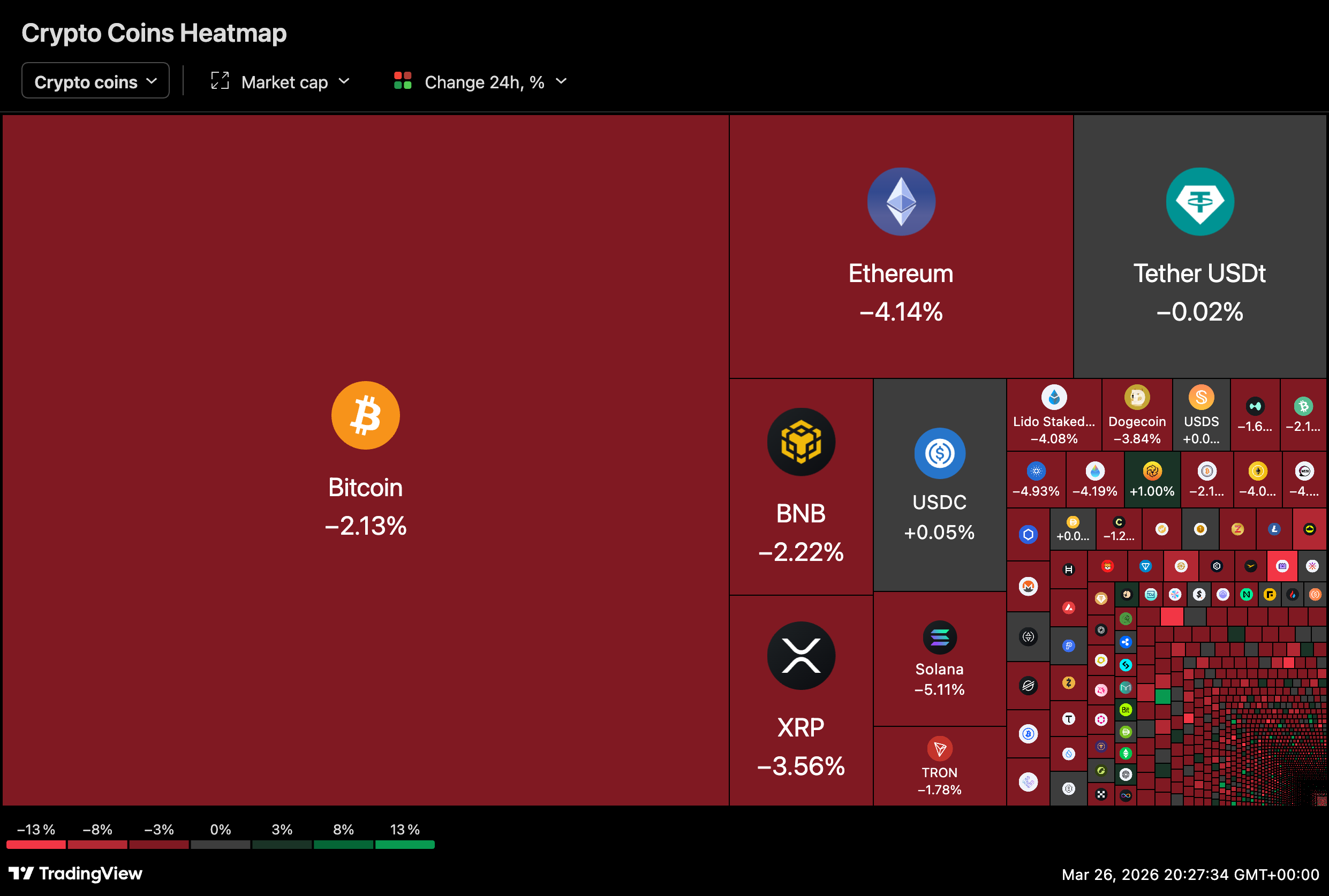
Source: TradingView

The absence of a clear catalyst suggests the move may be tied to broader macro positioning rather than crypto-specific developments.

Equities mirror the move with tech stocks under pressure

A similar pattern was visible in equity markets, particularly within the technology sector.

Major stocks such as NVIDIA and Meta Platforms fell sharply, with Meta dropping nearly 8% and Nvidia declining over 4%. Alphabet Inc. and Amazon also posted losses, contributing to a broader decline across the S&P 500.
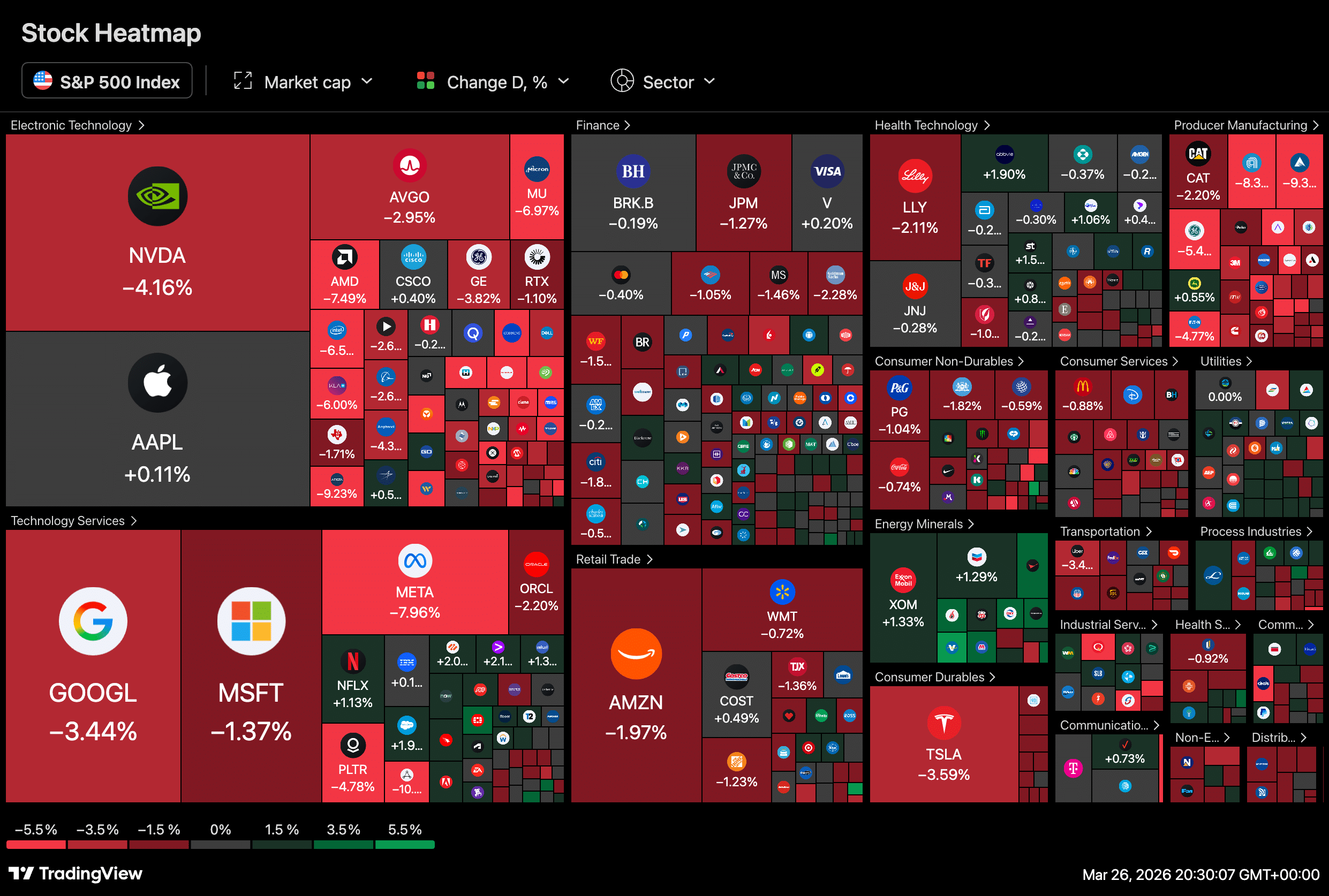
Source: TradingView

The concentration of losses in growth and tech names highlights a retreat from higher-risk segments of the market.

Correlation highlights risk-off sentiment across markets

The synchronized decline across crypto and equities points to a continued correlation between the two asset classes, particularly during periods of uncertainty.

Rather than acting as a hedge, crypto is trading in line with broader risk sentiment, moving alongside equities when investors reduce exposure to volatile assets.

This alignment has become more pronounced in recent years as institutional participation in digital assets has increased, linking crypto performance more closely to macro-driven market flows.


Final Summary

  • Crypto and equities declined simultaneously, reflecting a broader risk-off move rather than isolated weakness.
  • Continued correlation suggests digital assets remain tied to macro sentiment, especially during periods of market stress.


Related Questions

QWhat was the main reason for the simultaneous decline in both cryptocurrency and equity markets according to the article?

AThe decline was due to a broad risk-off sentiment spreading across markets, rather than isolated crypto-specific factors, indicating a coordinated pullback in risk assets.

QWhich two major cryptocurrencies led the sell-off in the crypto market and by how much did they decline?

AEthereum led with a 4.1% decline, and Solana fell over 5%.

QHow did Bitcoin's performance compare to other major cryptocurrencies during this market downturn?

ABitcoin posted a more modest decline of 2.1%, underperforming compared to Ethereum and Solana but still in negative territory.

QWhich technology stocks were mentioned as declining sharply in the equity market, and what were their approximate losses?

AMeta Platforms dropped nearly 8%, and Nvidia declined over 4%. Alphabet and Amazon also posted losses.

QWhat does the synchronized decline between crypto and equities suggest about their correlation according to the article?

AIt suggests that crypto is trading in line with broader risk sentiment and moving alongside equities during periods of uncertainty, rather than acting as a hedge, due to increased institutional participation linking crypto to macro-driven market flows.

Related Reads

"Crypto Retirement Plan" Heavily Criticized by Democrats: Trump Is "Harvesting" American Workers' Pensions

Democratic senators Bernie Sanders (I-VT) and Elizabeth Warren (D-MA), along with Representative Bobby Scott (D-VA), are urging the Labor Department to repeal a proposed rule that would open U.S. retirement savings accounts, such as 401(k)s, to investments in cryptocurrencies like Bitcoin and other alternative assets. The rule, stemming from an August executive order by President Trump, would provide a legal safe harbor for plan fiduciaries offering these volatile assets if they follow a prescribed process. The lawmakers argue in a 14-page letter that the rule dangerously weakens long-standing "prudent man" standards under the Employee Retirement Income Security Act (ERISA), potentially exposing the $14.2 trillion in 401(k) savings to high-risk, minimally regulated investments. They cite warnings from FINRA about crypto's high volatility and from the FBI about massive cryptocurrency scam losses. The letter also alleges a conflict of interest, noting that President Trump's adult children manage the family's crypto business, which has reportedly raised billions from digital token sales. They contend the rule change could enrich the Trump family at the expense of workers' retirement security. In defense, the Trump administration frames the rule as expanding worker choice. Acting Labor Secretary Keith Sonderling stated it ends the department "picking winners and losers," requiring fiduciaries to follow a prudent process. Treasury Secretary Scott Bessent supported it as a step toward the president's "Golden Age."

marsbit1m ago

"Crypto Retirement Plan" Heavily Criticized by Democrats: Trump Is "Harvesting" American Workers' Pensions

marsbit1m ago

When Google Also 'Prints Stocks' to Build AI, Whose Narrative is Shattering the High Valuations of Neocloud?

Google has announced its first equity financing since 2005, a series of moves totaling $80 billion that signal a strategic challenge to Nvidia's GPU dominance in the AI compute market. This impacts "Neocloud" companies like CoreWeave, Nebius, and IREN, whose valuations are heavily tied to Nvidia's perceived uniqueness. Google's three-part strategy involves: launching new TPU chips (TPU 8t/8i) and selling them to third parties for the first time; forming a $25 billion compute-as-a-service joint venture with Blackstone; and raising ~$50 billion in new equity (part of an $80B package) to fund AI infrastructure, underscoring the massive capital demands even for tech giants. This marks a divergence from Microsoft's path. Microsoft, lacking a mature in-house AI chip, relies heavily on outsourcing to Neocloud providers using Nvidia GPUs. Google, with its proprietary TPU, is pursuing vertical integration—building its own data centers, selling chips, and competing directly with Neocloud services. While Neocloud firms have strong near-term revenue from locked-in Nvidia GPU contracts (e.g., CoreWeave's ~$100B backlog), Google's moves undermine their long-term valuation narrative based on Nvidia's sole supremacy and perpetual supply shortage. TPU performance claims and adoption by firms like Anthropic add credibility to Google's alternative. The AI compute market is transitioning from a uniform seller's market to a layered one: top AI labs are diversifying their hardware stacks; hyperscalers are pursuing different chip strategies; and financing costs will become a critical differentiator, favoring players like Google with lower capital costs. Key metrics to watch include the progress of the Google-Blackstone JV, expansion of the TPU customer base beyond Anthropic, and potential shifts in Microsoft's sourcing strategy. If Google succeeds on these fronts, the Neocloud investment thesis will require significant reassessment.

marsbit1h ago

When Google Also 'Prints Stocks' to Build AI, Whose Narrative is Shattering the High Valuations of Neocloud?

marsbit1h ago

Trading

Spot
Futures
活动图片




