Crypto Downturn Slams Galaxy Digital With $241 Million Annual Loss

bitcoinistPublished on 2026-02-05Last updated on 2026-02-05

Abstract

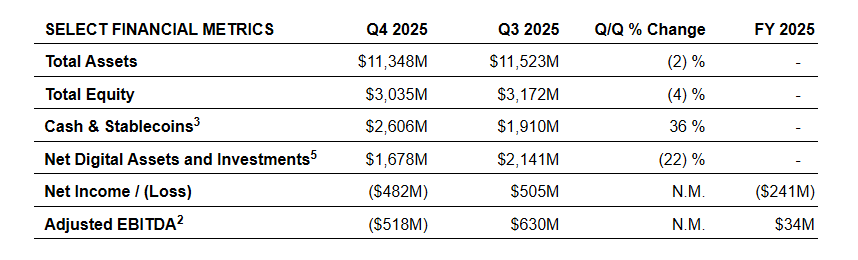
Galaxy Digital reported a significant annual loss of $241 million, driven by a sharp downturn in crypto markets. The fourth quarter alone saw a net loss of $482 million due to declining digital asset valuations and reduced trading volumes. These results fell well below Wall Street expectations. The company also incurred one-time charges related to mining infrastructure and reorganization. Despite the losses, Galaxy strengthened its liquidity, ending the year with $2.6 billion in cash and stablecoins. It is expanding into data centers and cloud partnerships to create more stable revenue streams. Market reaction was negative, with shares declining as analysts remain divided on the company’s near-term prospects.

Galaxy Digital posted a heavy loss for the year as the crypto slump bit into its holdings and trading business. The numbers show a company that weathered big markdowns on digital assets while trying to bulk up its cash and new revenue streams.

Losses And Liquidity

Reports say Galaxy recorded a GAAP net loss of $241 million for the full year, and a much larger hit in the fourth quarter alone: a $482 million net loss.

The quarterly shortfall came after a steep drop in the value of the firm’s crypto holdings and lower trading volumes, which together pushed reported results well below Wall Street expectations.

The Downturn Behind The Numbers

According to the company’s results, the value of its digital assets and investments fell sharply late in the year, producing most of the headline losses.

Trading activity cooled, and that reduced fees and transaction income. At the same time, one-time charges tied to mining infrastructure and a corporate reorganization added to the drag on annual results.
Source: Galaxy Digital

Data Center And New Business

Galaxy has not only been a crypto trading and asset management shop. It has been building out a large data-center footprint in Texas, including the Helios campus with approvals to scale power capacity to over 1.6 GW.

The company says that infrastructure work and deals with cloud partners could produce steadier revenue streams over time, even if crypto markets stay weak in the near term.

BTCUSD currently trading at $75,736. Chart: TradingView

Cash Cushion And Balance-Sheet Moves

Reports note that Galaxy finished the year with roughly $2.6 billion in cash and stablecoins, a position management highlights as a buffer against further market volatility.

The firm also raised capital and tapped debt markets late in the year, steps meant to preserve optionality while trading revenues slump.

At the same time, some asset management lines reported record activity, which helped offset a part of the losses when measured on an adjusted basis.

Market Reaction And Outlook

The market reacted quickly. Shares slid in premarket trading after the release and then fell further as investors digested the scale of the write-downs.

Analysts are split: some see the data-center push as a sensible hedge against volatile crypto returns, while others point out that near-term earnings will remain pressured until trading volumes and asset prices recover.

Featured image from Unsplash, chart from TradingView

Related Questions

QWhat was the total GAAP net loss reported by Galaxy Digital for the full year?

AGalaxy Digital reported a GAAP net loss of $241 million for the full year.

QWhat were the two main factors that contributed to the company's large net loss in the fourth quarter?

AThe quarterly net loss of $482 million was primarily due to a steep drop in the value of the firm’s crypto holdings and lower trading volumes.

QBesides trading losses, what other one-time charges added to the drag on the company's annual results?

AOne-time charges tied to mining infrastructure and a corporate reorganization also added to the drag on the annual results.

QWhat new business initiative is Galaxy Digital building in Texas to create steadier revenue streams?

AThe company is building out a large data-center footprint in Texas, including the Helios campus, which is approved to scale power capacity to over 1.6 GW.

QHow much cash and stablecoins did Galaxy Digital have at the end of the year to act as a buffer against market volatility?

AGalaxy Digital finished the year with roughly $2.6 billion in cash and stablecoins.

Related Reads

From Return to Resignation: Chen Hang's 437 Days at DingTalk

The 437-Day Return and Departure of Chen Hang at DingTalk This article chronicles the 437-day period from March 31, 2025, to June 11, 2026, when Chen Hang (also known as "No Move") returned as CEO of DingTalk, the enterprise communication platform he originally founded, only to later step down. Chen Hang, the creator of DingTalk in 2015, was brought back by Alibaba in 2025 after the company acquired his subsequent startup, HHO. His return was driven by Alibaba's renewed focus on AI and DingTalk's strategic role as its key to-B AI application. However, his aggressive management style, marked by strict work policies like mandatory clock-ins and extended hours, quickly caused internal friction and was criticized as being at odds with Alibaba's culture. Despite the internal turmoil, Chen Hang drove significant product launches. In August 2025, he unveiled "AI DingTalk 1.0," featuring new products like the AI-native entry point "DingTalk ONE." By March 2026, he announced "Wukong," touted as the world's first enterprise-grade AI-native work platform, representing a fundamental rebuild of DingTalk's architecture. The turning point came in early June 2026. A detailed internal post criticizing DingTalk's work culture went viral, followed by a public critique from a former executive. This prompted an unprecedented public rebuke from the Alibaba Partners Committee, which stated such management was not aligned with company values. One day later, on June 11, Alibaba announced Chen Hang's departure. He was succeeded by Chen Yusen, a 32-year-old technical expert known for founding cybersecurity firm Changting Technology. While Chen Hang's tenure laid the technical foundation for DingTalk's AI transformation with "Wukong," his leadership style ultimately led to his replacement as the company seeks a new direction under younger leadership.

marsbit11m ago

From Return to Resignation: Chen Hang's 437 Days at DingTalk

marsbit11m ago

The 2026 Landscape of Decentralized AI: Why Blockchain is the Inevitable 'Antidote' for AI?

Decentralized AI 2026 Landscape: Why Blockchain is AI's Essential "Antidote" Centralized AI faces structural bottlenecks—expensive compute, concentrated control, unverifiable outputs, and difficult data access—that cannot be solved by capital or code alone. Blockchain offers a path to make intelligence open, verifiable, and economically accessible. The decentralized AI stack comprises: * **Infrastructure:** The foundation with compute, verifiable inference, distributed training, data/storage, and privacy/verification layers. Projects like Akash, Render, and Filecoin provide cheaper, decentralized alternatives for raw resources. * **Middleware:** The coordination layer for agent discovery, identity, and commerce. Key players include Bittensor (a network of specialized AI subnets), Virtuals (an agent economy OS), and frameworks providing agent identity and tooling. * **Applications & Services:** Dominated by Agentic Finance (AI agents executing on-chain actions based on natural language) and Agentic Payments (machine-to-machine transactions using blockchain as a settlement layer). Projects like Giza, Infinit Labs, and x402 are enabling these use cases. Key trends for 2026-2027 show AI demand outgrowing infrastructure, compute becoming an asset class, and tokenomics emerging as a structural advantage for coordinating capital, compute, and data. While still early—with adoption uneven and revenue often trailing token incentives—projects like Bittensor, NEAR, and Venice demonstrate decentralized AI is evolving from a narrative into a new model for coordinating intelligence.

Foresight News31m ago

The 2026 Landscape of Decentralized AI: Why Blockchain is the Inevitable 'Antidote' for AI?

Foresight News31m ago

Trading

Spot
Futures
活动图片





