Crypto Crackdown Intensifies: Canada Revokes 47 Licenses

bitcoinistPublished on 2026-03-20Last updated on 2026-03-20

Abstract

Canada's financial regulator FINTRAC has intensified its crackdown on the crypto sector, revoking 47 money services business licenses from crypto-related firms in 2026 alone. This follows earlier major penalties, including a $126 million fine for Cryptomus and a $14 million penalty for KuCoin. Finance Minister François-Philippe Champagne signaled continued strict enforcement, specifically highlighting risks associated with crypto ATMs and money laundering. The move represents a significant shift in Canada's regulatory approach, with FINTRAC strengthening enforcement and using its actions as a public deterrent. The broader context notes that while illicit crypto transactions are estimated at under 1%, the sector faces stricter scrutiny than traditional finance.

Canada’s financial watchdog fined crypto platform Cryptomus $126 million last October after the company allegedly failed to flag suspicious transactions on 1,068 separate occasions in a single month.

A month before that, crypto exchange KuCoin was handed a $14 million penalty for operating in Canada without registering as a foreign money services business.

Those two cases now look like early warnings of what was coming.

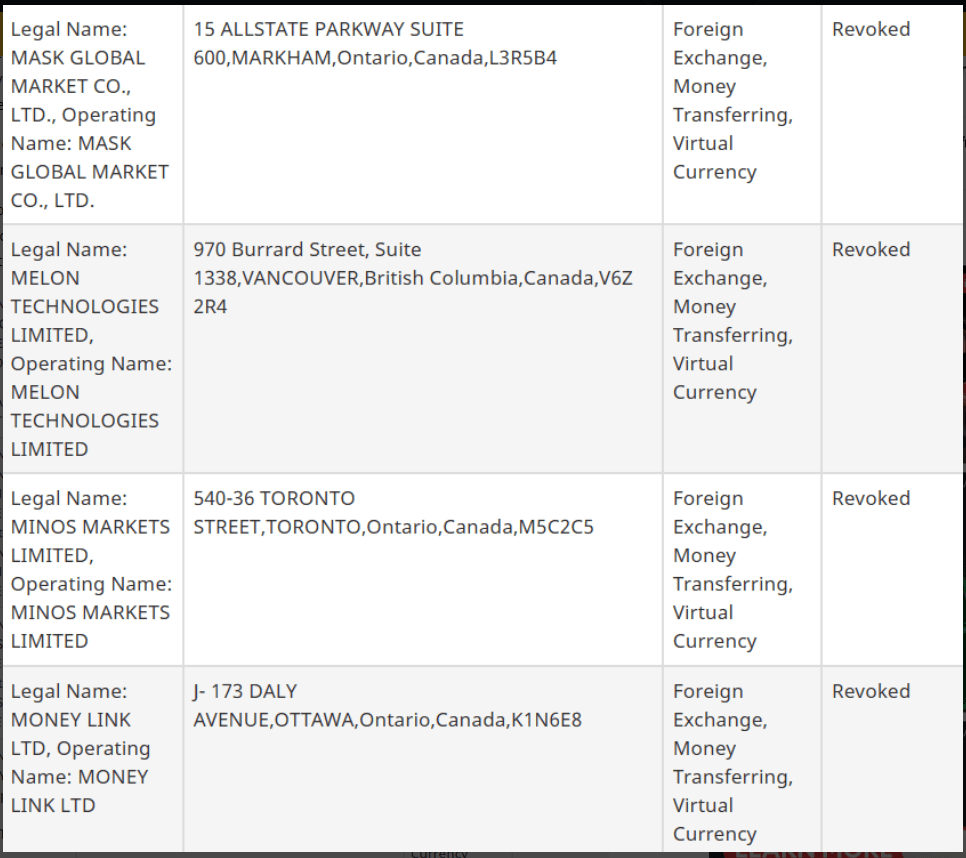
In the months since, the Financial Transactions and Reports Analysis Centre — better known as FINTRAC — has revoked 50 money services business registrations in 2026 alone.

Forty-seven of those belonged to crypto-related firms. The latest round, announced Monday, cut 23 registrations in one move.

Finance Minister Signals More Actions On The Way

Finance Minister François-Philippe Champagne called the pace of enforcement “significantly increased” and said the government has no plans to slow down.

“Our government will continue to monitor and pursue new measures to address risks posed by virtual currency businesses, such as cryptocurrency MSBs and crypto ATMs, which can be used to facilitate money laundering and fraud,” he said in a statement Tuesday.

FINTRAC canceled 23 MSB registrations on Monday, according to the agency.

Any business that loses its registration has 30 days to request a review. Some may get reinstated. But the scale of the sweep — nearly 50 revocations in under three months — signals a shift in how Canada is policing the crypto sector.

FINTRAC also said it is strengthening enforcement and increasing transparency around compliance actions, a move that suggests the agency wants its actions to serve as a public deterrent, not just a regulatory cleanup.

Total crypto market cap currently at $2.38 trillion. Chart: TradingView

What The Numbers Say About Crypto And Crime

Canada’s crackdown comes at a time when the relationship between cryptocurrency and illicit finance is still hotly debated.

The Financial Action Task Force estimates that between 2% and 5% of global GDP moves through illegal channels each year — almost entirely through traditional banking systems.

Blockchain analytics firm Chainalysis puts the share of crypto transactions tied to illicit activity at under 1%.

Those figures don’t mean crypto is clean. But they do raise questions about whether the sector is being held to a stricter standard than older financial industries.

For now, Canada appears committed to its current direction. Officials have specifically called out crypto ATMs as a concern, suggesting future enforcement could extend beyond online platforms to physical kiosks scattered across the country.

Businesses that aren’t in full compliance with registration and reporting rules have reason to take that warning seriously.

Featured image from Unsplash, chart from TradingView

Related Questions

QWhat was the total number of money services business registrations revoked by FINTRAC in 2026 alone, and how many of these were crypto-related firms?

AFINTRAC revoked 50 money services business registrations in 2026 alone, and 47 of those belonged to crypto-related firms.

QWhat were the two major enforcement actions taken by Canadian regulators against crypto platforms prior to the recent wave of license revocations?

ACanada's financial watchdog fined crypto platform Cryptomus $126 million for failing to flag suspicious transactions, and crypto exchange KuCoin was handed a $14 million penalty for operating without registering as a foreign money services business.

QAccording to the article, what is the estimated percentage of global GDP that moves through illegal channels each year, and what is the estimated share of crypto transactions tied to illicit activity?

AThe Financial Action Task Force estimates that between 2% and 5% of global GDP moves through illegal channels each year, while blockchain analytics firm Chainalysis puts the share of crypto transactions tied to illicit activity at under 1%.

QWhat did Finance Minister François-Philippe Champagne say about the government's future plans regarding virtual currency businesses?

AFinance Minister François-Philippe Champagne stated that the government will continue to monitor and pursue new measures to address risks posed by virtual currency businesses, such as cryptocurrency MSBs and crypto ATMs, which can be used to facilitate money laundering and fraud.

QWhat specific physical infrastructure, beyond online platforms, did Canadian officials call out as a concern for future enforcement actions?

ACanadian officials specifically called out crypto ATMs as a concern, suggesting future enforcement could extend to these physical kiosks scattered across the country.

Related Reads

WEEX TradFi Trading Competition Kicks Off, 50,000 USDT Prize Pool First-Come, First-Served, Open a Position and Get 5 U

WEEX Exchange Launches "TradFi Trading Competition" with a 50,000 USDT Prize Pool Amidst a crypto market downturn, WEEX Exchange highlights the growth of tokenized traditional finance (TradFi) assets as a key trend, allowing users to trade stocks, ETFs, and commodities using crypto. The platform has launched a "TradFi Trading Competition" from July 9th to 23rd, featuring a 50,000 USDT prize pool. The campaign offers three reward tiers: 1. **New User Bonus (25,000 USDT pool):** New users depositing ≥100 USDT, completing a specified spot trade, and one TradFi contract trade (margin ≥10 USDT) receive 200 USDT. 2. **Volume-Based Rewards (20,000 USDT pool):** All users can earn tiered bonuses for achieving TradFi contract trading volumes of 5,000 USDT (3 USDT), 20,000 USDT (10 USDT), and 100,000 USDT (50 USDT). Rewards are stackable. 3. **Participation Reward:** Any user opening a TradFi contract trade during the event receives 5 USDT instantly. The article promotes WEEX's TradFi features, which include trading tokenized shares of companies like NVIDIA and Tesla using USDT, 24/7 trading, fractional share investing starting from $5, and high leverage up to 100x for hedging. It positions these features as solutions to traditional investing barriers like high fees, strict trading hours, and high share prices. The summary concludes by encouraging users to join the competition and leverage WEEX's platform to access global TradFi markets.

marsbit16m ago

WEEX TradFi Trading Competition Kicks Off, 50,000 USDT Prize Pool First-Come, First-Served, Open a Position and Get 5 U

marsbit16m ago

Switching Chains for Another Shot at Success: Can It Really 'Change One's Destiny'?

Recent months have witnessed a wave of established blockchain projects migrating to new public chains, notably Base and Arbitrum, coupled with strategic pivots in their business models—essentially "re-starting" elsewhere. Examples include Sophon (moving from ZKsync to Base to cut $3M+ annual costs and focus on consumer apps), Moonbeam (shifting from Polkadot to Base to pursue decentralized AI), and Secret Network (planning a move from Cosmos to Arbitrum to explore privacy-AI integrations, though its token price plunged 30% post-announcement). A common thread is that these migrating projects are primarily layer-1 or layer-2 chains now seeking relevance in AI and real-world consumer applications. This trend highlights the relative stagnation of ecosystems like Polkadot and Cosmos, which are seeing significant outflows. However, the community remains skeptical about whether such chain-hopping truly enables a turnaround. Historical cases like y00ts NFTs (which moved from Solana to Polygon and back to Ethereum) and Synthetix (which retreated from a multi-chain strategy) show that migration often fails to deliver expected benefits and can add complexity. In today's more rational market, devoid of easy narrative or airdrop红利, simply changing chains is unlikely to be a silver bullet. For both migrating projects and destination chains, the real challenge lies not in attracting projects but in developing actual use cases that retain users.

marsbit19m ago

Switching Chains for Another Shot at Success: Can It Really 'Change One's Destiny'?

marsbit19m ago

Does Switching Chains to Re-entrepreneur Really "Change One's Destiny"?

Amid a recent wave of blockchain migrations, several established projects, including Sophon, Moonbeam, and Secret Network, are moving to new ecosystems like Base and Arbitrum. Unlike past migrations driven by hype or security, these moves are often accompanied by strategic pivots, such as shifting focus to consumer applications, AI, or privacy-AI integration, effectively representing a "re-startup" attempt. However, the crypto community has reacted cautiously. Following Secret Network's announcement of its planned migration to Arbitrum, its token price plummeted over 30% in 24 hours. While migrating to more cost-efficient, higher-traffic, or technologically suitable chains can be a pragmatic choice, history shows that such moves rarely guarantee success. Examples like the y00ts NFT project, which moved from Solana to Polygon and then to Ethereum, or Synthetix’s retreat from a multi-chain strategy, illustrate the challenges and often underwhelming results. The current market environment, characterized by greater user rationality and the partial validation of past narratives, makes a successful "pivot via migration" even more difficult. Simultaneously, destination chains themselves face challenges in demonstrating sustainable user adoption beyond merely attracting migrating projects. Ultimately, the competition is shifting from which chain can onboard the most projects to which can genuinely foster real-world application and retain users.

链捕手24m ago

Does Switching Chains to Re-entrepreneur Really "Change One's Destiny"?

链捕手24m ago

June Transaction Volume Doubles: x402 Ecosystem Continues to Expand, Content Monetization Narrative Faces Crucial Test

X402, a protocol for AI and data services, experienced significant growth in June. Its transaction volume doubled compared to May, primarily driven by the AI inference routing service BlockRun. The ecosystem expanded with new integrations: Apify enabled data scraping services, Exa extended its AI search to Solana, and Seal launched 'Hacks', a marketplace for automated AI agents. The protocol itself received crucial upgrades, including 'Builder Codes' for tracking and affiliate systems and 'Batch Settlement' to enable practical micropayments for high-frequency AI tasks. Major external validation came from tech giants. Amazon Web Services (AWS) launched a solution for AI traffic metering at its edge nodes. More significantly, Cloudflare opened its waitlist for a Content Monetization Gateway. This gateway allows websites to charge AI bots and other automated agents for accessing content, using x402 for stablecoin payments. This addresses a core internet monetization problem and represents x402's most promising path to mass adoption, though Cloudflare's CEO noted current blockchain scalability remains a critical hurdle. Current leading use cases are AI inference routing and paid data feeds. However, the large-scale real-world test with Cloudflare's gateway will be decisive in determining if x402 can transition from a useful tool to a fundamental infrastructure component for a new web economy where AI agents pay for the content they consume.

Foresight News50m ago

June Transaction Volume Doubles: x402 Ecosystem Continues to Expand, Content Monetization Narrative Faces Crucial Test

Foresight News50m ago

Trading

Spot
活动图片