Crisis or Feast? Unpacking JGB Risks Under Nikkei 57,000 and the New Logic of Global Asset Allocation

marsbitPublished on 2026-02-11Last updated on 2026-02-11

Abstract

Japan's Nikkei 225 surged past 57,000, a historic high, driven by political certainty after the ruling coalition secured a supermajority. This sparked expectations of aggressive fiscal stimulus and reflationary policies, boosting equities—particularly defense and tech stocks—while weakening the yen. However, Japanese government bonds (JGBs) sold off sharply, with the 30-year yield soaring to 3.615%, reflecting concerns over fiscal sustainability and higher debt issuance. The Bank of Japan faces pressure to hike rates as early as March to prevent yen depreciation, even at the risk of increasing government borrowing costs. Globally, this shift interacts with China's potential reduction of U.S. Treasury holdings, a tech-driven rally in U.S. equities, and gold's rise above $5,000 as a hedge against sovereign credit risks. Investors are advised to consider long volatility strategies, tactical JPY rebounds, and allocations to hard assets like gold and Bitcoin amid heightened macro uncertainty. The new era of Japanese markets implies higher growth but also greater volatility, ending the period of mild股债 correlations and demanding closer attention to central bank policies over corporate fundamentals.

Author: Max.S

Just 24 hours ago, Japanese financial history was rewritten. The Nikkei 225 index surged violently by over 2,700 points, decisively breaking through the historic high of 57,000 points. This is not merely a numerical breakthrough; it is a direct pricing-in of the results of the House of Representatives election held after the shortest official campaign period (16 days) since the end of World War II — the ruling coalition of the Liberal Democratic Party and Japan Innovation Party secured an absolute majority of two-thirds of the seats.

However, while equity traders were popping champagne corks, the bond trading desks were on high alert. Japanese Government Bonds (JGBs) faced a fierce selling wave, with the 30-year bond yield soaring to 3.615%—a veritable tsunami in a country accustomed to long-term low interest rates.

As finance professionals, we need to look beyond the surface of the price charts to dissect the logic behind this "Song of Ice and Fire": global markets are trading a new "Japan narrative," and this narrative is intertwining with the rebound in US tech stocks, gold's challenge of the $5,000 mark, and signals of China selling US Treasuries to form a complex macroeconomic mosaic.

The core driver of the surge on February 9th is singular: the expectation of fiscal expansion fueled by political certainty.

According to the latest vote count, the LDP won 316 seats. Combined with the Innovation Party's 36 seats, the ruling coalition holds a dominant position in the 465-seat chamber. This grants the government unprecedented legislative power, including the ability to push through controversial constitutional amendments and, more importantly — aggressive fiscal stimulus policies.

The logic of this trade is very clear:

  • Political Backing: An absolute majority means the opposition's (e.g., the Constitutional Democratic Party) power to check the government is at a nadir.
  • Policy Expectation: While Finance Minister Takaichi Sanae explained the "temporary cut in food sales tax" as "limited to two years and not reliant on debt issuance," the market is clearly pricing in longer-term fiscal easing.
  • Industrial Policy: Defense and industry are at the core of the Takaichi administration's policy. This explains why defense-related stocks like Mitsubishi Heavy Industries led the gains, while SoftBank Group's 8% surge was a direct reaction to expectations of liquidity easing and an improved environment for tech investment.

For quant funds, yesterday's strategy was simple: Long Nikkei, Short Yen, Short JGBs. This is the classic "Reflation" trade model.

If the stock market is trading "growth," then the bond market is trading the prelude to "default risk" — or at least a deterioration in fiscal sustainability.

The sell-off in the JGB market was not sudden. As early as January, global macro funds, including Schroders Plc and JPMorgan Asset Management, had begun reducing their holdings of ultra-long-term Japanese government bonds. Yesterday, the 10-year bond yield rose 4.5 basis points to 2.28%, and the 30-year yield climbed 6.5 basis points to 3.615%.
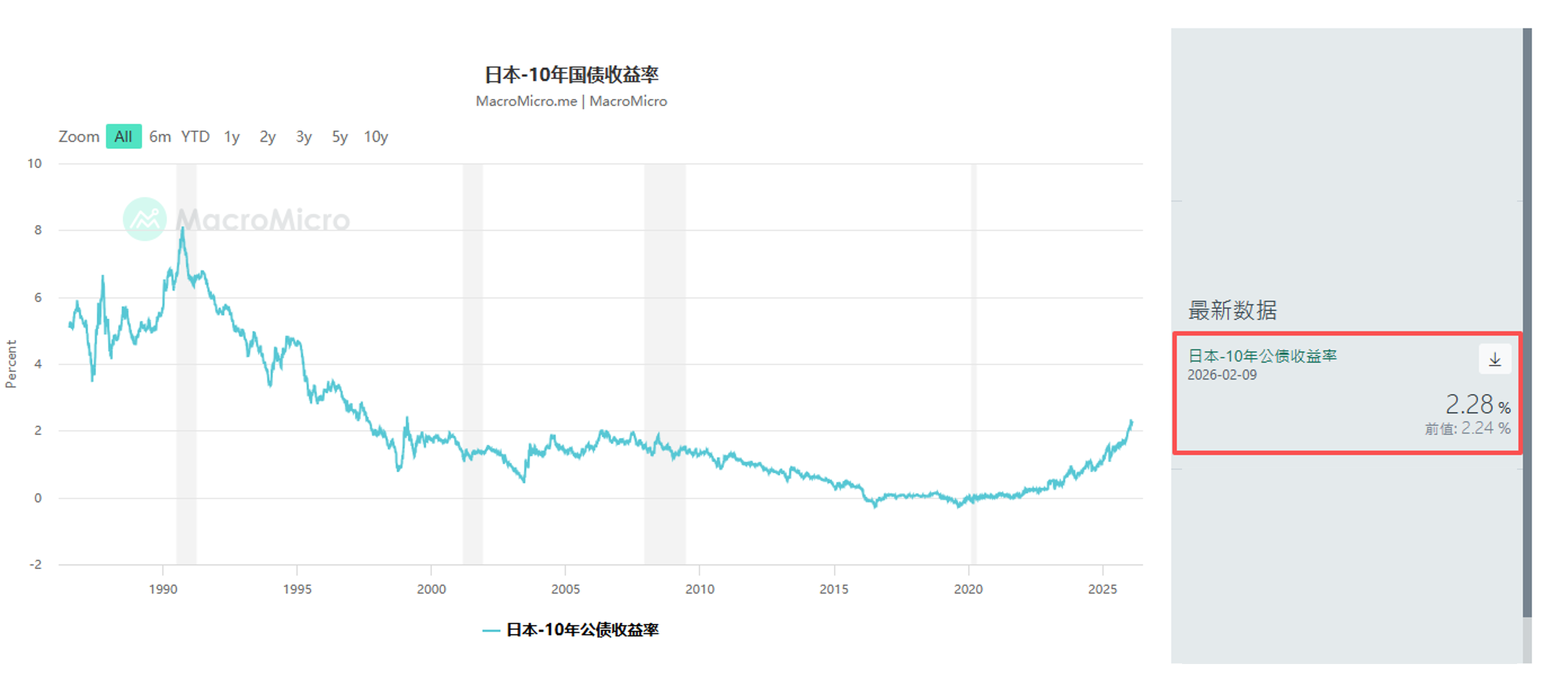
This sends a dangerous signal: the Term Premium is returning.

Investors fear that tax cuts, layered on top of an already heavy debt burden, will force the Japanese government to increase JGB issuance. Although officials have tried to reassure the market that the tax cuts will not be deficit-financed, in the liquidity-starved JGB market, any hint of trouble is magnified.

This also presents a huge dilemma for the Bank of Japan (BOJ). Overnight Index Swap (OIS) data shows the market is currently pricing in a 75% probability of a 25 basis point rate hike at the BOJ's April meeting, with some traders even starting to bet on a March hike.
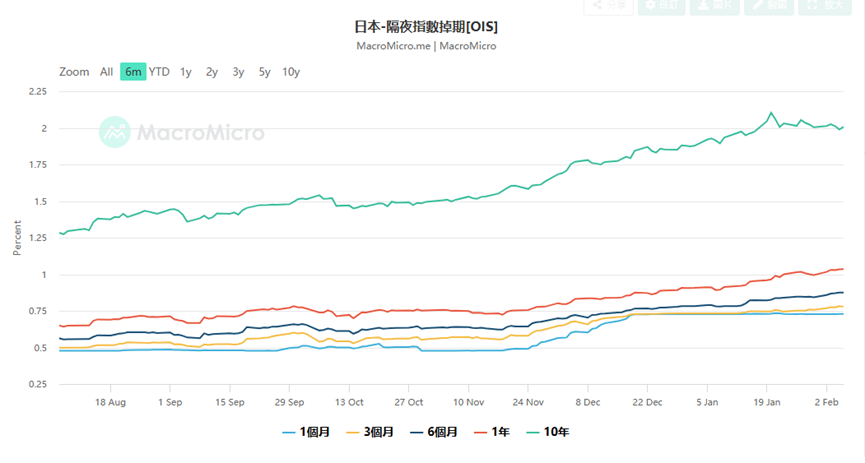
Why bet on a March hike? Because if the yen depreciates disorderly due to fiscal deterioration (it briefly broke past 157.76 yesterday), the central bank must hike rates to defend the currency, even if it exacerbates debt servicing costs. This is a classic "fiscal dominance" dilemma. Yusuke Matsuo, a senior market economist at Mizuho Bank, warned that we need to watch closely for hawkish comments from BOJ board members, as this could be verbal intervention to prevent a yen collapse.

The Japanese market is not an island. Zooming out to a global perspective, the moves on February 9th are part of a broader return of risk appetite, but they also come with deep structural fissures.

  • Chinese Market: This was the most intriguing piece of macro news yesterday: Chinese regulators advised financial institutions to control their holdings of US Treasury securities, citing "concentration risk and market volatility." Although the official wording was cautious, emphasizing this was not related to geopolitics, this move by the second-largest holder of US debt undoubtedly puts upward pressure on US Treasury yields (prices fall), especially amid global liquidity concerns. This is partly why US Treasury yields rose in tandem with JGB yields yesterday. This is essentially telling the market: the anchor of global sovereign credit is loosening.
  • US Market: US markets saw a rebound led by the semiconductor sector on Friday, with Nvidia, AMD, and Broadcom all gaining over 7%. This sentiment transmitted directly to Asia, where semiconductor equipment giants like Tokyo Electron and Advantest were main drivers in the Nikkei's charge. The capital expenditure (Capex) story for AI infrastructure continues, and although Amazon's massive spending raised profitability concerns, the logic of the hardware cycle remains intact as long as demand for Nvidia's GPUs persists.
  • Precious Metals Market: After experiencing sharp volatility, the gold price reclaimed the $5,000/oz level. This is not a safe-haven move; it's a "credit hedge." As Japan engages in fiscal expansion, US debt ceiling issues persist, and China diversifies its reserves, gold becomes the only "supra-sovereign currency." US Treasury Secretary Scott Bessent's accusation that Chinese traders are influencing gold price fluctuations itself exposes the US Treasury's anxiety over dollar pricing power.

Faced with such a fractured market — stock market狂欢 (狂欢:狂欢, feast/celebration) vs bond market暴跌 (暴跌:暴跌, crash/plunge) — how should investors respond?

  • Equity Markets: Long Volatility. Even as the Nikkei hits new highs, the retreat in the VIX index might be the calm before the storm. Key variables this week are Wednesday's labor market data and Friday's inflation (CPI) data from the US. If US inflation rebounds, coupled with a hawkish pivot from the BOJ, global liquidity faces a double tightening.

In this environment, while holding core growth stocks (e.g., semiconductors, Japanese trading houses), it is prudent to use put options for protection. Current Skew data shows put options remain expensive, indicating institutions are not completely off guard.

  • FX Market: Tactical Yen Rebound. The yen around the 157 level carries significant intervention risk. Japanese Finance Minister Takaichi Sanae explicitly stated she is in close contact with the US Treasury Secretary, meaning the possibility of coordinated intervention cannot be ruled out. If the BOJ confirms a hike in March or April, the yen could see a rapid short-covering rally. For carry traders, now is the time to gradually take profits.
  • Alternative Assets: Focus on "Hard Assets." In an era of shaky fiat currency credibility (be it concerns over Japan's fiscal path or US debt worries), gold, silver, and select cryptocurrencies that have stabilized in this pullback (Bitcoin > $70k) hold long-term allocation value. Particularly silver, which, after a sharp 50% correction, could see a new short squeeze triggered by tight physical inventories.

February 9, 2026, Nikkei 57,000 is a milestone and a watershed. It marks Japan's complete departure from the deflationary era and its entry into a "new normal" of high growth, high inflation, and high interest rate volatility. Takaichi Sanae's super-majority is a double-edged sword: it can push stock prices through aggressive policies, but it can also destroy bond market confidence through runaway fiscal deficits.

For finance professionals, the gentle era of "stocks and bonds rising together" is over. We need to adapt to extreme scenarios where the negative stock-bond correlation breaks down, or even situations where both stocks and bonds sell off simultaneously. In this new era, watching the central bank's balance sheet might be more important than watching corporate income statements.


Related Questions

QWhat was the main driver behind the Nikkei 225's surge to 57,000 points?

AThe core driver was the political certainty brought by the ruling coalition's supermajority victory in the lower house election, which fueled expectations of aggressive fiscal expansion and stimulus policies.

QWhy did the Japanese Government Bond (JGB) market experience a sell-off despite the stock market rally?

AJGBs were sold off due to concerns over fiscal sustainability and increased default risk, as investors anticipated higher government debt issuance from potential tax cuts and expansive fiscal policies, leading to a rise in long-term yields.

QHow does the Bank of Japan (BOJ) face a dilemma amid the current market conditions?

AThe BOJ faces a 'fiscal dominance' dilemma: it may need to raise interest rates to prevent disorderly yen depreciation caused by fiscal concerns, even though higher rates would increase the government's debt servicing costs.

QWhat global macro factors are interconnected with Japan's market movements mentioned in the article?

AGlobal factors include China's advice to reduce holdings of U.S. Treasuries (adding upward pressure on yields), the U.S. semiconductor-led stock rebound, and gold's rise as a hedge against sovereign credit risks amid fiscal expansions and debt concerns.

QWhat investment strategies does the article suggest for navigating the current volatile market environment?

AStrategies include long volatility positions in equities with protective put options, tactical bets on a yen rebound due to intervention risks, and allocations to hard assets like gold and cryptocurrencies as hedges against fiat currency credibility erosion.

Related Reads

Only 153 Venture Capital Firms Invested in July: Is the Crypto VC Industry Experiencing a 'Mass Extinction'?

In July 2026, only 153 unique venture capital firms participated in disclosed crypto funding rounds, marking the lowest monthly count since November 2020. This figure represents an 87% decline from the peak of 1,177 firms in 2022. Overall, the first seven months of 2026 saw crypto projects raise approximately $11.78 billion across 481 rounds. This crypto VC contraction contrasts sharply with the broader venture capital landscape, where global VC investment reached a record $560.4 billion in H1 2026, heavily fueled by major AI company financings. This shift in capital allocation has drawn funds away from the crypto sector. Within crypto, funding is highly concentrated. Trading platforms, prediction markets, and payment sectors absorbed 53% of the total capital. While early-stage deals remain frequent, the largest sums flow to a few late-stage rounds and mergers & acquisitions, which surged to $7.23 billion in Q2 2026. The market is consolidating around top funds like a16z crypto and Dragonfly, which successfully raised new multi-billion dollar funds, while many smaller firms have retreated. Analysts describe this as a "great extinction" for crypto VCs, where capital is becoming more selective, favoring proven business models and assets over early-stage speculation. This raises the bar for project quality, funding efficiency, and viable exit paths.

marsbit13m ago

Only 153 Venture Capital Firms Invested in July: Is the Crypto VC Industry Experiencing a 'Mass Extinction'?

marsbit13m ago

Strategy's Loss in the Second Quarter Reaches $8.22 Billion Amid Bitcoin Decline

Strategy, the largest corporate holder of Bitcoin, reported a net loss of $8.22 billion for the second quarter. This loss was primarily driven by an $8.32 billion unrealized loss on its Bitcoin holdings due to a decline in the asset's price during the period. Despite these paper losses, the company increased its Bitcoin holdings to 843,775 BTC, a 25% growth since the start of the year. As part of a new monetization strategy, Strategy sold approximately $218.4 million worth of Bitcoin, mainly to fund dividends for preferred shareholders, with $216 million of that sold after Q2 ended. The company also built a $3.75 billion cash reserve, which it claims is sufficient to cover over two years of dividend and interest payments, aiming to insulate itself from Bitcoin's volatility while meeting obligations. Following the earnings release, Strategy's stock (MSTR) rose 4.7% in regular trading but corrected slightly after-hours. This pattern reflects how the company's accounting results are heavily tied to Bitcoin's price swings, even as its long-term strategy remains unchanged. The report indicates that Strategy is maintaining its core strategy of accumulating Bitcoin while building a financial buffer. This quarterly loss follows a recognizable pattern, with the company posting significant unrealized losses in previous quarters (e.g., $12.4 billion in Q4 2025 and ~$12.5 billion in Q1 2026) due to fair-value accounting. A key technical shift is its new monetization program, which introduces periodic selling pressure on the market, transitioning Strategy from a pure accumulator to a participant that occasionally adds supply. A critical question remains: how long can the cash reserve cover dividend obligations if a Bitcoin price downturn persists beyond two years?

cryptonews.ru33m ago

Strategy's Loss in the Second Quarter Reaches $8.22 Billion Amid Bitcoin Decline

cryptonews.ru33m ago

Will Terrorist Durov Ban Russian Officials?

Telegram founder Pavel Durov publicly reacted to being labeled a "terrorist" by Russian authorities, stating the designation came after he refused demands for mass surveillance and censorship on the platform. In a Telegram post, he highlighted that this status formally bans him from "publishing information online." Durov concluded with a statement widely circulated: Russian officials "clearly don't understand who can ban whom on the internet." This remark suggests Durov could potentially restrict official Russian government and officials' channels on Telegram, which continue to operate on the platform despite its formal blocking in Russia. The situation parallels previous, slow-moving state directives, like switching officials to domestic cars, contrasted with the current push to migrate all government communication to the Russian-made messenger MAX by 2030. However, reports indicate many officials still use Telegram via workarounds, fearing surveillance on MAX, while alternatives like BiP and KakaoTalk recently became inaccessible in Russia without a VPN. Durov has not specified any immediate actions against state channels. His statement is an initial response, with further developments depending on the authorities' reaction. The dynamic differs from 2020 when Russian regulators lifted a block on Telegram; now, Durov implies control from within the platform itself over the official accounts that persisted through that earlier blockade.

cryptonews.ru33m ago

Will Terrorist Durov Ban Russian Officials?

cryptonews.ru33m ago

DeepSeek V4 Official Version Arrives, New Capabilities Emerge, Value-for-Money King Enters the Fray

On July 31st, DeepSeek officially launched the public API beta for its DeepSeek-V4-Flash model. A key highlight is its performance on multiple Agent benchmark tests, reportedly nearing or even surpassing the level of the V4-Pro preview version from three months ago. Notably, the Flash model achieves this with significantly smaller scale (130B active parameters vs. Pro's 490B), suggesting that post-training optimization and data quality may be as crucial as raw model size. DeepSeek emphasized that the V4-Flash-0731 uses the same model architecture and size as its preview version, with improvements attributed solely to "re-trained post-training." The update also marks the official debut of DeepSeek's self-developed Agent framework, "Harness." The move signals DeepSeek's strategic push to position its cost-effective Flash model as a competitive base for Agent applications—scenarios requiring autonomous planning, tool usage, and complex task execution—where inference speed and cost are critical. By natively supporting OpenAI's Responses API format and adapting for code-generation scenarios, DeepSeek aims not just to be a cheaper alternative but to establish its own ecosystem in the Agent era. This release follows DeepSeek's record-breaking ~$50 billion fundraising round roughly two months prior, underscoring market confidence in its technology and commercialization prospects. The company is reportedly preparing for another funding round at a valuation of approximately $71 billion. The Flash model's advancement represents a step in fulfilling the high expectations that come with this valuation, setting the stage for the impending release of the V4-Pro official version and intensifying competition in the global Agent landscape.

marsbit38m ago

DeepSeek V4 Official Version Arrives, New Capabilities Emerge, Value-for-Money King Enters the Fray

marsbit38m ago

Trading

Spot
活动图片