Key points:
- KOSPI’s back-to-back circuit breakers wiped $620 billion in two days, worsened by leveraged retail bets
- Hyperscaler CDS jumped from 115 basis points to 162bps in recent months, implying ~12% five-year default odds, with Oracle’s OpenAI exposure the biggest red flag
- Hynix posted a record 60.54 trillion Korean won profit but still missed the 64 trillion won estimate
Korea sees two-day, $620 billion wipeout
Korean equities saw the second day of a historic sell-off on Wednesday with market-wide circuit breakers again halting trading. Combined with Tuesday’s drop, the KOSPI has now shed nearly 17%, wiping out $620 billion in market capitalization. This has prompted the government to convene an emergency meeting of its financial authorities.
The initial trigger for the sell-off was SK Hynix’s Q2 earnings miss. The stock was down another 4% today, extending Tuesday’s 15% drop. Taken together with Samsung Electronics, the company makes up nearly half of the Korean index.
Related: Trade.xyz to cover SK Hynix perp liquidation losses tied to price anomaly
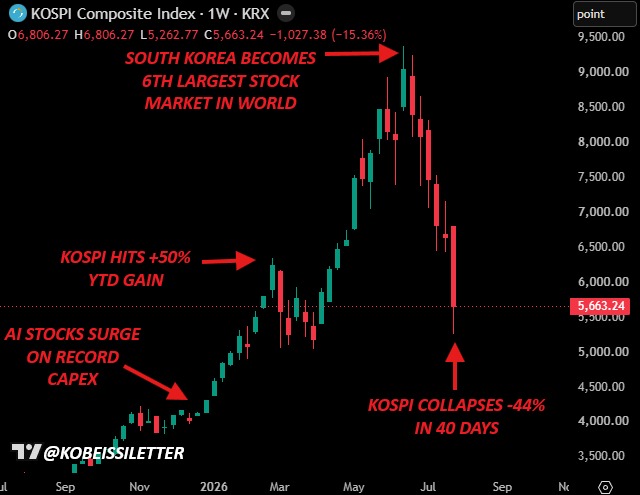
Current KOSPI sell-off on a high timeframe. Source: Kobeissiletter, Tradingview
Among a generation of Koreans priced out of housing and squeezed by a tightening labor market, all-or-nothing bets on high-risk instruments are increasingly popular. This week’s sell-off is hitting risk-loving young Korean retail traders, who have historically had an affection for the crypto sector, but flocked to AI and semiconductor equities in recent months. Korean crypto volumes are down 28%, while the KOSPI remains up 31% year-to-date.
With the approval and launch of single-stock leveraged exchange-traded funds for retail trading in May, those retail investors were drawn into the market and have added additional leverage. The assets under management of these products crossed $50 billion in July. After hefty losses in recent days, top policymakers have now apologized for the decision and called for a renewed ban on retail trading for these instruments.
The sell-off is a further sign that semiconductor and AI stocks are priced for flawless execution, leaving substantial downside if the sector’s aggressive growth targets are not met. Although Hynix brought in a record 60.54 trillion won ($41.25 billion) operating profit, up 557% year-over-year, this figure fell short of the 64 trillion won analyst consensus.
Bond vigilantes eye AI trade
The semiconductor sell-off is consistent with broader signs of fatigue in the AI trade. The uncertainty accruing in the sector has swept over from equity to credit markets. 5-year credit default swaps on a basket of the five largest US hyperscalers — Amazon, Meta, Microsoft, Google and Oracle — have jumped from 115bps to 162bps in recent months and is now at a record high. These instruments let a bondholder pay a periodic fee to a counterparty in exchange for a payout if the underlying borrower defaults. When compared to equal-dated government bonds, the resulting credit spread paints an even more concerning picture.
The market currently implies default odds of 12% for these companies within five years. Sage Advisory said hyperscalers have more than doubled their collective dollar debt footprint since September to more than $360 billion as free cash flow turns negative.The biggest contributor to the credit risk is Oracle after its aggressive AI investments. While the company boasts a massive contract backlog, a significant percentage of it is tied to OpenAI as a single customer, which has struggled to generate cashflow and delayed its IPO.
Combined 2026 capex guidance from Alphabet, Microsoft, Amazon, and Meta is now tracking toward $725 billion-$730 billion. Even Alphabet posted its first cash burn on record in the second quarter, at $5.9 billion, despite its cloud unit posting 82% growth. Meta is slated to report Q2 results later today after US markets close.
Related: Bitcoin lows pierce $63K as Asia chip-stock crash spreads to Wall Street