Coinbase mounts a cautious comeback in India, two years after exit

cointelegraphОпубліковано о 2025-12-08Востаннє оновлено о 2025-12-08

Анотація

Major US cryptocurrency exchange Coinbase is resuming operations in India after a two-year absence, having off-boarded its previous Indian customers in 2023 to start with a "clean slate." The company has reopened app registrations and is offering immediate crypto-to-crypto trading. Coinbase plans to introduce local fiat on-ramps by 2026. The comeback follows recent efforts to rebuild government relations, including securing a license from India’s Financial Intelligence Unit in March 2025 and signing a memorandum of understanding with Karnataka’s IT ministry to collaborate on blockchain innovation and cybersecurity. The exchange has also been engaging with Indian policymakers, expressing optimism about future crypto regulation in the country.

Major US cryptocurrency exchange Coinbase is returning to India after a two-year absence from the market.

Coinbase has resumed app registrations in India as it prepares to roll out local fiat on-ramps in 2026, Coinbase APAC director John O’Loghlen announced at India Blockchain Week (IBW), according to a Sunday report by TechCrunch.

Coinbase’s return to India comes more than two years after it ceased local services in September 2023, following a troubled debut of its local exchange launched in 2022.

“We had millions of customers in India, historically, and we took a very clear stance to off-board those customers entirely from overseas entities, where they were domiciled and regulated. Because we wanted to kind of burn the boats, have a clean slate here,” O’Loghlen said.

Crypto-to-crypto trades available immediately

As Coinbase resumes customer onboarding in India, users can immediately execute crypto-to-crypto trades, according to a report by TechCrunch.

The exchange initially began onboarding users through an early-access program in October, around the time it hired Karan Malik as its India marketing lead.

Source: Coinbase India marketing lead Karan Malik

Malik had previously overseen marketing for last year’s IBW event, where Coinbase served as a platinum sponsor this year.

“Last year, I was leading the charge and building the marketing and brand playbook for IBW. This year, I’m bringing Coinbase to the party,” the exec said.

Coinbase ramps up push in India

Coinbase has been actively working to rebuild its relationship with the Indian government recently. In early December, Coinbase’s international policy adviser Katie Mitch represented the exchange before India’s Parliamentary Standing Committee on Finance.

“We are optimistic on the potential for forward-looking VDA regulation in India,” she said in an X post last Thursday.

In another development last week, Priyank Kharge, IT minister for Karnataka, signed a memorandum of understanding with Coinbase India to deepen the state’s leadership in blockchain innovation and cybersecurity.
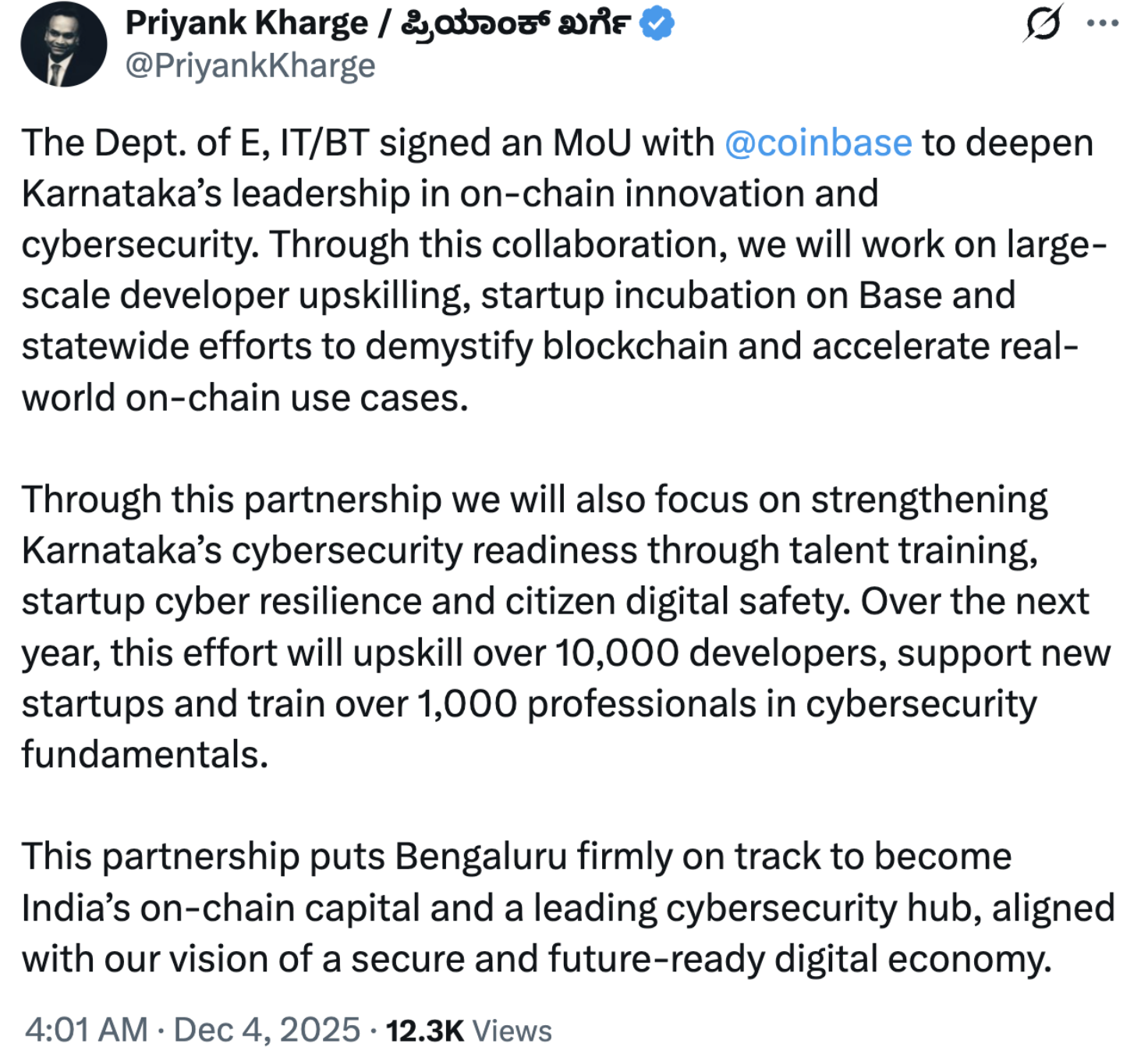
Source: Karnataka IT minister Priyank Kharge

Through the collaboration, the Karnataka government will collaborate with the exchange on startup incubation on Coinbase-backed Base protocol and speed up real-world applications of blockchain technology, the minister said.

Related: Coinbase invests in Indian crypto exchange CoinDCX at $2.45B valuation

As previously mentioned, Coinbase secured a license with India’s Financial Intelligence Unit in March 2025, positioning the exchange for a potential launch in the country. In August, Coinbase chief legal officer Paul Grewal also met with Karnataka’s IT minister Kharge to explore collaboration on developer tools, cybersecurity and blockchain in governance.

Cointelegraph approached Coinbase for comment regarding its relaunch in India, but had not received a response by the time of publication.

Magazine: When privacy and AML laws conflict: Crypto projects’ impossible choice

Пов'язані матеріали

When Nasdaq Starts 'Putting Stocks on the Chain', What Are We Really Welcoming?

Nasdaq is advancing a proposal to move U.S. stock settlement onto the blockchain, which could fundamentally reshape the infrastructure of American capital markets. This shift aims to replace the current slow, manual, and multi-layered clearing system with real-time, automated on-chain settlement. While many discussions focus on surface-level changes like 24/7 trading, the core transformation is structural: moving from outdated T+2 (or even T+1) settlement to instantaneous, programmable, and transparent ledger-based clearing. This isn’t about making stocks “more Web3” but modernizing a financial system that still relies on processes from the 1970s. The existing system—with its custodians, sub-custodians, and clearing intermediaries—creates operational friction, risk, and cost, as seen during events like the GameStop trading halts and the FTX collapse. On-chain settlement could reduce the need for traditional custodial roles, compress arbitrage opportunities built on settlement delays, and turn static securities into dynamic, composable financial instruments. The move faces significant resistance from entrenched intermediaries who profit from the current structure, but the direction of change appears inevitable. As demonstrated by Hong Kong’s recent issuance of a green bond settled in one second (versus five days), tokenization of traditional assets is becoming an operational reality—not a conceptual experiment. When stocks migrate on-chain, other assets like bonds and derivatives may follow, leading to a quiet but profound shift in how global markets function. This isn’t just a change in technology; it’s a change in the nature of finance itself.

cointelegraph_中文Щойно

When Nasdaq Starts 'Putting Stocks on the Chain', What Are We Really Welcoming?

cointelegraph_中文Щойно

Solana's Two Leading Lending Protocols Clash, Foundation Steps In to Mediate

Summary: Over the weekend, a public dispute erupted between Solana's two leading lending protocols, Jupiter Lend and Kamino, centered on the definition of "risk isolation." The conflict began when Kamino's co-founder, Marius Ciubotariu, accused Jupiter Lend of misleading users. He argued that Jupiter's early marketing claimed its lending pools were "risk-isolated," preventing cross-contamination between assets. However, Kamino contends that Jupiter Lend's design, which allows for the rehypothecation (re-use) of collateral across pools, creates a risk of contagion, contradicting its marketing. In response, Jupiter's COO, Kash Dhanda, admitted the initial "zero contagion risk" social media posts were inaccurate and apologized. The debate highlights a core disagreement on the definition of "risk isolation." Jupiter and its supporters argue the term has design flexibility, noting that while pools share a liquidity layer, each has independent parameters. Kamino and its allies insist that any rehypothecation negates true risk isolation. The dispute escalated when Tushar Jain, a partner at Kamino investor Multicoin Capital, strongly criticized Jupiter, accusing the team of being either incompetent or deliberately misleading. In contrast, Solana Foundation President Lily Liu urged for cooperation, emphasizing that the Solana lending market is much smaller than Ethereum's and that internal conflict only helps competitors. The clash is seen as an inevitable result of intense competition. Kamino was long the Solana lending leader, but Jupiter Lend has rapidly gained significant market share. In a tighter market with reduced liquidity and heightened safety concerns, the competition between the two protocols has become increasingly fierce.

marsbit11 хв тому

Solana's Two Leading Lending Protocols Clash, Foundation Steps In to Mediate

marsbit11 хв тому

Торгівля

Спот
Ф'ючерси
活动图片