This week, Coinbase and Robinhood will announce their second-quarter 2026 financial results, and in this regard, the reports will tell a story about the future of cryptocurrencies as well as about the companies themselves.
Robinhood will publish its report on Wednesday after market close, and Coinbase on Thursday. Collectively, the reports from both companies serve as one of the clearest indicators of whether digital assets continue to evolve through speculative trading or are transforming into a more sophisticated type of financial infrastructure, encompassing stablecoins, subscription products, and "tokenized" assets.
Two Financial Reports the Whole Market Will Read
Coinbase and Robinhood became public companies in 2021 but took different paths to do so. While Coinbase built its business on cryptocurrency trading and custody, Robinhood established itself as a company offering commission-free trading, later expanding its activities into cryptocurrencies and other digital assets. Today, both companies are becoming competitors in the same markets.
Wall Street expects Robinhood to report a profit of about $0.40 per share on expected revenue of $1.25 billion, and Coinbase to report a loss of about $0.36 per share on revenue of approximately $1.3 billion.
Although both companies have roughly similar revenue volumes, investors treat them completely differently. Data from Artemis shows that Robinhood has historically been valued higher than Coinbase based on the enterprise value-to-revenue ratio, indicating that investors perceive it more as a diversified fintech company than as an organization primarily engaged in cryptocurrency trading.
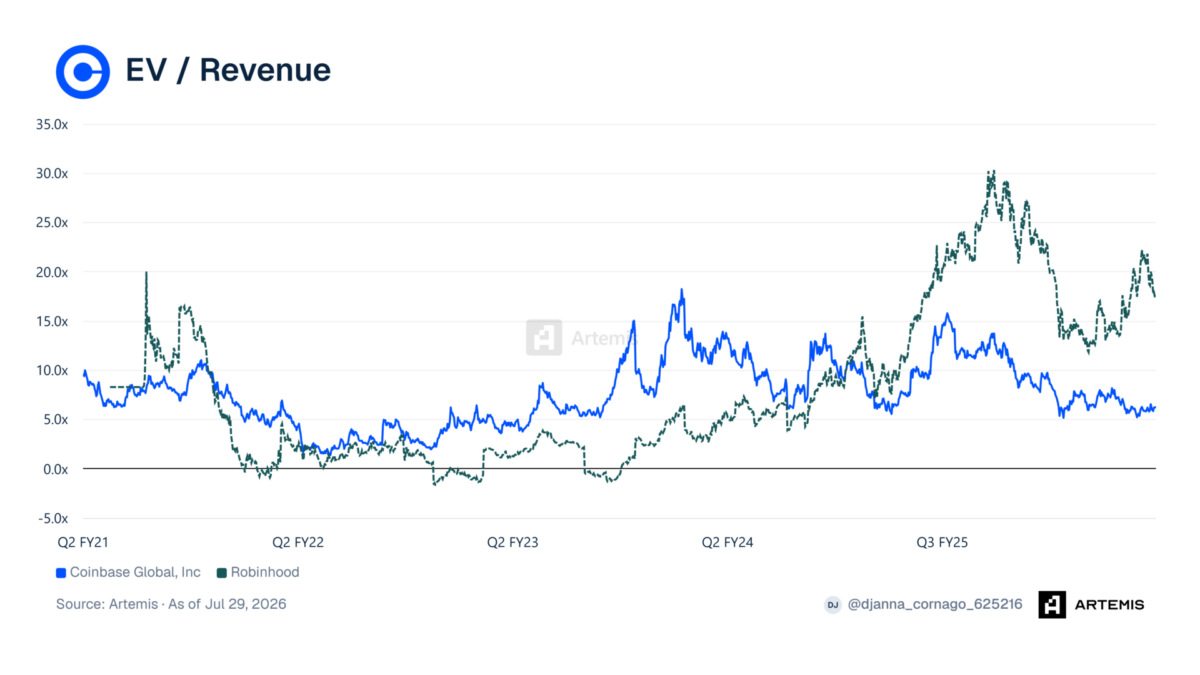
This distinction was further emphasized following downgrades of Coinbase by a number of analysts, with Mizuho analyst Dan Dolev suggesting that Robinhood could become the first "hyperscale player" in the brokerage sector.
Why the Retail Trading Downturn Matters Beyond Just Two Stocks
Cryptocurrency markets surged sharply after Donald Trump's election victory in late 2024, then fell as retail investor activity declined.
Robinhood appears to have adapted better to the changes. Data from Artemis showed that Robinhood's quarterly trading volume grew from about $261 billion in early 2024 to over $704 billion in Q1 2026. Coinbase also showed improvement: total trading volume increased from about $185 billion to around $517 billion over the same period, although more slowly than Robinhood.
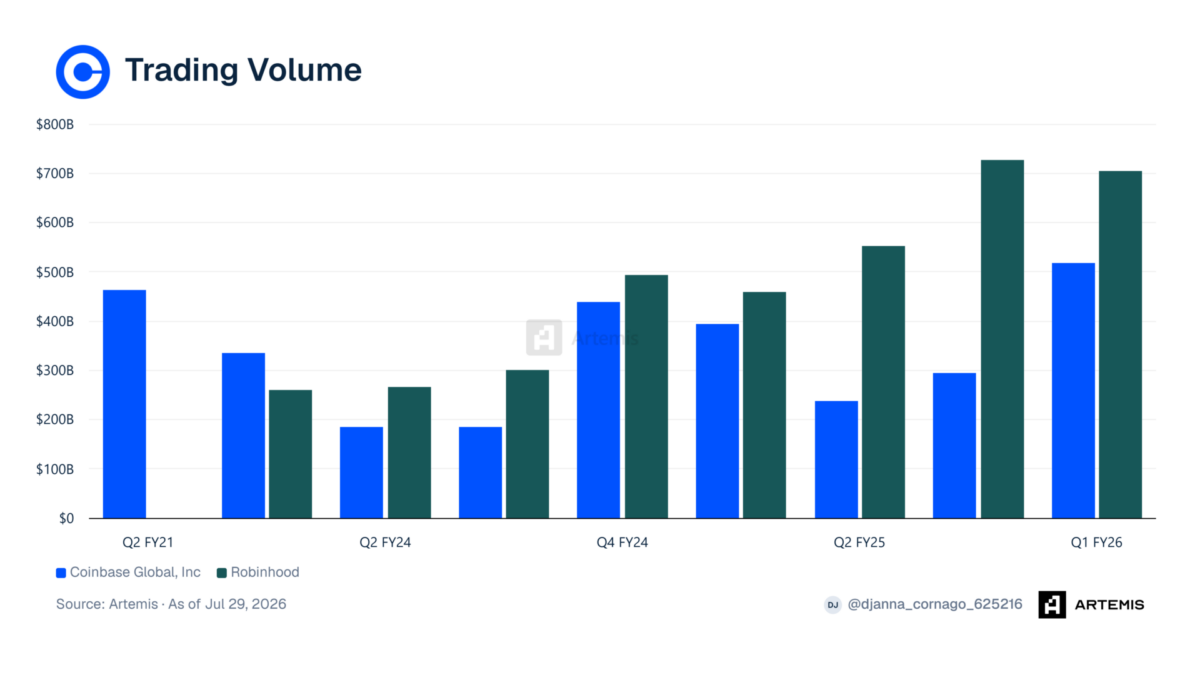
The difference indicates that Robinhood has gained a larger share of the retail trading business. However, investors will assess not only trading volumes but also whether these achievements can translate into sustainable profits.
Both companies have invested significant resources in the area of tokenized stocks and believe that their bet on blockchain technology will pave the way for integrating traditional financial instruments with cryptocurrencies. This strategy points to a broader movement towards creating other, more long-term revenue sources beyond transaction fees.
Coinbase's Stablecoin Processing System Faces New Competitors
Coinbase appears to have successfully reduced its reliance on fees from trading operations in recent years.
According to Artemis data, subscription and services revenue grew from about $103 million in mid-2021 to nearly $747 million by Q3 2025. Stablecoin revenue also increased significantly, rising from approximately $77 million at the end of 2022 to over $364 million, before slightly declining this year.
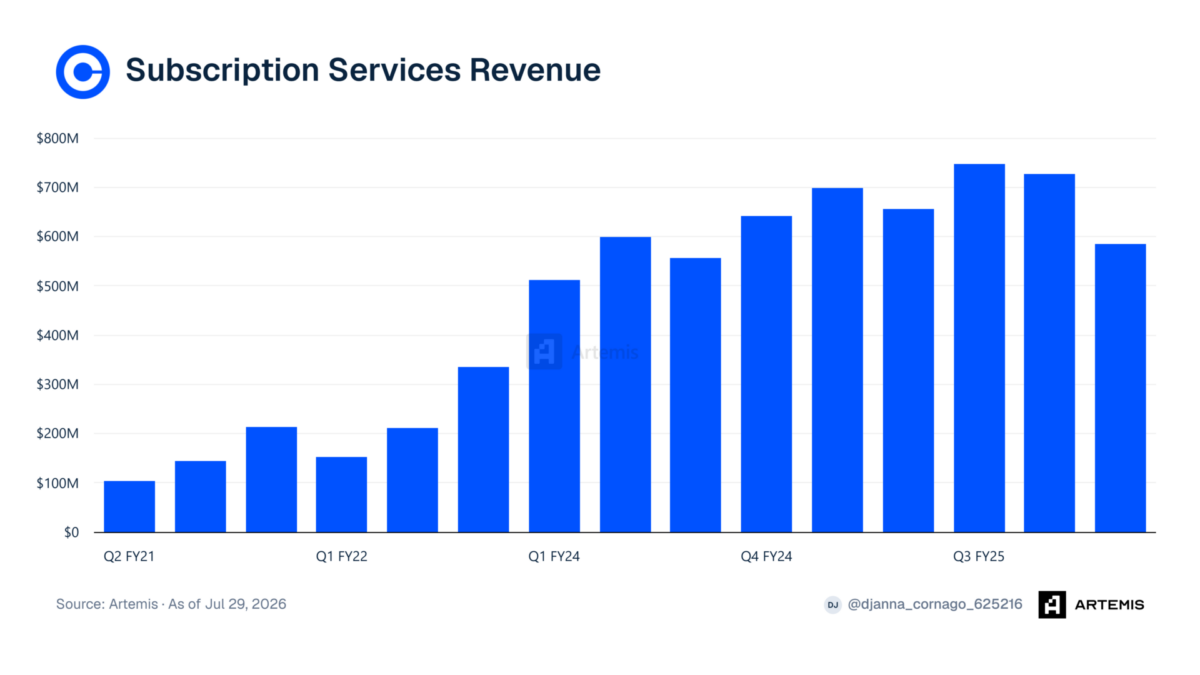
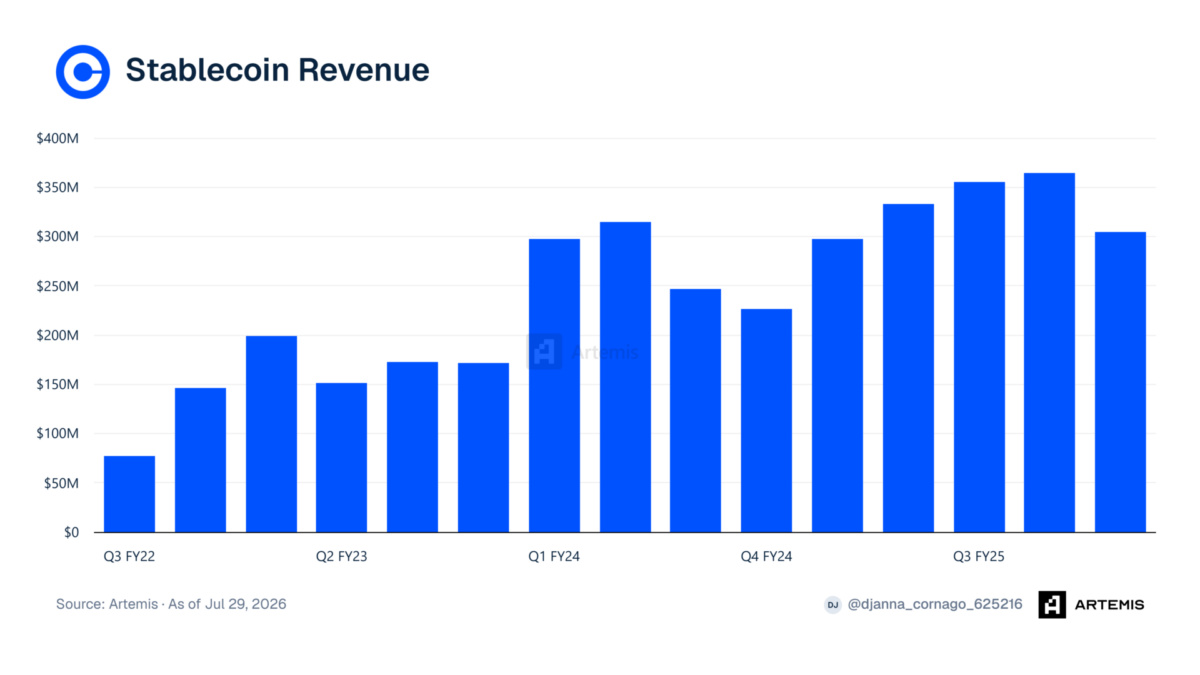
These segments have mitigated the impact of declining trading activity, and client assets on the exchange have remained above bear market lows despite recent fluctuations.
However, there is a concentration risk. In its Q1 shareholder letter, Coinbase reported that over half of its subscription and services revenue is linked to USDC. This segment may face pressure as both banks and major payment processors launch new dollar-backed stablecoins.
CEO Brian Armstrong has also refocused Coinbase's goals on financial infrastructure after realizing that the company's previous attempts to create a social network using Base were unsuccessful.
Robinhood's Global Expansion
The Robinhood company is pursuing many similar initiatives but is scaling them through its consumer platform.
Earlier this month, the company announced the launch of Robinhood Chain, an Arbitrum-based layer-2 blockchain, as well as the tokenization of U.S. company stocks for clients in over 120 countries. Robinhood claims to have nearly 28 million customers conducting business in 38 countries.
CEO Vlad Tenev called tokenization a potential "supercycle" for capital markets, reflecting growing institutional interest in blockchain-based settlements and digital securities.
However, Robinhood is not as dependent on cryptocurrencies as Coinbase. Digital assets account for only about 12% of the company's revenue, while brokerage services, options trading, prediction markets, and other products provide additional income streams.
Such diversification helps explain why investors continue to value Robinhood higher than Coinbase, despite both companies having roughly similar revenue.
end-content






