Yesterday, we introduced the hottest new Solana meme coin, $ANSEM, asking '24-Hour 600x Surge, How Long Can This Solana Meme Last?'
Then, this morning, another token surged over 20x, further heating up the meme frenzy on Solana. Let's first look at the new hot targets, then analyze the reasons behind this sudden market surge.
The 'Celebrity Coin' Spawned a Strong Second
TJR (@_TJRTrades) is also a well-known KOL. His regular content focuses on trading analysis, so on-chain meme players might not be very familiar with him. He has only 250k followers on X, but boasts over 1.5 million followers each on Instagram, TikTok, and YouTube.
Starting yesterday, TJR posted several tweets, publicly stating he would help Ansem create content for TikTok, expanding his influence beyond X to bring in more new users unfamiliar with cryptocurrency. He also purchased $100k worth of $ANSEM and continued to promote it.
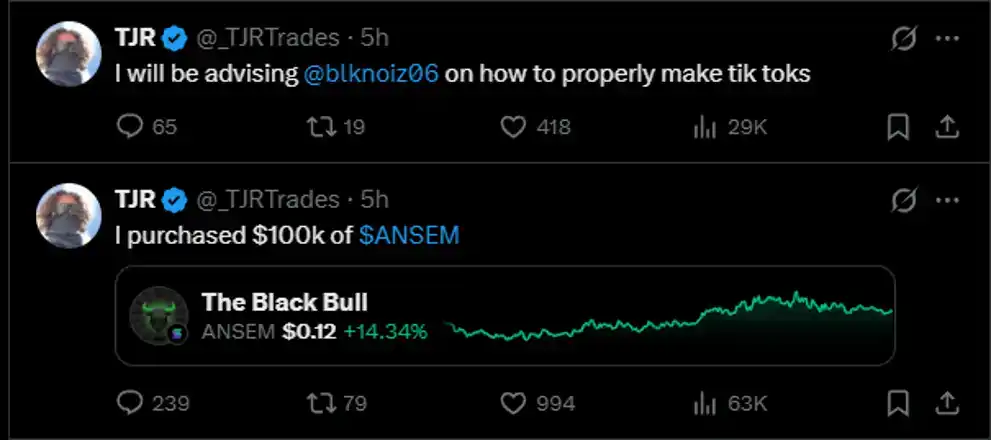
Originally, he indicated he would not participate in the typical behaviors of 'leaving a wallet address,' 'devs sending tokens,' or copying the $ANSEM success path:
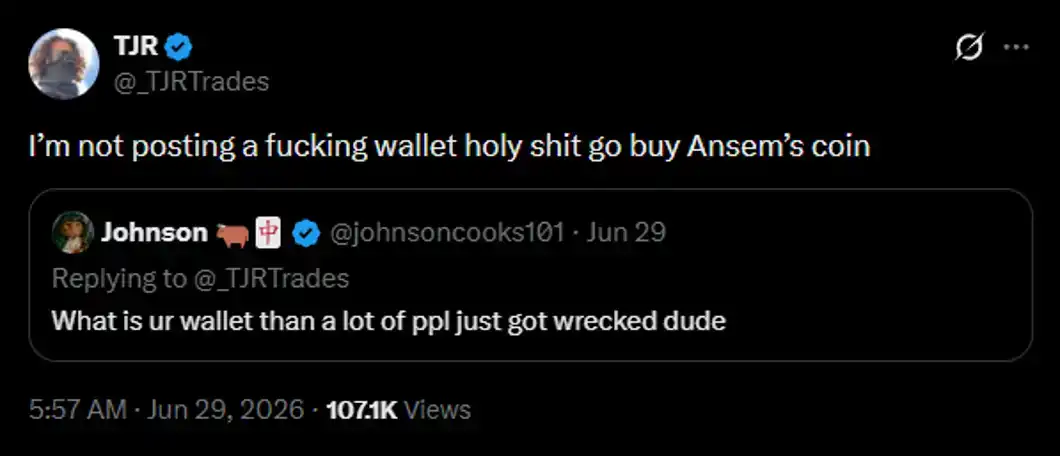
However, things changed at 6 AM this morning. He posted 'Should I hop in?', signaling a shift in stance:

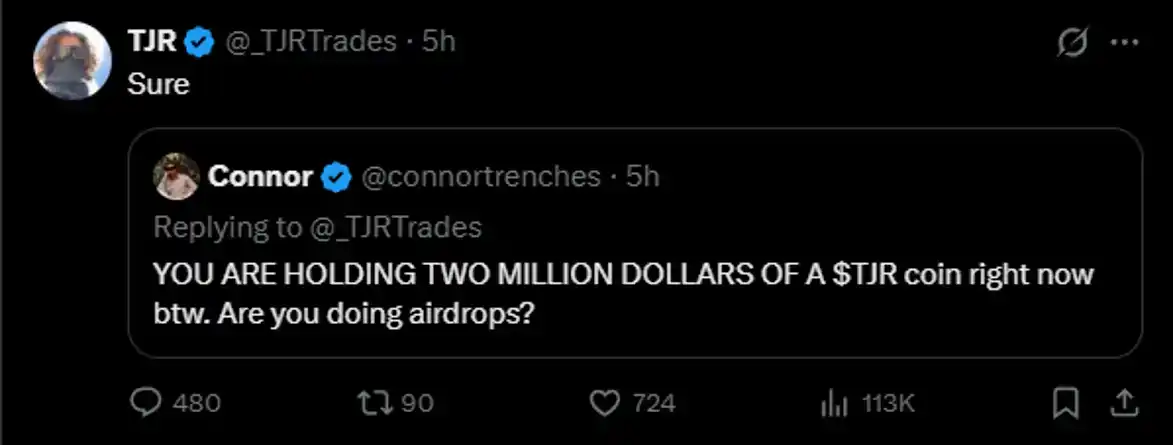
A few hours later, he replied to a tweet asking if he would airdrop his held $TJR with, 'Ofc.' This was seen by the market as a signal of endorsement. $TJR began to be FOMOed, surging from a market cap of around $1.6 million to a peak of $28 million. Just yesterday, $TJR had a market cap of only $400k at one point.
Furthermore, the dev who deployed $TJR is also the dev behind $ANSEM. This time, he sent 79% of the $TJR supply to TJR's address.
According to GMGN monitoring, since creating this token 13 days ago, this dev initially sold for a net profit of $5,500, then, over the past 7 days, began batch-minting tokens, frequently replicating various 'celebrity coins' and building his own positions while being highly active on X social media, frequently interacting to generate hype.
Within these 7 days, this address has created as many as 101 different meme coins (mostly various celebrity coins with some fan base). Among them, 12 reached highs exceeding a million-dollar market cap, and 3 broke through the ten-million-dollar mark.
As of now, the deployer's paper profit over the past seven days has reached 82,000 SOL, approximately $6.08 million. Just the deployer fees from several of these high-market-cap meme coins alone contributed $193k, with a 30-day profit of $8.77 million.
Beyond pure 'celebrity coins' like $TJR with KOLs personally promoting them, some variants have also performed well.
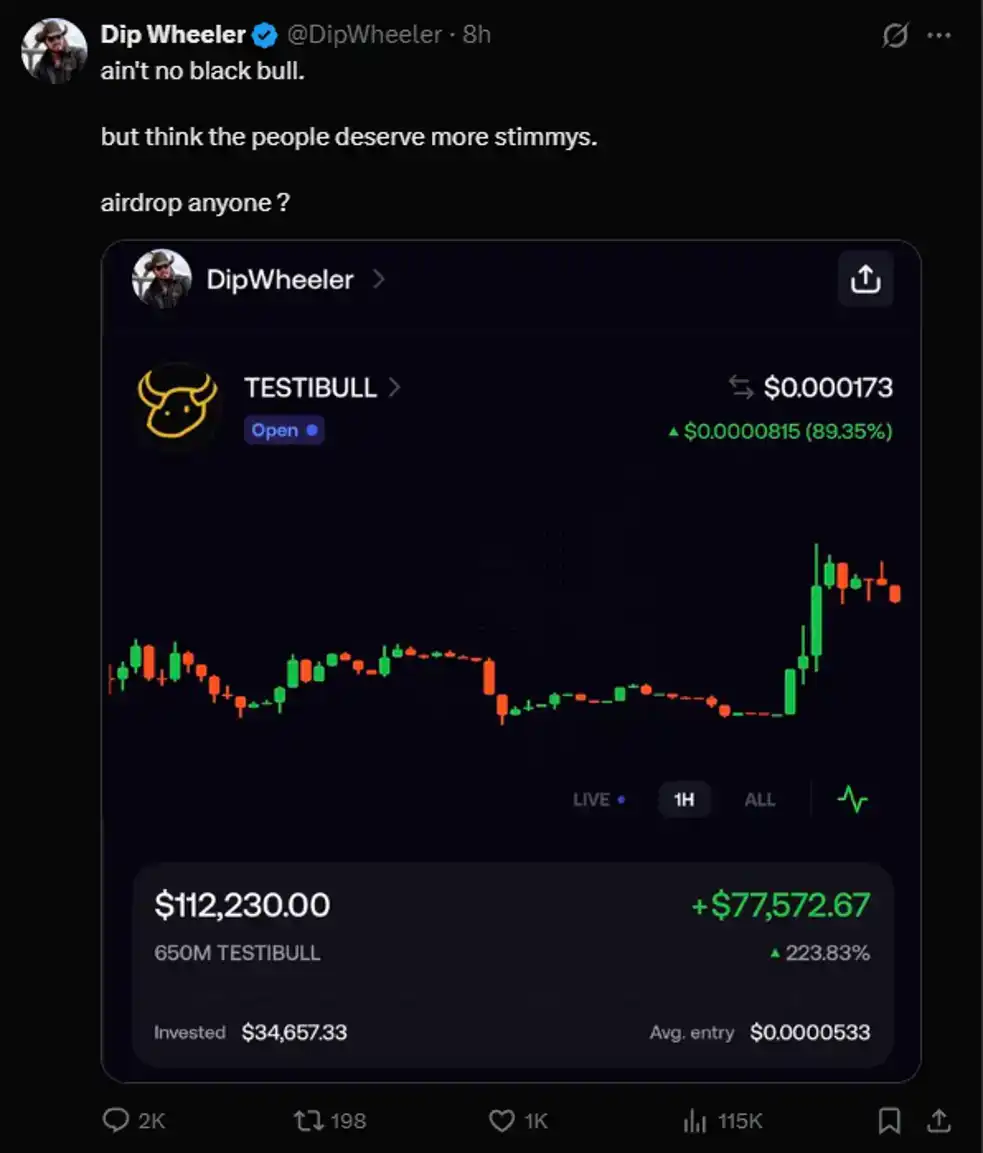
$TESTIBULL, a variant derived from the testicle-themed meme $TESTICLE, imitating the $ANSEM 'The Black Bull' theme. $TESTICLE was previously promoted mainly by KOL Dip Wheeler(@DipWheeler), known for achieving substantial gains on Fartcoin. He announced plans to airdrop $TESTIBULL, causing the coin's market cap to skyrocket from a low of $40k yesterday to nearly $5 million at its peak today.
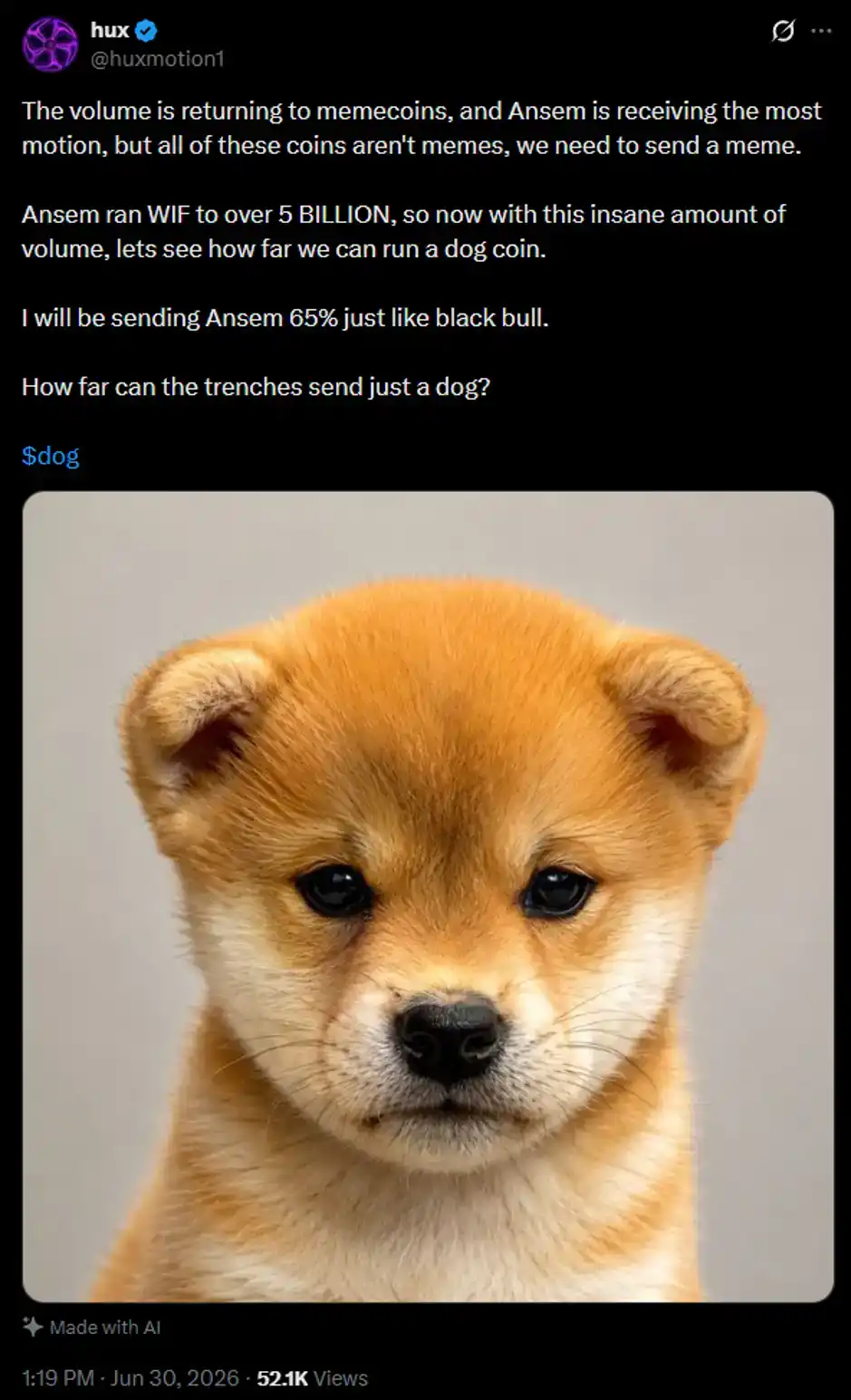
$dog, originally intended to reference Ansem's past success in pushing $WIF to tens of billions in market cap. With the market recovering, sending tokens to Ansem could supposedly create a new dog coin like $WIF.
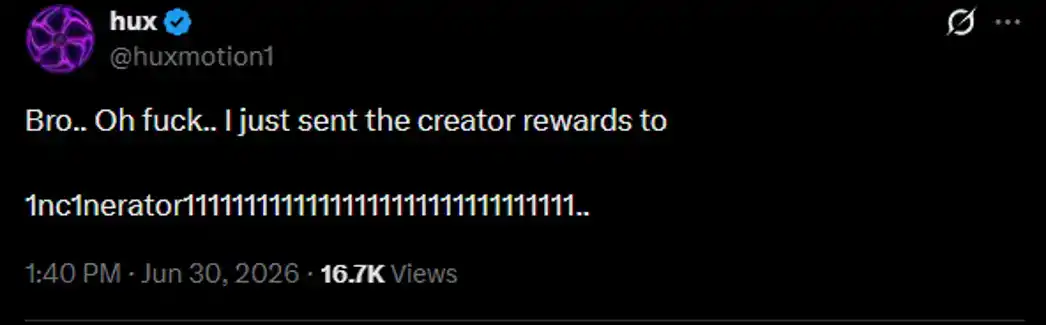
However, the dev made a mistake and sent the tokens to a burn address instead. This twist added a dramatic effect reminiscent of the $SLERF incident, combining the 'celebrity coin' airdrop play with unexpected drama, driving the coin's market cap to exceed $8 million at one point.
Market Analysis
This intraday surge arrived abruptly. While $ANSEM didn't experience a significant drop today, it also didn't continue its upward momentum from the previous two days.
'Celebrity coins' are not a novel concept. Some players who dislike this approach even viewed the rise of $TJR as a potential peak signal for this rally, calling it the 'MELANIA moment.'
While 'celebrity coin' frenzies appear repeatedly, it's not accurate to dismiss them all as the 'same old story.' Each occurrence, at different times and under different circumstances, has specific reasons for analysis. This time:
- On-chain players have been starved for too long. The meme market has been sluggish for a while; Solana hasn't seen a new meme coin break the $100 million market cap mark in a long time (though a large portion of $ANSEM is still controlled by Ansem).
- Severe FOMO from missing out, creating a tinderbox. Due to the prolonged market slump, most players didn't anticipate $ANSEM reaching a market cap exceeding $100 million. Many sold early or completely missed out. This FOMO sentiment transferred to $TJR.
- The VC-ization of Meme coins. On-chain players have persisted diligently, but reality shows it's become quite difficult for meme coins to reach even a ten-million-dollar market cap, with exchanges largely closing listing channels for new meme coins and market makers not providing significant pumps. For players, the 'fairness' of a meme coin is no longer about who holds more or less, but about 'whether I have a chance to get in at a low market cap for high-risk, high-reward odds.' In this context, even if a large portion is controlled by KOLs like Ansem or TJR, people might feel reassured by the celebrity endorsement or think 'they have to pump it to a certain level to exit.'
The VC-ization of meme coins was already evident when Trump launched his token. As long as there's a narrative and potential profits, few complain about large token concentrations; instead, they see a small float and high upside potential. Influencers are effectively playing the role VCs did in the VC coin era—traffic, recognition, and consensus become liquidity.
Based on current observations, this 'celebrity coin' rally has attracted the return of many previously active 'first-level' meme coin hunters. Encouraged by the success of $ANSEM and $TJR, they've begun accumulating tokens associated with potential figures who might step forward to endorse them, such as crypto KOLs like bonkguy, him, etc. However, whether the rally sustains depends on whether $ANSEM can set new highs; otherwise, the hype could dissipate quickly.