Indepth ResearchNews

Provide in-depth research reports and independent analysis, leveraging data, technology, and economic insights to deliver a comprehensive examination of the blockchain ecosystem, project potential, and market trends.

Annual Revenue of 13 Billion, Paying 17.2 Billion to Microsoft: The Truth Behind AI's Money-Burning in OpenAI's Leaked Ledger

Leaked OpenAI financial documents from June 2026 revealed that in 2025, the company achieved $13.07 billion in revenue, a 253% growth from 2024. However, this was accompanied by an operational loss of $20.92 billion and a net loss of roughly $8 billion. Despite ChatGPT surpassing 900 million weekly active users, the "burn rate" remained high: for every $1 earned, $1.60 was spent. The cost structure shows $34 billion in total costs. R&D was the largest expense at $19.18 billion, which included $10.59 billion paid to Microsoft. Compute costs for model inference were $7.5 billion, with sales and marketing at $5.73 billion. Notably, total payments to Microsoft reached $17.2 billion, accounting for over 50% of OpenAI's total costs and exceeding its annual revenue, highlighting a significant structural burden. This high-cost, high-loss model is an industry-wide trend. xAI reported a 2025 operational loss of $6.4 billion against $3.2 billion in revenue, spending $3 for every $1 earned. Anthropic, with a reported $90 billion annualized revenue by late 2025, also faced pressure with a 40% gross margin, lower than expected due to high inference costs. Combined, these top three firms' operational losses surpassed $30 billion in 2025. OpenAI's vast user base presents a monetization challenge. With only about 50 million of its 900 million weekly users paying (a ~5.6% conversion rate), the compute cost of serving free users is substantial. This contrasts with strategies like Anthropic's, which focuses on premium pricing for enterprise clients. The industry's path to profitability hinges on dramatically reducing marginal costs, particularly for inference, through innovations in specialized chips or model efficiency. Until then, massive capital inflows—like OpenAI's $122 billion funding round in March 2026—remain essential to fund the relentless pursuit of scale and advanced capabilities.

marsbit06/18 03:59

Annual Revenue of 13 Billion, Paying 17.2 Billion to Microsoft: The Truth Behind AI's Money-Burning in OpenAI's Leaked Ledger

marsbit06/18 03:59

Dalio's Key Long-Read: How to Position in the Current Market Environment?

Ray Dalio's latest article provides a strategic framework for navigating the current investment landscape, characterized by a market heavily concentrated in AI and other revolutionary new technologies. He argues that investors should view their decisions like moves in a game (e.g., chess, poker), assessing the current "board" shaped by key forces: the AI-driven industry cycle, debt/money, politics, geopolitics, and nature. He warns that such technology-driven periods naturally involve high excitement, volatility, and uncertainty, with historical precedents showing most investors fail by concentrating bets on a few leading companies. The core choice is whether to (a) overweight the new tech sector, (b) match index weightings, or (c) diversify away from this concentration. Dalio strongly advocates for (c) – embracing diversification. He emphasizes that large, new tech companies face inherent risks: over/under-investment, external shocks, future disruption, and intense geopolitical competition (notably from China). His guiding principle is the "holy grail" of investing: a well-engineered portfolio of 15+ high-quality, uncorrelated, and risk-balanced bets. Mathematically, this significantly improves the risk-return ratio compared to any concentrated position. Given the current environment's high uncertainty and concentration, he believes no one can reliably predict outcomes to justify large, concentrated bets. Dalio also expresses a tactical view that future equity returns appear low, with his metrics suggesting potentially negative real returns over 5-10 years. He cautions against conflating excitement about a technology with the attractiveness of its stocks. The key takeaway is that investors should acknowledge the limits of their knowledge, avoid forced opinions, and prioritize a strategically diversified portfolio over risky, correlated concentrated bets.

marsbit06/18 03:17

Dalio's Key Long-Read: How to Position in the Current Market Environment?

marsbit06/18 03:17

The DeepSeek Fundraising Story

"The DeepSeek Funding Story: Insights from the $2.15 Billion Round" This article details behind-the-scenes narratives from DeepSeek's recent massive funding round. Key highlights include the legendary four-hour online investor meeting where CEO Liang Wenfeng, despite not being a charismatic speaker, impressed attendees with his focus on AGI and team stability. He emphasized the philosophy of "ordinary people doing extraordinary things" and a steadfast commitment to solely advancing intelligence. The fundraising process, initiated in April, saw initial demands for a minimum investment of 5 billion RMB, no syndication, and a pure RMB structure. These terms were later adjusted to a 1.5 billion RMB minimum to accommodate more investors. A notable absence was the lack of participation from major VC firms Sequoia China and Hillhouse Capital, despite early rumors, making IDG the only established VC in the final lineup. The investor list, while showing 10 entities, actually involved nearly 100 underlying institutions and individuals upon closer examination. Significant participants included Monolith Capital, which doubled its commitment to 3 billion RMB, and Zhenxingu Capital, an unexpected entrant. Liang Wenfeng's paramount condition for all investors was a strict agreement not to poach DeepSeek employees. The article reflects on DeepSeek's unexpected openness to funding and the mix of strategies—synergy, insight, brand alignment, and persistence—that secured investors a stake. The overarching sentiment among participants is one of pride and a shared belief in DeepSeek's potential to become a landmark Chinese company, driven by a profound sense of purpose in the AGI race.

marsbit06/18 02:06

The DeepSeek Fundraising Story

marsbit06/18 02:06

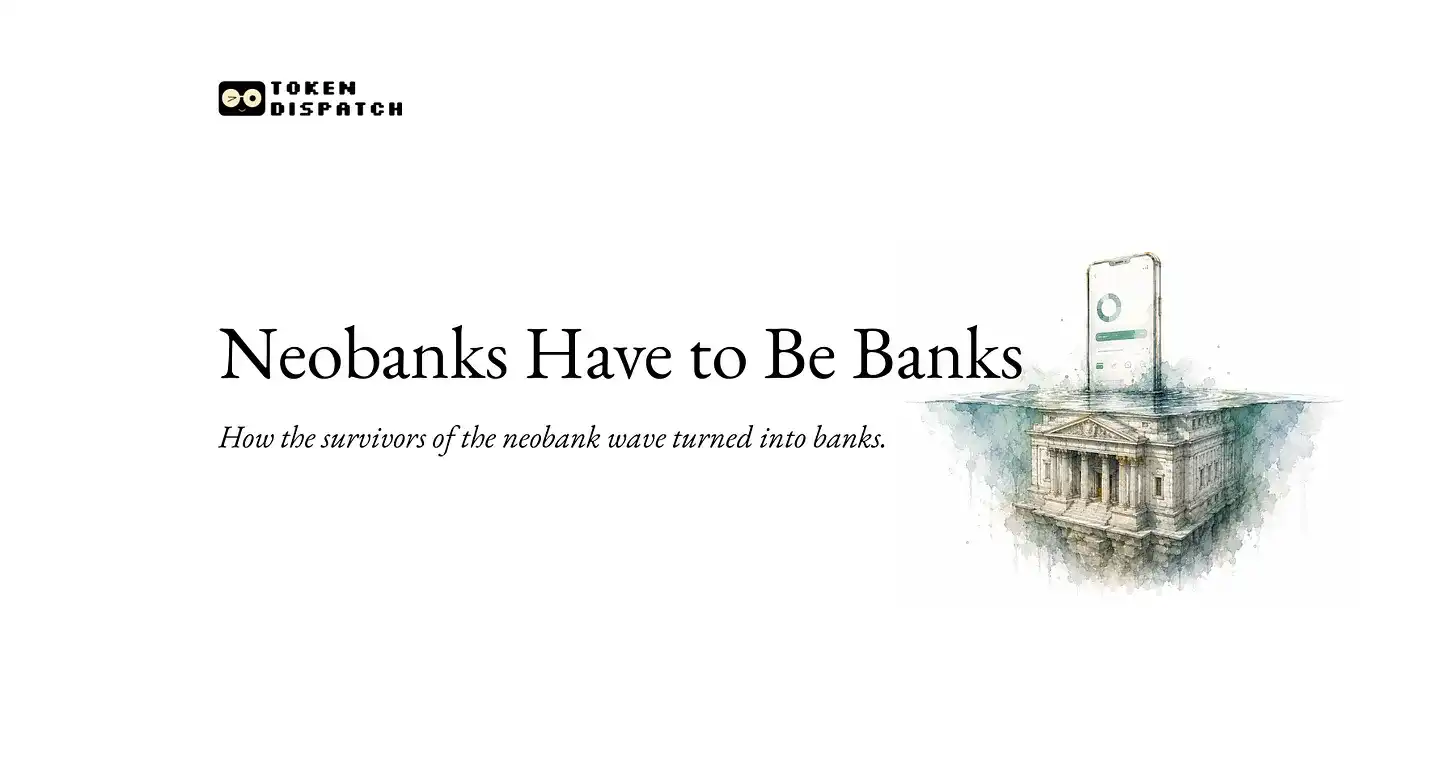
The Fate of Digital Banks: A Fancy App Can't Match a Banking License

**Title:** The Fate of Digital Banks: A Fancy App is No Match for a Banking License **Summary:** The article argues that digital-only "neobanks" have struggled to achieve profitability, with 76% still operating at a loss. Their core mistake was focusing on offering low-fee checking accounts, which generate minimal revenue from interchange fees. The fundamental profit engine of banking is **credit**—lending money and earning interest—a business largely restricted to licensed entities. Successful neobanks like **Nubank** and **Revolut** only became profitable by pivoting to become full-scale lenders, using their sleek apps as mere customer acquisition tools. Others, like **Chime**, suffered for years relying solely on transaction fees before embracing lending. The piece highlights the systemic risks of depending on third-party infrastructure, exemplified by the **Synapse** bankruptcy which froze millions in user funds. The only reliable safeguard is a **banking license**, which provides direct regulatory oversight and control over assets. This realization is now dawning in the cryptocurrency sector. Major firms like Paxos, Circle, and Crypto.com are actively seeking **national trust charters** from the OCC to legitimize their operations and escape dependency on traditional banking partners. Companies like **SoFi** have completed the evolution from fintech to licensed bank to stablecoin issuer. While DeFi has grown in secured lending, **unsecured lending** remains minuscule due to the lack of real-world identity and legal recourse for defaults on blockchain. Truly scaling credit likely requires a banking license. The conclusion is stark: despite promises of disruption, surviving digital banks have simply replicated the age-old banking model—profiting from interest on loans. A user-friendly interface changes the experience, but not the essential economics. In the end, a banking license is not an option but a necessity for sustainable operation.

marsbit06/18 01:53

The Fate of Digital Banks: A Fancy App Can't Match a Banking License

marsbit06/18 01:53

qinbaFrank: Review and Outlook of the AI Computing Power Wave — From the Three Debates on NVIDIA to Optical Interconnect and SpaceX IPO, How is Capital Rotating?

**Summary: Retrospective and Outlook on the AI Computing Wave - A Framework for Capital Rotation** Based on a presentation by investor qinbaFrank, this analysis reviews the AI computing market trajectory since 2023 and outlines a forward-looking framework. **Key Phases and Market Debates:** The AI bull market progressed through three major debates: 1) The necessity of massive capital expenditure (late 2023). 2) The sustainability of tech giants' spending (early 2024-early 2025). 3) Potential overestimation of compute needs (early 2025). Consensus solidified in late 2025 as model capabilities and utility demonstrably improved. **Core Thesis: Penetration Rate Drives Commercialization.** Unlike the 2000 dot-com bubble, the current AI wave benefits from mature digital infrastructure, enabling faster adoption. The critical threshold is 10% penetration; surpassing it (with recent enterprise intent surveys showing ~18%) indicates entry into a rapid growth "golden period" where user scale and willingness to pay increase simultaneously. **AI vs. Internet: A Fundamental Difference.** While the internet enhanced connection efficiency, AI directly substitutes human cognition and labor. Once AI performance exceeds the "societal average" human level, its commercial value scales exponentially as payment shifts from human labor costs to AI service fees. **Investment Logic Evolution in the Compute Chain.** The focus has expanded from GPUs to a systemic re-rating of the entire hardware stack: storage/HBM, CPUs, interconnects, power, and advanced packaging. The framework is: **short-term "scarcity pricing," mid-term "upgrade pricing" (e.g., optical interconnects, power networks), and long-term "Physical AI" pricing** (edge computing, robotics). **Market Focus Shift and Adjustment Framework.** The market is transitioning from "hardware scarcity" to "commercialization validation." The ultimate anchor for the narrative is sustained high growth in model providers' Annual Recurring Revenue (ARR) and cloud business revenue, which justifies continued capital expenditure. Adjustments are categorized into three levels: * **L1 (Minor):** Driven by valuation compression or macro noise (e.g., single CPI print). Fundamentals intact. * **L2 (Moderate):** Triggered by significant macro events requiring risk repricing. Requires new data for confidence restoration. * **L3 (Major):** Involves a reset of the core industrial narrative or macro regime (e.g., AI commercialization growth stalling). The **crucial dividing line** is whether AI commercialization growth slows. Without a slowdown, pullbacks are likely L1/L2 "repricing" events. A genuine growth deceleration would signal an L2/L3 narrative reset. **Conclusion: A Foundational Civilizational Leap.** AI represents a foundational upgrade to "intelligence" itself—akin to humanity mastering fire—rather than a single-point industrial revolution. This底层能力跃迁 (underlying capability leap) will spawn successive waves of innovation (Agent, robotics, industry workflow重构). The journey will be波浪式的 (wavelike), driven by cycles of scarcity, technological upgrades, and远期兑现 (long-term realization).

marsbit06/17 11:28

qinbaFrank: Review and Outlook of the AI Computing Power Wave — From the Three Debates on NVIDIA to Optical Interconnect and SpaceX IPO, How is Capital Rotating?

marsbit06/17 11:28

Bernstein Report: Agentic AI Will Transform CPU from Supporting Role to Leading Role, Bullish on Hygon Information

Bernstein research report: Agentic AI will turn CPUs from supporting players to leading roles, bullish on Hygon Information. Analysts led by David Dai argue that AI is transitioning from the chatbot era to the agentic AI era. Unlike simple query-response models, agentic AI involves complex workflows including retrieval, planning, tool calling, and multi-step reasoning. This shift dramatically increases the demand for CPU compute to orchestrate these tasks, manage memory, and prevent expensive GPU idling. The report forecasts that the GPU-to-CPU ratio in inference clusters will reverse from 8:1 in 2025 to 1:1 by 2029. In agentic AI workloads, CPUs could account for 50% of the compute, on par with GPUs. Consequently, the server CPU Total Addressable Market (TAM) is projected to surge from $37 billion in 2025 to $223 billion by 2030, representing a 6x expansion. Arm is identified as a key beneficiary due to its superior performance-per-watt and a strategic shift from IP licensing to designing its own chips, targeting $15 billion in chip revenue by 2030. Bernstein raises Arm's price target to $500. For x86 vendors, the report is Overweight on AMD (target $600) and Hygon Information (target CNY 450), citing leadership and strong growth in the Chinese market respectively. Intel's target is raised to $100, reflecting upgraded earnings assumptions. The analysis acknowledges significant supply-side risks, questioning whether foundry and memory capacity can support such rapid CPU growth. The optimistic demand forecast also heavily relies on Nvidia's guidance for over $1 trillion in annual AI infrastructure spend by 2027.

marsbit06/17 09:46

Bernstein Report: Agentic AI Will Transform CPU from Supporting Role to Leading Role, Bullish on Hygon Information

marsbit06/17 09:46

Will UNI Reach $100 in Four Years? Will Standard Chartered's Prediction Come True?

TL;DR: - According to reports, Standard Chartered Bank has published a research report on Uniswap, setting a 2030 price target of $100 for the UNI token. - The bank's core logic is that the tokenization of assets will drive demand for open DeFi liquidity, and Uniswap could capture significant trading volume and fee revenue. - However, most institutional-grade tokenized products are permissioned, and the example of BlackRock's BUIDL shows that DeFi still faces significant access barriers. Standard Chartered's $100 target for UNI by 2030 is based on the hypothesis that tokenized assets will grow massively and a significant portion will flow into open DeFi markets, requiring decentralized exchange platforms like Uniswap for liquidity. The bank forecasts tokenized assets could reach $4 trillion by 2028, with up to 30% in DeFi by 2030. The key question is whether tokenized assets like treasuries and funds will trade in open, decentralized markets or remain within closed, permissioned institutional systems. This directly impacts Uniswap's potential growth. A real-world example is BlackRock's BUIDL fund, which, while using UniswapX for trading, is strictly limited to pre-approved, whitelisted institutional participants. This highlights the current trend: institutions may leverage DeFi infrastructure but maintain strict control over access and transfers. Furthermore, for UNI's value to rise significantly, Uniswap must establish a clear value-capture mechanism, such as the approved fee switch and token burn proposal. Regulatory and interoperability hurdles also persist, as noted by bodies like the Financial Stability Board. In summary, Standard Chartered's bold prediction hinges on the future flow of tokenized asset liquidity. While it signals institutional recognition of DeFi's potential, the path to $100 depends on overcoming current permissioned models and enabling truly open, cross-asset liquidity pools on platforms like Uniswap.

Foresight News06/17 08:03

Will UNI Reach $100 in Four Years? Will Standard Chartered's Prediction Come True?

Foresight News06/17 08:03

The Trillion-Yuan Market Cap 'Yi Zhong Tian': Who is the True Value King?

The article analyzes the three leading Chinese optical module companies, collectively nicknamed "Yi Zhong Tian": Xinyisheng, Zhongji Innolight, and TFC Optical Communication. It evaluates their "cost-performance" not by current stock price, but through three lenses: PEG ratio (growth vs. valuation), earnings quality, and premium/discount for certainty. Xinyisheng shows the most attractive PEG ratio and high profitability, but its valuation reflects discounts for risks like high customer concentration and reliance on overseas markets. Zhongji Innolight, the most expensive, commands a premium for its market leadership, dominant share in key products like 800G/1.6T modules, and higher earnings certainty, though it faces geopolitical risks. TFC Optical, as an upstream component supplier ("water seller"), has the highest gross margin and bets on the long-term CPO/NPO architecture trend, but trades at a high valuation with more stable, less explosive growth. The core argument is that while these companies dominate module assembly, the true profit pool and technological moat lie upstream in laser and switch chips, currently controlled by U.S. firms like Lumentum and Coherent. The long-term "cost-performance" for these Chinese leaders hinges on whether the domestic industry, exemplified by companies like Yuanjie Technology, can successfully move up the value chain into high-power laser chips. Otherwise, their high growth may remain confined to the lower-margin assembly segment.

marsbit06/17 05:11

The Trillion-Yuan Market Cap 'Yi Zhong Tian': Who is the True Value King?

marsbit06/17 05:11

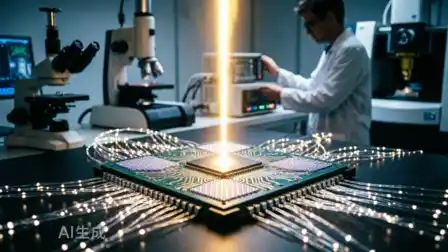
The 'Chip' Challenge and Breakthroughs in China's Optical Industry Chain

China's Photonics Industry: Bottlenecks and Breakthroughs In the global AI race, computing chips dominate the narrative, but the underlying bottleneck increasingly defining the scale of AI clusters is light—or more specifically, optical connectivity. Optical modules, which translate electrical signals to light and vice versa, are crucial for connecting thousands of GPUs in AI data centers, preventing data congestion and ensuring efficient model training. High-speed modules (800G, 1.6T) are now standard, with performance hinging on advanced DSP (Digital Signal Processor) chips. This is where a critical dependency lies. Two US giants—Marvell and Broadcom—collectively dominate over 90% of the high-end DSP chip market. Chinese optical module leaders like Zhongji Innolight and Eoptolink rely on these chips to manufacture modules for overseas AI customers, primarily in North America. While this creates a supply chain vulnerability, complete decoupling is difficult. Marvell derives over half its revenue from Greater China, and the US firms depend on Chinese partners for chip packaging and optical components. The risk from laser chips (e.g., from Lumentum), another key component, is considered more manageable due to multiple global suppliers and faster progress in domestic alternatives from companies like YOFC and Accelink. To mitigate risks, China's industry is pursuing a multi-pronged strategy: diversifying supply chains and locking in long-term orders; fostering a domestic market ecosystem to adopt homegrown DSPs from firms like Huawei HiSilicon and CETC; accelerating R&D in high-speed DSPs and advanced packaging; and investing in next-gen technologies like silicon photonics and Co-Packaged Optics (CPO) to reduce reliance on discrete DSPs. The ultimate solution lies not in short-term博弈 but in persistent advancement of domestic high-end chip R&D and manufacturing. While challenges remain in performance, certification, and ecosystem building, China's vast domestic market and manufacturing base provide a crucial buffer, buying time for the industry to achieve greater technological independence.

marsbit06/17 04:47

The 'Chip' Challenge and Breakthroughs in China's Optical Industry Chain

marsbit06/17 04:47

Behind SpaceX's $2 Trillion Market Cap: Why Does Musk Always Have the Next Move Planned?

On June 12th, SpaceX debuted on the Nasdaq, reaching a valuation that briefly touched $2 trillion. This marked the culmination of a 24-year journey from its founding in 2002, driven by Elon Musk's frustration at the high cost of buying rockets. The company's path was defined by early failures, with its first three Falcon 1 launches ending in explosions before a successful 2008 flight opened the era of commercial spaceflight. Key to its model was a fixed-price NASA contract, incentivizing cost reduction. SpaceX mastered rocket reusability, first achieving a Falcon 9 landing in 2015, which drastically cut launch costs. This enabled its profitable Starlink satellite internet constellation, envisioned years before reusability was proven, to create an internal market for frequent launches. Similarly, the next-generation Starship rocket was in development long before its first flight, with its business case evolving from Mars colonization to supporting the emerging concept of in-orbit data centers for AI—a story now central to its valuation. The company's recent IPO, a reversal of its long-standing "no IPO" stance, is funding this ambitious "space-based compute" vision. While major tech players like Google, Blue Origin, and others are investing heavily, significant technical and cost hurdles remain. Ultimately, SpaceX's history is one of creating its own demand: first with Starlink and now with space-based AI compute, betting that its next rocket will enable its next giant market.

marsbit06/17 04:45

Behind SpaceX's $2 Trillion Market Cap: Why Does Musk Always Have the Next Move Planned?

marsbit06/17 04:45

活动图片