Cardano Gains Institutional Momentum as Smart Contract Fund Exposure Surges

bitcoinistPublished on 2026-02-25Last updated on 2026-02-25

Abstract

Institutional investors are increasing their exposure to smart contract platforms, with Cardano (ADA) becoming a central focus. Grayscale Investments has raised its ADA allocation in its Smart Contract Fund to 20.2%, making it the fund's third-largest holding behind Ethereum and Solana. This signals growing institutional confidence in Cardano's long-term ecosystem, despite ongoing market weakness and ADA's price trading near key support at $0.24. Additionally, Cardano has integrated with LayerZero, enabling cross-chain interoperability with over 80 blockchains. This aims to improve liquidity and DeFi access by allowing direct asset and data transfers between networks like Ethereum and Solana. Further roadmap upgrades focus on scalability, privacy sidechains, and stablecoin integrations to attract institutional use cases. While technical indicators remain cautious, the institutional accumulation and ecosystem developments suggest strengthened long-term positioning.

Institutional investors are improving exposure to smart contract platforms amid ongoing market volatility, with Cardano (ADA) increasingly becoming a central focus. Recent portfolio adjustments by major crypto asset managers suggest long-term positioning is gaining priority over short-term price movements.

Related Reading: Strategy Makes 100th Bitcoin Purchase, Total Holdings Reach 717,722 BTC

Digital asset manager Grayscale Investments has steadily increased its allocation to Cardano’s ADA token within its Smart Contract Fund, signaling growing institutional interest in the network’s evolving ecosystem and infrastructure strategy.
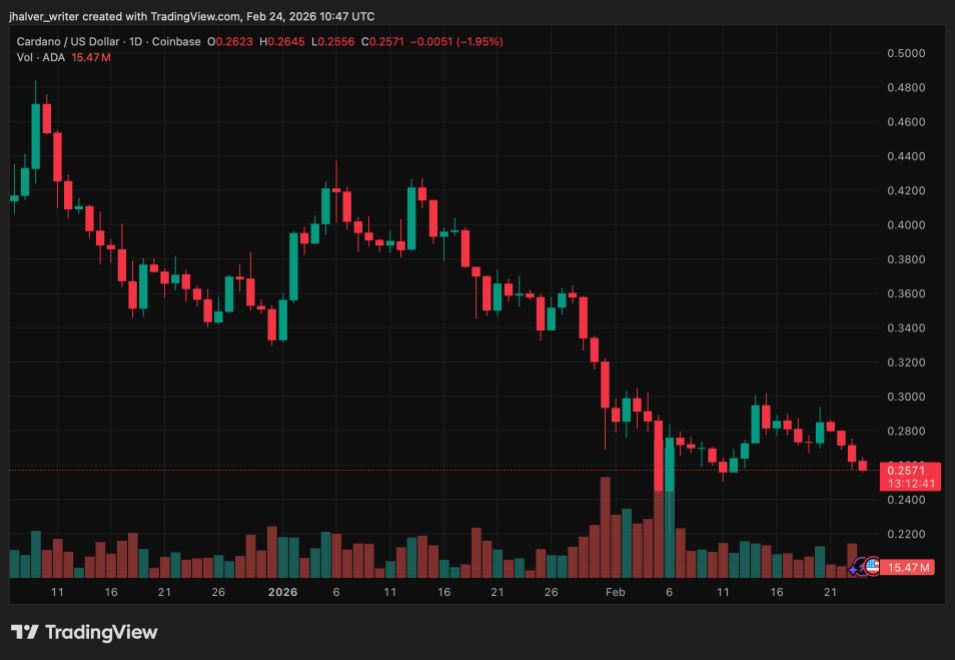
ADA's price trends to the downside on the daily chart. Source: ADAUSD on Tradingview 

Institutional ADA Allocation Expands Despite Market Weakness

Grayscale’s latest rebalancing shows ADA accounting for roughly 20.2% of the Smart Contract Platform Select Capped Index (SCPXC), up from about 18.55% at the start of the year. The increase makes Cardano the third-largest holding in the fund, behind Ethereum and Solana, which each command allocations above 28%.

The fund maintains diversified exposure across several smart contract networks, including Hedera, Avalanche, and Sui, while managing approximately $1.8 million in assets under management with a net asset value of $5.81 per share.

The rising allocation comes amid macro-driven pressure on crypto markets, with risk sentiment weakening across major tokens. Despite the downturn, institutional positioning suggests investors are reassessing long-term blockchain infrastructure plays rather than reducing exposure entirely.

Cardano-LayerZero Integration Strengthens Ecosystem Outlook

Alongside institutional accumulation, Cardano (ADA) has introduced technical developments to expand its interoperability. The network recently integrated with LayerZero, enabling cross-chain messaging and asset transfers across more than 80 blockchain networks.

The upgrade allows dApps on Cardano to interact directly with ecosystems such as Ethereum and Solana, addressing long-standing liquidity fragmentation challenges. Developers can now move assets and data across chains without relying heavily on wrapped tokens or centralized bridges, potentially widening DeFi access.

Additional roadmap initiatives, including protocol upgrades, privacy-focused sidechains, and stablecoin integrations, are designed to improve scalability and attract institutional-grade use cases over the coming year.

Price Structure Remains Fragile Near Key Support

While institutional signals have strengthened, ADA’s market structure remains under pressure. The token is trading around $0.25 after a prolonged downtrend from January highs around $0.42.

Analysts are closely monitoring the $0.24 level, a long-standing demand zone that has historically attracted buyers during periods of heavy selling.

Related Reading: CZ Eyes Binance US Expansion Following Withdrawal Of SEC’s Lawsuit – Report

Technical indicators remain cautious, with resistance forming near the $0.30–$0.31 range. A sustained move above that zone could shift short-term sentiment, while a breakdown below support may expose lower historical price areas.

Cover image from ChatGPT, ADAUSD chart on Tradingview

Related Questions

QWhat is the main reason for the increased institutional interest in Cardano (ADA) according to the article?

AInstitutional investors are increasing exposure to Cardano due to its evolving ecosystem and infrastructure strategy, prioritizing long-term positioning over short-term price movements.

QWhich asset manager has significantly increased its allocation to ADA in its Smart Contract Fund?

AGrayscale Investments has steadily increased its allocation to Cardano's ADA token within its Smart Contract Fund.

QWhat recent technical development has improved Cardano's interoperability with other blockchains?

ACardano has integrated with LayerZero, enabling cross-chain messaging and asset transfers across more than 80 blockchain networks.

QWhat is ADA's current ranking by allocation size in Grayscale's Smart Contract Platform Select Capped Index?

AADA is the third-largest holding in the fund, behind Ethereum and Solana, with an allocation of approximately 20.2%.

QWhat key price level are analysts monitoring for ADA amid its current downtrend?

AAnalysts are closely monitoring the $0.24 level, which is a long-standing demand zone that has historically attracted buyers during periods of heavy selling.

Related Reads

Huawei Cloud Rejects Token Price War, Zhou Yuefeng Seeks a New Winning Formula for AI Cloud

At the 2026 Huawei Cloud INSPIRE Creator Conference, CEO Zhou Yuefeng outlined Huawei Cloud's distinct strategy in the competitive AI cloud market. Instead of engaging in price wars based on token volume or Maas revenue—a common focus for rivals like Alibaba Cloud and ByteDance's Volcano Engine—Huawei Cloud is shifting the competition towards real-world productivity gains. Zhou highlighted three core differentiators: a fully domestic computing stack (Ascend, Kunpeng), a focus on government and enterprise clients rather than consumer internet, and a deep commitment to open-source ecosystems. To this end, Huawei Cloud launched a suite of new products under the "Agentic Infra" paradigm, including the AICS Lingqu computing cluster, AMS memory storage, and the ModelArts Next platform. These aim to solve enterprise challenges in deploying AI agents, such as latency, memory, scheduling, and security. The strategy further involves creating specialized industry zones ("AI Dream Factories") for sectors like healthcare and embodied intelligence. For example, a smart medical zone developed with Shanghai Ruijin Hospital aims to democratize expert-level diagnostic capabilities. In essence, Huawei Cloud is positioning itself not as a commodity token provider, but as the foundational infrastructure for industrial AI, leveraging its domestic supply chain and hybrid cloud solutions to serve sectors where productivity, not just scale, is the ultimate measure of value.

marsbit1h ago

Huawei Cloud Rejects Token Price War, Zhou Yuefeng Seeks a New Winning Formula for AI Cloud

marsbit1h ago

70% of the Public Opposes AI, Americans Hope the U.S. Loses the AI War

70% of Americans believe AI development is moving too fast, with growing public resistance evolving from online criticism to real-world protests and violence. This widespread anti-AI sentiment stems from fears of job losses, rising utility costs, environmental damage, threats to democracy, and financial instability. Key incidents illustrate the backlash: Google's former CEO Eric Schmidt was loudly booed at a graduation for promoting AI; AI company ads are vandalized; protests and even violent attacks target AI firms and data centers. Polls show deep public pessimism and strong local opposition to data center construction, often surpassing resistance to nuclear power plants. The core grievances are economic and practical: AI is seen as automating jobs, concentrating wealth, and increasing household electricity and water bills due to massive data center resource demands. Environmentalists also oppose AI's high energy use and carbon emissions. This opposition has turned AI into a major political issue in the US. While the Trump administration prioritizes AI innovation for global competition, bipartisan pushback is growing. Democrats and factions within the MAGA movement are forming temporary alliances to support stricter regulations and local bans on new data centers, pressuring the administration to choose between its tech industry backers and its voter base. The situation highlights a profound national divide over AI's future.

marsbit2h ago

70% of the Public Opposes AI, Americans Hope the U.S. Loses the AI War

marsbit2h ago

Trading

Spot
Futures

Hot Articles

Discussions

Welcome to the HTX Community. Here, you can stay informed about the latest platform developments and gain access to professional market insights. Users' opinions on the price of ADA (ADA) are presented below.

活动图片













