Cardano (ADA) Price Now At A Critical Level Following Strong Whale Activity

bitcoinistPublished on 2026-04-17Last updated on 2026-04-17

Abstract

Cardano (ADA) is showing renewed bullish momentum, approaching the $0.25 mark amid a broader cryptocurrency market recovery. This upward movement is partly attributed to increased whale activity, with large holders accumulating more ADA. Analyst Ali Chartz identifies the $0.243 level as a critical make-or-break point. Holding above this support could trigger a relief rally toward $0.30, while a breakdown may lead to a deeper correction toward yearly lows near $0.10. Data shows whale addresses holding at least 10 million ADA have reached a 4-month high, indicating strong accumulation. Currently, ADA is trading at $0.25, up nearly 5% in 24 hours, with trading volume also increasing.

Cardano (ADA)’s price appears to be regaining bullish momentum alongside other major cryptocurrency assets across the market, such as Bitcoin and Ethereum. This renewed upward performance of ADA is attributed to multiple factors, such as a broader market recovery and potentially the recent uptick in whale activity.

ADA Faces Key Test After Accumulation Surge

With the market environment slowly turning bullish once again, the price of Cardano is exhibiting upside action, approaching the $0.25 mark. Despite this upward move, the altcoin is now being faced by significant resistance that may serve as a trigger for more upside activity or downside trend.

After examining the chart on the 3-day time frame, Ali Chartz, a seasoned crypto analyst and trader, outlined that Cardano is currently approaching a decisive moment that could dictate its next move. Ali stated that the altcoin has returned to a make-or-break point, located at the $0.243 level.

Currently, the price seems to be tightening around this key area. Here, the support and resistance dynamics are expected to dictate the next significant direction as indicated by the market expert. According to Ali, this make-or-break zone has historically acted as the ultimate pivot for ADA’s trend.
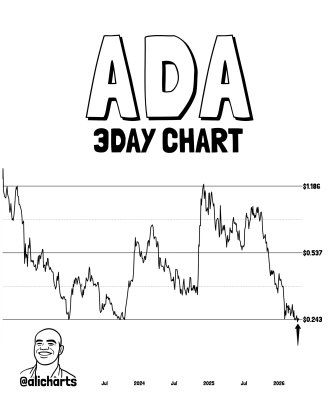
Source: Chart from Ali Chartz on X

This is backed by past scenarios where hitting this level becomes the launchpad for significant rebounds. At this point, a continued upward action falls into the bulls’ hands. If these investors can defend this floor, the positioning could set the stage for a relief rally toward the $0.03 resistance.

However, when ADA fails to hold here and loses the zone on a daily close, it would be a major structural failure and shift into a bearish phase. Ali highlighted that the breakdown here could expose ADA to a deeper correction, potentially testing the yearly lows near the $0.10 level.

Given the growing interest and demand for Cardano, the altcoin might gain the necessary momentum to push upward and break this zone, as accumulation often plays a role in price performance. Large holders were reportedly earlier to be steadily increasing their positions, signaling growing confidence even as the price approaches a decisive zone.

Cardano Whale Count At Multi-Month Level

Mintern shared on X that wallet addresses holding at least 10 million ADA have increased sharply, indicating a persistent buying activity by high-net-worth investors. As seen on the chart, the number of these large investors or whales is at a 4-month high, with 424 wallets.

According to Mintern, this is a clear sign of growing whale accumulation, representing an over 5.2% increase in just 9 weeks. In the meantime, this combination of a significant technical level and robust accumulation puts ADA at a pivotal juncture where the next move could determine its short-term course.

At the time of writing, the Cardano price was trading at $0.25 after recording a nearly 5% increase in the last 24 hours. As the price slowly moves toward the upside, its trading volume has flipped bullish, rising by over 9% within the same time frame.

ADA trading at $0.24 on the 1D chart | Source: ADAUSDT on Tradingview.com

Related Questions

QWhat is the current critical price level for Cardano (ADA) as mentioned in the article?

AThe current critical price level for Cardano (ADA) is $0.243.

QAccording to the analyst Ali Chartz, what are the two potential outcomes if ADA fails to hold the $0.243 support level?

AIf ADA fails to hold the $0.243 support level on a daily close, it would be a major structural failure leading to a bearish phase and could expose ADA to a deeper correction, potentially testing the yearly lows near the $0.10 level.

QWhat recent on-chain activity suggests growing confidence in Cardano among large investors?

AThe number of wallet addresses holding at least 10 million ADA has increased to a 4-month high of 424 wallets, representing a over 5.2% increase in just 9 weeks, indicating persistent buying activity by high-net-worth investors (whales).

QWhat was the price and 24-hour performance of ADA at the time the article was written?

AAt the time of writing, Cardano (ADA) was trading at $0.25 after recording a nearly 5% increase in the last 24 hours.

QWhat key resistance level does the article suggest a successful defense of the $0.243 support could allow ADA to rally towards?

AA successful defense of the $0.243 support could set the stage for a relief rally toward the $0.30 resistance level.

Related Reads

a16z: How Should Crypto Entrepreneurs Understand the CLARITY Act?

a16z: How Crypto Entrepreneurs Should Understand the CLARITY Act? The U.S. Senate Banking Committee's bipartisan vote to advance crypto market structure legislation, specifically the Digital Asset Market CLARITY Act, marks a historic moment for the industry. For a decade, a lack of clear U.S. regulation has stifled innovation, created consumer risks, and pushed development overseas. CLARITY aims to end this by establishing clear rules for blockchain networks and digital assets, similar to how the 1933 Securities Act shaped capital formation. The current regulatory patchwork has failed, causing legal confusion and enabling bad actors while hindering responsible builders. CLARITY provides a path forward by clarifying the regulatory roles of the SEC and CFTC, defining whether digital assets are securities or commodities, and establishing oversight for crypto exchanges and consumer protections. Crucially, CLARITY recognizes that blockchain networks are fundamentally different from traditional companies. Networks operate through shared rules and decentralized coordination, not centralized control. Applying corporate frameworks distorts them, leading to value extraction by intermediaries. Blockchain enables truly decentralized networks where value can be distributed to participants. CLARITY is designed to make this viable under U.S. law, allowing builders to operate transparently, raise capital domestically, and focus on long-term innovation without structural compromises due to regulatory ambiguity. The bill's progression follows earlier House efforts like FIT21 and the House CLARITY Act, which received strong bipartisan support. If passed, CLARITY could unlock significant innovation within the U.S., similar to the growth seen after the GENIUS Act for stablecoins, helping the U.S. lead in the digital economy while better combating fraud and abuse.

marsbit15m ago

a16z: How Should Crypto Entrepreneurs Understand the CLARITY Act?

marsbit15m ago

AI Benefits Senior Staff? 40% of CEOs Plan to Cut Junior Positions, Young People's Jobs Are More at Risk

The traditional assumption that senior employees are first in line during layoffs is being inverted in the AI era. A survey of 415 CEOs by Oliver Wyman and the NYSE reveals 43% plan to cut entry-level positions in the next 1-2 years to shift towards a mid-to-senior talent structure, a sharp rise from 17% last year. The logic is that AI excels at automating routine, cognitive tasks typically handled by junior staff (e.g., coding, data review), while the experience and judgment of senior employees remain harder to replicate. Research indicates this shift primarily manifests as a hiring freeze for junior roles rather than mass layoffs. Goldman Sachs estimates AI currently nets a loss of about 16,000 US jobs monthly, disproportionately impacting Generation Z concentrated in highly automatable white-collar roles. This raises long-term concerns about a broken talent pipeline, as companies risk having no future senior managers trained internally. Despite the dominant trend, a minority of successful AI adopters, like IBM and Salesforce, are expanding junior hiring, arguing these employees are adept at using and building AI tools. However, most companies are still in early AI deployment phases, with 67% in planning/pilot stages and many reporting returns below expectations. The overarching reality is a weakening of job security across all levels, as organizations reshape for an AI-augmented, leaner future.

marsbit1h ago

AI Benefits Senior Staff? 40% of CEOs Plan to Cut Junior Positions, Young People's Jobs Are More at Risk

marsbit1h ago

Physical AI is Hot, Some New Thoughts from Me

The term "Physical AI" is gaining significant traction, marking a shift from AI that processes information to AI that understands and interacts with the physical world. Unlike traditional AI confined to screens, Physical AI involves integrating intelligence into robotic bodies to perform tasks in environments governed by gravity, friction, and inertia. The concept, formally defined in a 2020 paper, focuses on creating embodied systems that can complete perception-to-action cycles. 2026 is identified as a pivotal "deployment year," where the focus moves from demonstrations to practical utility. Companies like China's Zhiyuan Robotics have transitioned to live, unscripted factory deployments and announced mass production targets. Internationally, Figure AI, after a major funding round, shifted to its own neural system, while NVIDIA partnered with major industrial robot firms to upgrade millions of existing units with AI capabilities. A key trend is the crossover from the automotive supply chain. Companies like Aptiv and Valeo are entering the Physical AI space, leveraging their expertise in sensors, control systems, and mass production from the autonomous vehicle sector. This "technology spillover" is accelerating development, as seen with Tesla's plans to repurpose automotive production lines for its Optimus robot. The technical breakthrough enabling this progress is the engineering maturity of "world models." Previously theoretical, these AI models can now simulate physical interactions and generate vast, realistic synthetic training data for robots. Innovations from NVIDIA's Cosmos, Ant's LingBot-World, and others have made this capability more accessible, drastically reducing the cost and time needed for real-world data collection. This is driving a fundamental architectural shift in robotics: from the traditional "sense-plan-act" model, reliant on pre-programmed rules, to a "sense-reason-act" paradigm where neural networks reason and make decisions. This change represents a new paradigm where machines understand the world's physics. The competition is intense, with the landscape still forming. While the direction is clear, success will depend not just on AI algorithms but on manufacturing scalability, supply chain resilience, and efficient data strategies, with infrastructure providers potentially capturing significant value in this new era.

marsbit1h ago

Physical AI is Hot, Some New Thoughts from Me

marsbit1h ago

Trading

Spot
Futures

Hot Articles

Discussions

Welcome to the HTX Community. Here, you can stay informed about the latest platform developments and gain access to professional market insights. Users' opinions on the price of ADA (ADA) are presented below.

活动图片













