Blockchain Association says no to expanding stablecoin yield prohibition

cointelegraphPublished on 2025-12-19Last updated on 2025-12-19

Abstract

The Blockchain Association, along with over 125 crypto industry groups, has written to the US Senate Committee on Banking opposing a proposed expansion of the ban on offering yield rewards to stablecoin holders. The letter argues that extending the prohibition—originally targeting stablecoin issuers under the GENIUS Act to include third-party platforms—would stifle innovation, increase market concentration, and unfairly disadvantage crypto services compared to traditional financial providers like banks and credit card companies that offer similar rewards. The Association contends that stablecoin rewards help consumers offset inflation and are a standard feature of competitive markets. It also challenges banking industry claims that yield-bearing stablecoins threaten bank lending, stating there is no evidence to support such concerns. Additionally, the letter comes as the FDIC proposes rules allowing banks to issue stablecoins through subsidiaries, subject to reserve requirements and regulatory oversight.

The Blockchain Association, a non-profit crypto advocacy organization, wrote a letter to the US Senate Committee on Banking, signed by over 125 crypto industry groups and companies, opposing the ban on third-party service providers and platforms offering customer rewards to stablecoin holders.

Expanding the prohibition on stablecoin issuers sharing yield directly with customers, outlined in the GENIUS stablecoin regulatory framework, to include third-party service providers stifles innovation and leads to “greater market concentration,” the letter said.

The letter compared the rewards offered by crypto platforms to those offered by credit card companies, banks and other traditional payment providers.
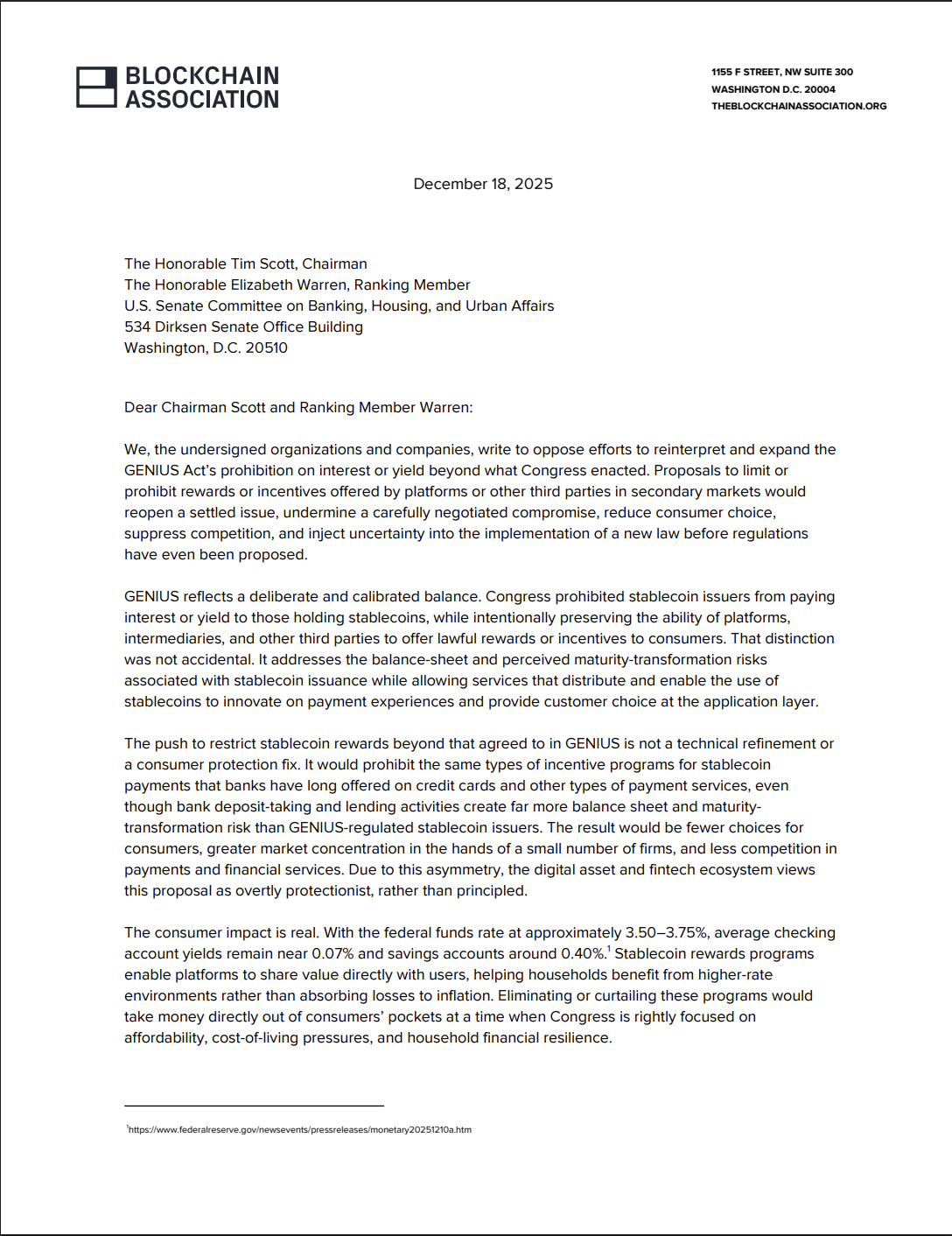
The letter opposes efforts to stop crypto platforms from sharing yield with customers. Source: The Blockchain Association

Prohibiting crypto platforms from offering similar rewards for stablecoins gives an unfair advantage to incumbent financial service providers, the Blockchain Association said.

“The potential benefits of payment stablecoins will not be realized if these types of payments cannot compete on a level playing field with other payment mechanisms. Rewards and incentives are a standard feature of competitive markets.”

The Blockchain Association has issued several statements and letters pushing back against efforts to prohibit crypto platforms from sharing yield-bearing opportunities with customers, arguing that these rewards help consumers offset inflation.

Related: Bank of Canada lays out criteria for ‘good money’ stablecoins

FDIC paves the way for banks to issue stablecoins, industry group says stables aren’t a threat

The Federal Deposit Insurance Corporation (FDIC), the US regulatory agency that oversees and insures the banking sector, published a proposal on Tuesday that would allow banks to issue stablecoins through subsidiaries.

Under the proposal, both the bank and its stablecoin subsidiary would be subject to FDIC rules and assessments for financial fitness, including reserve requirements.
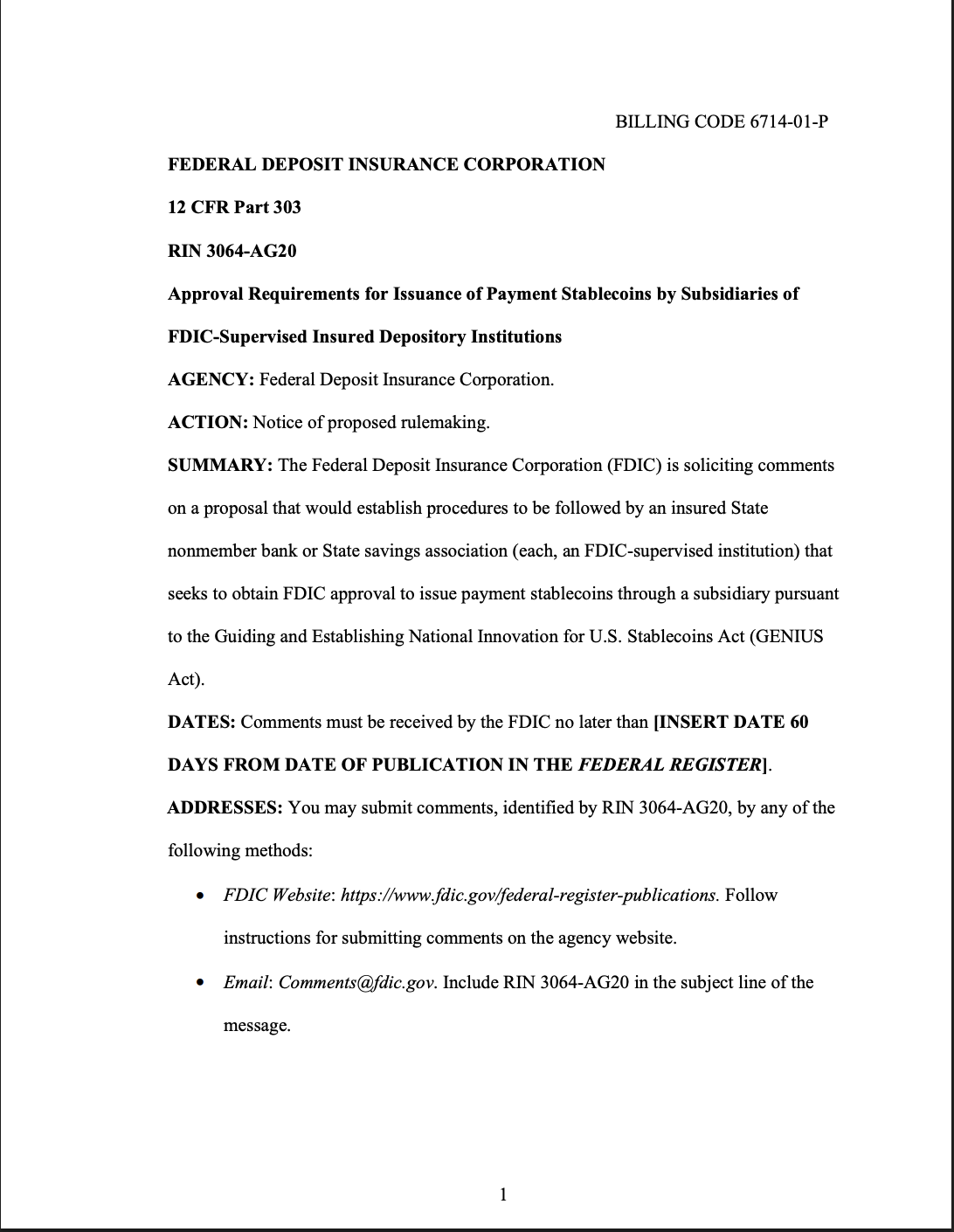
The FDIC proposal to allow banks to issue stablecoins. Source: FDIC

The Blockchain Association continues to push back on claims that yield-bearing stablecoins and sharing rewards with customers threaten the banking sector and bank lending.

“Evidence does not support claims that stablecoin rewards threaten community banks or lending capacity,” the Blockchain Association said, adding that it is difficult to make the case that bank lending is actually constrained by customer deposits.

Despite this, the banking industry has lobbied against yield-bearing stablecoins and crypto platforms sharing yield with clients over fears that interest offered on digital asset products will erode the market share of banks.

Magazine: Unstablecoins: Depegging, bank runs and other risks loom

Related Questions

QWhat is the Blockchain Association's main argument against expanding the stablecoin yield prohibition to third-party service providers?

AThe Blockchain Association argues that expanding the prohibition to third-party service providers stifles innovation, leads to greater market concentration, and gives an unfair advantage to traditional financial service providers by preventing crypto platforms from competing on a level playing field.

QHow does the Blockchain Association compare the rewards offered by crypto platforms to those in traditional finance?

AThe letter compares the rewards offered by crypto platforms to the rewards offered by credit card companies, banks, and other traditional payment providers, stating that such incentives are a standard feature of competitive markets.

QWhat recent proposal did the FDIC make regarding banks and stablecoins?

AThe FDIC published a proposal that would allow banks to issue stablecoins through subsidiaries, with both the bank and its subsidiary being subject to FDIC rules, assessments for financial fitness, and reserve requirements.

QWhat is the banking industry's primary concern regarding yield-bearing stablecoins, according to the article?

AThe banking industry fears that the interest offered on digital asset products like yield-bearing stablecoins will erode their market share, leading them to lobby against these products and platforms sharing yield with clients.

QWhat reason does the Blockchain Association give for supporting the ability of platforms to share yield with stablecoin holders?

AThe Blockchain Association argues that these rewards help consumers offset inflation and are necessary for the potential benefits of payment stablecoins to be realized in a competitive market.

Related Reads

The End of Old Cryptography: How Ethereum is Preparing for the Era of Quantum Computing

Ethereum developers have proposed a new system for handling staking deposits, aiming to future-proof the network against the potential threat of quantum computers. Currently, Ethereum's security relies on elliptic curve cryptography, which could be broken by sufficiently powerful quantum machines capable of deriving private keys from public ones. While estimates of the timeline for this threat vary, with Google research in March 2026 suggesting it could be closer than previously thought, major blockchains are proactively preparing. The new proposal introduces a more flexible deposit contract capable of accepting keys of various types and lengths, identified by a scheme label. It also changes how deposit data is communicated within the network's layers. Crucially, the transition plan involves a three-phase process to ensure a controlled and predictable shift, initially disabling new deposits, then re-enabling the current format, and finally permanently switching to new post-quantum cryptography in a future update. The proposal is currently a draft with no set implementation date. It represents a strategic move to build infrastructure in advance, rather than a direct solution for existing accounts. Analysis notes that Ethereum is structurally vulnerable to a "store now, decrypt later" attack, as public keys revealed in past transactions remain permanently on-chain. This proposal prepares for a signature algorithm change but does not address the risk to keys already exposed.

cryptonews.ru5m ago

The End of Old Cryptography: How Ethereum is Preparing for the Era of Quantum Computing

cryptonews.ru5m ago

Meta Faces a $1.4 Trillion Penalty: Algorithmic Recommendation in the Dock. Will the Rules Change in the Second Half of the Internet Era?

A landmark federal trial in Oakland, California, has begun against Meta, with 29 states accusing the company of harming children and teens through its social media platform designs. The states seek a potential maximum penalty of $1.4 trillion, calculated from alleged repeated violations of consumer protection laws and the Children's Online Privacy Protection Act (COPPA) involving millions of underage users. The core legal strategy bypasses the traditional shield of Section 230 by targeting Meta's own platform features—like its recommendation algorithms, infinite scroll, and "like" buttons—rather than user-generated content. The plaintiffs argue these designs are addictive and deceptive. Meta denies the claims, calling the penalty "unprecedented" and disputing the methodology. While the astronomical $1.4 trillion figure is seen as a starting point for negotiations, even a significantly reduced penalty in the hundreds of billions could establish a critical precedent. The case focuses on holding platforms legally responsible for their algorithmic designs. A ruling against Meta could force product changes, such as removing "likes" or imposing usage limits, and provide a legal template for similar suits against other tech giants like TikTok and YouTube. The trial's outcome may redefine accountability for algorithm-driven business models across the internet.

marsbit15m ago

Meta Faces a $1.4 Trillion Penalty: Algorithmic Recommendation in the Dock. Will the Rules Change in the Second Half of the Internet Era?

marsbit15m ago

A Precedent for the Prediction Markets: CFTC Aims to Prove Authority Over Polymarket via Criminal Case

A U.S. Army soldier, Gannon Ken Van Dyke, who earned $400,000 using non-public information on the crypto event-prediction platform Polymarket, is contesting the U.S. Commodity Futures Trading Commission's (CFTC) attempt to intervene in his criminal case. The CFTC, which initiated a separate civil suit against Van Dyke but has not pursued it to trial, seeks to submit arguments in the ongoing criminal proceeding. Van Dyke's lawyers filed a motion opposing this, arguing the CFTC is improperly trying to influence the criminal case as an outside expert rather than through its own lawsuit. They contend that event contracts traded on platforms like Polymarket are not swaps and thus fall outside the CFTC's jurisdiction, calling the regulator's tactics a procedural maneuver. Van Dyke faces criminal fraud charges for allegedly trading based on confidential information about potential regime change in Venezuela. His civil case with the CFTC is stayed pending the criminal trial, expected in late 2026 or early 2027. The court's decision on whether to allow the CFTC's intervention could set a precedent for how such event contracts are regulated. An AI analysis notes inconsistency in the CFTC's approach compared to a similar case involving a Google employee, raising questions about the legal strategy for the prediction market industry, which includes platforms like Kalshi. The outcome may define future regulatory standards for the entire market.

cryptonews.ru20m ago

A Precedent for the Prediction Markets: CFTC Aims to Prove Authority Over Polymarket via Criminal Case

cryptonews.ru20m ago

Trading

Spot
活动图片