Blackrock Attracted $322.79 Million, While Bitcoin and Ether ETFs Brought in $424 Million

cryptonews.ruPublished on 2026-08-27Last updated on 2026-08-27

Abstract

Institutional interest in cryptocurrency ETFs continues for an eighth consecutive session, with Bitcoin and Ether ETFs collectively attracting $424 million in new inflows. BlackRock's IBIT Bitcoin ETF led with $200.76 million, while Grayscale's GBTC saw $50.39 million in outflows. Ether ETFs saw a strong $192.35 million inflow, led by BlackRock's ETHA. Beyond the majors, altcoin ETFs also saw significant activity. XRP ETFs attracted $28.14 million, and Hyperliquid ($HYPE) ETFs drew a notable $14.71 million relative to their market size. Solana ETFs attracted $9.14 million. Analysts note that capital is increasingly flowing beyond Bitcoin and Ether, with smaller ETF categories gaining significant weight relative to their underlying token markets. Despite the altcoin inflows, BlackRock's current spot ETF strategy remains focused solely on Bitcoin and Ether.

For the eighth consecutive session, institutional interest in cryptocurrency exchange-traded funds (ETFs) has remained consistently high.

Bitcoin and ether collectively attracted another $424 million, while demand for smaller cryptocurrencies on the market has intensified. $HYPE demonstrated a particularly strong session relative to its size, and $XRP funds continued their recent inflow streak.

Bitcoin ETFs attracted $232.12 million, with Blackrock's IBIT once again contributing the most. IBIT attracted $200.76 million. It was followed by Grayscale's Bitcoin Mini Trust with $46.83 million, and Fidelity's FBTC attracted $25.59 million.

Bitwise's BITB received $5.96 million, and Morgan Stanley's MSBT received $3.37 million. An outflow of $50.39 million from Grayscale's GBTC reduced the final total. The daily trading volume of Bitcoin ETFs reached $2.26 billion. The total net asset value at the close was $98.63 billion, remaining near the $100 billion mark.
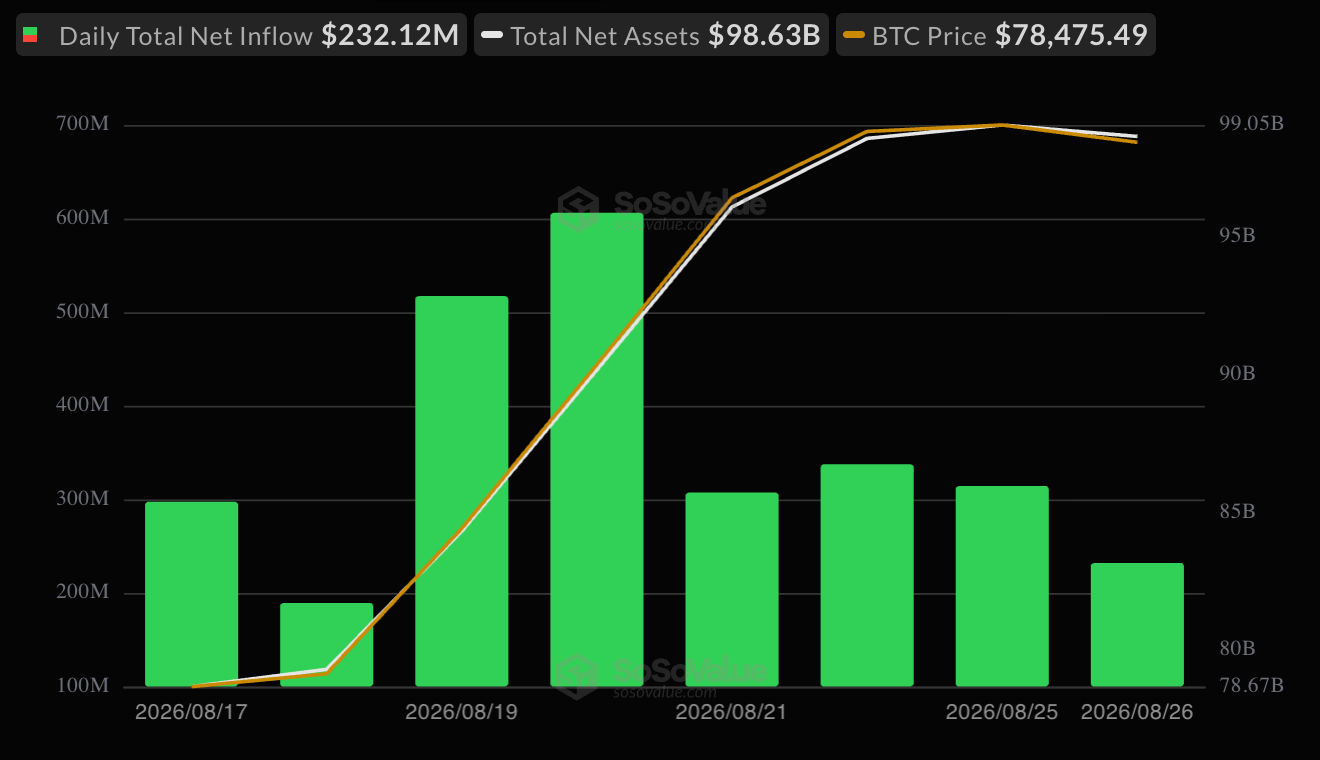
Eight sessions with inflows totaling $2.8 billion for Bitcoin ETFs. Source: Sosovalue

Ether ETFs demonstrated equally convincing results: the net inflow was $192.35 million, with no outflows reported. The leader was Blackrock's ETHA ETF with an inflow of $115.66 million. Grayscale's Ether Mini Trust attracted $34.67 million, and Fidelity's FETH attracted $32.01 million.

Blackrock's ETHB ETF received $6.37 million. TETH from 21Shares and EZET from Franklin Templeton attracted $2.71 million and approximately $937,000 respectively. The trading volume of Ether ETFs was $951.11 million, and net assets grew to $15.13 billion.

$XRP and $HYPE Attract More Funds from the Altcoin Segment

ETFs on $XRP recorded a net inflow of $28.14 million. The leader in inflows was Bitwise's $XRP fund, followed by XRPZ from Franklin Templeton and XRPC from Canary. Total assets at the end of the day were $1.40 billion.

ETFs on $HYPE attracted $14.71 million, a significant gain for a category with net assets of $419.48 million. Bitwise's BHYP fund attracted $9.57 million, Grayscale's HYPG attracted $3.73 million, and 21Shares' THYP attracted $1.41 million. $HYPE ETF assets currently account for approximately 2.35% of the token's market capitalization.

Solana funds attracted $9.14 million. The leader was Morgan Stanley's MSOL fund with $5.51 million, followed by Bitwise's BSOL with $2.65 million and Vaneck's VSOL with approximately $973,000. Net assets at the end of the day were $1.26 billion, corresponding to roughly 2.23% of Solana's market value.

Nate Geraci, President of ETF Store, stated that Blackrock's current strategy regarding spot cryptocurrency ETFs remains strictly focused on Bitcoin and Ether, despite the high returns of the IBIT, ETHA, and ETHB funds.

He argued that the company is effectively making a "market forecast that no other crypto assets possess sufficient value," while predicting that Blackrock will ultimately expand its lineup with additional spot cryptocurrency ETFs.

The capital flows recorded on Wednesday intensify this debate. Capital is increasingly moving beyond Bitcoin and Ether, and smaller ETF categories are beginning to gain significant weight relative to their underlying markets.


Trending Cryptos

Related Questions

QWhat is the total net inflow for Bitcoin and Ethereum ETFs combined as reported in the article?

AThe total net inflow for Bitcoin and Ethereum ETFs combined is $424 million.

QWhich specific BlackRock ETF contributed the most to the Bitcoin ETF inflows, and what was the amount?

ABlackRock's IBIT ETF contributed the most, with an inflow of $200.76 million.

QHow did the article characterize the performance of $XRP and $HYPE ETFs in the altcoin segment?

AThe article stated that $XRP and $HYPE ETFs attracted more capital from the altcoin segment, with net inflows of $28.14 million for $XRP and $14.71 million for $HYPE.

QAccording to Nate Geraci, what is BlackRock's current strategy regarding spot cryptocurrency ETFs, and what prediction did he make about their future?

ANate Geraci stated that BlackRock's current strategy is strictly focused on Bitcoin and Ethereum ETFs. He predicted that BlackRock will eventually expand its lineup to include additional spot cryptocurrency ETFs.

QWhat was the daily trading volume for Bitcoin ETFs mentioned in the article?

AThe daily trading volume for Bitcoin ETFs was $2.26 billion.

Related Reads

Solana Proposals Could Lead to Reduction in Staking Yields to 2.25% and Cut Emissions by $1.5 Billion

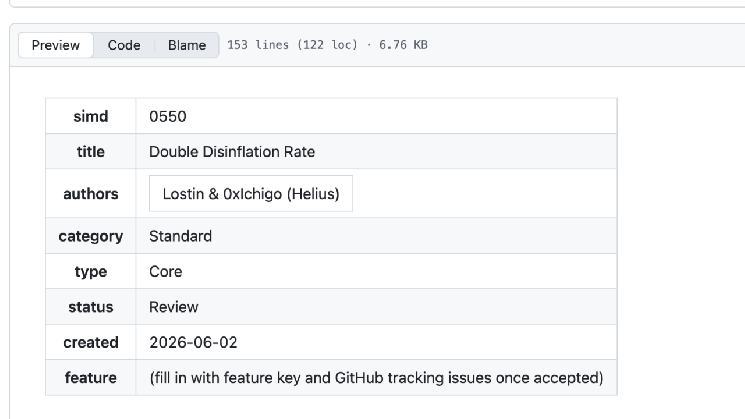
Solana is moving towards a stricter monetary model that could lead to a SOL deficit and significantly reduce staking rewards for holders. Two governance proposals drive these changes. SIMD-550, currently under vote, would double Solana's annual disinflation rate from 15% to 30%, accelerating the timeline to reach a final inflation rate of ~1.5% to the first half of 2029. The second, SIMD-553 (already approved), introduces additional token burning tied to computational units used on the network. Together, these measures could reduce SOL emission by an estimated $1.4-$1.5 billion over six years. The immediate impact would be lower staking yields, potentially falling from the current ~5.25% to approximately 4.34% in year one, 3% in year two, and 2.25% by year three. Analyst Matt Mena from 21Shares suggests inflation should be tied to economic metrics to help offset this decline. The changes also raise concerns for validator economics, with some potentially becoming unprofitable as inflation rewards decrease and voting costs may rise. However, the lower passive yield might push a significant portion of the 67.9% staked SOL into Solana's DeFi ecosystem for activities like lending and trading. This shift could boost network fee revenue to compensate for lower inflation rewards. The proposals aim to trade lower yield today for less dilution tomorrow, betting that network growth and usage will make this a worthwhile trade-off for SOL holders.

cryptonews.ru1h ago

Solana Proposals Could Lead to Reduction in Staking Yields to 2.25% and Cut Emissions by $1.5 Billion

cryptonews.ru1h ago

Trading

Spot

Hot Articles

Discussions

Welcome to the HTX Community. Here, you can stay informed about the latest platform developments and gain access to professional market insights. Users' opinions on the price of ETH (ETH) are presented below.

活动图片