Bitcoin Mining Pressure Eases After First Difficulty Adjustment Of The Year

bitcoinistPublished on 2026-01-12Last updated on 2026-01-12

Abstract

Bitcoin's mining difficulty decreased to approximately 146.4 trillion in the first adjustment of 2026, offering brief relief to miners. This change occurred as average block times dipped slightly below the 10-minute target. Despite the drop, mining difficulty remains historically high, and miner profitability continues to be pressured by post-halving economics and elevated operational costs. The next adjustment, expected around January 22, 2026, is projected to increase difficulty to around 148 trillion if block times normalize. This periodic recalibration mechanism helps maintain consistent block production, but sustained shifts may signal broader changes in miner behavior and network dynamics.

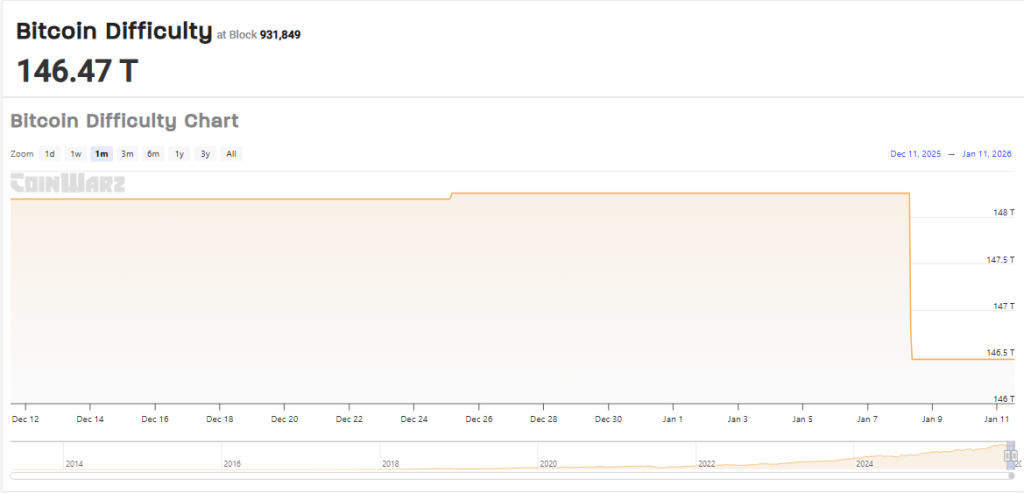
Bitcoin’s mining difficulty slipped to a little over 146 trillion in the network’s first difficulty recalibration of 2026, offering a small but measurable easing for miners. According to multiple reports, the adjustment completed in early January reduced the metric from levels seen at the end of 2025.

First Adjustment Offers Brief Relief

Average block times across the network were running near 9.88 minutes at the time of the change — a touch faster than Bitcoin’s target of 10 minutes — which helped produce the slight downshift in difficulty. That gap means the protocol briefly eased the hurdle miners face, because blocks were being produced a little quicker than expected.

Reports have noted that, even with this dip, difficulty remains high compared with earlier years and miner margins are under pressure following the 2024 halving and heavy hardware investment in 2025. Some miners reported thinner returns as hash price softened and energy and equipment costs stayed elevated. The drop to 146.4T gives a short window of relief, not a turnaround.

Source: CoinWarz

Next Adjustment Expected On January 22

Based on CoinWarz estimates and other trackers, the next difficulty recalculation is projected for January 22, 2026, with a likely uptick toward 148 trillion as average block times slow back toward the 10-minute target. If that pattern holds, the pause in difficulty will be temporary and competition among miners may ramp up again.

BTCUSD currently trading at $90,809. Chart: TradingView

Why The Number Matters

Difficulty is the protocol’s built-in way of keeping block production steady: it changes every two weeks (2016 blocks) to match the total computing power securing the chain. When more hash power joins, difficulty rises; when it drops or blocks come too fast, difficulty ease. These adjustments affect how quickly miners find blocks and how much work they must perform to earn rewards.

Miners will be watching hash rate trends, power costs, and Bitcoin’s price because those factors determine profitability in the days after an adjustment. Markets, meanwhile, often take such technical tweaks in stride, but sustained moves in difficulty or hash power can signal broader shifts in miner behavior that may influence supply dynamics over time.

According to the latest coverage, January’s first adjustment cut difficulty to roughly 146.4T and came as block times averaged 9.88 minutes. Estimates point to a likely rise around January 22 to roughly 148.20T if conditions change as expected. Observers say the change offers temporary breathing room for miners but does not erase the financial pressures many faced through 2025.

Featured image from Unsplash, chart from TradingView

Related Questions

QWhat was the new Bitcoin mining difficulty level after the first adjustment of 2026?

AThe new Bitcoin mining difficulty level after the first adjustment of 2026 was a little over 146 trillion, specifically 146.4T.

QWhat was the average block time that contributed to the decrease in mining difficulty?

AThe average block time across the network was running near 9.88 minutes at the time of the change, which was slightly faster than Bitcoin's 10-minute target.

QWhen is the next Bitcoin difficulty adjustment projected to occur, and what is the expected trend?

AThe next Bitcoin difficulty adjustment is projected for January 22, 2026, with an expected uptick toward 148 trillion as average block times slow back toward the 10-minute target.

QWhy did the protocol ease the mining difficulty in this adjustment?

AThe protocol eased the mining difficulty because blocks were being produced a little quicker than the expected 10-minute target, which is the protocol's built-in mechanism to keep block production steady.

QDespite the recent drop, why do miner margins remain under pressure?

AMiner margins remain under pressure due to the combined effects of the 2024 halving, heavy hardware investment in 2025, softened hash price, and elevated energy and equipment costs.

Related Reads

Running Gemma 4 Locally on iPhone Goes Viral: How Far Are We from the Zero Token Era?

Google's newly open-sourced Gemma 4 model, built on the same architecture as Gemini 3, has gained significant attention for its ability to run locally on mobile devices like the iPhone and Samsung Galaxy. With smaller versions such as E2B (2.3B parameters) and E4B (4.5B parameters), it supports native multimodal capabilities and offers a 128K context window. Users report impressive speeds—over 40 tokens per second on Apple chips with MLX optimization—making it feel "like magic." The model is accessible via Google’s official AI Edge Gallery app, ensuring ease of use and security. While Gemma 4 excels in tasks like text generation, coding, and image understanding, it struggles with more complex agent-based workflows, such as tool calling and structured outputs, where models like Qwen3-coder perform better. Despite some limitations in reasoning, Gemma 4’s local performance hints at a future where everyday AI tasks—chat, coding, reasoning—can be handled offline, reducing reliance on cloud-based token services. Although cloud models still lead in advanced reasoning and large-scale multi-agent tasks, the trend suggests that as hardware and quantization improve, on-device models will increasingly handle high-frequency simple tasks. This shift could disrupt the AI industry’s reliance on token sales and API subscriptions, pushing providers to focus on more complex, data-intensive capabilities. Gemma 4 is just the beginning of this transformation.

marsbit1h ago

Running Gemma 4 Locally on iPhone Goes Viral: How Far Are We from the Zero Token Era?

marsbit1h ago

Trading

Spot
Futures

Hot Articles

What is $BITCOIN

DIGITAL GOLD ($BITCOIN): A Comprehensive Analysis Introduction to DIGITAL GOLD ($BITCOIN) DIGITAL GOLD ($BITCOIN) is a blockchain-based project operating on the Solana network, which aims to combine the characteristics of traditional precious metals with the innovation of decentralized technologies. While it shares a name with Bitcoin, often referred to as “digital gold” due to its perception as a store of value, DIGITAL GOLD is a separate token designed to create a unique ecosystem within the Web3 landscape. Its goal is to position itself as a viable alternative digital asset, although specifics regarding its applications and functionalities are still developing. What is DIGITAL GOLD ($BITCOIN)? DIGITAL GOLD ($BITCOIN) is a cryptocurrency token explicitly designed for use on the Solana blockchain. In contrast to Bitcoin, which provides a widely recognized value storage role, this token appears to focus on broader applications and characteristics. Notable aspects include: Blockchain Infrastructure: The token is built on the Solana blockchain, known for its capacity to handle high-speed and low-cost transactions. Supply Dynamics: DIGITAL GOLD has a maximum supply capped at 100 quadrillion tokens (100P $BITCOIN), although details regarding its circulating supply are currently undisclosed. Utility: While precise functionalities are not explicitly outlined, there are indications that the token could be utilized for various applications, potentially involving decentralized applications (dApps) or asset tokenization strategies. Who is the Creator of DIGITAL GOLD ($BITCOIN)? At present, the identity of the creators and development team behind DIGITAL GOLD ($BITCOIN) remains unknown. This situation is typical among many innovative projects within the blockchain space, particularly those aligning with decentralized finance and meme coin phenomena. While such anonymity may foster a community-driven culture, it intensifies concerns about governance and accountability. Who are the Investors of DIGITAL GOLD ($BITCOIN)? The available information indicates that DIGITAL GOLD ($BITCOIN) does not have any known institutional backers or prominent venture capital investments. The project seems to operate on a peer-to-peer model focused on community support and adoption rather than traditional funding routes. Its activity and liquidity are primarily situated on decentralized exchanges (DEXs), such as PumpSwap, rather than established centralized trading platforms, further highlighting its grassroots approach. How DIGITAL GOLD ($BITCOIN) Works The operational mechanics of DIGITAL GOLD ($BITCOIN) can be elaborated on based on its blockchain design and network attributes: Consensus Mechanism: By leveraging Solana’s unique proof-of-history (PoH) combined with a proof-of-stake (PoS) model, the project ensures efficient transaction validation contributing to the network's high performance. Tokenomics: While specific deflationary mechanisms have not been extensively detailed, the vast maximum token supply implies that it may cater to microtransactions or niche use cases that are still to be defined. Interoperability: There exists the potential for integration with Solana’s broader ecosystem, including various decentralized finance (DeFi) platforms. However, the details regarding specific integrations remain unspecified. Timeline of Key Events Here is a timeline that highlights significant milestones concerning DIGITAL GOLD ($BITCOIN): 2023: The initial deployment of the token occurs on the Solana blockchain, marked by its contract address. 2024: DIGITAL GOLD gains visibility as it becomes available for trading on decentralized exchanges like PumpSwap, allowing users to trade it against SOL. 2025: The project witnesses sporadic trading activity and potential interest in community-led engagements, although no noteworthy partnerships or technical advancements have been documented as of yet. Critical Analysis Strengths Scalability: The underlying Solana infrastructure supports high transaction volumes, which could enhance the utility of $BITCOIN in various transaction scenarios. Accessibility: The potential low trading price per token could attract retail investors, facilitating wider participation due to fractional ownership opportunities. Risks Lack of Transparency: The absence of publicly known backers, developers, or an audit process may yield skepticism regarding the project's sustainability and trustworthiness. Market Volatility: The trading activity is heavily reliant on speculative behavior, which can result in significant price volatility and uncertainty for investors. Conclusion DIGITAL GOLD ($BITCOIN) emerges as an intriguing yet ambiguous project within the rapidly evolving Solana ecosystem. While it attempts to leverage the “digital gold” narrative, its departure from Bitcoin's established role as a store of value underscores the need for a clearer differentiation of its intended utility and governance structure. Future acceptance and adoption will likely depend on addressing the current opacity and defining its operational and economic strategies more explicitly. Note: This report encompasses synthesised information available as of October 2023, and developments may have transpired beyond the research period.

363 Total ViewsPublished 2025.05.13Updated 2025.05.13

What is $BITCOIN

Discussions

Welcome to the HTX Community. Here, you can stay informed about the latest platform developments and gain access to professional market insights. Users' opinions on the price of BTC (BTC) are presented below.

活动图片