Bitcoin Market Moves Into A Lower-Leverage Environment – What This Means

bitcoinistPublished on 2026-06-10Last updated on 2026-06-10

Abstract

Bitcoin's price remains below $65,000 amid high volatility, but a significant shift is occurring: the market is moving into a lower-leverage environment. Analysis indicates Bitcoin has exited an extreme leverage phase, entering moderate and slight leverage zones. This reduces the immediate risk of large-scale liquidations seen in highly leveraged conditions, suggesting a potential move toward a healthier market structure based more on spot demand than speculation. However, analysts caution the market has not yet reached an extreme deleveraging phase, which would offer greater safety for entry. Simultaneously, small whales (addresses holding 100-1,000 BTC) have fallen into a loss position due to recent price declines. For this group to return to profitability, Bitcoin's price needs to recover to approximately $64,000. Currently trading around $63,370, Bitcoin shows slight daily gains, but trading volume has decreased. The overall picture points to increased trader caution, with leverage drying up and key investor cohorts feeling pressure, setting the stage for Bitcoin's next directional move.

Despite a brief bounce, Bitcoin is still struggling with heightened volatility, capping every upward attempt and keeping its price below the $65,000 mark. In this unfavorable market environment, the flagship asset may be entering a crucial phase as leverage steadily dries up across the market.

Moderate Leverage Turning Up On The Bitcoin Market

Bitcoin is seeing persistent bearish pressure, but a report shows that the market just made a major shift that could play a role in its short-term trajectory. As volatility builds, the BTC market seems to be moving into a lower-leverage phase as traders become more cautious and speculative excesses start to calm.

A recent analysis of the Bitcoin Leverage Pressure Zone by Joao Wedson, the founder of Alphractal and verified author at CryptoQuant, shows that BTC has left the extreme leverage phase and moved into moderate and slight leverage. This implies that the risk of large-scale liquidations, which frequently accompany highly leveraged conditions, has decreased as aggressive positioning in derivatives markets has subsided.

Since many traders were liquidated last week, the risk of forced liquidations is dropping significantly. However, Wedson highlights that the market has not yet reached the blue/purple zone indicated on the chart, which marks extreme deleveraging.
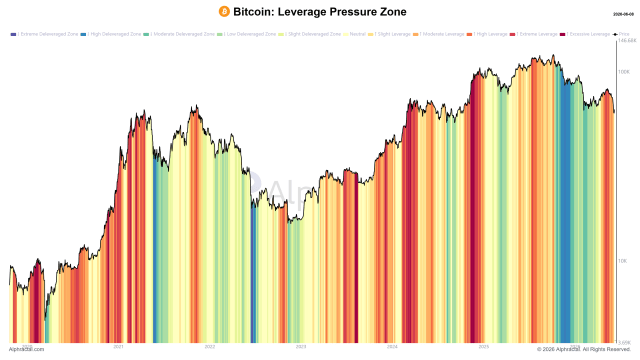
Source: Chart from Joao Wedson on X

In the past, this region was considered an ideal one to gain exposure with greater safety. The expert claims that the market has not yet gotten to that phase, but it will likely take a few more weeks or months before we reach that stage.

Even though it might occasionally indicate a declining risk appetite, lower leverage may indicate a healthier market structure based on higher spot demand rather than speculative momentum. Despite this shift into moderate and slight leverage, Wedson has urged investors to approach the derivatives market with caution. “If you do not understand its health, you can be liquidated at any moment, “ he added.

Small BTC Whales Are Now In Losses

With the Bitcoin market deeply in a volatile state, investors are beginning to feel the pressure of this downward action, even big investors. CW, a data analyst and investor, reported on X that small whales are now underwater as bearish performance mounts.

Here, small whales represent wallet addresses holding between 100 BTC and 1,000 BTC, and these investors have now returned to a loss position. This shift in profitability is attributed to the recent decline in BTC’s price to the $60,000 threshold.

In order for the group to return to profit territory, the expert stated that BTC’s price must bounce back to the $64,000 mark. CW added that the brief uptrend of Bitcoin started as these investors slowly approached the profit zone. In the meantime, recovering the $64,000 level is the first condition for the rise to kick off.

At the time of writing, Bitcoin’s price was trading at $63,370, and was showing a nearly 1% rise within the past day. While prices are slowly turning bullish, BTC’s trading volume within the same time frame has dropped by over 5%.

BTC trading at $63,376 on the 1D chart | Source: BTCUSDT on Tradingview.com

Related Questions

QAccording to the article, what is the current trend in Bitcoin market leverage and what does it indicate?

AThe Bitcoin market is moving into a lower-leverage phase, characterized by moderate and slight leverage, as traders become more cautious. This indicates a decrease in the risk of large-scale liquidations and suggests a potentially healthier market structure based more on spot demand than on speculative momentum.

QWhat does the analysis by Joao Wedson suggest about the market's current position relative to 'extreme deleveraging'?

AJoao Wedson's analysis indicates that while the market has moved out of an extreme leverage phase, it has not yet reached the blue/purple zone on his chart, which marks a state of extreme deleveraging. He states it will likely take a few more weeks or months to reach that stage.

QWhich group of Bitcoin investors is reported to be in a loss position, and what is the price level needed for them to return to profit?

ASmall whales, defined as wallet addresses holding between 100 and 1,000 BTC, are now in a loss position. According to the analyst CW, Bitcoin's price needs to bounce back to the $64,000 mark for this group to return to profit territory.

QWhat caution does Joao Wedson advise regarding the derivatives market, despite the shift to lower leverage?

ADespite the shift to moderate and slight leverage, Joao Wedson urges investors to approach the derivatives market with caution, warning that "If you do not understand its health, you can be liquidated at any moment."

QWhat was Bitcoin's price and trading volume trend at the time of the article's writing?

AAt the time of writing, Bitcoin's price was trading at $63,370, showing a nearly 1% rise over the past day. However, its trading volume within the same timeframe had dropped by over 5%.

Related Reads

SemiAnalysis Report Claims Delay in Two Key Technologies, Triggers Sharp Decline in 'Optoelectronics', Sparking Online Debate Over CPO

A report from analysis firm SemiAnalysis, claiming significant delays in two key AI data center technologies, triggered a sharp sell-off in the photonics sector and sparked intense online debate. The report, dated June 10, states that NVIDIA's 800VDC power architecture rollout is pushed to 2028 and CPO (Co-Packaged Optics) mass production is likely delayed until 2028 or even 2029. Following the news, U.S. optical communication stocks fell sharply, with AAOI dropping 17% and Lumentum down about 8%. The delays were attributed to engineering challenges like photonic engine yield and cost-effectiveness, not a disappearance of demand. Simultaneously, an interview with NVIDIA's networking SVP Gilad Shainer presented an opposing, optimistic view, stating CPO is "the most exciting thing" and shipments would begin scaling in the second half of the year. This contradiction fueled debate on social media. Bears pointed to unresolved reliability and maintenance hurdles for CPO. Bulls argued the delay simply redirects capital to interim solutions like traditional pluggable optical modules and NPO (Near-Packaged Optics), extending their revenue runway. Some users questioned the report's internal logic and timing, noting similar views had circulated earlier. Analysts highlighted potential beneficiaries, including companies in the 1.6T pluggable modules, NPO, and 400VDC power transition supply chains. The consensus suggests the market reaction reflects a recalibration of the technology adoption timeline rather than a fundamental weakening of AI infrastructure demand, with key bottlenecks like power, storage, and GPUs remaining unchanged.

marsbit30m ago

SemiAnalysis Report Claims Delay in Two Key Technologies, Triggers Sharp Decline in 'Optoelectronics', Sparking Online Debate Over CPO

marsbit30m ago

U.S. Stock Market Trend: Nasdaq Plunges 3.5% Intraday Before a Remarkable Recovery, All Eyes on CPI Tomorrow

"US Stock Market Trends: Nasdaq Plunges 3.5% Before Dramatic Recovery, Eyes on Tomorrow's CPI" On Tuesday, US markets experienced a wild swing. The Nasdaq initially surged nearly 0.7% before plummeting to a 3.5% intraday loss following a post by Donald Trump on Truth Social. He stated that Iran had shot down a US Apache helicopter in the Strait of Hormuz and that the US "must...respond." The index, however, staged a remarkable recovery in the final two hours, closing down only 0.97%, as subsequent remarks from Trump and Vice President Vance suggested a potential Iran deal within days. The S&P 500 fell 0.26%, while the Dow Jones gained 0.17%, supported by its non-tech components. This incident marked the first loss of a US military asset since tensions with Iran escalated in late February. Despite the event, crude oil prices fell sharply (WTI -3.93%) due to expectations of a near-term deal, OPEC+ plans to increase output, and fears that strong jobs data could lead to Fed rate hikes. Market attention is now laser-focused on the May CPI data release Wednesday morning. This report is seen as critical evidence for whether hot job growth is fueling inflation and will heavily influence expectations for the Federal Reserve's upcoming meeting. A hotter-than-expected reading could trigger further sell-offs, particularly in tech, while a cooler print could spark a significant rebound. The article notes a clear sector rotation, with money flowing out of tech (Nasdaq down over 5% in a week) into defensive sectors like healthcare and consumer staples. Other assets like gold and Bitcoin also remain under pressure. The overarching sentiment is one of "war fatigue," with markets desperately awaiting concrete results from the prolonged Iran negotiations rather than reacting to each new headline.

marsbit1h ago

U.S. Stock Market Trend: Nasdaq Plunges 3.5% Intraday Before a Remarkable Recovery, All Eyes on CPI Tomorrow

marsbit1h ago

Trading

Spot
Futures

Hot Articles

What is $BITCOIN

DIGITAL GOLD ($BITCOIN): A Comprehensive Analysis Introduction to DIGITAL GOLD ($BITCOIN) DIGITAL GOLD ($BITCOIN) is a blockchain-based project operating on the Solana network, which aims to combine the characteristics of traditional precious metals with the innovation of decentralized technologies. While it shares a name with Bitcoin, often referred to as “digital gold” due to its perception as a store of value, DIGITAL GOLD is a separate token designed to create a unique ecosystem within the Web3 landscape. Its goal is to position itself as a viable alternative digital asset, although specifics regarding its applications and functionalities are still developing. What is DIGITAL GOLD ($BITCOIN)? DIGITAL GOLD ($BITCOIN) is a cryptocurrency token explicitly designed for use on the Solana blockchain. In contrast to Bitcoin, which provides a widely recognized value storage role, this token appears to focus on broader applications and characteristics. Notable aspects include: Blockchain Infrastructure: The token is built on the Solana blockchain, known for its capacity to handle high-speed and low-cost transactions. Supply Dynamics: DIGITAL GOLD has a maximum supply capped at 100 quadrillion tokens (100P $BITCOIN), although details regarding its circulating supply are currently undisclosed. Utility: While precise functionalities are not explicitly outlined, there are indications that the token could be utilized for various applications, potentially involving decentralized applications (dApps) or asset tokenization strategies. Who is the Creator of DIGITAL GOLD ($BITCOIN)? At present, the identity of the creators and development team behind DIGITAL GOLD ($BITCOIN) remains unknown. This situation is typical among many innovative projects within the blockchain space, particularly those aligning with decentralized finance and meme coin phenomena. While such anonymity may foster a community-driven culture, it intensifies concerns about governance and accountability. Who are the Investors of DIGITAL GOLD ($BITCOIN)? The available information indicates that DIGITAL GOLD ($BITCOIN) does not have any known institutional backers or prominent venture capital investments. The project seems to operate on a peer-to-peer model focused on community support and adoption rather than traditional funding routes. Its activity and liquidity are primarily situated on decentralized exchanges (DEXs), such as PumpSwap, rather than established centralized trading platforms, further highlighting its grassroots approach. How DIGITAL GOLD ($BITCOIN) Works The operational mechanics of DIGITAL GOLD ($BITCOIN) can be elaborated on based on its blockchain design and network attributes: Consensus Mechanism: By leveraging Solana’s unique proof-of-history (PoH) combined with a proof-of-stake (PoS) model, the project ensures efficient transaction validation contributing to the network's high performance. Tokenomics: While specific deflationary mechanisms have not been extensively detailed, the vast maximum token supply implies that it may cater to microtransactions or niche use cases that are still to be defined. Interoperability: There exists the potential for integration with Solana’s broader ecosystem, including various decentralized finance (DeFi) platforms. However, the details regarding specific integrations remain unspecified. Timeline of Key Events Here is a timeline that highlights significant milestones concerning DIGITAL GOLD ($BITCOIN): 2023: The initial deployment of the token occurs on the Solana blockchain, marked by its contract address. 2024: DIGITAL GOLD gains visibility as it becomes available for trading on decentralized exchanges like PumpSwap, allowing users to trade it against SOL. 2025: The project witnesses sporadic trading activity and potential interest in community-led engagements, although no noteworthy partnerships or technical advancements have been documented as of yet. Critical Analysis Strengths Scalability: The underlying Solana infrastructure supports high transaction volumes, which could enhance the utility of $BITCOIN in various transaction scenarios. Accessibility: The potential low trading price per token could attract retail investors, facilitating wider participation due to fractional ownership opportunities. Risks Lack of Transparency: The absence of publicly known backers, developers, or an audit process may yield skepticism regarding the project's sustainability and trustworthiness. Market Volatility: The trading activity is heavily reliant on speculative behavior, which can result in significant price volatility and uncertainty for investors. Conclusion DIGITAL GOLD ($BITCOIN) emerges as an intriguing yet ambiguous project within the rapidly evolving Solana ecosystem. While it attempts to leverage the “digital gold” narrative, its departure from Bitcoin's established role as a store of value underscores the need for a clearer differentiation of its intended utility and governance structure. Future acceptance and adoption will likely depend on addressing the current opacity and defining its operational and economic strategies more explicitly. Note: This report encompasses synthesised information available as of October 2023, and developments may have transpired beyond the research period.

363 Total ViewsPublished 2025.05.13Updated 2025.05.13

What is $BITCOIN

Discussions

Welcome to the HTX Community. Here, you can stay informed about the latest platform developments and gain access to professional market insights. Users' opinions on the price of BTC (BTC) are presented below.

活动图片