Bitcoin ETF Sees Sudden Reversal After Five Consecutive Weeks of $3.8 Billion Outflows: Who Decides the Next Move?

marsbitОпубликовано 2026-03-02Обновлено 2026-03-02

Введение

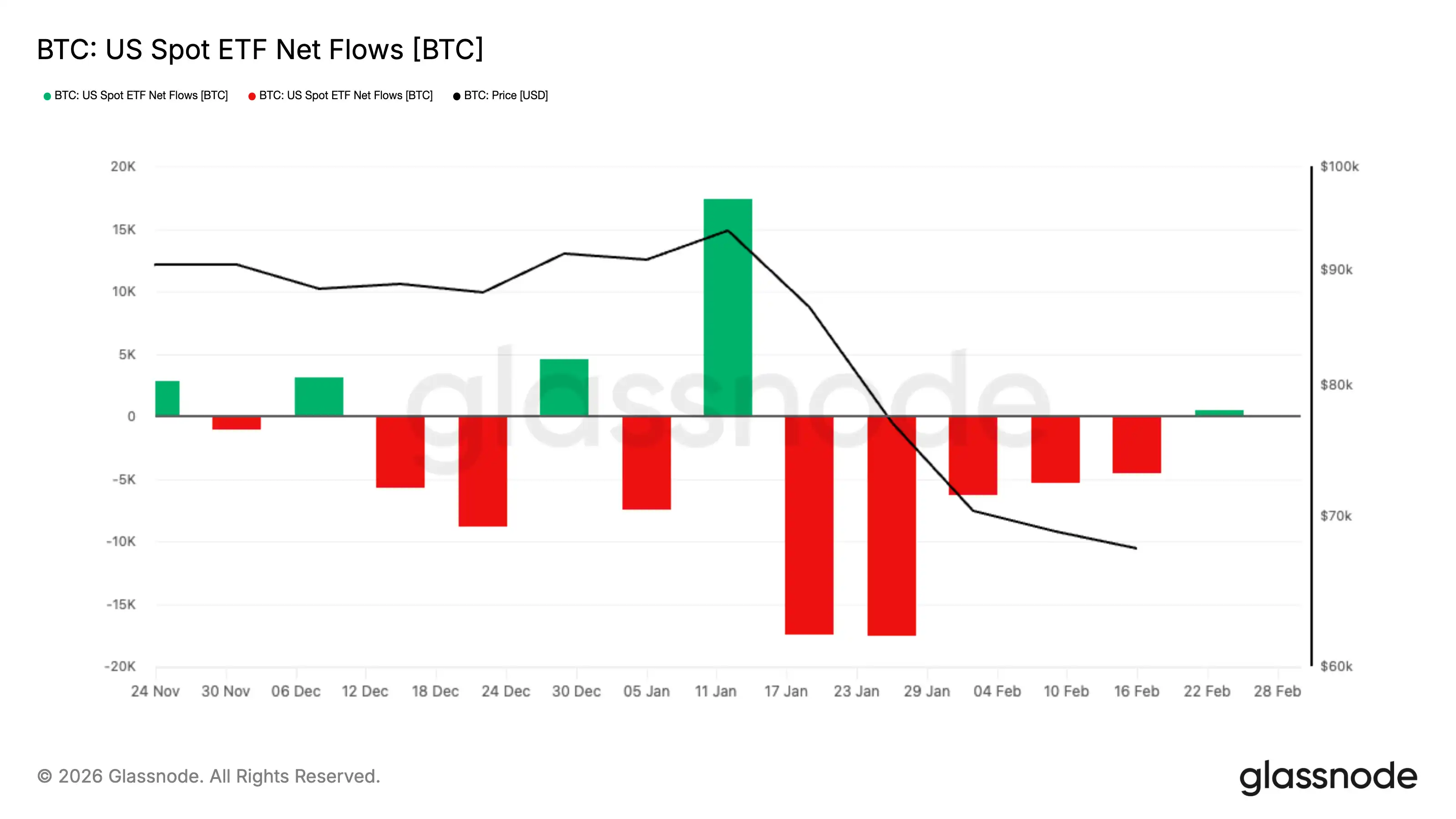
Bitcoin ETFs experienced a five-week outflow streak totaling $3.8 billion, marking the longest continuous withdrawal period since early 2025. This occurred amid heightened macroeconomic uncertainty driven by tariff policy shifts, which amplified volatility across risk assets. However, a reversal began around February 20, with approximately $875.5 million in net inflows over several days, suggesting a potential shift in institutional sentiment. The article emphasizes that ETF flows act as a key indicator of institutional demand. Sustained outflows remove a structural buyer, making price support more fragile and rebounds weaker. Key signals to watch include the persistence of weekly inflows, Bitcoin’s performance on macro-negative days, its ability to rise without ETF support, and the pattern of outflows. Three potential paths are outlined: renewed consistent inflows indicating structural recovery; transient inflows followed by further outflows, suggesting tactical rather than strategic demand; or stabilization with neutral flows, allowing quieter market recalibration. The critical question remains whether marginal buyers are returning with conviction or merely reacting to short-term price levels.

Author: CryptoSlate

Compiled by: Deep Tide TechFlow

Deep Tide's Guide: This article clarifies a structural issue that is easily overlooked: Bitcoin ETFs are not a floor; they are conditional buyers. Five weeks of net outflows totaling $3.8 billion are not just an ugly number; they represent the quiet closing of what was once the most stable institutional door at the peak of tariff uncertainty. After February 20th, the data reversed, but is this reversal a true signal or a tactical move? The author outlines three paths and four indicators to watch, making it worth a careful read.

Full Text Below:

Bitcoin ETFs have just experienced their longest net outflow cycle since early 2025. The uncertainty surrounding tariff policy is stirring interest rates and the stock market, making this outflow particularly critical as it alters Bitcoin's support structure under pressure.

For nearly two years, spot Bitcoin ETFs were almost seen as a one-way street. They liberated Bitcoin from the hassles of private keys and operational complexities, turning it into code that fits into any ordinary investment portfolio. Money flowed in, shares were created, and Bitcoin gained a stable, compliant source of demand.

In the five consecutive weeks leading up to the end of February, investors withdrew approximately $3.8 billion from U.S.-listed spot Bitcoin ETFs, marking the longest streak of weekly net outflows since early 2025. Bitcoin mostly hovered around $60,000 during this period, with recent trading prices around $68,000 as the market attempts to regain balance.

The scale of this outflow is staggering, but the timing is even more critical. The outflow period coincided with tariff policy uncertainty seeping into interest rates, stocks, and commodities, making the entire macro environment jittery again.

However, since February 20th, the flow of funds has at least temporarily shifted.

Between February 20th and 27th, U.S.-listed spot Bitcoin ETFs recorded approximately $875.5 million in net inflows, with strong share creation on multiple consecutive days. This is not enough to erase the losses of the past five weeks, but it complicates the narrative.

What initially seemed like a one-way de-risking cycle may be turning into a reset—institutional demand is cautiously re-emerging amid ongoing macro uncertainty.

What Have ETFs Actually Done to the Bitcoin Market?

Spot ETFs operate through a share creation and redemption mechanism. When demand for ETF shares rises, authorized participants create new shares by injecting assets into the fund. When demand wanes and shares are redeemed, the mechanism contracts. This process connects the buying and selling activity in the stock market with Bitcoin exposure behind the scenes, which is why ETF flows serve as a daily scorecard for Bitcoin.

The SEC approved rules allowing certain crypto ETP shares to be created and redeemed in-kind, meaning authorized participants can exchange the underlying asset for shares directly without routing everything through cash. The SEC's focus was on efficiency and cost reduction.

But even if daily execution remains primarily cash-based, the core logic remains unchanged: ETF flows are one of the cleanest bridges between institutions and the Bitcoin market.

A simple framework to understand:

On net inflow days, the ETF expands, shares are created, and exposure grows. The market feels the presence of a buyer that doesn’t require a new catalyst every day.

On net outflow days, the ETF contracts, shares are redeemed, and exposure shrinks. The market loses that default buyer and must also absorb additional selling pressure.

How Are Five Consecutive Weeks Different from a Single Week of Large Outflows?

The cumulative withdrawal of approximately $3.8 billion over five weeks marks a record duration for weekly net outflows in the recent cycle. Such a prolonged streak of weekly net outflows has not been seen since early 2025. The macro backdrop adds extra weight to this.

Trade policy is once again impacting crypto markets. Tariff uncertainty creates a headline-driven environment where sudden repricing in one asset quickly spills over into others.

In such conditions, portfolios are managed more conservatively. When volatility rises, fund managers quickly cut positions that can be cut easily, forming a negative feedback loop that further depresses prices and exacerbates outflows. They often revisit the assets they cut later, but this does little to calm the outflows.

Whether one admits it or not, Bitcoin falls into the "quick to cut" bucket, and ETF flows are one of the first places this decision becomes visible.

Another comparison looming over this period is gold. Gold has gained safe-haven demand due to tariff uncertainty, with recent dollar weakness and geopolitical risks only amplifying this demand.

But this doesn’t mean Bitcoin has failed in this cycle. The market is clearly categorizing assets by behavior, and Bitcoin is trading more like risk exposure than a safe haven.

When ETF Buying Stops, Who Replaces It?

To understand this, set aside grand narratives and ask one simple question:

When Bitcoin drops 3% in a day, who becomes the buyer that doesn’t need convincing?

In 2024, ETFs gave the market a clear answer. Net inflows were the default demand. They didn’t need leverage, memes, or perfect sentiment—just a committee decision and broker execution.

But when this channel narrows, two specific things happen.

First, declines feel lonelier.

Without consistent ETF net inflows, price discovery relies more on active spot buyers and liquidity providers who require higher compensation to take the other side. This is why pullbacks feel sharper and rebounds feel more hesitant, even if the news doesn’t seem dramatic.

Second, net outflows can bring real market force.

Redemptions are not just a reflection of market sentiment; they are a mechanical contraction of institutional positions. Depending on the product structure and how participants hedge, redemptions can translate into actual Bitcoin sales, hedge adjustments, or basis trade unwinding.

The external result is the same: less support, more supply, weaker bounces.

We can attribute Bitcoin’s poor performance to an overall cooling of U.S. institutional participation and say that ETF net outflows and lighter overall positioning in regulated venues exacerbated this. You may disagree with the tone of this characterization, but it aligns with what the ETF data shows.

This shatters a misconception: ETFs are Bitcoin’s floor. A floor requires a consistently buying buyer. A buyer that steps away for five consecutive weeks was always a conditional buyer.

What to Watch?

To fully grasp the implications, watch four signals and understand what each means.

Watch the weekly net flow data. A single week turning positive is a pulse; two or three consecutive weeks indicate the channel reopening. If weekly data turns consistently positive, it means institutional money pipelines are reopening. If it slips back into sustained negative territory, rebounds may feel like climbing without a handrail, as the cleanest institutional money pipeline is still contracting.

Watch Bitcoin’s performance on macro-negative days. In tariff-driven markets, stocks swing with headlines, rates repricing, and volatility spikes. At such times, Bitcoin either holds up like a scarce asset or trades like risk beta.

Watch if the price can rise without ETF net inflows. If Bitcoin starts climbing while ETF flows are flat or negative, it means another type of buyer has taken the baton. Sometimes it’s derivative position resetting; other times, it’s crypto-native spot demand returning. Either way, that’s the moment it no longer relies solely on ETFs.

Watch the pattern of outflows. A slow drip is different from a sudden gush. A slow drip is position trimming; a sudden gush usually signals forced selling or rapid de-risking.

None of this predicts price, but it tells you whether the market’s biggest demand engine is running, idling, or reversing.

What’s Next?

The answer is no longer as one-directional as it was a week ago.

Five consecutive weeks and $3.8 billion in net outflows marked a clear contraction in institutional positioning. But the data since February 20th introduces a new variable: approximately $875.5 million in net inflows in just over a week.

This doesn’t negate the prior de-risking, but it does suggest the institutional money pipeline isn’t broken—it may have just undergone a stress test.

There are three realistic paths now.

The first is confirmation. If net inflows persist for multiple weeks and begin to stack steadily, these five weeks of outflows will look more like a position reset than a structural exit. In this scenario, ETFs resume functioning as a stable allocation channel, Bitcoin performs better under macro pressure, and recent volatility is reclassified as a shakeout rather than a demand collapse.

The second is fragility. A brief inflow rebound followed by a return to net outflows means last week’s share creation was tactical, not strategic—fast money reacting to price levels, not long-term capital rebuilding positions. If this happens, rebounds may continue to feel heavy, especially in a macro environment where fund managers are tariff-sensitive and quick to cut risk.

The third is stability without acceleration. Flows flatten near zero, extremes on both ends fade, Bitcoin trades in a compressed range, and positions quietly rebuild. This sideways repair may be less dramatic but is often more constructive, as it removes forced flows from the equation and returns price discovery to normal.

The key shift is this: the market is no longer facing one-directional, sustained ETF outflows. It is now testing whether the institutional demand engine is restarting.

The $3.8 billion outflow is eye-catching. But the more important question today is: has the marginal buyer returned, and are these buyers early allocators rebuilding positions, or just traders standing in front of what they perceive as a floor?

ETF flows don’t predict price. But they will continue to show whether Bitcoin’s cleanest institutional buying is expanding, idling, or sliding toward reversal again. And when macro uncertainty makes markets jittery once more, this pipeline matters most.

Связанные с этим вопросы

QWhat was the recent trend in Bitcoin ETF flows before the reversal mentioned in the article?

ABitcoin ETFs experienced a five-week streak of net outflows totaling approximately $3.8 billion, marking the longest weekly net outflow period since early 2025.

QWhat key event or change occurred starting February 20th regarding Bitcoin ETF flows?

AStarting February 20th, U.S.-listed spot Bitcoin ETFs recorded net inflows of about $875.5 million over several days, indicating a potential reversal in the previous outflow trend.

QHow do ETF flows mechanically impact the Bitcoin market according to the article?

AETF flows create or redeem shares based on demand. Net inflows expand ETF size, creating shares and adding buying pressure, while net outflows shrink it, redeeming shares and increasing selling pressure.

QWhat are the three possible paths outlined for Bitcoin ETF flows going forward?

AThe three paths are: 1) Confirmation - sustained net inflows indicating stable institutional demand; 2) Fragility - inflows prove temporary with renewed outflows; 3) Stabilization without acceleration - flows flatten near zero, allowing quiet rebuilding.

QWhat does the article suggest Bitcoin ETF flows reveal about institutional demand during macroeconomic uncertainty?

AETF flows act as the cleanest pipeline for institutional demand, showing whether institutional buying is expanding, idling, or reversing, especially crucial during periods of macroeconomic uncertainty like tariff policy shifts.

Похожее

UBS: The Crowdedness of A-Share Tech Stocks Is Far From Reaching Historical Peaks

UBS: A-share tech stocks still far from peak crowding levels A-shares' technology sector has seen a strong rebound, with trading activity hitting record highs, raising concerns about market crowding. However, UBS Securities argues that a key indicator of institutional positioning suggests the current crowding level remains well below historical peaks. While the large-cap tech sector's share of total A-share trading volume and market capitalization have reached historical highs, the overweight ratio of domestic mutual funds in this sector stood at 9.9% in Q1 2026. This is down from 11.6% in Q3 2025 and significantly lower than the historical peak of 14.1% in Q4 2015. It also pales in comparison to the historical peak overweight of 18.7% for the consumer sector. UBS notes that typical cycles from a low to a peak in fund overweighting last about three years, and the current outperformance of the tech/growth style has lasted less than two years since the policy pivot in September 2024. UBS expects A-share earnings recovery to accelerate, providing fundamental support. It forecasts 2026 A-share profit growth to rise to 11% from 3.9% in 2025. Non-financial A-share profits grew 11.8% YoY in Q1 2026, with gross and net profit margins at their highest since 2023. Persistent fund inflows, the expansion of thematic ETFs, and a recovery in private fund issuance are supporting market liquidity. In tactical allocation, UBS favors growth and cyclical styles under its "slow bull" base case, with overweight ratings on six sectors: Electronics (benefiting from semiconductor inventory recovery and AI innovation), Communications (driven by AI computing demand), Machinery (aided by domestic capex recovery), Non-ferrous Metals (due to rising copper/aluminum prices), Chemicals (supported by anti-involution policies), and Electrical Equipment (driven by policy support and AI data center power demand).

marsbit12 мин. назад

UBS: The Crowdedness of A-Share Tech Stocks Is Far From Reaching Historical Peaks

marsbit12 мин. назад

Should You Buy SpaceX Stock at $1.7 Trillion? Here's What the Market Is Worried About

SpaceX is preparing for a massive IPO aiming to raise around $75 billion at a valuation of approximately $1.75 trillion. While its achievements in reusable rockets and the profitable Starlink satellite internet service are clear, the market is concerned about the aggressive valuation. Key issues include: the current $1.75 trillion valuation, which is about 94 times 2025 revenue, seems to price in not just existing businesses but also unproven future ventures like AI infrastructure and orbital data centers. Financially, while Starlink is profitable, the AI division, bolstered by the acquisition of xAI, is incurring massive losses and consuming the majority of capital expenditures. This acquisition also introduced complex related-party financing arrangements and debt onto SpaceX's balance sheet. Furthermore, corporate governance poses a challenge. SpaceX's dual-class share structure ensures founder Elon Musk retains absolute control, limiting ordinary shareholders' influence over high-risk, long-term strategic decisions. The future success of ambitious projects like the Starship rocket—critical for lowering costs and enabling new services—remains a significant variable for the valuation. In summary, the market's apprehension (FUD) centers not on doubting SpaceX's past technological triumphs but on questioning how much premium public investors should pay for a future that combines proven profits with highly speculative and capital-intensive new ventures, all under a governance structure that offers limited shareholder oversight.

marsbit1 ч. назад

Should You Buy SpaceX Stock at $1.7 Trillion? Here's What the Market Is Worried About

marsbit1 ч. назад

Breaking the DeFi Cascading Liquidation Curse: Vitalik Proposes a New Solution

Vitalik Buterin has proposed a new DeFi design to eliminate the automatic liquidation mechanism that causes market instability during sharp downturns. The current system, used by protocols like Aave, triggers forced sales when collateral value falls below a threshold, often exacerbating price drops and creating systemic selling pressure. Buterin's alternative model is based on splitting an asset like ETH into two synthetic option-like tokens, P and N, pegged to a price index. Their combined value always equals one ETH. Instead of sudden liquidation, a position's value gradually drifts from its target peg if the market moves. Users must proactively rebalance their holdings to maintain their desired exposure, transferring the management burden from the protocol to the user or automated tools. A key advantage is the reduced reliance on real-time oracles. Pricing decisions are deferred until contract expiry, allowing for more robust, fault-tolerant oracle designs. This removes a clear liquidation threshold that speculators can target for manipulation or MEV extraction. However, significant challenges remain. Frequent rebalancing could incur high slippage and transaction costs, necessitating new liquidity provider models. The design is better suited for hedging instruments than for stablecoins requiring a rigid 1:1 peg. While not an immediate replacement for existing systems, the proposal challenges the foundational assumption that instantaneous forced liquidation is an unavoidable necessity in DeFi, opening the door for fundamentally different risk management architectures.

marsbit1 ч. назад

Breaking the DeFi Cascading Liquidation Curse: Vitalik Proposes a New Solution

marsbit1 ч. назад

Торговля

Спот
Фьючерсы

Популярные статьи

Тест по Bitcoin Биткоина

HTX Learn: Изучите Bitcoin halving и Заработаете Токены USDT

3.1k просмотров всегоОпубликовано 2024.04.16Обновлено 2024.04.16

Тест по Bitcoin  Биткоина

Что такое $BITCOIN

ЦИФРОВОЕ ЗОЛОТО ($BITCOIN): Комплексный анализ Введение в ЦИФРОВОЕ ЗОЛОТО ($BITCOIN) ЦИФРОВОЕ ЗОЛОТО ($BITCOIN) — это проект на основе блокчейна, работающий в сети Solana, который стремится объединить характеристики традиционных драгоценных металлов с инновациями децентрализованных технологий. Хотя он носит имя Биткойн, часто называемого “цифровым золотом” из-за его восприятия как средства хранения ценности, ЦИФРОВОЕ ЗОЛОТО является отдельным токеном, предназначенным для создания уникальной экосистемы в ландшафте Web3. Его цель — позиционировать себя как жизнеспособный альтернативный цифровой актив, хотя детали его применения и функциональности все еще развиваются. Что такое ЦИФРОВОЕ ЗОЛОТО ($BITCOIN)? ЦИФРОВОЕ ЗОЛОТО ($BITCOIN) — это токен криптовалюты, специально разработанный для использования в блокчейне Solana. В отличие от Биткойна, который выполняет широко признанную роль хранения ценности, этот токен, похоже, сосредоточен на более широких приложениях и характеристиках. Примечательные аспекты включают: Инфраструктура блокчейна: Токен построен на блокчейне Solana, известном своей способностью обрабатывать высокоскоростные и недорогие транзакции. Динамика предложения: ЦИФРОВОЕ ЗОЛОТО имеет максимальное предложение, ограниченное 100 квадриллионами токенов (100P $BITCOIN), хотя детали о его обращающемся предложении в настоящее время не раскрыты. Утилита: Хотя точные функциональные возможности не описаны, есть указания на то, что токен может быть использован для различных приложений, потенциально связанных с децентрализованными приложениями (dApps) или стратегиями токенизации активов. Кто создатель ЦИФРОВОГО ЗОЛОТА ($BITCOIN)? На данный момент личность создателей и команды разработчиков, стоящих за ЦИФРОВЫМ ЗОЛОТОМ ($BITCOIN), остается неизвестной. Эта ситуация типична для многих инновационных проектов в области блокчейна, особенно тех, которые связаны с децентрализованными финансами и феноменом мем-криптовалют. Хотя такая анонимность может способствовать культуре, ориентированной на сообщество, она усиливает опасения по поводу управления и ответственности. Кто инвесторы ЦИФРОВОГО ЗОЛОТА ($BITCOIN)? Доступная информация указывает на то, что у ЦИФРОВОГО ЗОЛОТА ($BITCOIN) нет известных институциональных спонсоров или значительных венчурных капиталовложений. Проект, похоже, функционирует по модели пирингового взаимодействия, сосредоточенной на поддержке и принятии сообществом, а не на традиционных путях финансирования. Его активность и ликвидность в основном сосредоточены на децентрализованных биржах (DEX), таких как PumpSwap, а не на устоявшихся централизованных торговых платформах, что еще больше подчеркивает его подход, ориентированный на grassroots. Как работает ЦИФРОВОЕ ЗОЛОТО ($BITCOIN) Операционные механизмы ЦИФРОВОГО ЗОЛОТА ($BITCOIN) можно подробно описать на основе его дизайна блокчейна и характеристик сети: Механизм консенсуса: Используя уникальный механизм доказательства истории (PoH) Solana в сочетании с моделью доказательства доли (PoS), проект обеспечивает эффективную валидацию транзакций, что способствует высокой производительности сети. Токеномика: Хотя конкретные дефляционные механизмы не были подробно описаны, большое максимальное предложение токенов подразумевает, что оно может быть предназначено для микротранзакций или нишевых случаев использования, которые еще предстоит определить. Интероперабельность: Существует потенциал для интеграции с более широкой экосистемой Solana, включая различные платформы децентрализованных финансов (DeFi). Однако детали относительно конкретных интеграций остаются неуточненными. Хронология ключевых событий Вот хронология, которая подчеркивает значимые вехи, касающиеся ЦИФРОВОГО ЗОЛОТА ($BITCOIN): 2023: Первоначальное развертывание токена происходит в блокчейне Solana, отмеченное его адресом контракта. 2024: ЦИФРОВОЕ ЗОЛОТО приобретает видимость, когда оно становится доступным для торговли на децентрализованных биржах, таких как PumpSwap, позволяя пользователям обменивать его на SOL. 2025: Проект наблюдает спорадическую торговую активность и потенциальный интерес к инициативам, возглавляемым сообществом, хотя на данный момент не зафиксировано никаких значительных партнерств или технических достижений. Критический анализ Сильные стороны Масштабируемость: Основная инфраструктура Solana поддерживает высокие объемы транзакций, что может повысить полезность $BITCOIN в различных сценариях транзакций. Доступность: Потенциально низкая цена торговли за токен может привлечь розничных инвесторов, способствуя более широкому участию благодаря возможностям дробного владения. Риски Отсутствие прозрачности: Отсутствие публично известных спонсоров, разработчиков или процесса аудита может вызвать скептицизм относительно устойчивости и надежности проекта. Волатильность рынка: Торговая активность сильно зависит от спекулятивного поведения, что может привести к значительной волатильности цен и неопределенности для инвесторов. Заключение ЦИФРОВОЕ ЗОЛОТО ($BITCOIN) является интригующим, но неоднозначным проектом в быстро развивающейся экосистеме Solana. Хотя он пытается использовать нарратив “цифрового золота”, его отход от установленной роли Биткойна как средства хранения ценности подчеркивает необходимость более четкого различения его предполагаемой утилиты и структуры управления. Будущее принятие и усвоение, вероятно, будут зависеть от решения текущей непрозрачности и более четкого определения его операционных и экономических стратегий. Примечание: Этот отчет охватывает синтезированную информацию, доступную на октябрь 2023 года, и с тех пор могут произойти события.

99 просмотров всегоОпубликовано 2025.05.13Обновлено 2025.05.13

Что такое $BITCOIN

Fractal Bitcoin: масштабирование Биткоина с помощью рекурсивной системы

Fractal Bitcoin — масштабное Layer-1-решнение, созданное на базе кода Биткоина, позволяющего достигать бесконечного масштабирования с помощью рекурсивного подхода.

2.3k просмотров всегоОпубликовано 2025.06.30Обновлено 2025.06.30

Fractal Bitcoin: масштабирование Биткоина с помощью рекурсивной системы

Обсуждения

Добро пожаловать в Сообщество HTX. Здесь вы сможете быть в курсе последних новостей о развитии платформы и получить доступ к профессиональной аналитической информации о рынке. Мнения пользователей о цене на BTC (BTC) представлены ниже.

活动图片