Bitcoin At A Crossroads: $60,000 Fortress Vs. $70,000 Ceiling

bitcoinistPublished on 2026-03-01Last updated on 2026-03-01

Abstract

Bitcoin is currently range-bound between $60,000 support and $70,000 resistance. Long-term holders are strengthening the $60K floor, with data showing increased coin aging and low selling from this cohort. However, resistance near $70K is driven by selling from large whales. The negative Coinbase Premium Index indicates weak U.S. institutional demand, which is necessary for a sustained breakout. Short-term holders are capitulating, signaling a market cleansing phase. For a definitive upward move, a return of institutional buying and improved macro conditions are required. BTC is trading around $63,823.

Bitcoin has experienced another net loss over the past week, with the premier cryptocurrency struggling to reclaim key technical levels. Meanwhile, a recent market evaluation shows that while price action is volatile, it is largely range-trapped between $60,000 to $70,000.

Bitcoin’s $60,000 Shield: Long-Term Holders Refuse To Fold

In a recent QuickTake report, a pseudonymous analyst with the username GugaOnChain analyzed Bitcoin’s current market structure, describing a battle between long-term conviction and short-term pressure. According to data from the on-chain platform, Bitcoin remains in a mature bear market, consistent with projections made in December 2025.

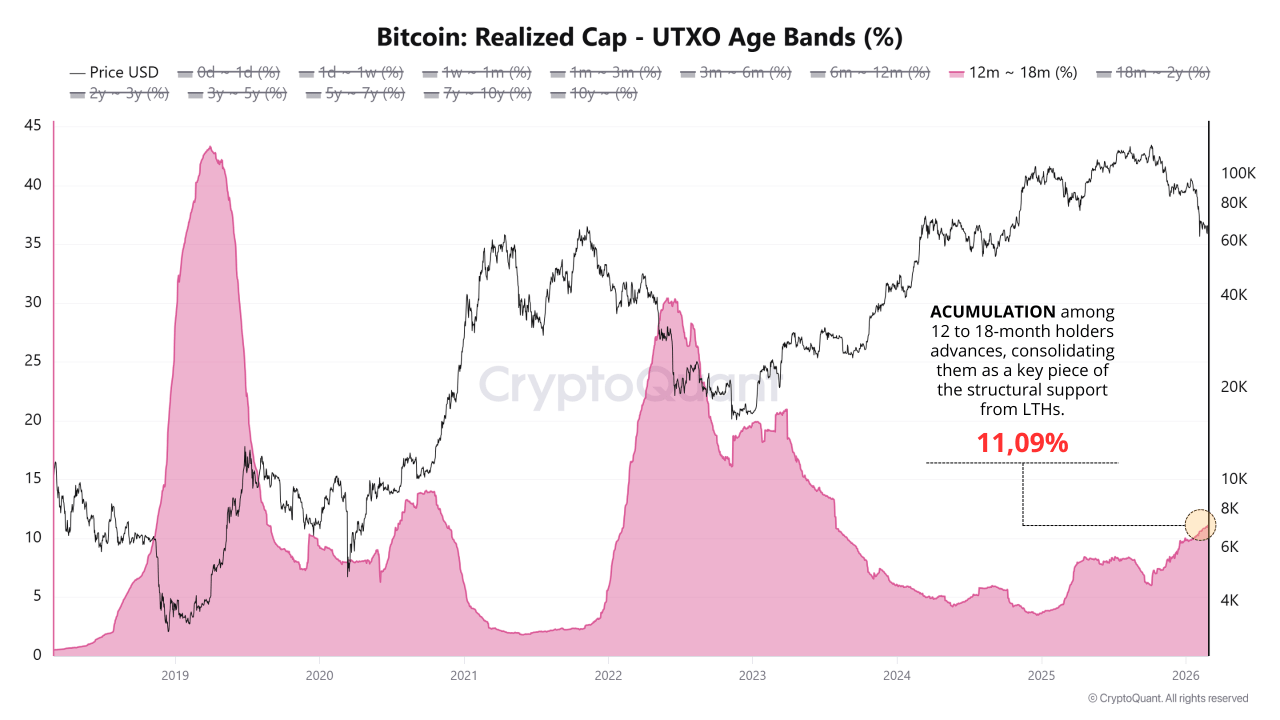
Analyst GugaOnChain noted that at the $60,000 support level, long-term holders are described as the primary defensive force. In particular, the 12 -18-month UTXO cohort has grown from 9.67% to 11.09%, indicating that more Bitcoin is aging into long-term storage.

Source: CryptoQuant

This suggests strengthening conviction among holders who accumulated over a year ago and are choosing not to sell despite market weakness. However, he notes that historical bear market bottoms have seen this cohort reach much higher levels (30-44%), implying that while structural support is forming. A definitive macro bottom may not yet be confirmed.

BTC’S Next Move Hinges On US Institutions Returning

Interestingly, a low Binary Coin Days Destroyed (CDD) reading of 0.14 reinforces the idea that older coins remain dormant. Long-term holders are not distributing or panic selling, effectively acting as a liquidity anchor that prevents a deeper collapse below $60,000.

On the resistance side near $70,000, active whales holding between 1,000 and 10,000 BTC are identified as the main source of selling pressure. Their distribution directly counters long-term holders’ resilience and caps upward momentum. Meanwhile, the Coinbase Premium Index remains negative (-0.04), signaling weak US institutional demand and a broader macro environment marked by risk aversion. Without strong institutional inflows, the market lacks the catalyst needed for a sustained breakout.

Additionally, short-term holders are experiencing capitulation, reflected in an MVRV-STH (Market value to Realized value – Short-term holders) ratio of 0.74, meaning many are holding at a loss and exiting positions. Overall, this shows that Bitcoin is undergoing a cleansing phase. While long-term value is gradually emerging, sustainable upside depends on the return of US institutional demand and a shift in macro conditions.

As of this writing, the price of BTC stands at around $63,823, reflecting a 5.75% jump in the past 24 hours.

BTC trading at $63,659 on the daily chart | Source: BTCUSDT chart on Tradingview.com

Related Questions

QWhat are the key support and resistance levels for Bitcoin in the current market according to the article?

AThe key support level is $60,000, defended by long-term holders, and the key resistance level is $70,000, where active whales are creating selling pressure.

QWho is identified as the main defensive force at Bitcoin's $60,000 support level?

ALong-term holders, specifically the 12-18-month UTXO cohort, are identified as the primary defensive force refusing to sell and providing support.

QWhat does a negative Coinbase Premium Index indicate about the market?

AA negative Coinbase Premium Index signals weak US institutional demand and a broader macro environment of risk aversion.

QWhat on-chain metric suggests that older Bitcoin coins are not being sold, and what is its current reading?

AThe Binary Coin Days Destroyed (CDD) metric suggests older coins are dormant. Its current reading is a low 0.14.

QWhat is the significance of the MVRV-STH ratio being at 0.74 for short-term holders?

AAn MVRV-STH ratio of 0.74 indicates that many short-term holders are holding at a loss and are capitulating, or exiting their positions.

Related Reads

Three Frameworks for Ordinary People to Achieve AI Capability Leap: Say Goodbye to the Dilemma of 'Repeating Inputs Every Day'

Summary: This article outlines three frameworks for maximizing AI efficiency, moving beyond basic prompt usage. 1. **Three-Layer Evolution**: Users progress from (1) **Prompt** (one-off instructions, reset each session), to (2) **Project** (context-aware within a specific project), to (3) **Skill** (permanent, auto-applied knowledge). Most users stagnate at the first layer, repeating the same instructions daily with no cumulative improvement. Skills transform the AI from a chat tool into a personalized work system. 2. **Transaction vs. Compound Interest Mindset**: Using prompts is a linear transaction—effort and output are 1:1, and stopping resets progress. Investing time in building Skills is compound interest; a small initial time investment pays continuous dividends, as each Skill permanently elevates the AI's baseline performance. 3. **Thin Harness, Fat Skills**: The system architecture should prioritize thick, well-defined Skills (90% of the value—containing processes, standards, and domain knowledge) and a thin "harness" (the minimal technical environment). Avoid over-engineering the toolchain while neglecting the AI's actual knowledge. Skills are permanent assets that automatically improve with model updates. The key takeaway: Identify tasks you repeat, encode them into Skills (using tools like Claude's Skill Creator), and shift focus from daily prompting to building a compounding, self-improving AI system.

marsbit38m ago

Three Frameworks for Ordinary People to Achieve AI Capability Leap: Say Goodbye to the Dilemma of 'Repeating Inputs Every Day'

marsbit38m ago

Trading

Spot
Futures

Hot Articles

What is $BITCOIN

DIGITAL GOLD ($BITCOIN): A Comprehensive Analysis Introduction to DIGITAL GOLD ($BITCOIN) DIGITAL GOLD ($BITCOIN) is a blockchain-based project operating on the Solana network, which aims to combine the characteristics of traditional precious metals with the innovation of decentralized technologies. While it shares a name with Bitcoin, often referred to as “digital gold” due to its perception as a store of value, DIGITAL GOLD is a separate token designed to create a unique ecosystem within the Web3 landscape. Its goal is to position itself as a viable alternative digital asset, although specifics regarding its applications and functionalities are still developing. What is DIGITAL GOLD ($BITCOIN)? DIGITAL GOLD ($BITCOIN) is a cryptocurrency token explicitly designed for use on the Solana blockchain. In contrast to Bitcoin, which provides a widely recognized value storage role, this token appears to focus on broader applications and characteristics. Notable aspects include: Blockchain Infrastructure: The token is built on the Solana blockchain, known for its capacity to handle high-speed and low-cost transactions. Supply Dynamics: DIGITAL GOLD has a maximum supply capped at 100 quadrillion tokens (100P $BITCOIN), although details regarding its circulating supply are currently undisclosed. Utility: While precise functionalities are not explicitly outlined, there are indications that the token could be utilized for various applications, potentially involving decentralized applications (dApps) or asset tokenization strategies. Who is the Creator of DIGITAL GOLD ($BITCOIN)? At present, the identity of the creators and development team behind DIGITAL GOLD ($BITCOIN) remains unknown. This situation is typical among many innovative projects within the blockchain space, particularly those aligning with decentralized finance and meme coin phenomena. While such anonymity may foster a community-driven culture, it intensifies concerns about governance and accountability. Who are the Investors of DIGITAL GOLD ($BITCOIN)? The available information indicates that DIGITAL GOLD ($BITCOIN) does not have any known institutional backers or prominent venture capital investments. The project seems to operate on a peer-to-peer model focused on community support and adoption rather than traditional funding routes. Its activity and liquidity are primarily situated on decentralized exchanges (DEXs), such as PumpSwap, rather than established centralized trading platforms, further highlighting its grassroots approach. How DIGITAL GOLD ($BITCOIN) Works The operational mechanics of DIGITAL GOLD ($BITCOIN) can be elaborated on based on its blockchain design and network attributes: Consensus Mechanism: By leveraging Solana’s unique proof-of-history (PoH) combined with a proof-of-stake (PoS) model, the project ensures efficient transaction validation contributing to the network's high performance. Tokenomics: While specific deflationary mechanisms have not been extensively detailed, the vast maximum token supply implies that it may cater to microtransactions or niche use cases that are still to be defined. Interoperability: There exists the potential for integration with Solana’s broader ecosystem, including various decentralized finance (DeFi) platforms. However, the details regarding specific integrations remain unspecified. Timeline of Key Events Here is a timeline that highlights significant milestones concerning DIGITAL GOLD ($BITCOIN): 2023: The initial deployment of the token occurs on the Solana blockchain, marked by its contract address. 2024: DIGITAL GOLD gains visibility as it becomes available for trading on decentralized exchanges like PumpSwap, allowing users to trade it against SOL. 2025: The project witnesses sporadic trading activity and potential interest in community-led engagements, although no noteworthy partnerships or technical advancements have been documented as of yet. Critical Analysis Strengths Scalability: The underlying Solana infrastructure supports high transaction volumes, which could enhance the utility of $BITCOIN in various transaction scenarios. Accessibility: The potential low trading price per token could attract retail investors, facilitating wider participation due to fractional ownership opportunities. Risks Lack of Transparency: The absence of publicly known backers, developers, or an audit process may yield skepticism regarding the project's sustainability and trustworthiness. Market Volatility: The trading activity is heavily reliant on speculative behavior, which can result in significant price volatility and uncertainty for investors. Conclusion DIGITAL GOLD ($BITCOIN) emerges as an intriguing yet ambiguous project within the rapidly evolving Solana ecosystem. While it attempts to leverage the “digital gold” narrative, its departure from Bitcoin's established role as a store of value underscores the need for a clearer differentiation of its intended utility and governance structure. Future acceptance and adoption will likely depend on addressing the current opacity and defining its operational and economic strategies more explicitly. Note: This report encompasses synthesised information available as of October 2023, and developments may have transpired beyond the research period.

363 Total ViewsPublished 2025.05.13Updated 2025.05.13

What is $BITCOIN

Discussions

Welcome to the HTX Community. Here, you can stay informed about the latest platform developments and gain access to professional market insights. Users' opinions on the price of BTC (BTC) are presented below.

活动图片