Before Musk Gave Him $1 Million, He Made $600,000 by Launching Coins

marsbitPublished on 2026-02-12Last updated on 2026-02-12

Abstract

On February 4th, X awarded user @beaverd $1 million for winning an article competition with a piece criticizing Deloitte. Beaver, a well-known meme coin trader, was later accused by Bubblemaps of being a "serial rugger" who allegedly made $600,000 by deploying and manipulating the price of a token called $SIAS on pump.fun, which rapidly rose to a $6 million market cap before crashing to zero. Bubblemaps claimed Beaver used multiple wallets to snipe and profit from the token. In response, Beaver gave a defiant reply, garnering significant support from parts of the crypto community. Supporters argued that since he did not promote the token on his social media, his actions weren’t fraudulent—just a high-risk bet that others lost. Some even criticized Bubblemaps’ own token $BMT as a worse offender. Beaver is also known for Somaliscan, a data site tracking U.S. government spending and exposing corruption, which earned him admiration, particularly among right-leaning audiences. The incident reignites the ongoing debate in crypto over whether launching and manipulating tokens without promotion constitutes unethical behavior or simply reflects the risky nature of meme coin trading.

On February 4th, X announced the winner of its million-dollar article competition. @beaverd, with his piece "Deloitte, a $74 billion cancer metastasized across America," became the ultimate winner, receiving a $1 million reward.
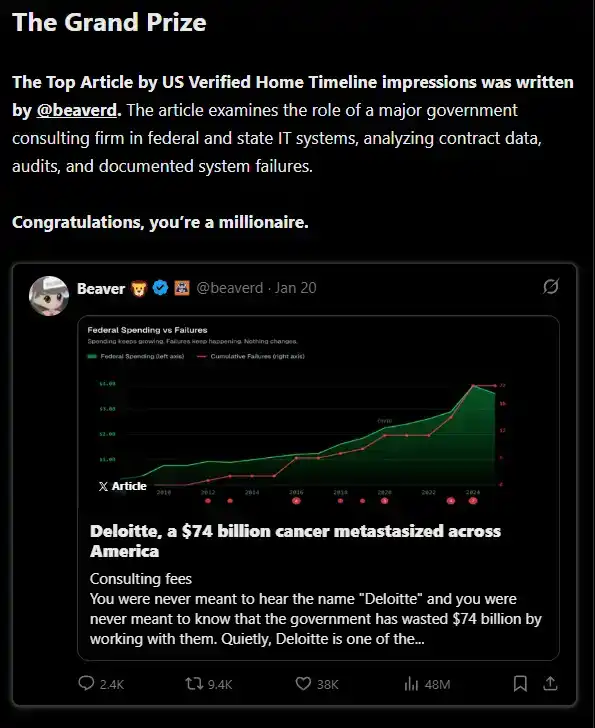
In the English-speaking crypto community, Beaver is a relatively well-known meme coin player, so his win excited the crypto circle. However, the day before yesterday, Bubblemaps posted a tweet accusing him of being a "serial rugger," alleging that he manipulated coin prices to profit $600,000.

Bubblemaps stated that based on Beaver's public Solana address, they discovered an associated address "2mQB8o," which launched the token $SIAS on pump.fun. $SIAS quickly reached a market cap of $6 million within 7 minutes of deployment, but then rapidly plummeted to zero in the next 10 minutes due to large sell-offs by the dev.
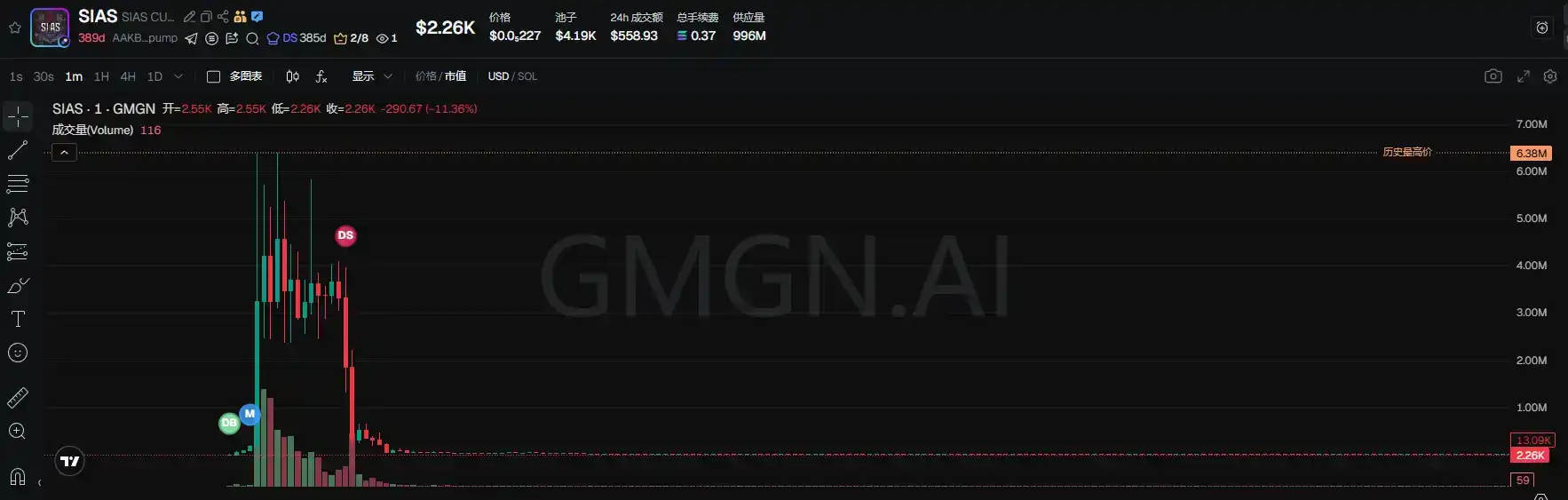
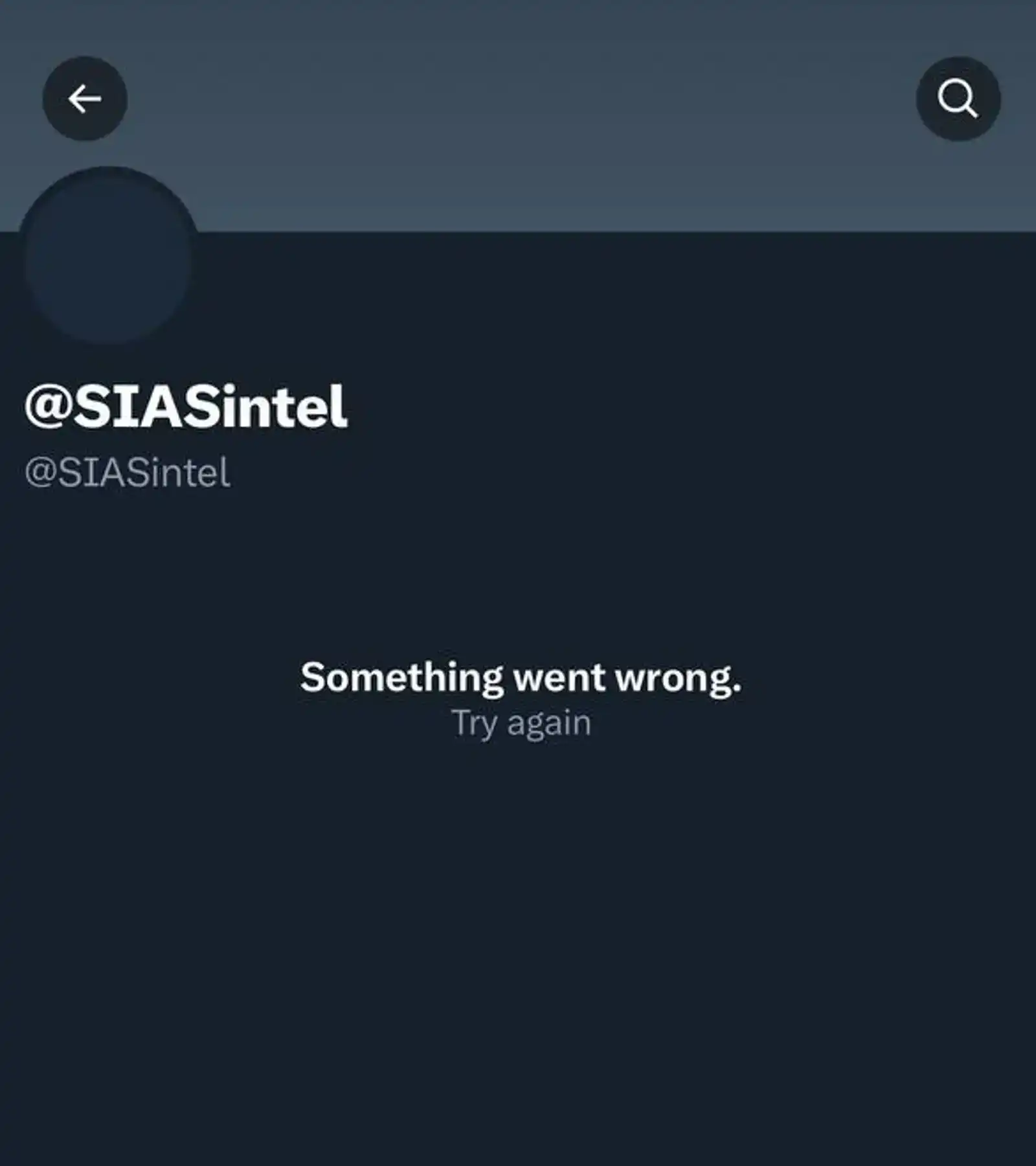
After the token crashed to zero, its X account was also deleted.
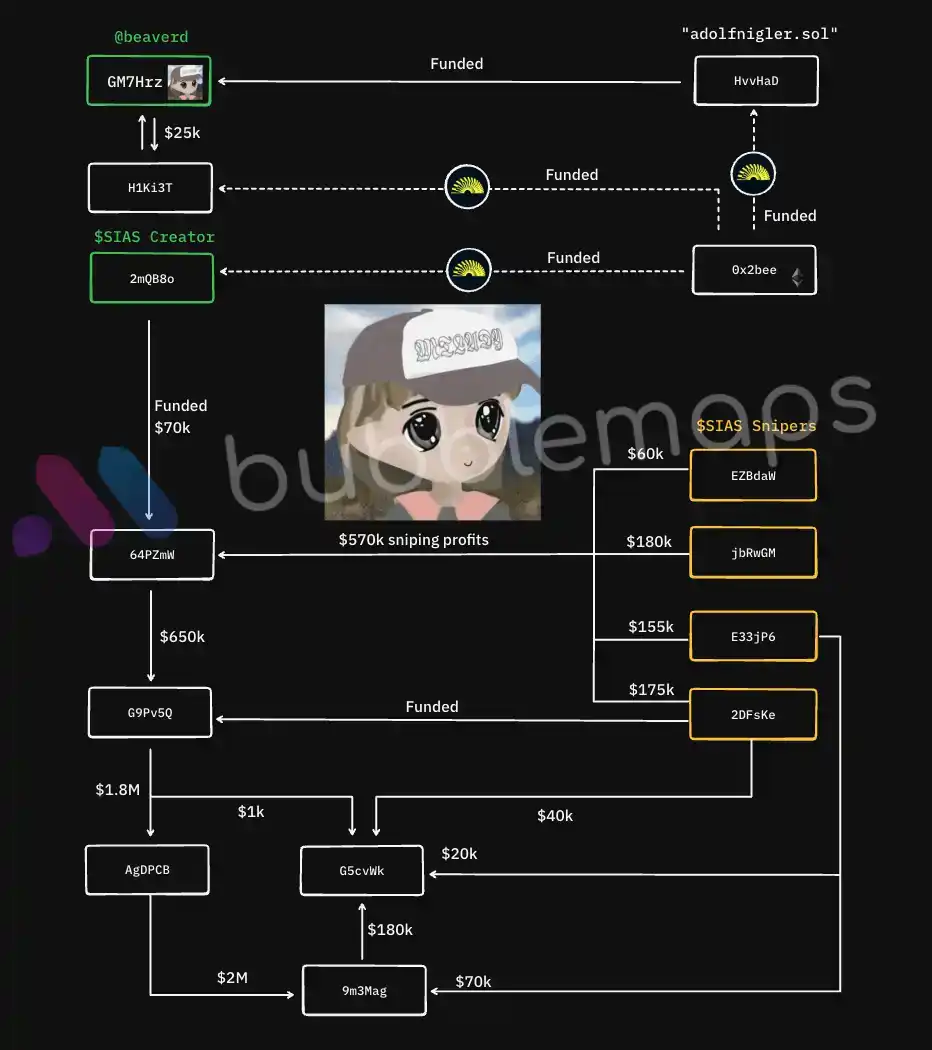
Through further on-chain analysis, Bubblemaps pointed out that Beaver was not only the dev but also used four other addresses to snipe the token, totaling a profit of $600,000.
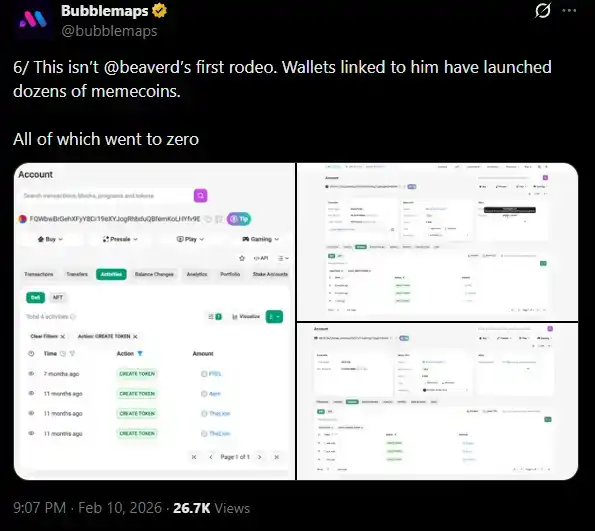
Finally, Bubblemaps also noted that all tracked addresses related to Beaver did not just launch this one token but many others, all of which crashed to zero.
In response to Bubblemaps' accusations, Beaver's reply was as wild as his Milady avatar:

Precisely because of Beaver's response, he gained considerable support. In the English-speaking community, Beaver is popular for being "fun," similar to figures like Bob Lax and mitch. To make an imperfect analogy, it's somewhat like Liang Xi in the Chinese circle.

This is an interesting manifestation of the crypto subculture. Whether in the Chinese or English-speaking circles, a significant portion of players hold the view of "you win some, you lose some"—meme coins are essentially a gamble, and if devs can make money through clever means, that's their skill. Since you gambled, you should take responsibility for yourself.
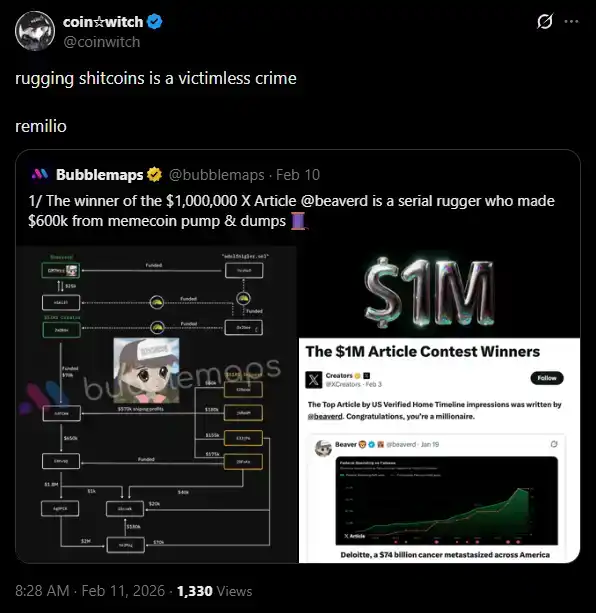
There is also the view that Beaver did not promote $SIAS through his X account (Bubblemaps' accusation also acknowledged this but pointed out that Beaver even profited from the token using his public address, which is an act of audacity). Therefore, Beaver is not guilty of "fraud"; rather, those who bet against him lost to him.

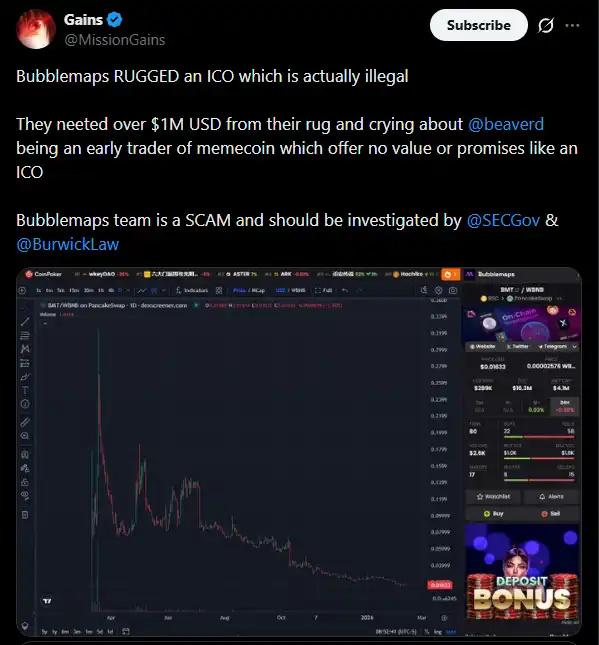
Players siding with Beaver even mocked the market performance of Bubblemaps' token $BMT, arguing that compared to Beaver, Bubblemaps—which conducted an ICO and made promises—is the illegal scam that should be held accountable:
Besides the有趣的 subculture of the crypto world, another reason for Beaver's popularity is his project Somaliscan. Somaliscan is an open-source data website that tracks over $55 trillion in U.S. government fiscal expenditures, exposing massive corruption in the U.S. government's refugee resettlement programs, particularly aid to Somalia. The data on this website covers U.S. government spending, political donations to officials, healthcare system fund allocations, federal loans, and summaries of individuals linked to the Epstein files. Beaver's million-dollar-winning article exposed the massive corruption of Deloitte, which received a $40 billion contract from the U.S. government but caused an estimated $34 billion in losses—a discovery he made while building the database for Somaliscan.

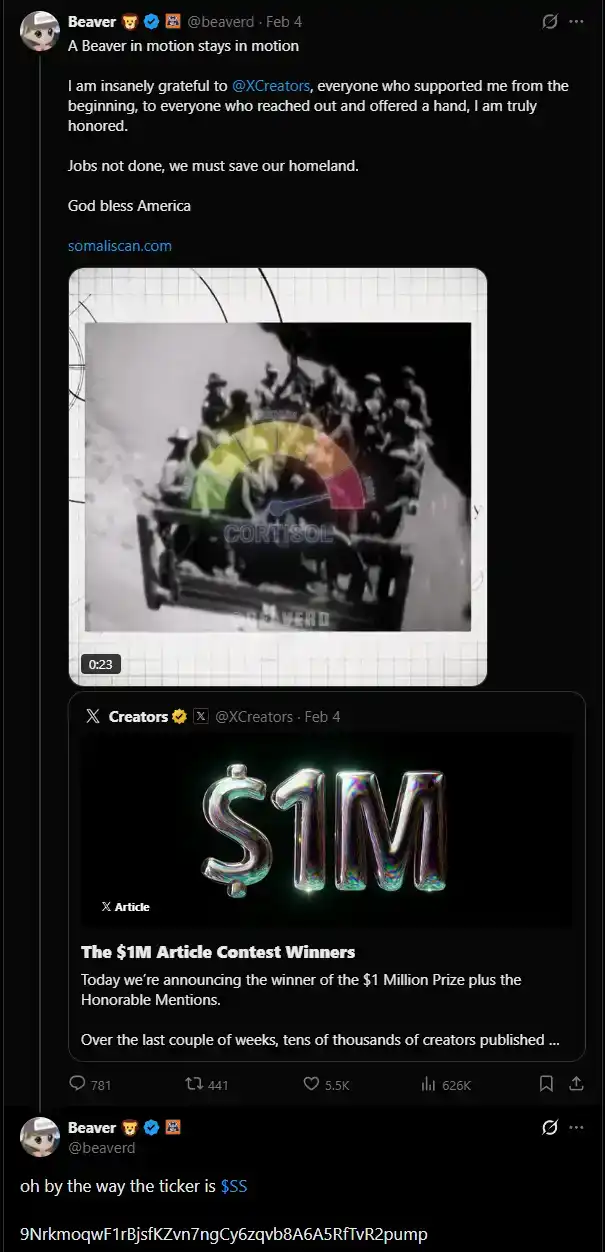
As a result, Beaver is seen as a hero by right-leaning players in the English-speaking community (especially in the U.S.). After X announced his million-dollar article prize, he immediately promoted Somaliscan and included the CA in the tweet's comments:
Setting aside emotional factors, this incident has indeed reignited a long-standing debate in the crypto community—if someone launches a token and manipulates its price but does not promote it, should they be criticized?

This debate will not cease unless the market ceases to be残酷.

Related Questions

QWho won the $1 million article competition on X and what was the title of their winning article?

AThe winner was @beaverd with the article titled 'Deloitte, a $74 billion cancer metastasized across America'.

QWhat accusation did Bubblemaps make against Beaver regarding his activities in the crypto space?

ABubblemaps accused Beaver of being a 'serial rugger' who manipulated the price of a token called $SIAS on pump.fun, making a profit of $600,000 by quickly selling off his holdings and causing the token's value to plummet to zero.

QHow did Beaver respond to the allegations made by Bubblemaps?

ABeaver responded defiantly and with a wild attitude, which actually garnered him significant support from parts of the crypto community who view meme coin trading as a form of gambling where participants are responsible for their own risks.

QWhat is Somaliscan, and how is it related to Beaver's public image?

ASomaliscan is an open-source data website created by Beaver that tracks over $55 trillion in U.S. government spending, exposing corruption in programs like refugee安置 (especially aid to Somalia). It enhanced his reputation, particularly among right-leaning circles, who see him as a hero for uncovering government waste and corruption.

QWhat ongoing debate in the crypto community does the article highlight through Beaver's story?

AThe article highlights the debate over whether creating a token and manipulating its price without promoting it should be considered fraudulent or simply a risky bet that participants enter into willingly, reflecting the community's divided views on responsibility and ethics in meme coin trading.

Related Reads

From Banning Doubao to Embracing Honor: Why Did WeChat Suddenly 'Change Its Face'?

The article explores the sudden shift in WeChat's strategy towards AI assistants from mobile phone manufacturers, transitioning from strict opposition to active collaboration. For over a year, WeChat fiercely resisted attempts by phone AI assistants (like ByteDance's Doubao in late 2025) to control its features via GUI automation ("simulated clicking"), citing security and data control concerns. This stance created a significant barrier for system-level AI integration. Now, Tencent has initiated A2A (Agent-to-Agent) partnerships with major phone brands like Honor, Xiaomi, OPPO, and vivo. This model allows a phone's system AI (e.g., Honor's YOYO) to parse a user's voice command and send a structured request directly to WeChat's own internal AI agent via secure APIs. WeChat then executes the action (e.g., sending a message) and returns the result. The article attributes Tencent's "change of face" to strategic pressure. While leading in social app usage, Tencent trails rivals like ByteDance and Alibaba in standalone AI app popularity. WeChat, with its vast mini-program ecosystem, is Tencent's key asset for an AI comeback. The upcoming WeChat AI agent aims to handle tasks like booking and payments within the app. However, phone system assistants remain the primary AI entry point for most users. The A2A collaboration allows Tencent to extend WeChat's AI reach to this crucial system layer while maintaining control over its core functions and data. For phone manufacturers, embracing A2A is a pragmatic move. The GUI route proved unviable due to WeChat's blocks. A2A offers a compliant path to integrate a vital service, enhancing their AI assistants' usefulness. It allows them to focus on developing their own AI ecosystems for other services while cooperating on WeChat access. The collaboration is framed as a mutual, strategic necessity: Tencent gains a distribution channel, and manufacturers gain a key functionality. The partnership relies on a "dual authorization" mechanism for security, requiring both user and app consent for each action. While questions about long-term data privacy practices remain, experts note A2A is more secure and compliant than GUI automation. Ultimately, this cooperation is seen as a tentative, calculated truce. Tencent's long-term goal is to make WeChat an AI-powered "service OS." Phone manufacturers aim to make their system AI the central user interface. Their paths may converge or clash in the future, but for now, the A2A deal represents the opening chapter in the battle for the AI-era user入口, driven by necessity and strategic calculus on both sides.

marsbit18m ago

From Banning Doubao to Embracing Honor: Why Did WeChat Suddenly 'Change Its Face'?

marsbit18m ago

On-Chain Figures on the Eve of Kickoff: 1.6 Billion Traded Before the World Cup Even Begins

"On-Chain Numbers on the Eve of the World Cup: $1.6 Billion Traded Before Kick-off" Analysis of on-chain markets before the 2026 FIFA World Cup reveals significant crypto integration into football. The most striking figure is the approximately **$1.6 billion** in total trading volume on the single "World Cup Winner" contract on the Polymarket prediction market platform, accumulated before a single match was played. This represents explosive growth for a sector whose annual volume surged from ~$16B in 2024 to ~$64B in 2025. The ecosystem is maturing beyond speculation. Key developments include: 1) **Infrastructure upgrades** like Polymarket's migration to native, regulated USDC stablecoin for settlements; 2) **Reliable data oracles**, such as Chainlink, being used to resolve real-world match outcomes on-chain; and 3) **Official recognition**, with FIFA appointing its first-ever "Prediction Markets" partner. Over 100 contracts now cover everything from the outright winner to individual match results and even non-sporting risks like venue relocation. This evolution marks a fundamental shift. While crypto firms are absent from FIFA's top-tier sponsor list, the technology has deeply penetrated the tournament's financial and predictive infrastructure through regulated stablecoin settlements, decentralized oracles, and new official partnership categories. The regulatory landscape remains complex and varies by jurisdiction, but on-chain markets for the World Cup are already a multi-billion-dollar reality.

marsbit1h ago

On-Chain Figures on the Eve of Kickoff: 1.6 Billion Traded Before the World Cup Even Begins

marsbit1h ago

From SpaceX's IPO to the Future of Crypto: Which Crypto Sectors Will Host the Trillion-Dollar Narrative?

From the SpaceX IPO, which targets a $750 billion raise at a $1.77 trillion valuation, we can extrapolate capital flow trends relevant to crypto. The focus shifts from speculative narratives to foundational infrastructure and real-world asset (RWA) integration. Key crypto sectors poised to benefit include: 1. **AI Infrastructure**: The narrative is moving from consumer-facing AI applications to underlying, scarce resources like compute power and decentralized GPU networks (e.g., TAO, RENDER, AKT, IO). These protocols are positioning as the essential "picks and shovels" providers for the AI economy. 2. **Real-World Assets (RWA)**: Beyond tokenized treasury bonds, RWA's future lies in on-chain equity and pre-IPO assets like SpaceX. This could democratize access to high-growth assets and reshape global capital flows, benefiting infrastructure projects like ONDO, LINK, and Plume that facilitate issuance, data, and liquidity. 3. **Core Financial Infrastructure**: Stablecoins, payment networks, and DePIN (Decentralized Physical Infrastructure Networks) are critical for settling the future on-chain economy. Their role expands from internal trading tools to foundational layers for global finance, AI systems, and real-world asset networks, leading to potential value reassessment. In summary, the next cycle may prioritize long-term infrastructure value—AI compute, asset tokenization networks, and settlement layers—over short-lived application hype, mirroring the broader market's shift towards funding the foundational systems of the future.

marsbit1h ago

From SpaceX's IPO to the Future of Crypto: Which Crypto Sectors Will Host the Trillion-Dollar Narrative?

marsbit1h ago

Trading

Spot
Futures
活动图片