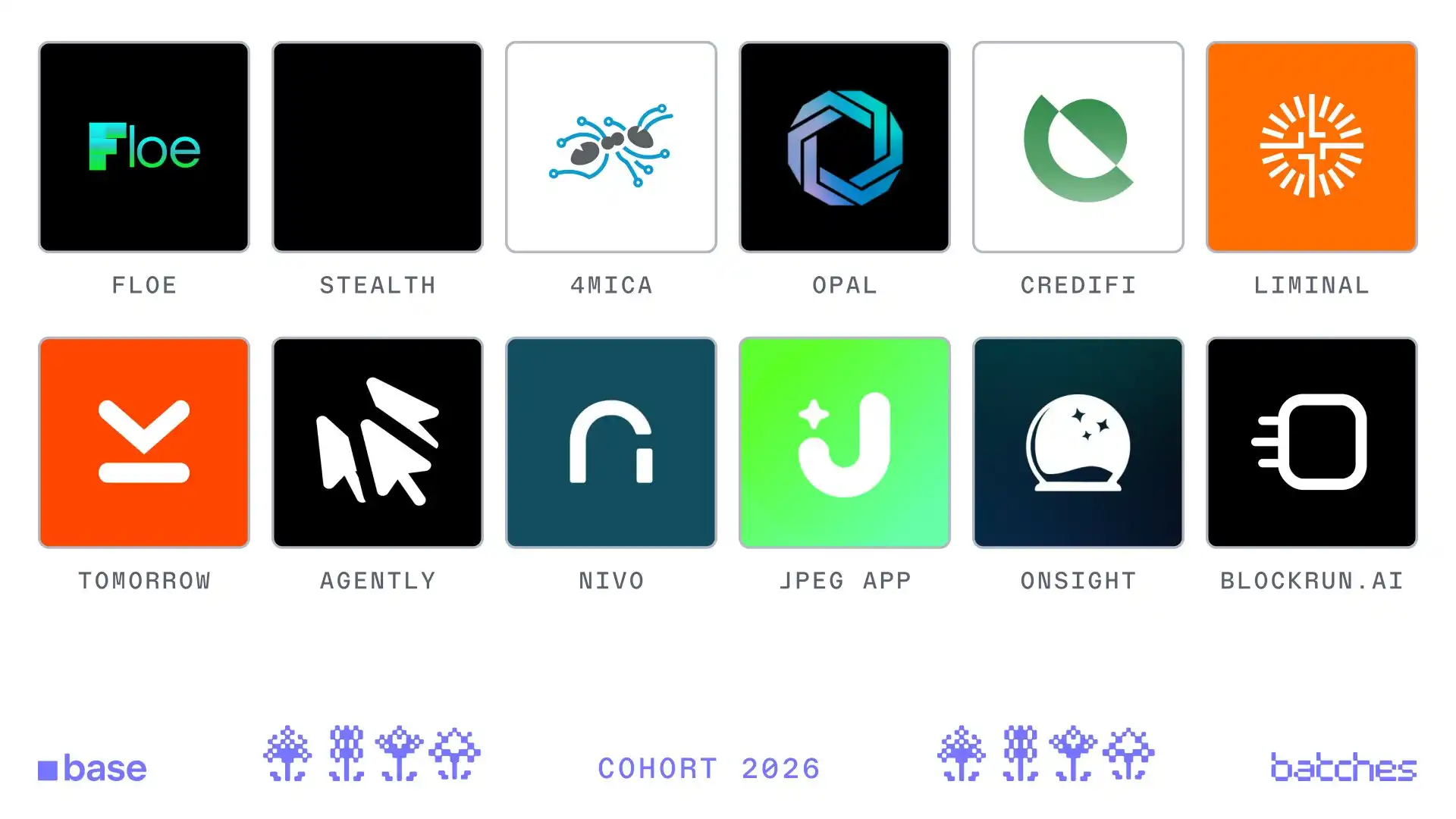
Base Official Selection: 12 Promising Projects Chosen from 1,175 Applications

marsbitPublished on 2026-04-10Last updated on 2026-04-10

Abstract

Base has officially selected 12 standout projects from 1,175 applications for its accelerator program, signaling a strategic focus on high-potential on-chain ecosystems over independent unified stacks outside the OP Superchain. The chosen projects span key sectors including DeFi, prediction markets, AI agents, and payments. Highlights include: BlockRunAI (AI agent infrastructure with x402 pay-per-use payments), a stealth prediction market with novel leverage primitives, 0x4Mica (micropayment clearing for AI agents), Opal DEX (privacy-focused perpetual DEX), TradeOnsight (gamified social prediction platform), Credifi (uncollateralized lending via zkTLS), Tomorrow Loans (creator economy lending), AgentlyHQ (AI agent coordination layer), Nivo Finance (FX hedging for SMEs), JPEGapp (image-based prediction market), Floe Labs (AI agent credit infrastructure), and Liminal (AI-native neobank). Base is positioning itself as a major hub for on-chain innovation this cycle.

Author: yyy

Base has just announced the 12 ecosystem projects selected for its official accelerator program, which I believe sends an important strategic signal:

@base prioritizes the development of on-chain potential ecosystems over building a unified stack independent of the OP Superchain.

These 12 projects were chosen from 1,175 applications to the @base official accelerator program, covering promising sectors such as DeFi, prediction markets, AI Agents, and payments. They are truly one-in-a-hundred selections, with higher credibility than previous batches.

Here is the information on these 12 projects:

1/ @BlockRunAI

Sub-sector: AI Agent Infrastructure / x402 Payments

Provides routing for LLM, tools, and data access for AI Agents, with pay-per-request via the x402 protocol.

2/ (Stealth Project)

Sub-sector: Prediction Markets

Develops a new leverage primitive for prediction markets to enhance trading capital efficiency.

3/ @0x4Mica

Sub-sector: AI Agent Micropayments / Clearing Infrastructure

Provides clearing infrastructure for high-frequency micro-transactions of AI Agents, supporting collateralization and batch settlements.

4/ @opal_dex

Sub-sector: DeFi / Privacy Perpetual DEX

A privacy-protected perpetual contract DEX supporting cryptocurrency and RWA trading, with sealed matching and "dealer" privacy.

5/ @TradeOnsight

Sub-sector: Prediction Markets / Social Gamification

A gamified social prediction market platform that combines social chat with betting experiences.

6/ @credifi

Sub-sector: DeFi / Uncollateralized Lending

An uncollateralized lending protocol based on zkTLS and on-chain credit scoring, lowering the barrier to DeFi lending.

7/ @tomorrowloans

Sub-sector: DeFi / Creator Economy Lending

A collateralized stablecoin lending platform for creators based on verifiable revenue (e.g., Google AdSense).

8/ @AgentlyHQ

Sub-sector: AI Agent Coordination / Transaction Routing

A coordination and transaction routing layer for AI Agents, enabling multiple agents to collaborate on complex tasks and on-chain payments.

9/ @nivo_finance

Sub-sector: DeFi / Foreign Exchange Hedging

An on-chain foreign exchange hedging and forward locking protocol for SMEs and cross-border businesses to manage exchange rate risks.

10/ @jpegapp

Sub-sector: Prediction Markets / Opinion Markets

An opinion market based on photo content where users bet on images, and the highest bet wins.

11/ @FloeLabs

Sub-sector: AI Agent Credit / DeFi

Provides credit lines and credit infrastructure for AI Agents and institutions, supporting payment scenarios like x402.

12/ @liminalcash

Sub-sector: Neobank / AI-Native Banking

An AI-native, self-custodial digital bank integrating self-custody wallets, payments, and smart financial management features.

Base is highly likely to become one of the main battlegrounds for on-chain ecosystem innovation in this crypto cycle. Wait for the wind to come.


Related Questions

QWhat is the main strategic signal released by Base according to the article?

ABase prioritizes the layout of on-chain potential ecosystems over building a unified stack independently from the OP Superchain.

QHow many projects applied to Base's official accelerator program, and how many were selected?

AThere were 1175 applications, and 12 projects were selected.

QWhich project provides a new leverage primitive for prediction markets to improve capital efficiency?

AThe stealth project (unnamed) in the prediction market segment.

QWhat is the core function of the project @0x4Mica?

AIt provides clearing infrastructure for high-frequency micro-transactions of AI Agents, supporting collateralization and batch settlements.

QWhat type of financial service does @liminalcash aim to provide?

AIt aims to be an AI-native, self-custodial digital bank that integrates self-custody wallets, payments, and intelligent financial management features.

Related Reads

Bank of America Quietly Positions: Could $6 Trillion in Bank Deposits Flow into Stablecoins?

Bank of America has quietly made leadership appointments to accelerate its digital asset strategy, sparking discussion about a potential large-scale migration of bank deposits to stablecoins. Reports highlighted the bank naming Sonali Theisen, Kevin Milsom, and Adam Dixon to lead its global digital asset and AI platform, focusing on stablecoins, tokenized deposits, custody, and crypto settlement. This move revived a claim that $6 trillion in bank deposits could flow into stablecoins, a figure originally cited by Bank of America's CEO Brian Moynihan in January. However, he conditioned this shift on stablecoins being allowed to pay interest—a feature not permitted under the current GENIUS Act. The legislation's final rules are delayed, pushing its effective date to January 2027. Major banks are not waiting. JPMorgan and Citigroup are already piloting tokenized deposit services, and a consortium including Bank of America is building a shared tokenized deposit network targeting a 2027 launch. While some, like Pacemakers.io's Alessandro Hatami, remain skeptical of rapid bank collaboration, data shows significant institutional adoption. Stablecoin settlement volume hit $33 trillion in 2025, and analysts project the market could surpass $1 trillion by 2026. Despite a recent dip in crypto prices and stablecoin supply, the institutional push for real-world use cases continues. The race is on for January 2027, when the GENIUS Act takes effect, potentially reshaping the competition between traditional finance and digital assets.

Foresight News2m ago

Bank of America Quietly Positions: Could $6 Trillion in Bank Deposits Flow into Stablecoins?

Foresight News2m ago

US Treasury Secretary Bement Claims: The US Will Soon Control 80% of Global Computing Power

U.S. Treasury Secretary Ben Sent proclaimed that America is poised to control 80% of the world's computing power, positioning compute dominance as a core pillar of U.S. economic strategy. Speaking on the Mike Rowe show, he stated the U.S. currently holds 50-60% of global compute share, with expectations to reach 80% soon. He framed this as a strategic competition the U.S. "cannot afford to lose," warning that a rival's lead would grant "unacceptable" strategic leverage, while asserting a current one-year AI lead. This high-level policy endorsement is seen as a direct boost for AI infrastructure investment, benefiting chipmakers like NVIDIA and cloud providers' capex cycles. Sent positioned AI compute, semiconductors, and quantum computing as three pillars of national economic strength and security. He defended AI's societal impact, citing historical tech shifts, and argued AI empowers small businesses without causing net job loss so far. He highlighted government efforts to deepen public-private AI cybersecurity cooperation. For investors, the statement signals sustained U.S. policy support for AI infrastructure. However, analysts urge caution, noting "compute share" lacks a standard public metric; the 80% figure is a forecast, not audited data. They recommend focusing on tangible indicators like physical capacity expansion and power infrastructure, with future semiconductor and cloud reports providing key verification data.

marsbit13m ago

US Treasury Secretary Bement Claims: The US Will Soon Control 80% of Global Computing Power

marsbit13m ago

Trading

Spot
活动图片