Attacker takes over multisig minutes after creation, drains up to $40M slowly

cointelegraphPublished on 2025-12-18Last updated on 2025-12-18

Abstract

A crypto attacker took control of a multisig wallet just minutes after its creation 44 days ago, ultimately draining up to an estimated $40 million. Blockchain analysis reveals the wallet was created by the victim on November 4th, but ownership was transferred to the attacker only six minutes later. The attacker then patiently drained and laundered the funds in stages, using Tornado Cash over several weeks. Security experts note the wallet was configured as a "1-of-1" multisig, requiring only one signature, which defeats its purpose. Possible attack vectors include malware, phishing, or poor security practices like storing keys in plaintext. The incident highlights growing security concerns, especially as new research shows AI models are already capable of autonomously finding and exploiting smart contract vulnerabilities.

A crypto attacker apparently took over a whale’s multisig wallet minutes after it was created 44 days ago, and has been draining and laundering funds in stages since.

In a Thursday post on X, blockchain security firm PeckShield reported that a whale’s multisig wallet had been drained of roughly $27.3 million due to a private key compromise. PeckShield noted that the attacker has laundered about $12.6 million, or 4,100 Ether (ETH), through Tornado Cash and retained around $2 million in liquid assets, while also controlling a leveraged long position on Aave (AAVE).

However, new findings from Yehor Rudytsia, head of forensic at Hacken Extractor, indicate the total losses may exceed $40 million and that the incident likely began much earlier, with first signs of theft dating back as far as Nov. 4.

Rudytsia told Cointelegraph that the multisig wallet labeled as “compromised” may never have been meaningfully controlled by the victim. Onchain data shows the multisig was created by the victim’s account on Nov. 4 at 7:46 am UTC, but ownership was transferred to the attacker just six minutes later. “Very likely the theft actor created this multisig and transferred funds there, then promptly swapped the owner to be himself,” Rudytsia said.
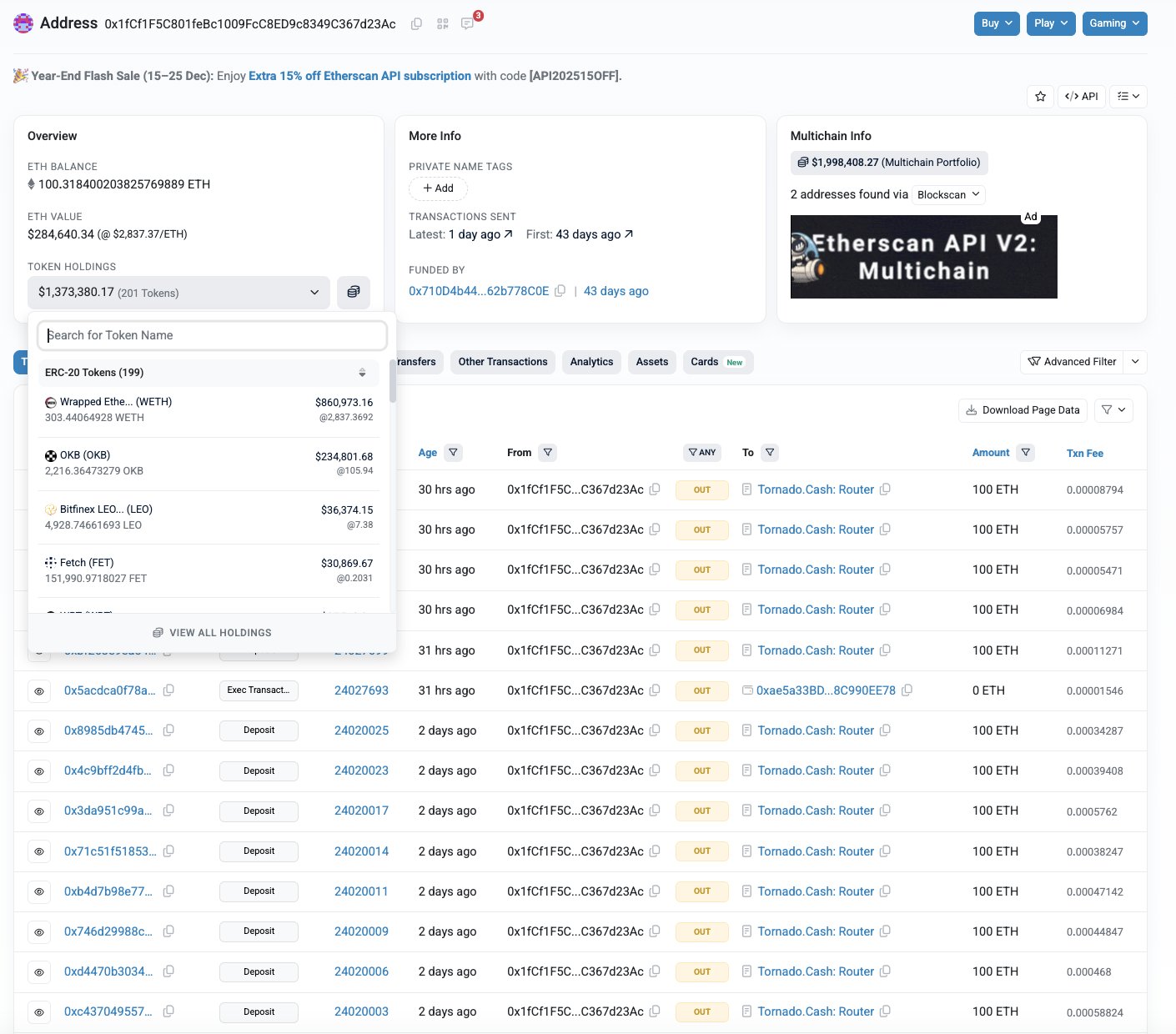
Attacker laundering funds in batches. Source: PeckShield

Related: Spear phishing is North Korean hackers’ top tactic: How to stay safe

Attacker plays the long game

Once in control, the attacker appears to have acted patiently. They made Tornado Cash deposits in batches over several weeks, starting with 1,000 ETH on Nov. 4 and continuing through mid-December in smaller, staggered transactions. Around $25 million in assets also remains on the multisig still controlled by the attacker, according to Rudytsia.

He also raised concerns about the wallet structure. The multisig was configured as a “1-of-1,” meaning only a single signature was required to approve transactions, “which is not a multisig conceptually,” Rudytsia added.

Abdelfattah Ibrahim, a decentralized application (DApp) auditor at Hacken, said several attack vectors remain possible. These include malware or infostealers on the signer’s device, phishing attacks that trick users into approving malicious transactions, or poor operational security practices such as storing keys in plaintext or using the same machine for multiple signers.

“Preventing this would involve isolating signing devices as cold devices and verifying transactions beyond the UI,” Ibrahim said.

Related: Balancer community proposes plan to distribute funds recovered from hack

AI models capable of smart contract exploits

As Cointelegraph reported, a recent research by Anthropic and the Machine Learning Alignment & Theory Scholars (MATS) group found that today’s leading AI models are already capable of developing real, profitable smart contract exploits.

In controlled tests, Anthropic’s Claude Opus 4.5, Claude Sonnet 4.5 and OpenAI’s GPT-5 collectively generated exploits worth $4.6 million, showing that autonomous exploitation is technically feasible using commercially available models.

In further testing, Sonnet 4.5 and GPT-5 were deployed against nearly 2,850 recently launched smart contracts with no known vulnerabilities. The models uncovered two previously unknown zero-day flaws and produced exploits worth $3,694, slightly more than the $3,476 API cost required to generate them.

Magazine: 2026 is the year of pragmatic privacy in crypto — Canton, Zcash and more

Related Questions

QHow much was initially reported to be stolen from the multisig wallet, and through which service were the funds laundered?

AInitially, roughly $27.3 million was reported stolen, and the funds were laundered through Tornado Cash.

QAccording to Yehor Rudytsia, what was the critical flaw in the multisig wallet's configuration that made it vulnerable?

AThe multisig was configured as a '1-of-1,' meaning only a single signature was required to approve transactions, which is not a true multisig and provided no security benefit.

QWhat does the on-chain data reveal about the timing of the attacker taking control of the wallet relative to its creation?

AThe on-chain data shows the multisig was created by the victim's account on Nov. 4 at 7:46 am UTC, but ownership was transferred to the attacker just six minutes later.

QWhat are some of the possible attack vectors that could have led to this private key compromise, as suggested by Abdelfattah Ibrahim?

APossible attack vectors include malware or infostealers on the signer’s device, phishing attacks, or poor operational security practices like storing keys in plaintext or using the same machine for multiple signers.

QWhat did research from Anthropic and MATS demonstrate about the capabilities of current AI models regarding smart contracts?

AThe research found that leading AI models like Claude Opus 4.5 and GPT-5 are capable of developing real, profitable smart contract exploits, generating a total of $4.6 million in exploits in controlled tests.

Related Reads

90,000 Users Participated, $14 Billion USDT Trading Volume: Huobi HTX Peak Competition Ignites the 2025 Year-End Finale

Huobi HTX's "Peak Championship" trading competition for 2025 has concluded, attracting over 90,000 participants and generating a total trading volume exceeding 14 billion USDT. Nearly 1 million USDT in rewards were distributed. The event featured three core formats: Points Race, Individual Challenge, and Team Competition, with both spot and futures tracks. Approximately 56,000 users joined the Individual Challenge, with top winners in both tracks each receiving 17.4 billion HTX tokens. The Team Competition saw intense participation from 126 trading teams. In the spot team category, "孙哥小弟" team won first place with a trading volume of over 196 million USDT, employing a steady strategy focused on major cryptocurrencies. The third-place "메타 기사단" (Meta Knights) team made a remarkable comeback by capitalizing on altcoin opportunities. The futures team champion, "小青龙社区," achieved a trading volume of over 420 million USDT through strong coordination, while the third-place "天道智能合约" team, composed of Web3 developers, rose steadily with a disciplined, logic-based approach. For the 2026 season, Huobi HTX plans significant upgrades, such as introducing an "AI Strategy Captain" for human-machine collaboration, adding rankings based on profit and yield, implementing smart team-matching, and launching a "one-click copy trading" feature to enhance accessibility and inclusivity.

marsbit26m ago

90,000 Users Participated, $14 Billion USDT Trading Volume: Huobi HTX Peak Competition Ignites the 2025 Year-End Finale

marsbit26m ago

Trading

Spot
Futures

Hot Articles

Discussions

Welcome to the HTX Community. Here, you can stay informed about the latest platform developments and gain access to professional market insights. Users' opinions on the price of M (M) are presented below.

活动图片