Amplify ETFs for stablecoins, tokenization go live for trading

cointelegraphPublished on 2025-12-24Last updated on 2025-12-24

Abstract

Amplify has launched two new exchange-traded funds: the Amplify Stablecoin Technology ETF (STBQ) and the Amplify Tokenization Technology ETF (TKNQ), both now trading on NYSE Arca. These ETFs track indexes of companies involved in stablecoin and tokenization infrastructure, including major players like Visa, Circle, Mastercard, PayPal, BlackRock, and JPMorgan. The launch comes amid growing regulatory clarity in the U.S. and Europe, with laws like the GENIUS Act and MiCA positioning stablecoins as compliant digital finance tools. Tokenization and stablecoins have gained significant traction this year as institutions explore digitizing traditional financial services.

Digital asset manager Amplify has launched two exchange-traded funds tracking blockchain projects across stablecoins and tokenization.

The company said on Tuesday that its Amplify Stablecoin Technology ETF (STBQ) and Amplify Tokenization Technology ETF (TKNQ) both went live on the NYSE Arca exchange.

Both funds track a diversified index of companies working on products or infrastructure, along with projects that generate revenue from tokenization and stablecoins.

“These new ETFs expand Amplify’s lineup at a time when the infrastructure behind stablecoins and the growth of tokenization are shaping the next phase of digital finance,” the company said.
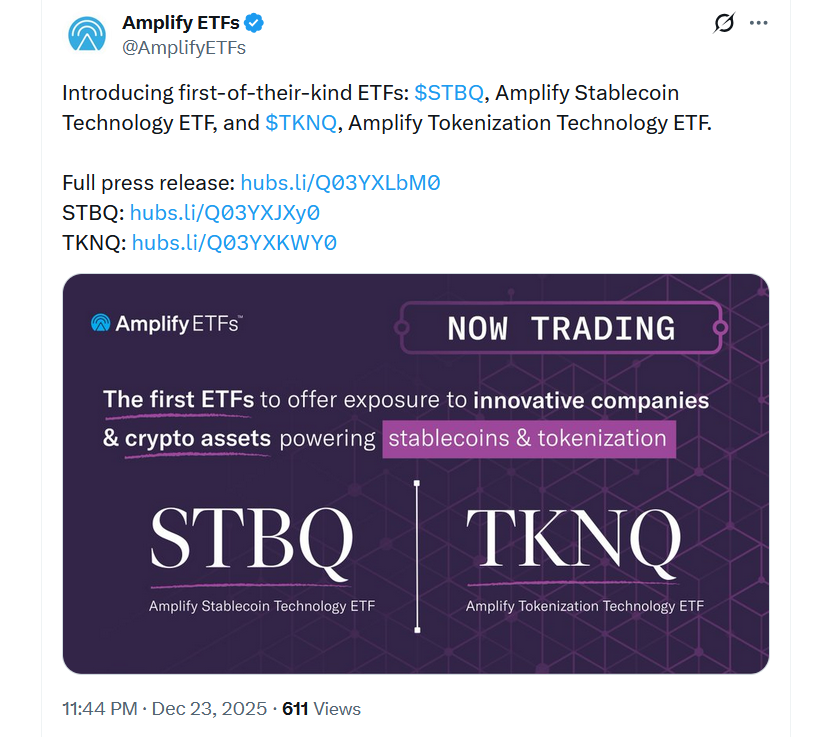
Source: Amplify ETFs

Stablecoins and tokenization have been among the most popular themes in crypto this year, with the US passing laws that have given institutions confidence to launch stablecoins, and regulators opening dialogue on how they should treat assets such as tokenized stocks.

Amplify said its stablecoin-focused ETF tracks shares of companies “generating significant revenue from payments technology, digital asset infrastructure, and trading platforms.”

It holds shares in companies working on stablecoins such as Visa, Circle, Mastercard and PayPal, alongside crypto ETFs from Grayscale, iShares and Bitwise.

The firm pointed to regulatory developments in the US and EU, noting that the “GENIUS Act in the US and MiCA in Europe are positioning stablecoins as the compliant backbone of digital finance.”

Related: Clarity Act delays led to $952M in crypto fund outflows: CoinShares

Meanwhile, the tokenization fund includes exposure to BlackRock, JPMorgan, Figure Technology Solution, Citigroup and the Nasdaq, which all have made tokenization plays over the past few years as they seek opportunities to digitize traditional financial services.

Crypto and blockchain ETFs stormed onto the market in 2025 after the US Securities and Exchange Commission under chair Paul Atkins loosened requirements for crypto ETFs.

Magazine: Big questions: Would Bitcoin survive a 10-year power outage?

Related Questions

QWhat are the names of the two new ETFs launched by Amplify and on which exchange did they go live?

AThe two new ETFs are the Amplify Stablecoin Technology ETF (STBQ) and the Amplify Tokenization Technology ETF (TKNQ). They both went live on the NYSE Arca exchange.

QWhat is the primary focus of the Amplify Stablecoin Technology ETF (STBQ)?

AThe Amplify Stablecoin Technology ETF (STBQ) tracks shares of companies generating significant revenue from payments technology, digital asset infrastructure, and trading platforms related to stablecoins.

QWhich major companies are included in the stablecoin-focused ETF's holdings?

AThe stablecoin-focused ETF holds shares in companies such as Visa, Circle, Mastercard, PayPal, as well as crypto ETFs from Grayscale, iShares, and Bitwise.

QWhat regulatory developments does Amplify cite as supporting the growth of stablecoins?

AAmplify points to the GENIUS Act in the US and the Markets in Crypto-Assets (MiCA) regulation in Europe, which are positioning stablecoins as the compliant backbone of digital finance.

QWhich types of companies does the Amplify Tokenization Technology ETF (TKNQ) provide exposure to?

AThe tokenization fund provides exposure to companies like BlackRock, JPMorgan, Figure Technology Solution, Citigroup, and Nasdaq, which are involved in tokenizing traditional financial services.

Related Reads

When AI Begins to Audit the World: From Claude Discovering the ZEC Vulnerability, Watching the Encryption Industry Enter the 'Recursive Security Era'

**When AI Audits the World: From Claude's Discovery of a ZEC Vulnerability, Viewing the Crypto Industry Entering a "Recursive Security Era"** This article examines a pivotal shift in the blockchain security landscape, triggered by the convergence of two events: Anthropic's research on AI's "Recursive Self-Improvement" and Claude Opus 4.8's discovery of a critical vulnerability in Zcash's code. Traditionally, crypto security has relied on human experts and automated tools for periodic audits. However, the article argues AI is transitioning from a mere tool to an active participant in understanding and analyzing complex systems. Claude's ability to identify a subtle flaw in Zcash's zero-knowledge proof system demonstrates AI's potential to dramatically lower the cost and time required for risk discovery. This goes beyond finding a single bug; it signals a change in the very mechanism of how vulnerabilities are found. The core thesis introduces the concept of "Recursive Security," drawing a parallel to Anthropic's "Recursive Self-Improvement." Just as AI can accelerate its own development through feedback loops, security systems are evolving towards a continuous cycle of analysis, risk identification, remediation, and re-analysis. Security is becoming a persistent, evolving capability integrated into a system's lifecycle, rather than a one-time pre-launch audit. This shift is particularly urgent for the crypto industry, where system complexity from Layer-2 networks, modular architectures, and ZK-proofs is growing faster than human analysis capacity. AI excels at the pattern recognition and contextual understanding needed to navigate this complexity. Importantly, the article cautions that AI augments both defenders and potential attackers, accelerating the entire threat landscape. The future competitive advantage may not lie in having zero vulnerabilities, but in having the fastest risk discovery, validation, and response capabilities. The Claude-Zcash incident is thus an early signal of an era where AI-driven, recursive security systems become essential for managing risk in an increasingly complex digital world.

marsbit8m ago

When AI Begins to Audit the World: From Claude Discovering the ZEC Vulnerability, Watching the Encryption Industry Enter the 'Recursive Security Era'

marsbit8m ago

From MSTR to STRC+: Where Is the Limit of the Strategy Universe?

From MSTR to STRC+: The Evolution and Limits of the Strategy Universe This article examines the transformation of Strategy (formerly MicroStrategy) from a simple "Bitcoin treasury" company into a complex financial engineering firm building a BTC-backed credit system. **Core Thesis:** Strategy's true significance lies not just in its massive BTC holdings (~844k BTC), but in its attempt to transform this static reserve into a multi-layered credit curve within traditional capital markets and, subsequently, into on-chain yield infrastructure. **The MSTR Flywheel:** The initial model was a reflexive loop: BTC price rises → MSTR stock rises → company raises capital (debt/equity) at a premium → buys more BTC → increases per-share BTC exposure → MSTR premium grows. This "amplified Bitcoin" equity (MSTR) thrives on bullish momentum but is vulnerable to tightening premiums and rising funding costs. **Building the Credit Curve:** Strategy's innovation is slicing its single BTC balance sheet into different risk/return profiles via specialized securities: * **MSTR:** High-volatility equity layer absorbing full BTC upside/downside. * **STRC:** Key product. A perpetual preferred stock designed as "short duration high yield credit," offering ~11.5% floating monthly dividends. It attracts fixed-income investors seeking yield without direct BTC exposure, funding Strategy's operations. * **STRD/STRK/STRF:** Other preferred/share classes with varying durations, conversion rights, and fixed dividends. **Risks of the STRC Model:** STRC's high yield is not risk-free. Its stability depends on: 1) Sufficient BTC asset coverage, 2) Strategy's continued ability to pay dividends, and 3) Market faith in the MSTR/STRC funding flywheel. Stress points include deep BTC price declines eroding the asset buffer, rising dividend costs if STRC trades below par, and a broken flywheel if MSTR's premium (mNAV) falls persistently. **On-Chain Expansion: STRC+:** Projects like **Saturn** and **Apyx** aim to package STRC's (and other DAT preferred stock) cash flows into on-chain stablecoin yield (e.g., sUSDat, apyUSD). They offer DeFi a new yield source distinct from trading fees or incentives—cash dividends from traditional securities. However, this introduces compounded risks: off-chain custody, issuer credit risk, BTC volatility, and protocol execution risk. **Conclusion: The Ultimate Boundary** Strategy's endgame is not infinite BTC accumulation. It is the market's long-term acceptance of a new credit system where BTC serves as collateral for tradable securities whose cash flows can power on-chain financial applications. Its "universe" expands if this BTC-native credit curve gains legitimacy, but contracts if these instruments are repriced purely as high-risk, yield-bearing credit assets without stablecoin mythology.

marsbit27m ago

From MSTR to STRC+: Where Is the Limit of the Strategy Universe?

marsbit27m ago

Founder of Baixing.com: My Fourteen Claude Code Usage Experiences

Founder of Baixing.com Shares 14 Personal Tips for Using Claude Code The author outlines his personal, non-universal strategies for maximizing Claude Code. Key points include: focusing deeply on one primary tool (Claude Code) rather than constant comparison; mastering essential shortcuts for the editor and command line; utilizing voice input like HoldSpeak; starting projects with a structured PROJECT.md file; defaulting to Claude agents for most tasks; and leveraging integrations with GitHub and Cloudflare for build, deployment, and infrastructure. He emphasizes a clear separation between human and machine work: manually maintain a core CLAUDE.md file, and understand AI-generated content by asking the AI, not reading its raw code. Efficient communication involves dragging files (screenshots, audio, documents) directly into the interface. For knowledge management, he recommends a centralized, Git-synced memory system based on ~/.claude/CLAUDE.md to ensure permanence and avoid scattered project memories. Other practices include writing and continuously refining "Skills," using the expensive but reliable ultracode for complex dynamic workflows, and employing Git documentation as handoff points between agents. The overarching philosophy is to treat Claude Code like a horse (or a person) with its own pathfinding abilities—setting goals and boundaries rather than micromanaging every turn.

链捕手35m ago

Founder of Baixing.com: My Fourteen Claude Code Usage Experiences

链捕手35m ago

Trading

Spot
Futures
活动图片