AGI is Not the End, DeepMind's New Paper: Moving Towards ASI, the Real AI Progress Has Just Begun

marsbitPublished on 2026-06-16Last updated on 2026-06-16

Abstract

In a new report, Google DeepMind researchers argue that achieving Artificial General Intelligence (AGI) is not the end goal, but rather a step toward Artificial Superintelligence (ASI). They outline four potential pathways for this transition: 1) continued scaling of compute, models, and data; 2) algorithmic evolution and potential paradigm shifts; 3) recursive self-improvement; and 4) multi-agent coordination and collective intelligence. The report also identifies six key bottlenecks that could hinder progress: data limitations (the "data wall"), economic and resource pressures, limitations of current neural network paradigms, increasing research difficulty, "abstraction barriers" in forming new concepts, and regulatory and societal pushback. Looking ahead, the authors emphasize the need for new evaluation methods once AI surpasses human benchmarks. They call for a large-scale, interdisciplinary effort to prepare for a future where AI-driven advancements could trigger transformative changes across multiple fields. The path and speed of progress remain uncertain, constrained by physical laws, computational complexity, and real-world feedback loops.

If artificial general intelligence (AGI) were achieved tomorrow, what would the next phase of AI look like?

Google DeepMind's team and its collaborators propose in a latest research report that AGI is likely not the endpoint. In their view, AI will not plateau at a level close to humans but will continue to become more powerful, surpassing the most top-tier teams of human experts and ultimately moving towards artificial superintelligence (ASI).

As Alan Turing wrote in 1950: “We can only see a short distance ahead, but we can see plenty there that needs to be done.”

In this report, the research team outlines four potential pathways for AI's transition from AGI to ASI, possible key bottlenecks, and the most pressing research questions to advance.
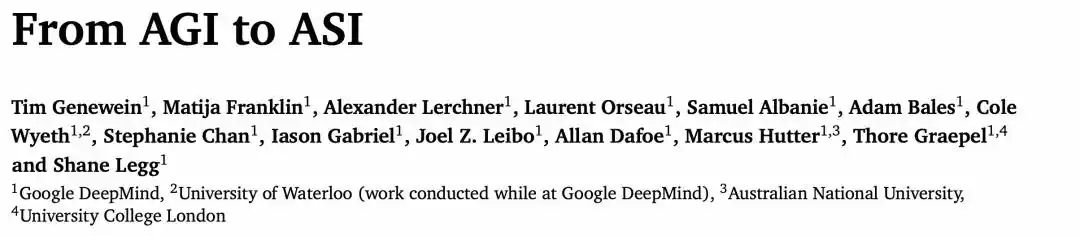
Paper Link: https://arxiv.org/abs/2606.12683

The research team stated that due to the considerable uncertainty in predicting ASI progress, the possibility of AI continuing to accelerate its development in the coming years cannot be ruled out. This may mean that the notion of a “single transformative leap” triggered by introducing human-level AGI into society might be inaccurate.

A more fitting prospect might be that AI-driven progress and breakthroughs will emerge successively across numerous fields of science and technology, thereby triggering a series of transformative societal changes.

To address this prospect, a large-scale, interdisciplinary project with a global vision and broad concern is needed.

After AGI, Comes ASI

Before discussing how AI might continue to become stronger, the research team first distinguishes three easily confused concepts: AGI, ASI, and UAI.

AGI (Artificial General Intelligence): A general intelligent system that reaches the median human level in most cognitive tasks. This corresponds to the general cognitive ability of an average person, not the level of top experts. The research team also notes that the first generation of AGI might already surpass humans in some tasks, just not yet possessing sufficiently broad generality.

ASI (Artificial Super Intelligence): It does not surpass humans in only a few tasks but overall exceeds humans in nearly all fields of human concern; the reference is not a single expert but large-scale, well-coordinated collectives of human experts.

UAI (Universal Artificial Intelligence): The theoretical upper bound of machine intelligence, formally described by the AIXI framework. AIXI corresponds to a theoretically optimal universal agent. Real-world AI can only gradually approach this upper bound, not directly achieve it.

Simultaneously, the research team points out that the transition from AGI to ASI might not have only one path. They propose four potentially parallel advancing pathways, detailed as follows:

Path One: Continue Scaling Computation, Models, and Data

This path continues the basic logic of AI progress over the past decade, including more powerful hardware, larger training runs, higher algorithmic efficiency, larger models, and more data. The research team notes that recent “effective compute” has roughly grown tenfold annually. Following this path, AI's improvement comes not only from individual models becoming stronger but also potentially from collective capability expansion due to more instances, faster inference, and larger-scale collaboration.

Path Two: Continued Algorithmic Evolution, Even New Paradigm Shifts

The research team states that longer context, continual learning, retrieval augmentation, tool use, robust decision-making in interactive environments, world models, etc., all belong to extensions of existing paradigms; whereas new architectures, training objectives, or learning mechanisms are closer to genuine paradigm shifts. The team does not specifically predict what the next paradigm shift might be but believes it could still be a crucial source of continued AI progress post-AGI.

Path Three: Recursive Self-Improvement

A stronger AI can help develop the next generation of even stronger AI, forming a positive feedback loop. The research team mentions this mechanism could manifest in algorithm and code improvement, hardware design, data generation and filtering, and efficiency gains in division of labor. For example, AlphaZero's approach of first using search to improve outputs, then distilling results back into the model, is a relevant case. More importantly is the question of how far this positive feedback can develop in reality.

Path Four: Multi-Agent Coordination and Collective Intelligence

This path focuses not on how strong a single model becomes, but on numerous AGI systems forming collective intelligence exceeding individual limits through division of labor and collaboration. The research team views automated companies, research organizations, and virtual economic systems as possible manifestations of this path. According to this path, ASI might not necessarily be an extremely powerful individual model but could be a highly coordinated AI collective.

The research team also cautions that the move from AGI to ASI may not simply be about more compute being better. Compute expansion is certainly important but will soon hit resource ceilings, requiring new algorithmic ideas, even new paradigms. More notably, even if a single AGI is only near human-level, once many AGIs can efficiently divide labor and collaborate, their collective capability might exceed humanity's.

Where Do the Real Challenges Lie?

After discussing the four potential paths, the research team also summarizes six categories of key bottlenecks that could affect AI's continued strengthening. Details as follows:

1. Data Wall

The research team points out that high-quality human-generated data is finite; human text data suitable for large-scale pre-training may approach its limit within this decade. Whether synthetic data, simulated environment data, and data generated from AI interacting with the real world can fill this gap fast enough is not concluded by the team but listed as a core uncertainty.

2. Economic and Natural Resource Pressures

If AI progress continues to rely primarily on scaling, then energy, chips, data centers, supply chains, and capital investments must grow in sync. The research team sees this as a real-world constraint but also notes that AI itself might increase economic output and improve algorithmic and hardware efficiency, thereby alleviating these pressures.

3. Current Neural Network Paradigms Might Be Inadequate

The research team does not rule out the possibility of the current path leading to ASI but also cautions that this path may still have fundamental limitations in areas like continual learning, stable reasoning, interactive decision-making, uncertainty representation, as well as issues like hallucinations and prompt injection.

4. Research Itself Will Become Increasingly Difficult

The research team notes that as a field matures, further progress often requires greater investment; whether AI can offset this trend through automated research remains to be studied.

5. Abstraction Barrier

The research team believes that if today's AI primarily learns from concepts and symbolic systems humans have already formed, it might excel at recombining existing concepts but not necessarily at autonomously extracting new conceptual primitives from the raw world. For example, if a modern large model were trained solely on pre-Newtonian knowledge, it would be almost impossible for it to derive general relativity or quantum mechanics from that material alone.

6. Regulation, Governance, and Societal Backlash

The research team argues that regulatory thresholds, licensing regimes, incident reporting requirements, and societal reactions to accidents will all influence the pace of AI capability expansion. This involves not just technical issues but also policy, institutions, markets, and public risk perception.

Shortcomings and Future Developments

Finally, the research team raises a very practical question: If AI already surpasses humans, how should we continue to assess its capabilities?

Today, many benchmarks use human-level as a reference. Once AI approaches or surpasses top humans in exams, programming, mathematics, Q&A, and professional knowledge tests, the original evaluation metrics may lose meaning. Therefore, future needs include establishing new evaluation and forecasting systems for the post-AGI era, encompassing tasks like multi-agent competition and cooperation, automated test generation, universal compression tasks, economic productivity and other indirect indicators, along with assessment mechanisms that can be continuously updated and do not saturate prematurely.

However, in terms of content, this is not an experimental paper but more like a technical report centered on the post-AGI era. The research team points out that future directions worthy of attention include: continuing to scale existing AGI systems, exploring new AI paradigms, achieving recursive self-improvement of systems, and forming stronger overall capabilities through large-scale multi-agent collaboration.

Finally, the research team notes that ASI is also not an omniscient, omnipotent “magic system”; it remains constrained by physical laws, computational complexity, data, resources, experimentation time, and the speed of real-world feedback. Which path AI will advance along and at what speed remains highly uncertain. In the future, there is still a need to establish continuously updated benchmarks, predictions, and research mechanisms to reduce uncertainty in judgment.

This article is from the WeChat public account "Academic Headlines" (ID: SciTouTiao), author: Academic Headlines


Trending Cryptos

Related Questions

QWhat are the four potential pathways for AI to progress from AGI to ASI according to the DeepMind paper?

AThe four potential pathways are: 1. Continued scaling of compute, models, and data. 2. Algorithmic evolution, including possible paradigm shifts. 3. Recursive self-improvement. 4. Multi-agent coordination and collective intelligence.

QWhat is the key difference between AGI and ASI as defined in the research?

AAGI (Artificial General Intelligence) refers to a system performing at the median human level across most cognitive tasks. ASI (Artificial Super Intelligence) refers to a system that surpasses human capability not just in a few tasks, but across virtually all domains of human concern, exceeding the collective performance of large, well-coordinated teams of human experts.

QWhat are some of the major bottlenecks that could hinder AI's progress from AGI to ASI?

AThe major bottlenecks include: 1. The data wall (limited high-quality human-generated data). 2. Economic and natural resource pressures. 3. Potential fundamental limitations of current neural network paradigms. 4. Increasing difficulty of research itself. 5. The abstraction barrier (AI may struggle to autonomously derive new primitive concepts). 6. Regulation, governance, and societal backlash.

QWhy might traditional AI benchmarks become inadequate in the post-AGI era?

ATraditional benchmarks, which are often anchored to human-level performance, may lose their meaning once AI approaches or exceeds top human performance in tests like exams, coding, and expert knowledge. New evaluation systems are needed, focusing on multi-agent competition/cooperation, automatically generated tests, universal compression tasks, and indirect metrics like economic productivity.

QWhat is the purpose of the 'large-scale interdisciplinary project' mentioned in the report?

AThe purpose is to proactively address the prospective scenario where AI-driven advancements and breakthroughs emerge successively across many fields of science and technology, leading to a series of transformative social changes. This project requires a global perspective and broad concern to manage this transition.

Related Reads

NVIDIA CPU Advances, China's RISC-V Responds: Semiconductor Deep Dive - Part Four

NVIDIA is set to launch its new Vera AI data center CPU in China as early as August, with high pricing. While this move offers a new option, it highlights China's continued dependence on foreign-controlled Arm architecture. In response, the Chinese semiconductor industry is increasingly turning to RISC-V as a strategic alternative for achieving high-performance computing autonomy. The article explores the concept of the "impossible triangle" in CPU development—balancing prosperity, control, and autonomy—and posits that RISC-V's open-source, modular nature offers a unique path to achieving all three. While RISC-V is already dominant in embedded systems, the focus is now shifting to data centers and AI workloads. China has become a global hotspot for RISC-V development, driven by AI-driven compute demand, supply chain concerns from export controls, cost benefits of open-source, and strong policy support. Multiple Chinese companies have reportedly crossed the key performance threshold of 15 SPECint per GHz, a benchmark for entering the high-performance CPU club. Progress extends beyond single-core benchmarks. Companies are developing complete computing subsystems, including commercial-grade coherent network-on-chip (NoC) technology and server processors with up to 40 cores that strictly adhere to the RVA23 standard to ensure software compatibility. Real-world applications are emerging in areas like video transcoding and edge AI. However, significant challenges remain. The RISC-V ecosystem faces fragmentation, immature toolchains and verification processes, and gaps in single-core performance and energy efficiency compared to mature x86 and Arm architectures. The formidable software moat, epitomized by NVIDIA's CUDA, is a long-term hurdle. In conclusion, while RISC-V cannot immediately replace offerings like NVIDIA's Vera, it represents a viable long-term path for China to develop a self-sufficient, high-performance CPU ecosystem. The journey is acknowledged to be long and arduous, requiring sustained effort to overcome technical and ecosystem challenges.

marsbit45m ago

NVIDIA CPU Advances, China's RISC-V Responds: Semiconductor Deep Dive - Part Four

marsbit45m ago

My Coding Betting Dashboard is Profiting, but Polymarket is Truly Not a Good Place for 'Arbitrage'

The author built a custom monitoring dashboard for Polymarket, a prediction market platform, and tested it with $1,600, achieving over 30% returns. However, the core argument is that Polymarket is not a good venue for traditional arbitrage. The dashboard has two main sections: a "Portfolio Dashboard" for tracking active positions with key metrics like total capital, P&L, and a risk-control module using a tier system (T1, T2, T3), and an "Opportunity Watchlist" for monitoring markets. The article details a critical structural trap in binary markets: a bet with a high perceived probability of success still carries a 100% loss risk if wrong. The author's T1/T2/T3 system is designed to manage this by limiting position sizes based on conviction and time horizon, emphasizing that high confidence should not equal high concentration. A key insight is the danger of "pseudo-diversification"—betting on different markets driven by the same underlying variable. The author concludes that Polymarket offers few true low-risk, arbitrage opportunities. It is instead a high-risk environment where wins can create a false sense of mastery, leading to large losses. The platform is better viewed as a training ground for honing judgment through disciplined, framework-driven betting rather than a reliable income source. The tools help transform intuition into structured, rule-based decisions to mitigate the risk of catastrophic errors.

marsbit3h ago

My Coding Betting Dashboard is Profiting, but Polymarket is Truly Not a Good Place for 'Arbitrage'

marsbit3h ago

WeChat AI Card Hands-On Guide: Has the AI Shopping Era Arrived?

**"WeChat AI Card" Practical Test Guide: Has the Era of AI Shopping Arrived?** WeChat has officially launched the "AI Exclusive Card," a feature integrated into its Workbuddy AI assistant. This card is designed to handle payments for AI-initiated purchases. Our hands-on test reveals it's not yet a tool for fully autonomous AI shopping, but rather a controlled payment layer for AI agents. The AI Card functions as an isolated sub-wallet within WeChat Pay. Users must bind the card and transfer funds into it from their main wallet. Crucially, every transaction requires explicit user confirmation via smartphone scan; AI cannot spend autonomously. Currently accessible through the Workbuddy agent, the card targets specific digital consumption scenarios: purchasing paid content (reports, data), calling paid APIs/tools, and subscribing to services. Its design prioritizes security and control by separating funds and mandating approval for each payment. We tested a real-world scenario: ordering bubble tea via Workbuddy using a "Meituan Life Assistant" skill. The process encountered multiple hurdles: high "skill" usage costs (exceeding daily free credits), and most importantly, while a payment was successfully initiated, the AI purchased an incorrect product (a mismatched group-buy coupon instead of the desired drink). This highlights the current limitation: the **AI Card only solves the payment step**. The broader challenge lies in the **AI agent's execution chain**—accurately understanding intent, navigating third-party platforms, selecting the right product, and ensuring proper fulfillment. The payment succeeded, but the purchase failed to meet the user's need. In conclusion, the WeChat AI Exclusive Card is a cautious, early-step experiment in AI commerce. It provides a secure, user-controlled payment method for agent interactions but is not yet capable of reliable, end-to-end complex purchases. For now, it's best used for low-value, low-risk digital services with careful user verification at each step. The vision of AI handling complete shopping tasks remains a work in progress.

marsbit6h ago

WeChat AI Card Hands-On Guide: Has the AI Shopping Era Arrived?

marsbit6h ago

Deconstructing Notion's Growth: From a Note-taking Tool to 100 Million Users—How Notion Built a Triple Growth Flywheel Through Product, Templates, and Community

Notion's growth from a niche note-taking tool to a platform with 100 million users is powered by three interconnected flywheels: Product-Led Growth (PLG), a Template Economy, and Community-Driven Growth. First, Notion's PLG strategy relies on a highly flexible, "plastic" product that users can adapt to countless personal and team workflows. Its freemium model lowers the barrier to entry, while features like page sharing and collaboration drive organic, usage-based viral growth as users naturally invite others. Second, the Template Economy solves the "blank page" problem. Templates, created by both Notion and its community, transform abstract product capabilities into concrete, copyable solutions for specific scenarios (e.g., project management, content calendars). This dramatically lowers activation costs for new users and fuels SEO-driven discovery. Third, a vibrant Community acts as a distributed growth engine. Users and official Ambassadors create tutorials, share use cases, and host local events. This community not only educates users but also fosters a sense of identity around pursuing "better ways of working," strengthening loyalty and enabling global, low-cost expansion. Together, these flywheels create a self-reinforcing ecosystem: a great product attracts users who create templates and community content, which in turn attracts more users and deepens engagement. This system allowed Notion to scale from individuals to teams and enterprises through a bottom-up adoption path. Looking ahead, AI integration promises to accelerate these flywheels further by making templates smarter and the platform a potential AI-native work operating system. Ultimately, Notion's defensible advantage is not just its features, but this deeply entrenched network of user assets, creators, and community trust.

marsbit6h ago

Deconstructing Notion's Growth: From a Note-taking Tool to 100 Million Users—How Notion Built a Triple Growth Flywheel Through Product, Templates, and Community

marsbit6h ago

Trading

Spot
Futures

Hot Articles

Discussions

Welcome to the HTX Community. Here, you can stay informed about the latest platform developments and gain access to professional market insights. Users' opinions on the price of AI (AI) are presented below.

活动图片