After the Implementation of Uniswap's Fee Switch: Is This DeFi Transformation's 'Report Card' Impressive Enough?

marsbitPublished on 2026-01-14Last updated on 2026-01-14

Abstract

Uniswap's fee switch activation, implemented through the "UNIfication" proposal, marks a pivotal shift in its tokenomics by linking UNI tokens directly to protocol usage and revenue. Previously a governance-only asset, UNI now accrues value through a deflationary mechanism where a portion of protocol fees from Uniswap V2, V3, and Unichain is used to programmatically burn UNI tokens. An initial one-time treasury burn of 100 million UNI was executed to compensate holders for past unaccrued fees. Early data indicates an annualized protocol revenue of approximately $26-27 million, resulting in a revenue multiple of around 207x relative to UNI’s $5.4 billion market capitalization. The current annualized burn rate is estimated at 4-5 million UNI, representing only 0.4% of the circulating supply. This high valuation implies strong market expectations for future growth, requiring expanded fee capture—such as broader pool coverage, V4 hooks, and Unichain optimization—to justify current levels. The move reflects a broader DeFi trend toward "fee-hooked" token models, where tokens are designed to better align holders with protocol economics through mechanisms like burns, staker rewards, or ve-token lockups. This transition makes UNI more analytically grounded but also subjects it to greater scrutiny based on sustainable value accumulation and real yield generation. Regulatory developments regarding revenue-sharing tokens will also play a critical role in shaping its future.

Author: Tanay Ved

Compiled by: Saoirse, Foresight News

Key Points

  • Uniswap's fee switch links the UNI token to protocol usage through a token supply burn mechanism. Currently, fees generated by the protocol are used to reduce the supply of UNI. This adjustment transforms the UNI token from having only governance functions to an asset that can directly accumulate value.
  • Early data shows the protocol's annualized fees are approximately $26 million, with a revenue multiple of about 207x; it will continue to burn around 4 million UNI tokens annually. This move has already incorporated high growth expectations into UNI's $5.4 billion valuation.
  • DeFi is gradually transitioning to a "fee-hooked" token model. Mechanisms such as token burning, staker reward distribution, and "vote-escrowed (ve)" locking are all designed to align token holders more closely with the protocol's economic system, thereby reshaping the valuation logic in this field.

Introduction

In late 2025, Uniswap governance passed the "UNIfication" proposal, officially activating the long-awaited protocol "fee switch." This is one of the most significant token economic changes in a DeFi blue-chip project since 2020—a time when the market is increasingly focused on "real yield" and "sustainable value accumulation driven by fees." Now, this fee switch establishes a more direct link between the UNI token and Uniswap's revenue and trading activity, with Uniswap itself being one of the largest decentralized exchanges (DEX) in the cryptocurrency space.

In this article, we will delve into Uniswap's token economic system after the fee switch is enabled, assess the dynamics of UNI token burning, the fee mechanism, and its impact on valuation, and explore the significance of this transformation for the entire DeFi field.

The Disconnect Between DeFi Tokens and Protocol Value

One of the core challenges in the DeFi space is the disconnect between "powerful protocols" and "weak tokens." Many DeFi protocols have achieved clear product-market fit, high usage rates, and stable revenue, but the tokens they issue often only serve governance functions, providing almost no direct access to protocol cash flows for holders. In this context, capital increasingly flows into areas like Bitcoin, underlying public chains (L1s), Meme coins, etc., while the trading prices of most DeFi tokens are severely disconnected from the actual equity of protocol growth.
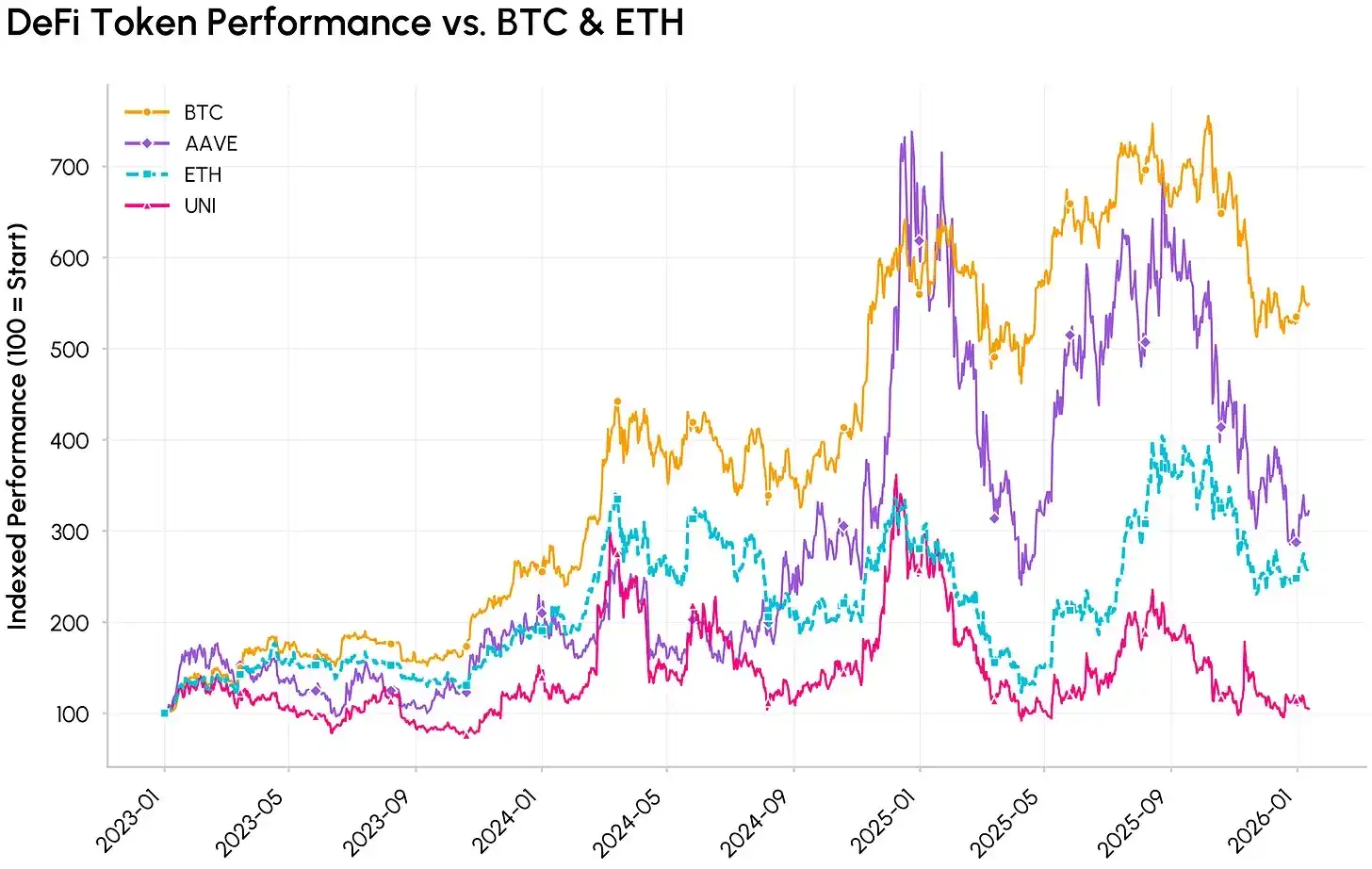
Indexed performance comparison of DeFi tokens (AAVE, UNI) vs. mainstream cryptocurrencies (BTC, ETH)

Uniswap launched as a decentralized exchange (DEX) on the Ethereum network in November 2018, designed to enable order book-free, intermediary-free exchange of ERC-20 tokens. In 2020, Uniswap issued the UNI token and positioned it as a governance token—a practice consistent with DeFi blue-chip projects like Aave, Compound, and Curve, where the primary purpose of issuing tokens is often governance voting and user incentives.
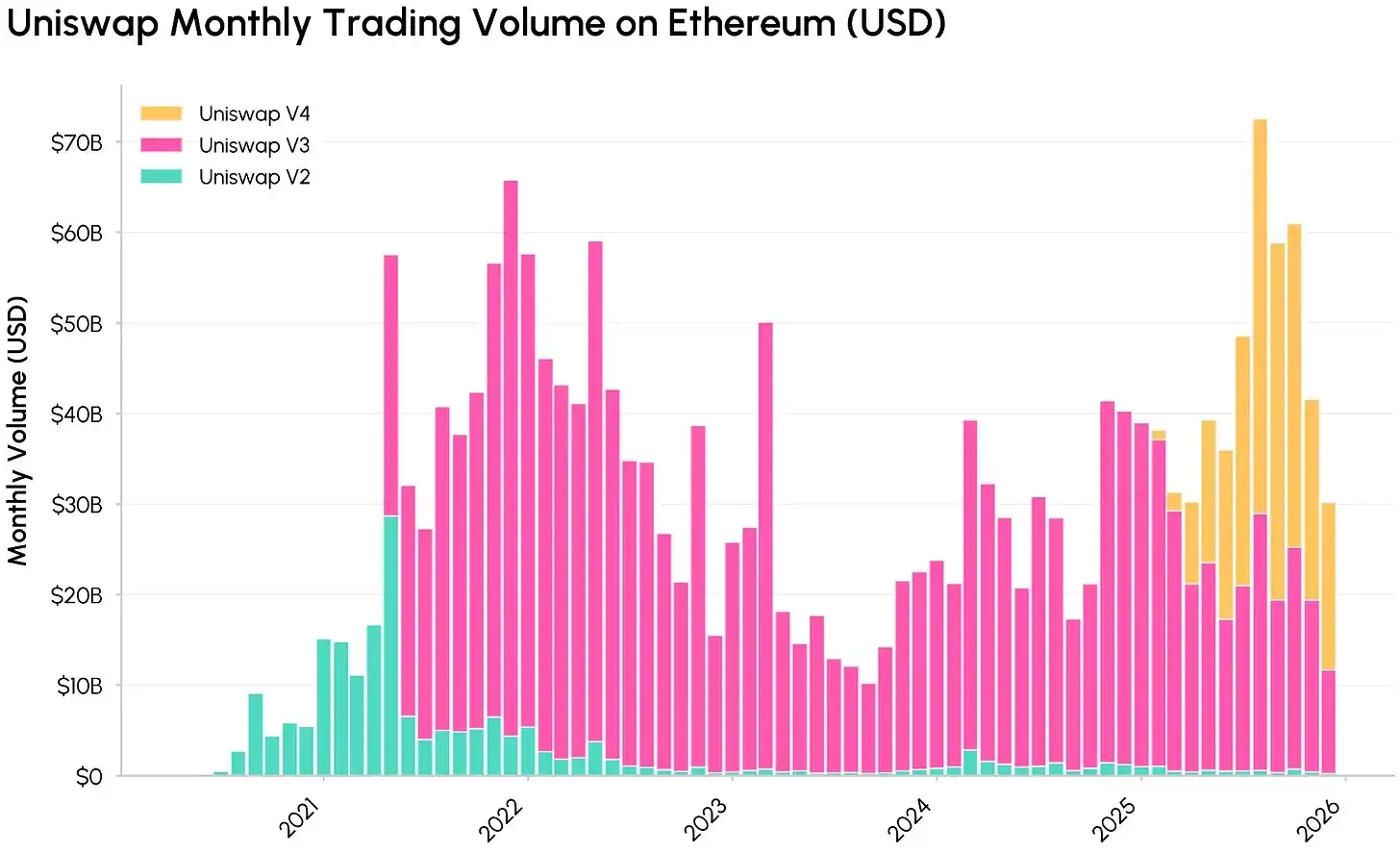
Monthly trading volume (in USD) trends of various Uniswap versions (V2, V3, V4) on the Ethereum network. Source: Coin Metrics Network Data Pro

With version iterations, Uniswap has become a core component of on-chain financial infrastructure, processing tens of billions of dollars in trading volume and generating substantial fee income for liquidity providers (LPs). However, like most DeFi governance tokens, UNI token holders cannot directly share in the protocol's revenue, leading to an increasing disconnect between the scale of the protocol's underlying cash flow and the economic interests of token holders.

In practice, the value generated by Uniswap primarily flows to liquidity providers (LPs), borrowers, lenders, and related development teams, while token holders only receive governance rights and inflationary rewards. This contradiction between "governance-only" tokens and the "need for value accumulation" laid the foundation for the introduction of Uniswap's fee switch and the "UNIfication" proposal—which explicitly links the value of the UNI token to protocol usage, aligning token holders more closely with the economic system of the decentralized exchange (DEX).

Uniswap Fee Switch: Fees and Burn Mechanism

With the passage of the "UNIfication" governance proposal, the Uniswap protocol introduced the following key adjustments:

  1. Activate protocol fees and UNI burn mechanism: Turn on the protocol "fee switch," directing protocol-level pool fees from Uniswap V2 and V3 on the Ethereum mainnet into the UNI token burn mechanism. By establishing a programmatic link between "protocol usage" and "token supply," UNI's economic model shifts from "governance-only" to "deflationary value accumulation."
  2. Execute retrospective treasury token burn: A one-time burn of 100 million UNI tokens from the Uniswap treasury to compensate token holders for the fee revenue missed over the years.
  3. Include Unichain revenue: Sequencer fees generated by the Unichain network (after deducting Ethereum Layer 1 data costs and Optimism's 15% share) will be fully incorporated into the aforementioned "burn-driven" value capture mechanism.
  4. Adjust organizational incentive structure: Integrate most functions of the Uniswap Foundation into Uniswap Labs, and establish an annual growth budget of 20 million UNI, enabling Uniswap Labs to focus on protocol promotion; simultaneously, reduce its take rate in interfaces, wallets, and API services to zero.
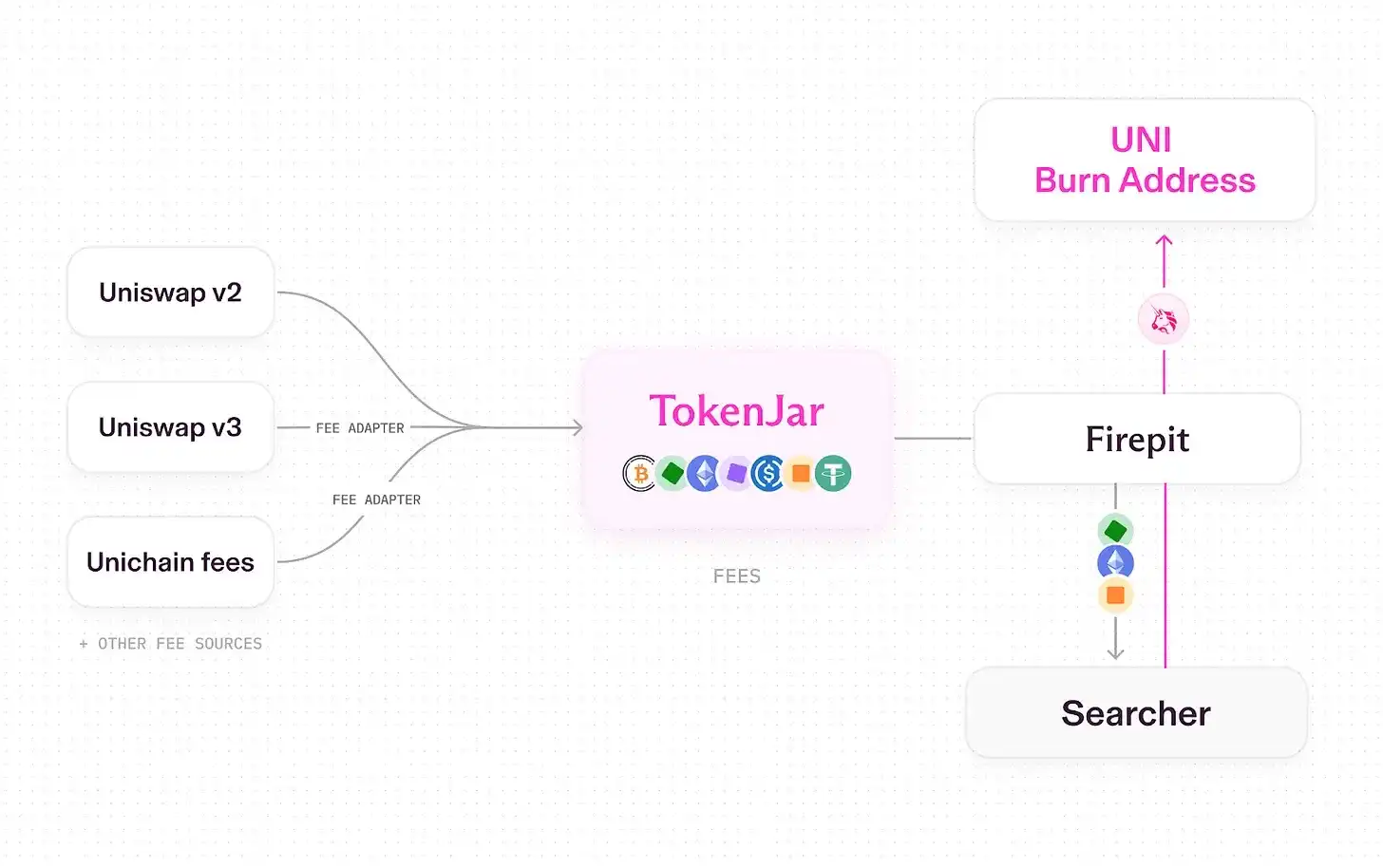
Complete process of converting protocol fees into UNI token burns after the Uniswap fee switch is turned on. Source: Uniswap UNIfication

Currently, Uniswap operates in a "pipelined" mode, using dedicated smart contracts to handle asset release and conversion (such as UNI token burning). The specific process is:

  1. Transactions on Uniswap V2, V3, and Unichain generate fees;
  2. A portion of the fees belongs to the protocol (the rest is distributed to liquidity providers);
  3. All protocol-level fees flow into a single treasury smart contract called "TokenJar" on each chain;
  4. Value in the TokenJar can only be released when UNI tokens are burned through the "Firepit" smart contract.
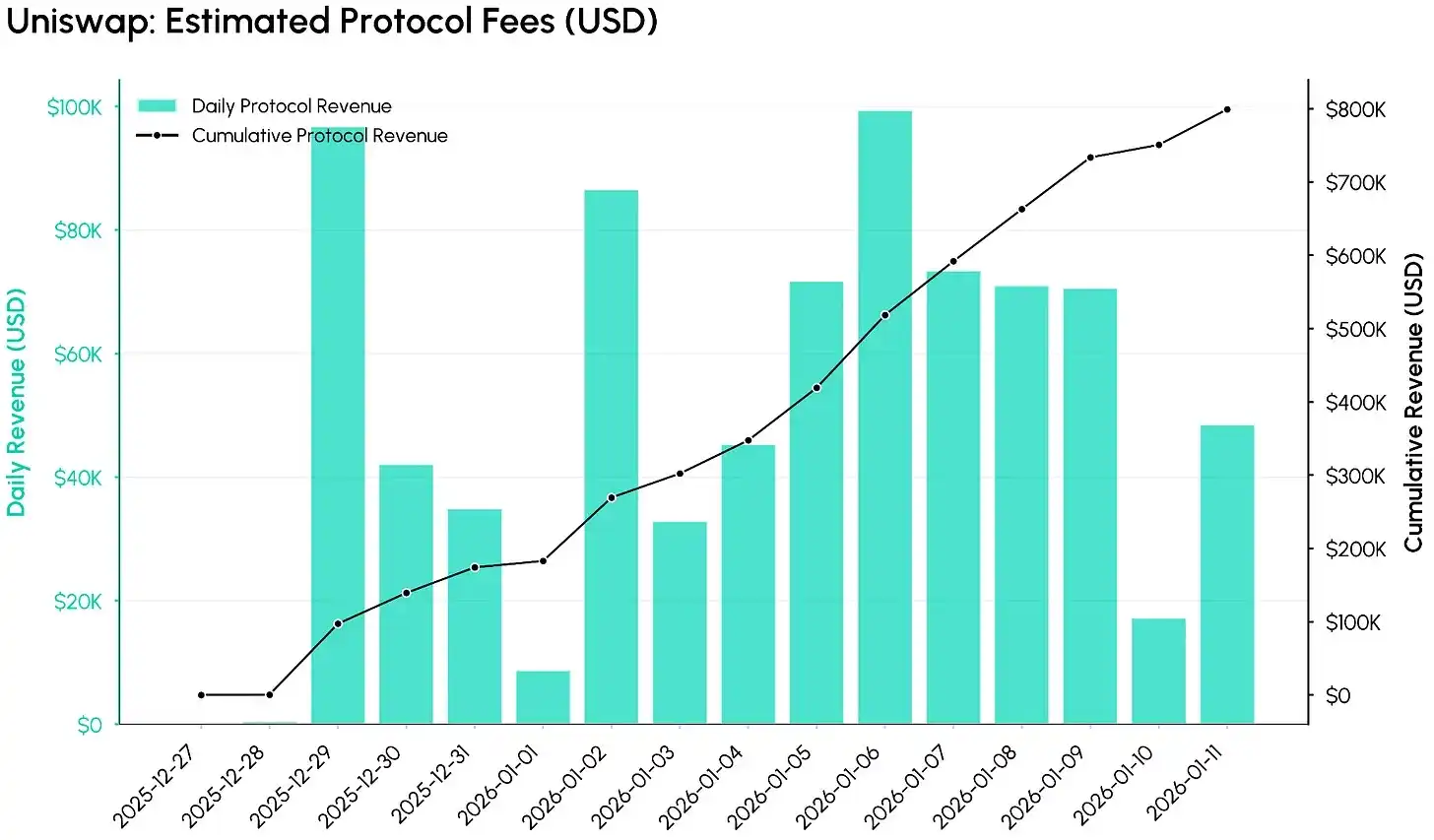
Protocol fee data after the Uniswap fee switch was turned on (starting December 27, 2025). Source: Coin Metrics ATLAS

According to Coin Metrics ATLAS data, significant protocol fees have flowed into the system in the first 12 days after the fee switch was enabled. The chart below tracks the daily estimated protocol fees (in USD) and the cumulative total, showing that under the initial configuration, the fee switch quickly monetized Uniswap's trading volume—within just 12 days, cumulative protocol-level fees reached approximately $800,000.

If current market conditions remain stable, the protocol's annualized revenue is projected to be around $26-27 million (for reference only), but actual revenue will depend on market activity and the promotion progress of the fee mechanism across various pools and chains.
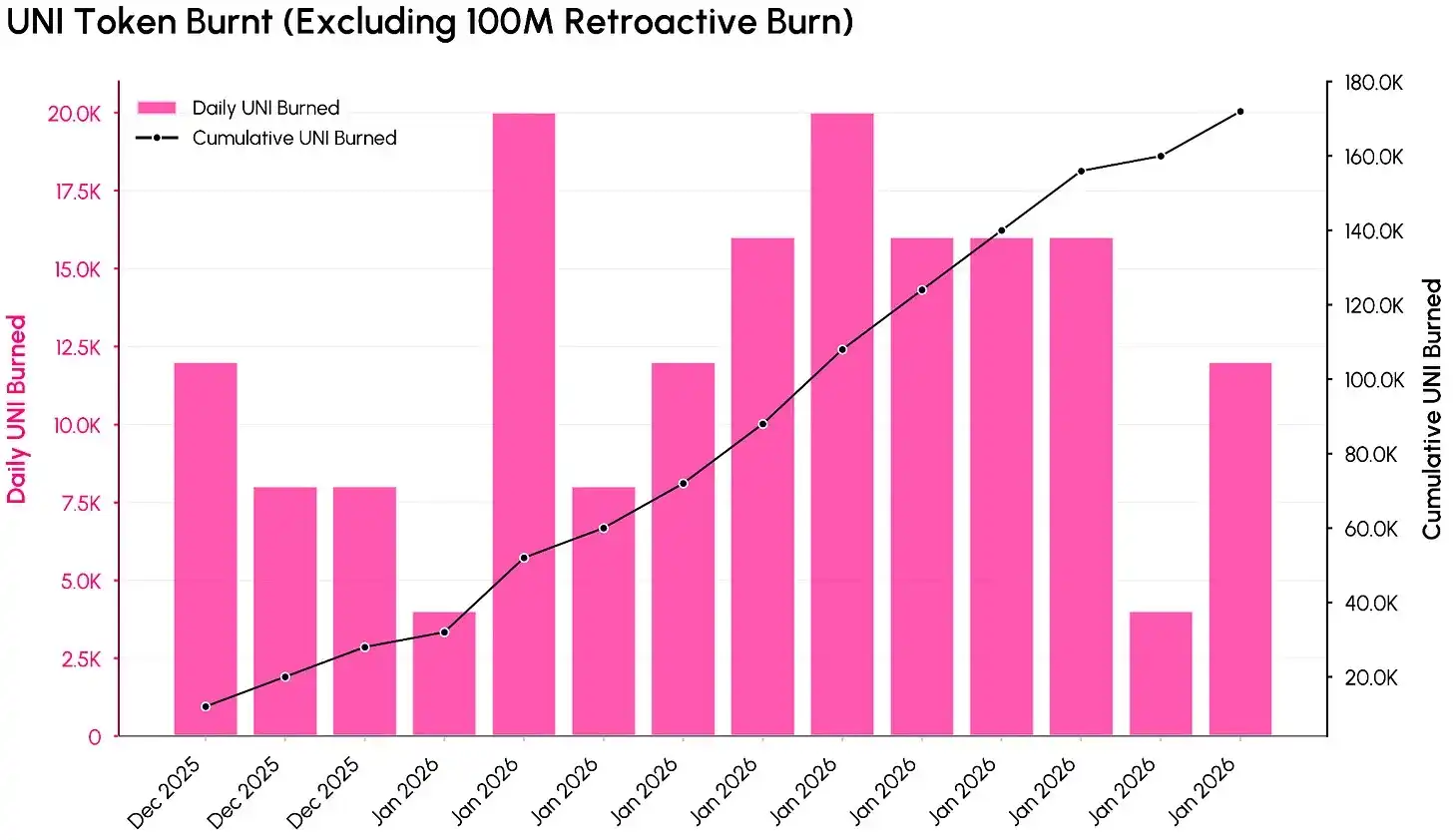
UNI token burn data after the Uniswap fee switch was turned on (excluding the 100 million retrospective burn). Source: Coin Metrics ATLAS

The chart above shows how protocol fees are converted into a reduction in the UNI token supply (excluding the 100 million retrospective burn). As of the time of data collection, the total number of UNI tokens burned had reached approximately 100.17 million (equivalent to about $557 million), accounting for 10.1% of the initial total supply of 1 billion.

Based on the burn data from the first 12 days after the "UNIfication" proposal took effect, the annualized burn rate for UNI tokens is estimated to be around 4 to 5 million. This data highlights that protocol usage now generates "periodic, programmatic" UNI burns, rather than simply inflationary token issuance.

Valuation and Impact on the DeFi Field

After the fee switch is enabled, UNI token valuation can be assessed not just from a "governance function" perspective but also through a "cash flow lens." With UNI's current market capitalization of $5.4 billion, compared to the initial annualized protocol fees of approximately $26 million shown by TokenJar data, its revenue multiple is about 207x—a valuation closer to high-growth tech assets than a mature decentralized exchange (DEX). Excluding the treasury burn portion, UNI's annualized burn volume is about 4.4 million tokens, representing only 0.4% of the current supply, indicating a relatively low "burn rate" relative to its valuation.
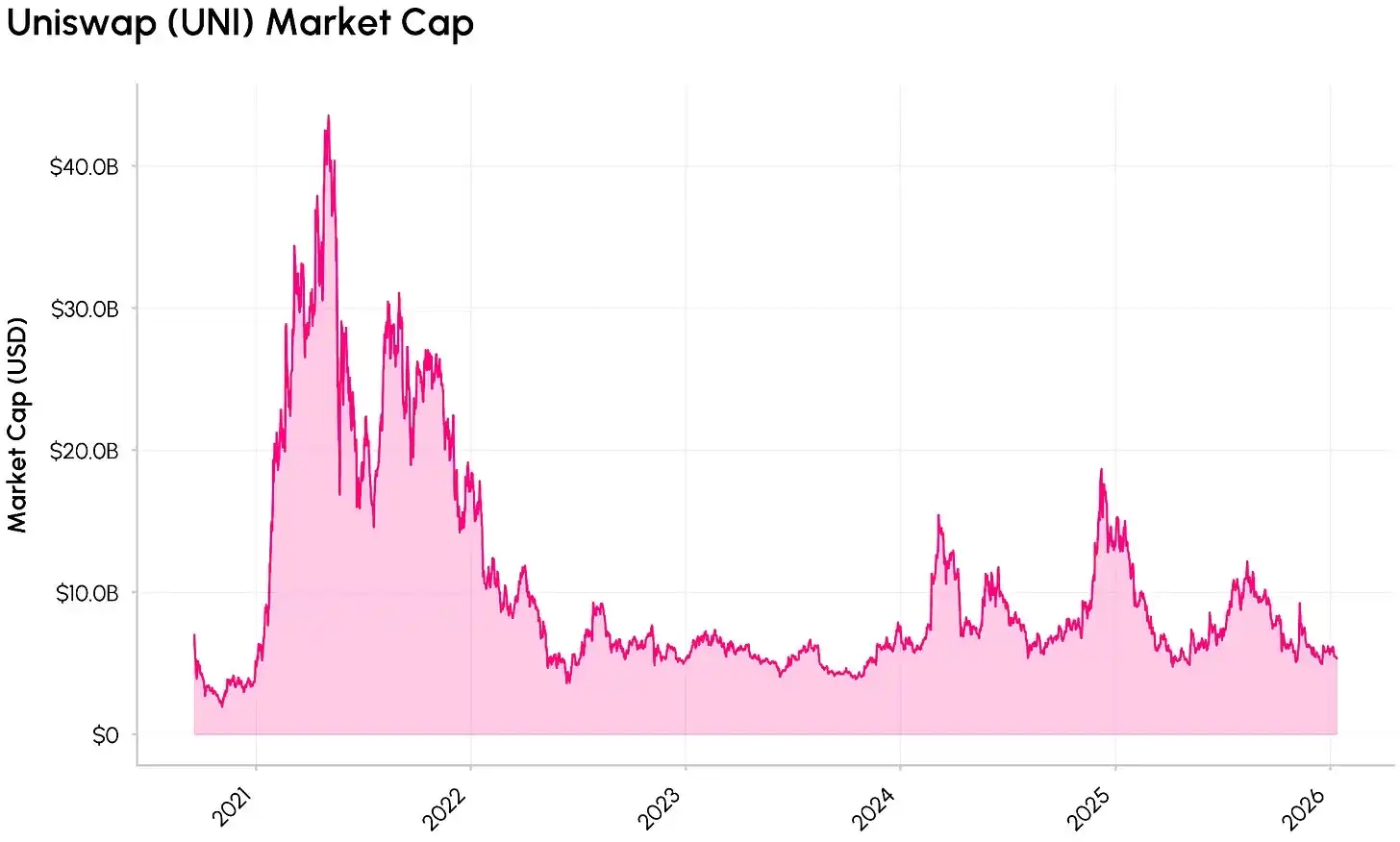
Market capitalization trend of Uniswap token UNI. Source: Coin Metrics Network Data Pro

This situation highlights a new trade-off: although a clearer value capture mechanism enhances UNI's investment attributes, the current data implies that the market has extremely high expectations for its future growth. To reduce this revenue multiple, Uniswap needs to take comprehensive measures: expand the scope of fee capture (e.g., cover more pools, launch V4 version "hook" features, conduct fee discount auctions, optimize Unichain), achieve sustained trading volume growth, and offset the annual 20 million UNI growth budget and other token releases through deflationary mechanisms.

From an industry structure perspective, the "UNIfication" proposal pushes the DeFi field towards a direction where "governance tokens must be explicitly linked to the protocol economy." Whether it's Uniswap's token burning, Ethena's "direct fee distribution to stakers," "vote-escrowed locking + fee/bribe sharing" in DEXs like Aerodrome, or hybrid mechanisms like the Hyperliquid perpetual contract model, they are essentially different forms of "protocol fee sharing," with the core purpose of strengthening the link between tokens and the protocol economy. As the world's largest decentralized exchange (DEX) adopts a "fee-hooked + burn-driven" design, future market评判标准 for DeFi tokens will no longer be limited to "Total Value Locked (TVL)" or "narrative heat," but will focus more on "the efficiency of converting protocol usage into lasting value for holders."

Conclusion

The activation of Uniswap's fee switch marks a critical juncture: the UNI token transforms from a "pure governance asset" to an "asset explicitly linked to protocol fees and usage." This shift makes UNI's fundamentals more analyzable and investable, but also subjects its valuation to stricter scrutiny—current valuations already incorporate strong expectations for future fee capture capabilities and growth potential.

In the future, two key variables will influence UNI's long-term trajectory: first, the level to which Uniswap can raise protocol-level fees without harming the economic interests of liquidity providers (LPs) and trading volume; second, the evolving attitude of regulators towards "fee-hooked tokens" and the "buyback-and-burn token" model. These two factors will jointly shape the long-term risk-return characteristics of the UNI token and will also provide important references for how other DeFi protocols share value with token holders.


Trending Cryptos

Related Questions

QWhat is the core change introduced by the Uniswap fee switch, and how does it transform the UNI token?

AThe Uniswap fee switch introduces a token supply burn mechanism that links the UNI token to protocol usage. It transforms UNI from a token with only governance utility into an asset that directly accrues value by using protocol-generated fees to reduce the supply of UNI.

QAccording to the early data, what is the estimated annualized protocol fee and the resulting annual UNI burn rate?

AEarly data shows the protocol is generating an estimated annualized fee of approximately $26-27 million, which is resulting in an annualized burn rate of about 4-5 million UNI tokens.

QWhat was the 'UNIfication' proposal's approach to addressing the historical lack of fee accrual for UNI token holders?

AThe 'UNIfication' proposal executed a one-time, retroactive treasury token burn of 100 million UNI tokens to compensate holders for the fees they had missed out on over the years.

QHow does the article characterize the current valuation of UNI (with a ~$5.4B market cap) relative to its projected annual fees?

AThe article characterizes the current valuation as having a revenue multiple of approximately 207x, which is akin to a high-growth tech asset, indicating the market has priced in strong expectations for future growth and fee capture.

QWhat broader trend in the DeFi sector does the activation of Uniswap's fee switch represent?

AIt represents a broader trend of DeFi moving towards 'fee-hooked' token models, where mechanisms like token burns, staker revenue distribution, and vote-escrow locking are used to better align token holders with the protocol's economic system, reshaping valuation logic in the space.

Related Reads

Senior Trader's Confession: How to Trade Market's False Expectations?

Veteran trader's case study: trading the market's "wrong expectations". This trade centered on a textbook "expectation error" after a weak CPI report. While the market initially priced in broad monetary easing (sending Nasdaq to 30,060), the crucial 30-year real yield hit a 20-year high. This signaled a fractured transmission mechanism: short-term rates eased, but long-term funding costs (vital for tech valuations) refused to fall. The trader executed five short positions on the Nasdaq (NQ) as it fell from 30,060 to 28,768. The core methodology: don't just trade the data, but analyze the market's implied causal chain and identify where it breaks. In this case, the chain was: Weak CPI → Policy Easing → Lower Long-Term Funding Costs → NQ Valuation Expansion. The break occurred between policy easing and long-term rates. The "veto variable" – long-term real yields – refused to confirm the bullish narrative. Trades were structured around "fast variables" (price) temporarily repairing while "slow variables" (funding conditions) remained broken. The article outlines a repeatable framework: 1) Map the market's implied causal chain. 2) Identify the veto variable. 3) Observe if it rejects the narrative. 4) Enter when price still follows the old script. 5) Choose the cleanest asset expression (e.g., short NQ, not broad S&P). 6) Define both invalidation and fulfillment exit conditions. The key insight: Alpha often comes not from an information edge, but from a "reaction function edge" – recognizing when the market is applying an outdated causal logic to new data. The critical question: What causal chain is the market's first reaction relying on, and is that chain still valid today?

marsbit23m ago

Senior Trader's Confession: How to Trade Market's False Expectations?

marsbit23m ago

Opinion: The Hedging Relationship Between U.S. Treasuries and Stocks Has Broken Down, and BTC, as a Risk Asset, Is Under Dual Pressure

For the past 20 years, U.S. investors relied on a free insurance policy: when stocks fell, bonds rose, cushioning portfolio losses. This reliable inverse correlation underpinned entire financial strategies. However, this mechanism broke down around 2020 and has not recovered. Currently, the two-month rolling correlation between the S&P 500 and 10-year Treasury yields is at -0.69, its lowest level since 1996, indicating stocks and bonds are moving in sync to an unprecedented degree, eliminating the traditional portfolio shock absorber. The失效 of this hedge is not simply due to lost confidence in U.S. debt. The key driver is the shift from growth-dominated to inflation-dominated market narratives. When growth fears prevail, stocks and bonds move inversely. Since 2022, persistent inflation volatility has been the dominant factor, causing both asset classes to suffer simultaneously from higher inflation expectations. Investors now seek safety without duration risk, favoring cash, dollars, and short-term Treasuries while selling long-duration bonds. Record U.S. deficits, rising net interest payments, and waning foreign demand (e.g., from Japan) are pressuring long-term yields, with the 30-year yield surpassing 5%. This environment places Bitcoin, as a risk asset on the far end of the risk curve, under dual pressure. Higher risk-free rates increase the opportunity cost of holding non-yielding assets like Bitcoin, while falling equities reduce overall risk appetite. Bitcoin's performance has become highly sensitive to macro conditions such as real yields, dollar strength, and financial conditions. While its long-term thesis as a fixed-supply asset outside the sovereign credit system is strengthened by these fiscal trends, the same conditions hurt it in the short term. The return of bonds as a effective hedge requires inflation volatility to subside, growth risks to retake dominance, and the Fed to have room to ease policy. Until then, Bitcoin trades in a market where the deepest asset class no longer absorbs shocks, removing the safety floor for all risk assets, especially those that pay nothing to wait.

marsbit23m ago

Opinion: The Hedging Relationship Between U.S. Treasuries and Stocks Has Broken Down, and BTC, as a Risk Asset, Is Under Dual Pressure

marsbit23m ago

Funding Weekly | Crypto.com Secures $400M Investment, CeFi and Stablecoin Sectors Continue to Attract Capital

Crypto Weekly Investment Recap: Funds Converge on CeFi, Stablecoins, and AI Last week's crypto and AI investment landscape saw significant capital concentration, with a few large deals dominating. **Crypto/Web3 Highlights (July 13-19):** Total investment exceeded **$812 million** across 17 deals. Key trends: * **Centralized Finance (CeFi) & Stablecoins** remained a major magnet, led by **Crypto.com**'s massive **$400 million** raise from Citadel Securities, valuing the exchange at $20B. * **Infrastructure & Tools** saw 7 deals, including **Cyclops** ($20M for stablecoin payments) and **ADI Chain** ($50M for stablecoin settlement infrastructure). * **DeFi** had 2 deals, such as AI-native DEX **Quote Trade** ($4M). * Other notable raises: API broker **Alpaca** ($135M), cross-border platform **Flex** ($70M), treasury firm **ORANGE JUICE** ($40M), and prediction market **Pascal** ($9M). * **Acquisitions:** Keyrock bought BlockFills' trading unit, SBI Holdings acquired Singapore exchange Coinhako, and MoonPay bought startup Glide. **AI & Robotics Highlights:** Investment momentum in AI remained very strong. * Nvidia-backed AI cloud service **Fireworks** raised a massive **$1.5 billion** at a $17.5B valuation. * In robotics, **Walden Robotics** (spun out from Toyota) secured **$300 million**, and Chinese humanoid firm ****逐际动力** **(Climax Dynamics) raised nearly **$200 million** in a Pre-IPO round. * Other significant AI raises included Indian programming platform **Emergent** ($130M) and drone company **Brinc** ($125M), backed by Sam Altman. Overall, the trend shows capital flowing heavily into established crypto financial services, stablecoin infrastructure, and large-scale AI/robotics commercialization.

marsbit1h ago

Funding Weekly | Crypto.com Secures $400M Investment, CeFi and Stablecoin Sectors Continue to Attract Capital

marsbit1h ago

The Gentlest Bear Market? BTC Bears Exit, ARK and Bitwise Collectively Bullish

**Title: The Mildest Bear Market? BTC Shorts Exit, ARK and Bitwise Collectively Bullish** Bitcoin continues to consolidate around $75,000 while Ethereum struggles near $1,900. Market data shows $116 million in liquidations over 24 hours, with $62.7 million from short positions, and the Fear & Greed Index remains at 35 (Fear). According to Polymarket, there's a 33% probability BTC falls below $50,000 this year. ARK Invest's Q2 2026 Bitcoin report notes technical weakness but identifies potential bottoming signals, including a record high in long-term holder supply, suggesting selling exhaustion. Bitwise's Juan Leon calls this the "structurally mildest bear market" on record, with a ~50% drawdown from highs, less severe than past cycles. He highlights institutional accumulation and a shift in investor dialogue from survival to entry points. Technical analysis from Bit suggests a potential C-wave low may have formed, with an ideal bottoming range between $50,000-$55,000. However, glassnode's CryptoVizArt warns that failure to break $66,000 could signal a local top, as new buyer accumulation is concentrated there. Analyst Darkfost identifies a critical support band between $59,000-$70,000, where 50% of BTC's circulating supply has changed hands. Notably, trader Doctor Profit announced closing all crypto short positions—including BTC shorts from $115k-$125k and over 100 altcoin shorts—for significant profit. He has begun a phased accumulation of Bitcoin spot starting at $64,000, reversing his previous $40k-$50k target, citing structural positives like regulatory clarity and institutional adoption. He argues the anticipated September/October bottom may arrive earlier than the herd expects.

Foresight News2h ago

The Gentlest Bear Market? BTC Bears Exit, ARK and Bitwise Collectively Bullish

Foresight News2h ago

Trading

Spot

Hot Articles

Discussions

Welcome to the HTX Community. Here, you can stay informed about the latest platform developments and gain access to professional market insights. Users' opinions on the price of S (S) are presented below.

活动图片