After 500 Rejections, I Started Building Products That People Actually Use

marsbitPublished on 2025-12-30Last updated on 2025-12-30

Abstract

After 500 rejections and years of failed infrastructure projects in crypto, the author shifted focus to building consumer-facing products that people actually use and pay for. Key lessons from transitioning to Solana and launching a consumer app include: Target younger users (ages 13-21) who are more open to adopting new technologies and sharing them socially. Design products that are inherently shareable to reduce marketing costs, as organic virality is critical in a low-trust, high-cost acquisition environment. Prioritize rapid user feedback—fix bugs within hours and implement requested features in days to build trust and habit formation. Choose simple, memorable app names to ease word-of-mouth sharing. Engage users directly through cold DMs (despite low reply rates) to gather honest feedback and build early supporter communities. Iterate quickly—observe user behavior rather than relying solely on feedback, and be willing to pivot radically. Simplify onboarding and avoid assumptions about user knowledge; make the product intuitive within seconds. Ultimately, speed, user-centricity, and distribution matter more than technical perfection in consumer crypto.

Editor's Note: In the crypto industry, discussions about 'whether to build infrastructure' and 'whether technical complexity equals competitive moat' have never ceased. But this article offers a counterexample from a frontline entrepreneur: from consecutive failures in betting on infra to pivoting towards consumer products that people are willing to use and pay for, the author uses personal experience to复盘 the real difficulty of 'building products' in the crypto industry.

Compared to technical complexity and grand narratives, the article focuses more on users, distribution, and execution details. In the consumer crypto space, value is not 'proven' but 'used into existence'.

The following is the original text:

As a first-time founder, I spent years working on three infrastructure protocols, all of which ultimately failed. By 2025, I began shifting to building a consumer product that people actually want to use. This piece shares the lessons I learned about user growth and fundraising 'after stepping into pitfalls'.

I've been in this industry for about 4 years.

In 2023, I started my venture in the EVM ecosystem, right when 'account abstraction' was the hottest topic. Almost everyone was developing SDKs for account abstract wallets. Meanwhile, the Rollup ecosystem heated up rapidly. Optimism, Arbitrum, and various RaaS projects dominated the mainstream view.

As someone who loves math, I was deeply attracted to ZK, believing it would change the world (I still believe it eventually will).

A core mistake I made back then was: equating 'complexity' with 'credibility'.

When VCs asked me about use cases, I would confidently list directions like zkML, zk identity, zk voting — yet in reality, almost none of these are actually used today. I mistook 'the technology looks impressive' for 'this is a useful product'.

As time went on, I even started to believe: the more complex the idea, the higher the probability of startup success.

Many investors also told me that in the crypto industry, only infrastructure has a chance to succeed. It wasn't until nearly two years and over 500 rejections later that I realized: this path wasn't for me.

So, I entered the Solana ecosystem.

For me, this was a whole new world. People here care about practical use cases. Even if it's memes, revenue matters. Speed matters. Distribution matters. (Special thanks to @superteamin for the help along the way.)

So far, we've been building consumer applications in this ecosystem for nearly 7 months. During the private testing phase, we've already processed over $12 million in transaction volume. Below are some of the lessons I've summarized:

1. Build for Young Users Willing to Try New Things

Aim to design products for a demographic that is naturally more receptive to new products.

In consumer crypto products, this usually means 'trenchers' or younger users, many concentrated in the 13–21 age range.

A 2024 study by the Consumer Technology Association (CTA) on Gen Z (11–26 years old) showed: 86% of Gen Z believe technology is an indispensable part of life, a higher proportion than any older group. They adopt new technologies earlier, with an average household owning 13 devices, using about 6 of them daily, for nearly 12 hours.

Gen Z is also more likely to personally own emerging tech products, such as crypto apps (e.g., 58% own game consoles, a significantly higher than older groups). They have a stronger willingness to spend on new technology, subscribe to more services, and their habits change and adapt noticeably faster than Millennials, Gen X, or Boomers.

They are more willing to try new apps, experiment, and quickly change usage habits.

In contrast, older users (in many cases, 25+) are generally less willing to change established workflows unless the incentives are very strong. Side note: this conclusion might not apply if you're building for institutions.

Multiple studies also show clear behavioral differences: younger users engage in social communication with more people daily, meaning they are more likely to share 'interesting products they discover' with friends. Around ages 20–21, social messaging activity typically peaks, largely related to college or being in school.
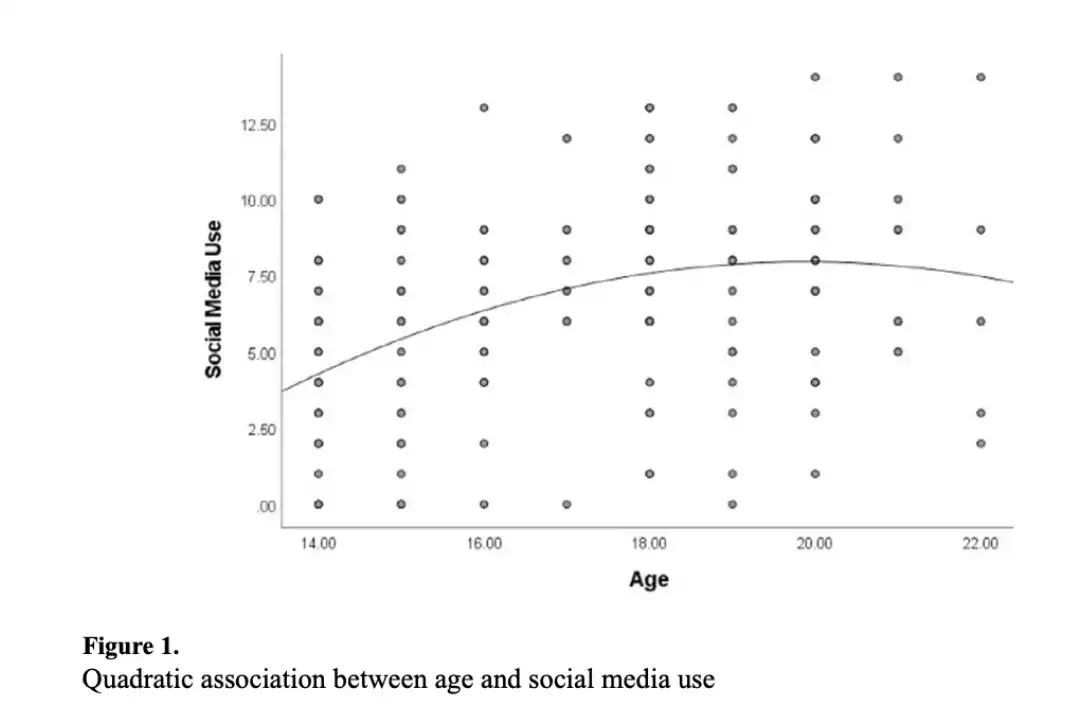
This trend leads to a very direct implication: products designed for younger users naturally have stronger virality.

2. Make the Product Itself Shareable to Reduce Marketing Costs

If you don't have ample marketing or advertising budgets, then your product itself must serve as the 'distribution channel'.

In other words, the product is the marketing, the product is the propagation.
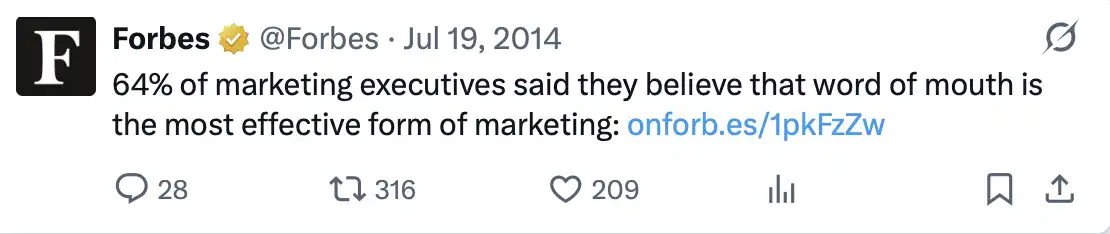
A highly shareable product can significantly reduce marketing costs.

This is especially important in the crypto industry because:

· KOL marketing is expensive

· User trust is generally low

· Most users expect rewards or incentives before participating

In such an environment, relying on traditional marketing methods is often inefficient, while organic propagation driven by the product itself is more sustainable.
If your product can give users a reason to share spontaneously, whether with friends, groups, or communities, you can achieve distribution without burning大量资金.

This isn't easy to do in crypto, but optimizing for it from day one is very worthwhile in the long run.

3. Respond to User Feedback ASAP

When users report issues with the experience, or encounter poor interactions, fix them immediately, especially those that directly block the usage flow.

My previous approach was to save bug fixes for the end of the day. But once, a user DM'd me saying: 'Your App doesn't have this feature yet, I'll use Y for now.'

I said I understood, but the result was, the user kept using product Y afterwards. I tried multiple times via DMs to win them back, but it was very difficult — they had already formed a habit of using Y.

Ultimately, once users establish habits on another product, the cost of switching them back becomes extremely high.

Therefore, try to: resolve bugs within 2–5 hours.

If multiple users repeatedly request a new feature that is very important to them and technically feasible:

· Develop and launch it within 2–3 days

· Clearly tell them it was launched based on their feedback

·甚至可以给予一定的经济激励 (this might turn them into your product's most active evangelists)
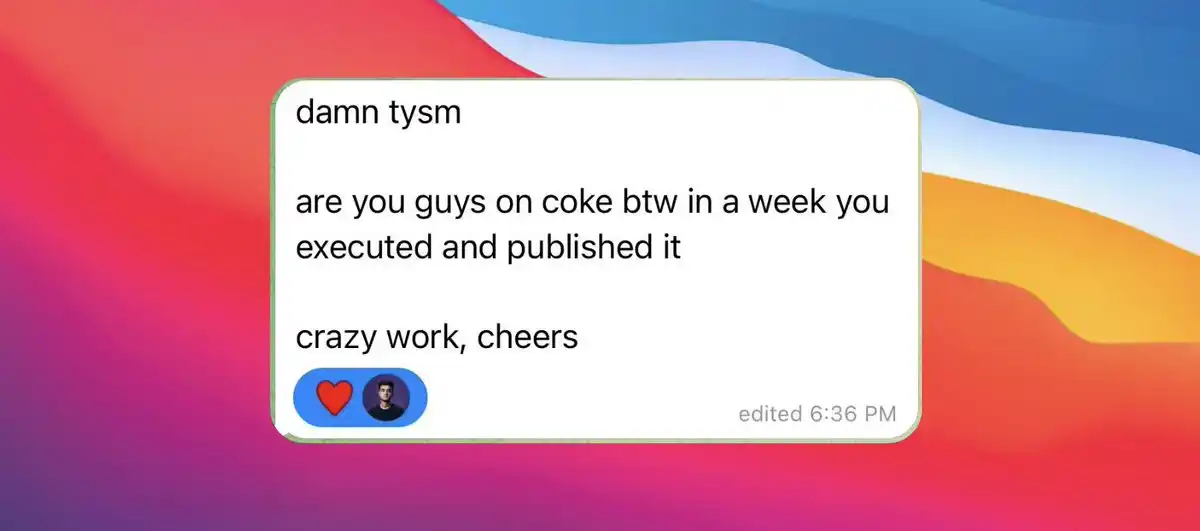
Delivering features around user needs does three things: directly improves the product, increases user frequency, and builds deep trust.

When users see their feedback taken seriously and actually turned into product features, they start to feel: this product is 'partly theirs'.

This emotional sense of 'ownership' is extremely important and powerful in early-stage consumer products.

4. The App's Name is Very Important

This might sound basic, but many people — including myself — have made serious mistakes at this step.

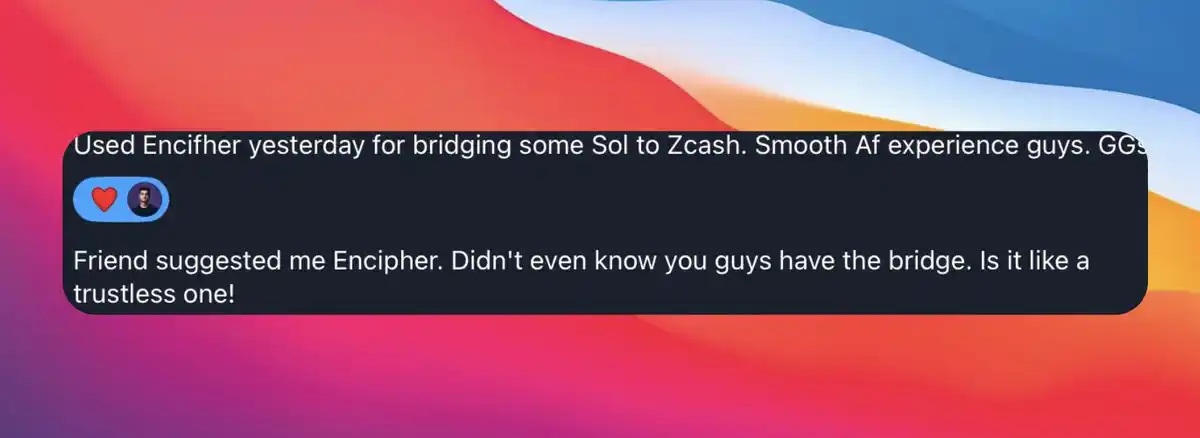
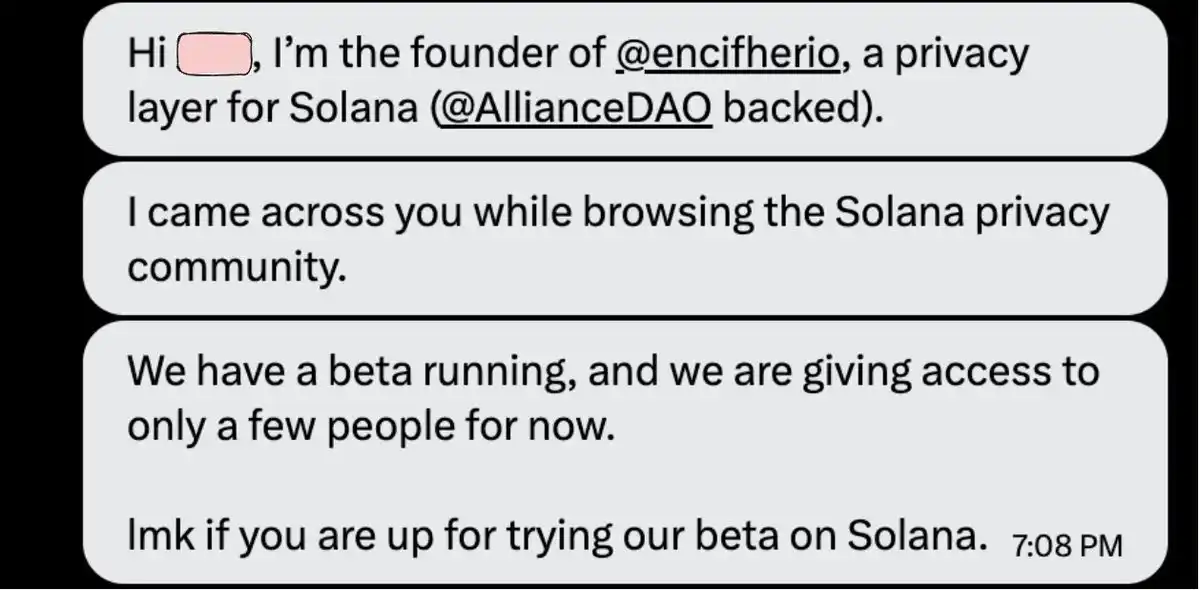
Your App's name must be highly memorable and easy enough to relay and share. Otherwise, you'll frequently receive messages like this (users want to recommend it but can't remember what it's called).
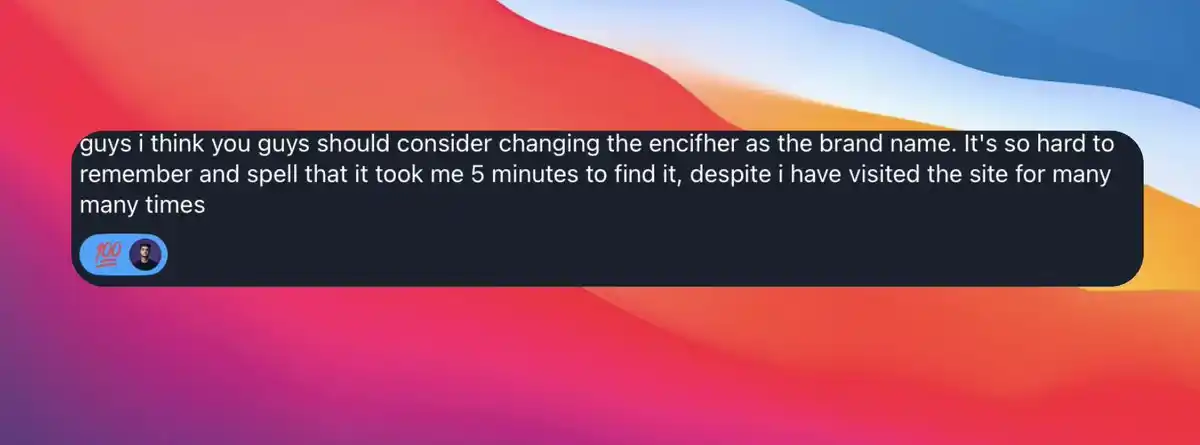
The truth is indeed so — the name 'encifher' itself was hard to remember, I really can't blame users for that.

There were even many group chats created by investors or partners where the product name was misspelled, something I can only苦笑 about now.
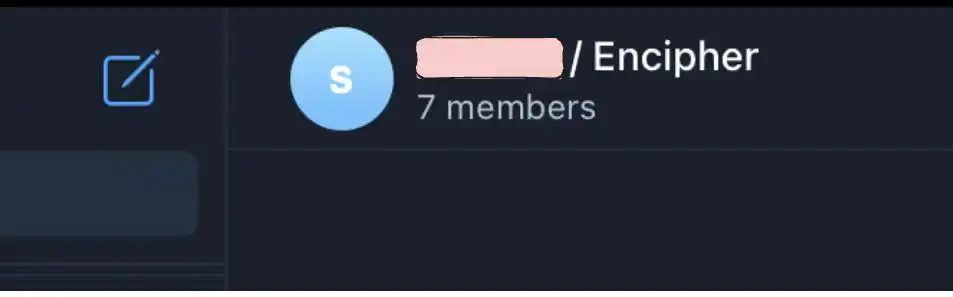
Because of this, we later changed the name to encrypt.trade.


There are plenty of existing methods and resources online for how to choose a 'memorable and shareable' name.

5. Talking to Users is Hard, But Non-Negotiable

Finding users and actually talking to them is inherently very difficult, especially when your direction isn't within the current mainstream narrative.

When I first started working on privacy-related products, it wasn't a popular niche. Although many retail users had real privacy needs, they were scattered and hard to find.

So I did something most people actively avoid: during the idea validation phase, I proactively cold-DM'd nearly 1000 people.

If lucky, about 10 out of 100 people might reply; and among those replies, only maybe 3–4 might give you useful feedback.
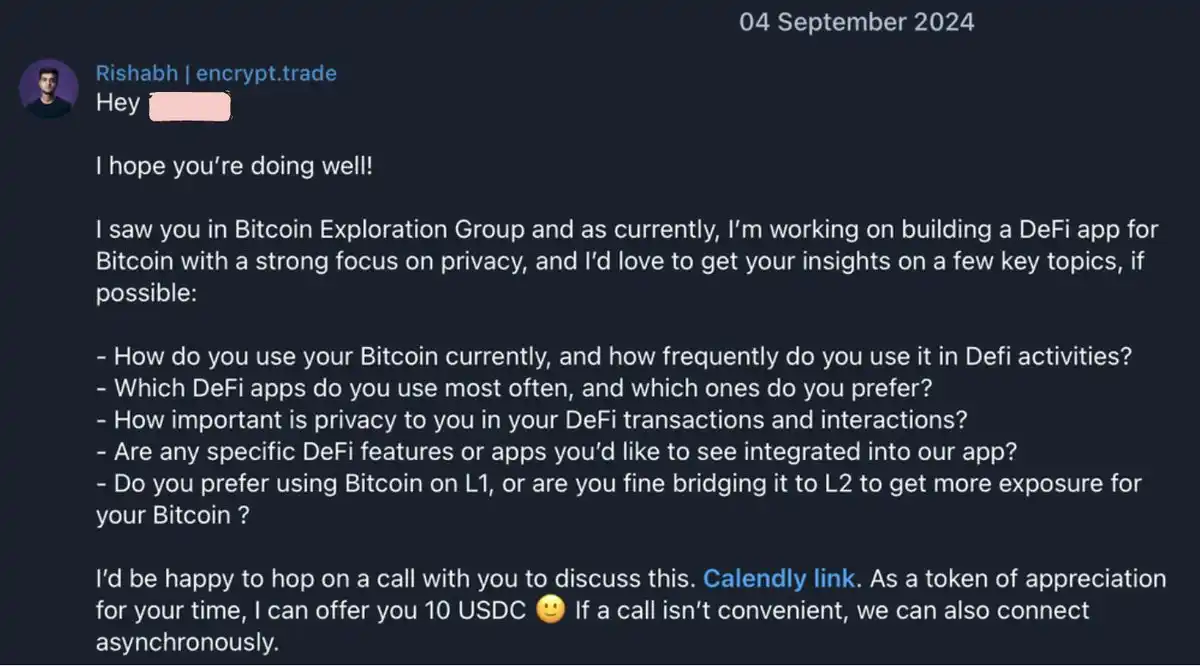
In practice, whenever someone showed even the slightest interest, I would have in-depth conversations with them, iterating on the product while communicating with users.

In fact, cold DMing itself is a process that needs constant iteration. When writing and sending cold DMs, there are several key points to note: try to start with a relatively 'soft' opener, put the most substantial information first (e.g., funding status, transaction volume processed, etc.), mention where you saw or learned about them, maintain a friendly, non-intrusive call-to-action (CTA), and definitely follow up, don't just send once and stop.

There is no such thing as a 'perfect cold DM'. You need to constantly A/B test different versions to find out which ones actually work for your target users.

Below is a high-quality cold DM template (thanks to @realsimon, from @alliance), which you can refer to directly:
But it's important to be clear: this process is slow and psychologically draining.

In crypto, very few people are willing to reply to cold DMs because scams are everywhere. Low response rates are the norm (it is indeed a bit discouraging).

But even so, you still must do it.

At this stage, your goal is not to get 1000 users. Your goal is 10–20 early users who have the following characteristics: genuinely care about the problem you're solving, are willing to try your product, and can give honest, direct feedback.

These early users will gradually become your support system. Early products will almost certainly have frequent problems, and it is these users who help you through the most vulnerable stages.

6. Iterate Quickly

The pace of the crypto industry is extremely fast. Narratives change rapidly, and user attention spans are even shorter.

If the product you build has no real value, it's inherently hard to get attention; even if you briefly gain attention without value, that focus won't last.

It might bring a short burst of hype at best, but the product itself cannot survive long-term.

This is toly's advice for developers at Breakpoint 2025.

The core meaning is just three points: ship fast, iterate frequently, be willing to pivot radically

I also learned one very important thing: users won't always directly tell you what to do next.

You need to judge by observing their behavior: what are they doing repeatedly? What workarounds or detours are they using? What are they already willing to pay for?

Many ideas sound reasonable, but most users might not be willing to pay for them.

7. Please Make Your Website 'Idiot-Proof'

I don't know why this needs to be emphasized repeatedly, but it must be said: 'Do not make any assumptions about users.'

If you think users should understand, you are wrong. Things that are obvious to us developers who have spent hundreds of hours building the product are completely foreign to users encountering it for the first time.
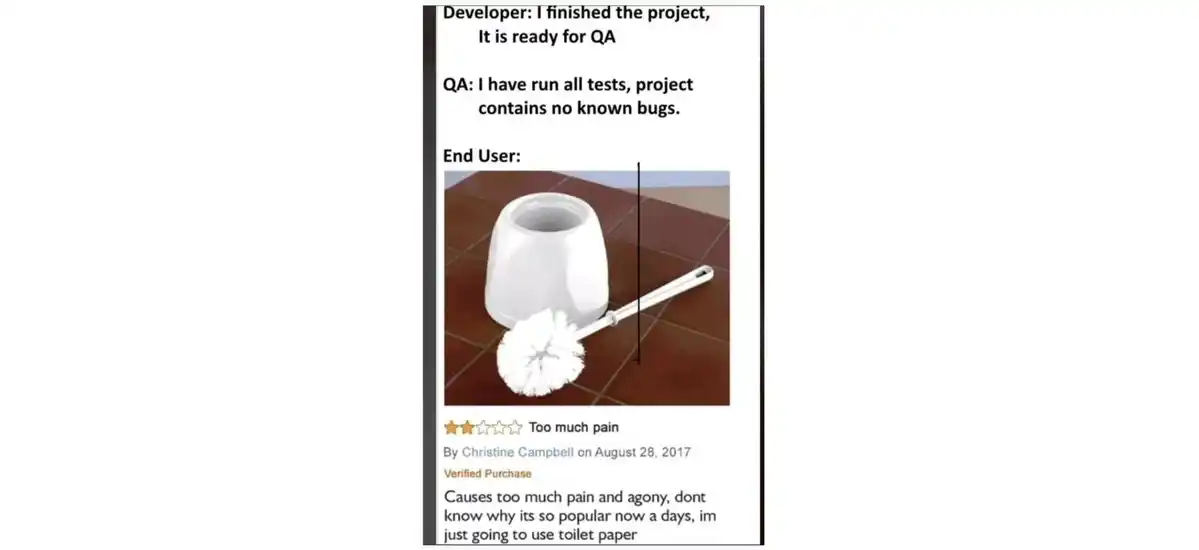
Don't introduce any new concepts or workflows. Only use simple, familiar things that genuinely make users' lives easier. The click path should be as streamlined as possible; users should be able to see, understand, or perceive the product's value within 5 seconds of entering the app (this is something we are still continuously optimizing).

I can't attach screenshots, but I've received many DMs where users completely misunderstood the purpose of a feature.

Conclusion

Building consumer crypto products is both fun and challenging.


Speed, extreme focus on users, and distribution capability are often more important than 'perfect technology'.

This is very different from B2B products, but I still believe it was the right choice we made.

This piece is already long enough; I'll save the lessons on fundraising for the next post. Finally, just use encrypt.trade :)

If this content resonates with you, or if you're also building consumer crypto products and want to chat about GTM, distribution, or the product itself, feel free to DM me.
I'm always happy to talk with other founders and developers.


Trending Cryptos

Related Questions

QWhat was the author's key mistake when building infrastructure protocols in the crypto space?

AThe author's key mistake was equating 'complexity' with 'credibility'—believing that technically impressive ideas (like zkML, zk identity, zk voting) would naturally translate to useful products, when in reality, they were rarely adopted by users.

QWhy does the author recommend building for younger users (ages 13-21) in consumer crypto products?

AYounger users (Z世代) are more likely to adopt new technologies, change habits quickly, share products with friends, and spend on emerging tech, making them ideal early adopters for consumer crypto applications.

QHow can a crypto product reduce marketing costs according to the author?

ABy designing the product itself to be highly shareable, so it acts as its own distribution channel—users naturally share it with others, reducing reliance on expensive KOL marketing or ads.

QWhat is the author's advice for handling user feedback and bug fixes?

AFix critical bugs within 2-5 hours to prevent users from switching to competitors. Implement highly requested features in 2-3 days, acknowledge user contributions, and offer incentives to turn users into advocates.

QWhy is the name of an app important for consumer crypto products?

AA memorable and easily shareable name is crucial for word-of-mouth growth. Complex or hard-to-spell names (like 'encifher') hinder users from recommending the product, reducing organic distribution.

Related Reads

Weekly Editor's Picks (0725-0731)

Weekly Editor's Picks (0725-0731) provides a curated selection of deep analysis, filtering out market noise. Key themes from this week include: **Macro & Policy:** The Federal Reserve's upcoming meeting is marked by high uncertainty, balancing cooling inflation data against persistent price pressures. Meanwhile, the U.S. crypto regulatory Clarity Act faces critical political hurdles, with its 2026 passage probability seen as low. **Investing & Crypto:** Analysis suggests long-term crypto success depends on conviction through volatile cycles, focusing on assets like Bitcoin and core smart contract platforms. A trend noted is the increasing similarity between global equity markets (especially tech) and crypto, driven by narrative and leverage. Several major crypto protocols show strong revenue growth, but this isn't always translating to token price appreciation due to sell pressure and structural factors. **AI & Semiconductors:** Nvidia's rising credit default swap rates signal market concern over AI infrastructure financing risks. The storage sector experienced volatility as markets began pricing in potential 2027 oversupply. Despite a record profitable quarter, SK Hynix's results were deemed "below expectations," reflecting heightened investor demands for future growth visibility. **Markets & DeFi:** TradeXYZ demonstrated remarkable accuracy in pre-market pricing for a major A股 listing. The token ONDO saw gains, linked to its growing role in the on-chain tokenized stock ecosystem. **Ethereum:** Post-Pectra upgrade, a major structural shift is underway as Lido begins migrating millions of ETH to new validator architectures designed for capital efficiency. **Also Highlighted:** Butian's bullish stock market move; OpenAI's Altman promising major advances; Samsung and SK Hynix securing large AI chip deals; Apple reaching a $5T market cap; and ongoing discussions around exchange security following Poolin's bankruptcy case.

marsbit29m ago

Weekly Editor's Picks (0725-0731)

marsbit29m ago

Low Investment Isn't Apple's Immunity Pass

While Meta and Google face investor scrutiny over ballooning AI capital expenditures, Apple's minimal AI investment has paradoxically become a strength. Its market cap recently reclaimed the global top spot, surpassing $5 trillion. The irony is deep: Apple's own AI efforts have lagged, with "Apple Intelligence" delayed and core talent lost, forcing reliance on partners like Google Gemini and Alibaba's Qianwen. Its Q3 FY2026 (Q2 CY) earnings initially seemed stellar. Revenue hit $109.4B (up 16% YoY), with iPhone and Mac sales, growing 22% and 29% respectively, driving most of the growth. However, the stock fell over 8% post-earnings. The primary concern was a weaker Q4 revenue growth forecast of 9-11%, below expectations, due to looming supply chain constraints. Apple is feeling the indirect cost of the AI boom. Soaring memory and chip prices, fueled by massive data center investments from Microsoft, Amazon, and others, are forcing Apple to raise Mac and iPad prices significantly. The upcoming iPhone launch is also expected to see substantial price hikes. Despite avoiding heavy AI infrastructure spending—its capital expenditures are actually down 28%—Apple cannot escape the industry-wide supply and cost pressures. While Apple's operating cash flow remains robust, its substantial R&D spending (up 32% YoY) has yet to yield major AI breakthroughs. As Tim Cook prepares to step down as CEO, Apple faces a challenging transition: balancing its premium hardware success against the strategic and cost pressures of the AI era it has so far cautiously navigated.

marsbit1h ago

Low Investment Isn't Apple's Immunity Pass

marsbit1h ago

PA Graphics Explanation | One Chart to Understand the Major Web3 Events in August 2026

**PANews Crypto Calendar: Key Web3 Events in August 2026** PANews introduces its revamped crypto calendar, featuring comprehensive coverage, flexible filtering, and easy export options. The market in August will be shaped by multiple key events across macroeconomics, regulation, tokenomics, and project developments: * **Macro & Policy:** Key US economic data releases (July Non-Farm Payrolls, CPI), the Federal Reserve meeting minutes, and the Jackson Hole Economic Symposium will be in focus. On the regulatory front, the US Senate plans to release a new draft of the *CLARITY Act*, while the EU's expanded crypto ban against Belarus comes into effect. * **Token Unlocks:** Significant token unlocks are scheduled for assets including ENA, AVAX, CONX, ZRO, and KAITO, which may influence market volatility. * **Project Updates & Shutdowns:** Several services, including Exchange Art, Ctrl Wallet, Zapper, NFTfi, and Summer.fi, are set to cease operations or undergo major adjustments. Users are advised to manage their assets accordingly. * **Corporate Activity:** Q2 earnings reports from companies like SpaceX, Circle, and Nvidia are due. Unitree Robotics will initiate its IPO subscription on the STAR Market, and Moonshot AI plans to begin a Pre-IPO financing round. * **Industry Events:** Major conferences such as Bitcoin Asia 2026 and the 2026 Digital Expo will take place. The overarching market narrative for August will revolve around macroeconomic expectations, regulatory developments, token unlock schedules, and ongoing industry consolidation.

marsbit1h ago

PA Graphics Explanation | One Chart to Understand the Major Web3 Events in August 2026

marsbit1h ago

Wall Street's Most Famous 'Cassandra' Now Has His Sights Set on Nvidia

Michael Burry, the famed "Big Short" investor, has once again captured Wall Street's attention with a series of short positions against major tech and semiconductor stocks, most notably Nvidia. In late June and July, through his "Cassandra Unchained" newsletter, Burry disclosed short bets against Nvidia, Tesla, Applied Materials, Caterpillar, the SOXX semiconductor ETF, and later, Micron Technology. His core thesis revolves around potential distortions in the AI infrastructure boom, specifically questioning whether extended depreciation schedules (e.g., 6 years vs. a realistic 2-3 years for AI chips) by cloud giants like Microsoft and Google artificially inflate profits. He also raises concerns about possible "off-balance-sheet circular financing," where chip demand might be propped up by vendor-backed funding to clients. Nvidia's stock experienced volatility following these disclosures, briefly dipping but largely holding near Burry's reported entry points, leaving his positions roughly flat or slightly underwater as of late July. This move is part of a pattern for Burry, whose track record since his legendary 2008 bet is mixed. He has faced notable losses, such as on Tesla in 2021, while scoring on broader market turns like the 2020 pandemic crash. His methodology focuses intensely on free cash flow and scrutinizing original financial documents to spot overvaluation and structural risks, but it often struggles with timing the market. The article contrasts Burry's stance with other prominent investors. Steve Eisman, another "Big Short" figure, is not shorting Nvidia, citing strong fundamentals but expressing nervousness about sustainability. Jim Chanos agrees with the broad "accounting mismatch" concern—comparing it to the dot-com bubble—but targets financial leverage in private equity firms rather than the chip stocks themselves. While Nvidia's short interest remains relatively low at 1.3-1.4% of float, the massive stock size means absolute short losses have been significant, exceeding $5 billion earlier this year. The piece concludes that for ordinary investors, the key takeaway is not replicating specific short bets but learning from the critical frameworks these investors use: questioning rosy accounting, identifying structural vulnerabilities, and maintaining skepticism during market euphoria, even if pinpointing the exact catalyst for a downturn remains elusive.

marsbit1h ago

Wall Street's Most Famous 'Cassandra' Now Has His Sights Set on Nvidia

marsbit1h ago

Trading

Spot

Hot Articles

How to Buy PEOPLE

Welcome to HTX.com! We've made purchasing ConstitutionDAO (PEOPLE) simple and convenient. Follow our step-by-step guide to embark on your crypto journey.Step 1: Create Your HTX AccountUse your email or phone number to sign up for a free account on HTX. Experience a hassle-free registration journey and unlock all features.Get My AccountStep 2: Go to Buy Crypto and Choose Your Payment MethodCredit/Debit Card: Use your Visa or Mastercard to buy ConstitutionDAO (PEOPLE) instantly.Balance: Use funds from your HTX account balance to trade seamlessly.Third Parties: We've added popular payment methods such as Google Pay and Apple Pay to enhance convenience.P2P: Trade directly with other users on HTX.Over-the-Counter (OTC): We offer tailor-made services and competitive exchange rates for traders.Step 3: Store Your ConstitutionDAO (PEOPLE)After purchasing your ConstitutionDAO (PEOPLE), store it in your HTX account. Alternatively, you can send it elsewhere via blockchain transfer or use it to trade other cryptocurrencies.Step 4: Trade ConstitutionDAO (PEOPLE)Easily trade ConstitutionDAO (PEOPLE) on HTX's spot market. Simply access your account, select your trading pair, execute your trades, and monitor in real-time. We offer a user-friendly experience for both beginners and seasoned traders.

7.8k Total ViewsPublished 2024.03.29Updated 2026.06.02

How to Buy PEOPLE

Discussions

Welcome to the HTX Community. Here, you can stay informed about the latest platform developments and gain access to professional market insights. Users' opinions on the price of PEOPLE (PEOPLE) are presented below.

活动图片