Original Author: Vaidik Mandloi
Original Compilation: Chopper, Foresight News
Nowadays, buying stocks can be settled instantly, but subsequent corporate actions such as dividends and stock splits remain chaotic and cumbersome.
When Netflix or Apple announces a dividend, the funds don't go directly to investors' accounts. They go through a fragmented process: intermediaries like the Depository Trust Company (DTC), brokers, and others rely on their own internal ledgers to calculate dividends, and only later cross-reference and synchronize the data.
These types of operations are collectively known as corporate actions. The entire financial industry spends up to $58 billion annually on handling these processes, with the vast majority of costs consumed in the multi-party data reconciliation required to ensure synchronized information across independent ledgers. This is an industry pain point that has persisted for 40 years and has never been fully automated. Now, a new on-chain token standard has the potential to eradicate this problem at its root.
Why Has the Traditional System Been Unable to Cure This Pain Point?
As I mentioned in a previous article, in 1968, the processing of physical stock certificates on Wall Street became completely overloaded, forcing exchanges to close every Wednesday. Subsequently, the Depository Trust Company (DTC) established a centralized depository system, converting physical stocks into book-entry registration, perfectly solving the problem of securities clearing and settlement.
However, there is a fundamental difference between corporate actions and settlement: settlement is a one-to-one transaction, involving only a buyer and a seller; whereas corporate actions like dividends and stock splits are one-to-many operations, where a single announcement simultaneously affects all shareholders.
Because share registration is dispersed across the entire intermediary chain—from transfer agents to underlying brokers—each party must calculate entitlements based on their own independent databases and subsequently reconcile repeatedly, leading to conflicts.
Let's dissect the existing process with a complete example. Suppose Apple announces a dividend of $0.25 per share. The dividend funds do not go directly to retail investors; the full amount is first allocated to the transfer agent (such as Computershare, the official custodian of the shareholder register).
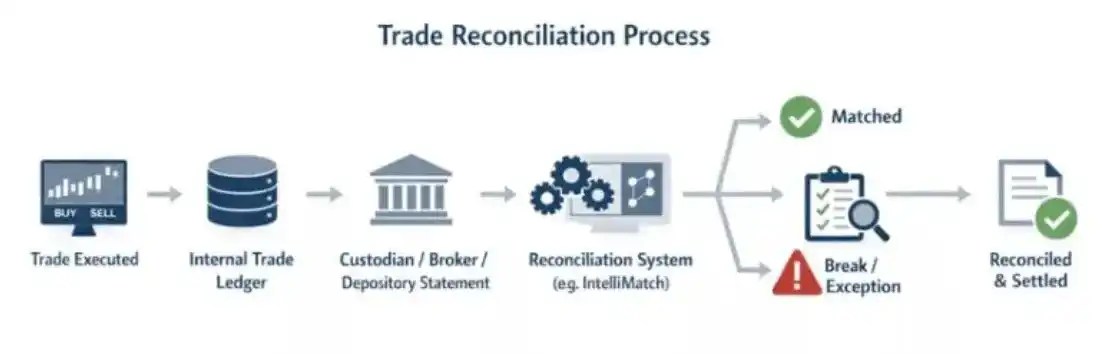
However, the names of ordinary investors do not appear on the official register; all shares are uniformly registered in the name of Cede & Co., the nominee of DTC. Therefore, the transfer agent only pays the dividend to DTC. DTC then splits the corresponding amount based on its own ledger and allocates it to its custodian banks (such as Bank of New York Mellon); the custodian banks further split the funds and distribute them to their partner brokers; finally, your broker (such as Fidelity) separately pulls its own customer data, calculates the dividend each person is entitled to, and credits their account.
This entire process involves five independent institutions, each repeating the same dividend calculation based on non-interoperable databases.
Even more unreasonable is that the data updates in the various ledgers are not synchronized. Asset managers execute corporate actions on the ex-dividend date, but custodians typically wait until the payment date weeks later to actually distribute. During this period, the broker's ledger will falsely show that you hold the corresponding stock, and traders can even sell shares they haven't actually received.
Globally, there are about one million corporate action events each year, each one must go through this fragmented chain, generating a staggering $58 billion in processing costs. The high costs, in turn, create industry inertia, with little motivation for any single party to drive optimization.
The root cause of this system's ailment lies in data formats and the distribution of interests. After Apple announces a dividend, it only files documents with the SEC and issues a press release. The announcements are in unstructured SWIFT text, which cannot be automatically parsed and integrated into systems for automated processing.
Even today in 2026, while trillions of dollars in daily stock trading can be cleared in seconds, dividend and stock split announcements still circulate as non-machine-readable PDFs or copy-pasted text.
The industry is not without machine-readable data standards; XBRL (eXtensible Business Reporting Language) has been around for over a decade. However, the business of filtering through messy announcements and extracting standardized, valid data has long been monopolized by Bloomberg and S&P. These institutions employ hundreds of analysts to manually interpret ambiguous statements in announcements and organize standardized data for downstream institutions. S&P Global alone manually verifies 1.4 million corporate action announcements covering 170 countries each year. If listed companies uniformly issued machine-readable, standardized announcements, the core business of these data service providers would be significantly eroded. They, who are most capable of promoting source data standardization reform, have instead become the biggest obstacle.
On the other hand, issuing companies like Apple bear no processing costs; they merely complete the filing and bear no further responsibility, with all costs borne by downstream intermediaries. Industry associations have proposed that issuers adopt standardized messaging, but companies have explicitly stated they need corresponding incentives to cooperate.
Financial infrastructure iteration is rarely driven by a 'efficiency improvement' logic. Only a major industry crisis can break the inertia of the existing system and drive change. Unfortunately, corporate action operations have never faced a systemic risk severe enough to force an industry-wide overhaul. The total cost is enormous, but when distributed among each institution, the amount is limited, and no single entity has the motivation to lead a unified reform.
ERC-8056: A New On-Chain Token Standard
Since the traditional system cannot solve the problem internally, can blockchain be used to completely bypass the existing old-fashioned chain? The ERC-8056 token standard provides a solution.
ERC-8056, introduced by Robinhood's Chris Ridmann in collaboration with Superstate, is a balance multiplier display standard compatible with ERC-20 tokens. The traditional model for stock splits requires minting a large number of new tokens; this standard only adjusts the displayed multiplier on the ledger without minting new tokens. Example: You hold 100 tokens, and a 4-for-1 stock split occurs. Your wallet will automatically update the displayed quantity of your holdings; the contract itself does not mint any new tokens. The original holdings and transaction history are completely preserved, requiring no transfer or reconciliation processing.
With just one smart contract rule, it can replace the entire process of separate calculation and repeated reconciliation by five institutions in the traditional system.
This programmable logic can be reused for all corporate actions difficult to automate in the traditional system. Dividends only need to invoke the contract once to uniformly distribute funds to all on-chain shareholders, no longer requiring cascading distribution and multi-ledger updates on staggered schedules; operations like rights offerings and proxy voting can also be encoded as on-chain rules, automatically executed based on a single authoritative share register.
For forty years, corporate actions have relied on manual processing, with the core root cause being five independent databases performing redundant calculations and post-facto reconciliation. ERC-8056 simplifies the entire value chain into one programmable layer.
Here, it's necessary to distinguish between two types of tokenized stock models to avoid misconceptions. Some tokenized products are merely digital mirrors of traditional stocks. For example, Robinhood issues tokenized stocks for Apple and Tesla, where the underlying real stocks are held in traditional brokerage accounts. The tokens are just a sixth layer of ledger superimposed on the original five-layer intermediary system, not solving the root reconciliation problem.
xStocks on the Solana blockchain uses a similar architecture, with even more glaring product design flaws. It holds the majority of the tokenized stock market share on Solana, but user dividends are forcibly reinvested and cannot be withdrawn as cash; the contract has built-in permanent authorization functions, allowing the issuer to unilaterally transfer tokens from user wallets at will. These so-called 'decentralized' equity products grant the issuer far greater control over assets than traditional brokers.
Only the native on-chain issuance model can solve the problem at its root, making the blockchain itself the official shareholder register. Superstate is a representative company in this field. It has registered a legitimate transfer agent with the U.S. SEC, no longer maintaining an independent database to periodically reconcile with DTC; share ownership is directly recorded on-chain.
Galaxy Digital recently announced plans to leverage Superstate's native issuance solution to tokenize all its equity on Solana. Once implemented, all shareholder information for Galaxy Digital will be natively on-chain. Dividends will no longer need to flow through multiple layers of intermediaries; the entire intermediate chain disappears.
Ian Grigg proposed the theory of triple-entry bookkeeping in the early 2000s, perfectly aligning with the value of native on-chain issuance. He suggested that when two parties complete a transaction, they generate a cryptographic record that both can verify and that is not controlled by either party alone—the third bookkeeping entry.
Since Luca Pacioli established double-entry bookkeeping in 1494, it has remained the foundation of global financial accounting. Triple-entry bookkeeping is the first major upgrade to this system since its inception, relying on a single authoritative shared ledger to completely eliminate the need for bilateral reconciliation.
The logic of the existing system is 'first process the business, then reconcile afterwards,' with costs and risks concentrated in the reconciliation step. Achieving instant settlement via a shared ledger means the reconciliation step disappears entirely—it's not just about reducing costs, but eliminating the very step that generates them.
The good news is that global regulation is rapidly adapting to this new model. In December 2025, the Depository Trust & Clearing Corporation (DTCC) issued a no-action letter, removing obstacles for tokenized securities to connect to the existing clearing system; Nasdaq has also received approval to conduct tokenized securities business, and traditional exchanges have incorporated native on-chain equity issuance into their long-term plans.
As mentioned at the beginning of the article, corporate actions have been stagnant for 40 years, largely because financial infrastructure reforms have historically required major crises to drive them. But this time, the industry might not need to wait for a crisis. Companies can issue equity natively on-chain, with the blockchain serving as the official transfer agent register, avoiding the arduous task of fixing the outdated system of five database layers.
The industry will directly build a new alternative, rendering the traditional processes that generate high reconciliation costs obsolete. The speed of this transformation depends on the progress of regulatory frameworks in various countries and how many issuing companies are willing to make the change.