Author: Ma He, Foresight News
Original Title: He Made $300,000 by Counting Musk's Tweets
Polymarket is home to many top-tier, profit-savvy minds. A player with the nickname noovd (0x063aeee10fbfd55b6def10da28e87a601e7deb4b) has earned hundreds of thousands in profits simply by predicting the number of tweets from the world's wealthiest man, Elon Musk.
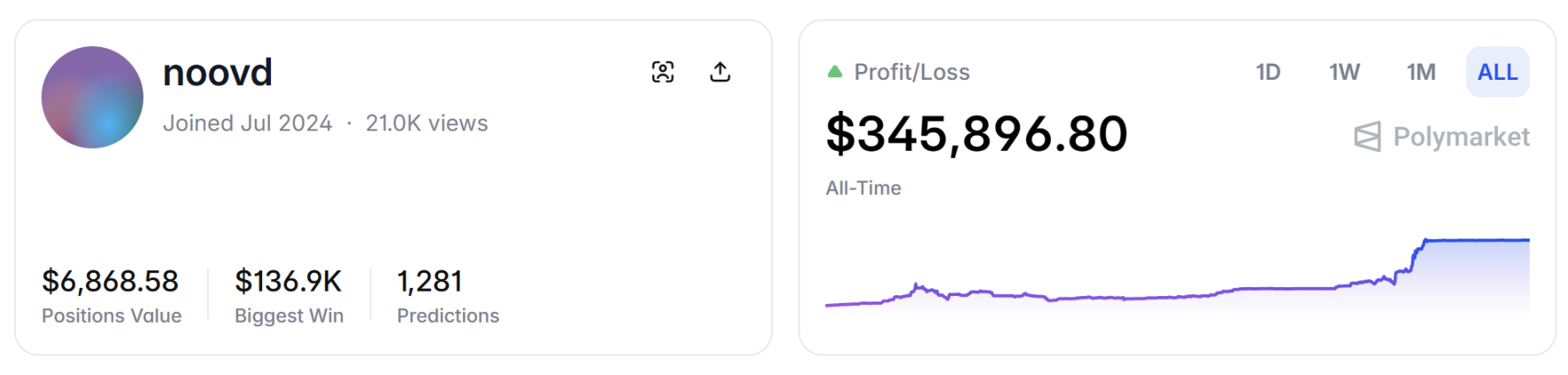
According to the official homepage, he only joined in July 2024 but has already netted $345,000. This player has made 1,281 predictions, with the single largest win being $136,000, and currently holds positions worth $6,877.
Looking at his profit curve, it was almost flat for the first few months, but starting from late 2025, it suddenly shot up with several near-vertical spikes, each surge originating from the same source: interval bets on how many tweets Elon Musk would post per week.
As the world's richest billionaire, Musk certainly has no incentive to manipulate the market.
He doesn't guess NBA scores or bet on various political events; he sticks to this one track. Looking at his settled records, the top eight profits all come from betting "Yes" on "Will Musk post between X and Y tweets this week?"
Polymarket breaks down Musk's weekly tweet count into over a dozen mutually exclusive intervals, each spanning about 20 tweets—200-219, 220-239......420-439, and even extreme intervals like 850-874. Retail investors, faced with so many choices, often pick something in the middle, buying a little at 35-50 cents for psychological comfort. What about the edge intervals? Their prices often drop to 2-24 cents, even when the actual probability is clearly 15-30%.
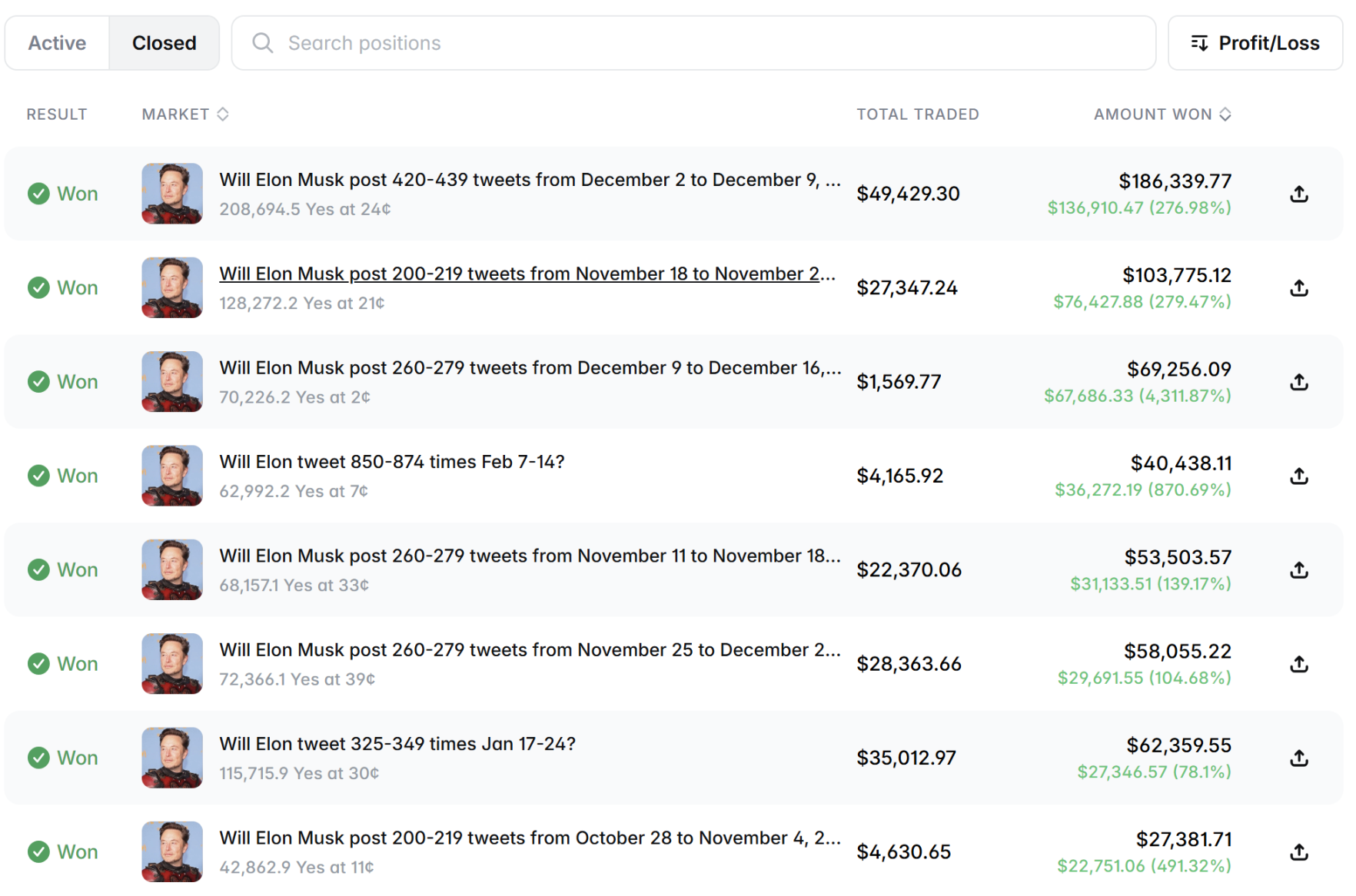
noovd feasts on these undervalued bargains. He only buys "Yes," never "No," never sells early, and never diversifies or hedges. When he places a bet, his positions range from $4,000 to $30,000, with an average entry price between 2-39 cents. Once his model confirms, he goes all in and waits for Sunday's settlement. His brilliance lies in having a real-time rhythm model that others don't see. He doesn't rely on hunches like "Musk will probably post more this week"; instead, he feeds his model with daily tweet data since 2022, updating it daily.
Musk's posting habits from Monday to Friday, the weekend lulls, the weight of catalysts like Starlink launches, Tesla earnings, DOGE news, and xAI new features—all are quantified. By Wednesday or Thursday, he can already precisely calculate how many tweets are needed each remaining day to land exactly within a specific 20-tweet interval.
While the market is still guessing blindly with historical averages, he has compressed the error margin to within ±10-15 tweets. If he detects that a 2-cent interval has an actual probability of 18-25%, he goes heavy. The single-bet expected value advantage often reaches 8-20x. One big win can wipe out dozens of small losses and then some.
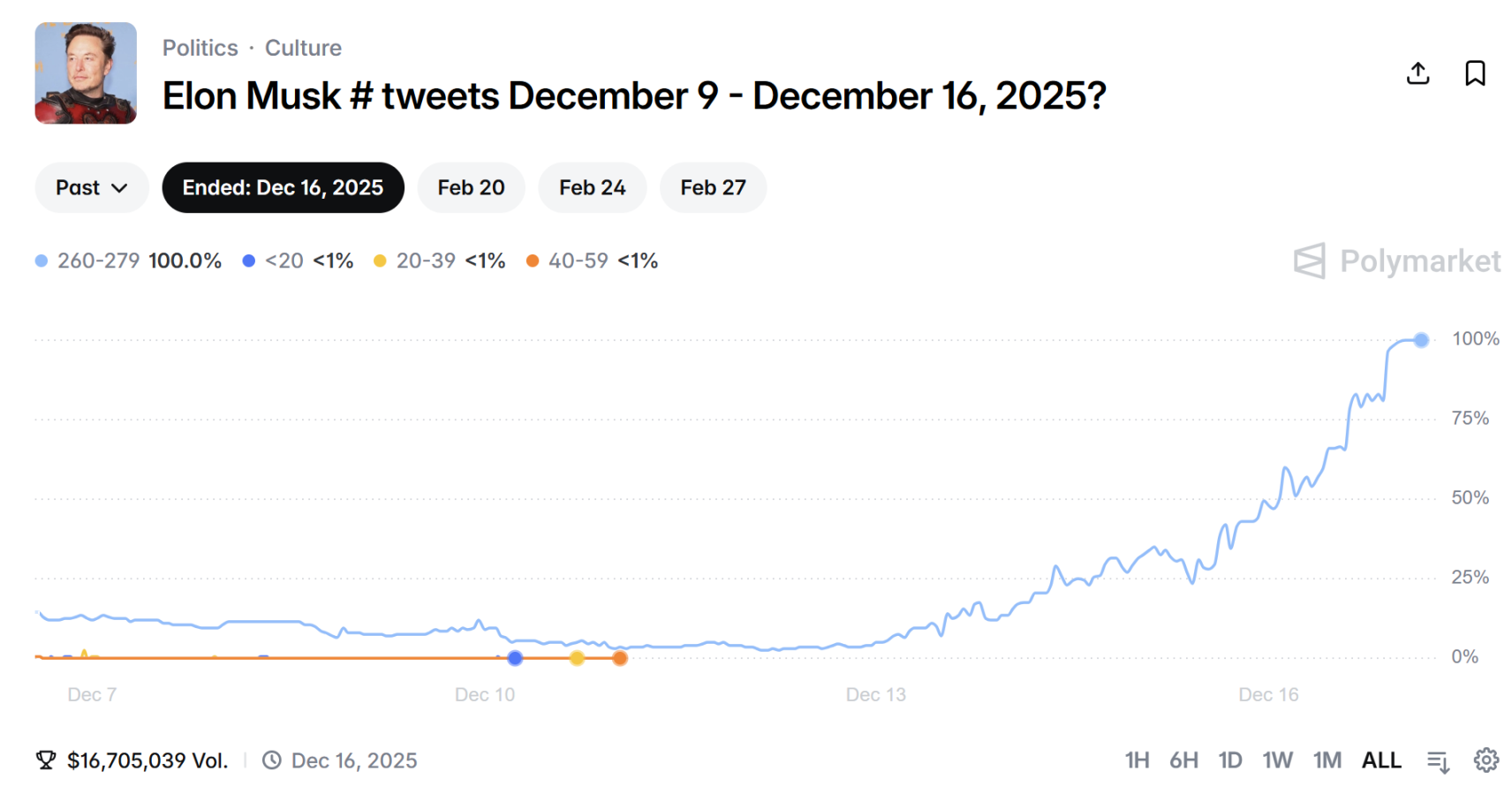
Take the prediction for December 9-16, 2025, for example. By Wednesday night, Musk had already posted 130+ tweets, leaving four days where he needed 32-35 tweets per day to precisely hit the 260-279 interval. That week had no explosive news, but discussions about xAI and Tesla were ongoing. The market, however, priced this interval extremely low because everyone thought "either it'll be平淡 180-220, or it'll shoot straight to 400+".
noovd's model might have captured some pattern of Musk's "sporadic activity." The player bought in at an average price of 2¢, investing about $1,569, and ultimately profited $67,686.33—a return of 4,311.87%.
He entered when the odds were extremely skewed, using minimal cost to lock in this narrow profit interval. This is a typical "deep out-of-the-money options" strategy, betting on the long-tail opportunities of probability distributions.
While the previous case already boasts an astonishing 43x return, the next case became his most profitable bet.
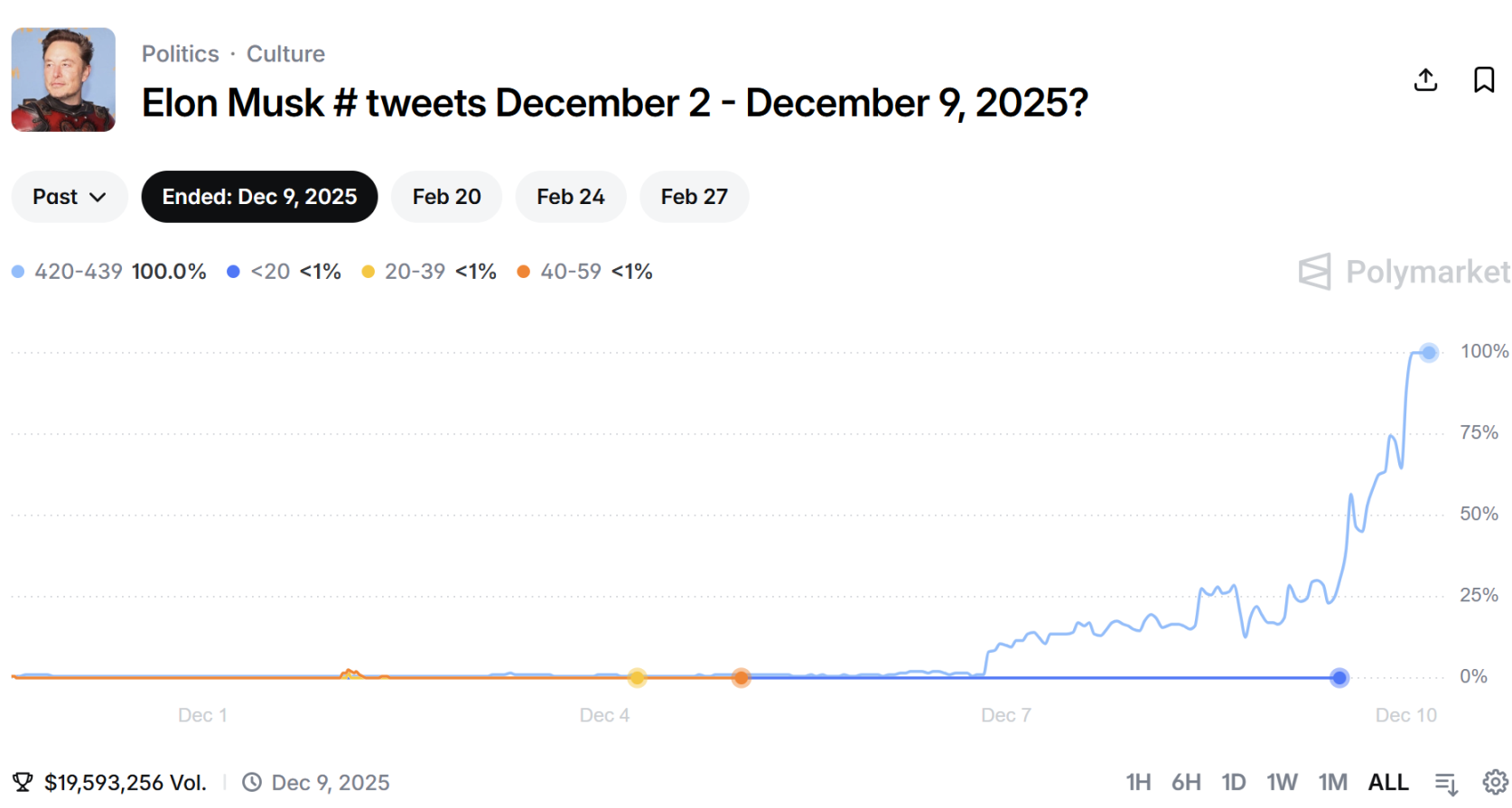
December 2-9: Will Musk post 420-439 tweets?
He bought at an average price of 24¢, heavily with $49,429, and finally profited over $130,000.
At that time, Musk's tweet count had already surged to 180+ by Tuesday. For the remaining days, he needed to maintain 65-70 tweets per day to firmly nail the 420-439 interval. That week had election aftermath and product pre-hype. The market priced it at 24 cents, but he saw that others were spreading their positions across the 400-419, 420-439, and 440-459 intervals, while the most likely landing spot was the middle one. He directly scooped up all 208,694 shares at a cost of $49k, settled for $186k—another near 3x return. Just these two December trades combined for over $255,000. The other thousand or so bets were mostly small tests or辅助 intervals in the same赛道, essentially keeping the machine oiled.
Why can this strategy keep making money, and why is it almost impossible to replicate?
First, the information barrier is too high. You need to scrape his timeline daily, preferably have a complete historical dataset, and write your own Poisson distribution model that refreshes every 6-12 hours. Ordinary people either can't scrape the data or can't be bothered to tune the parameters. The psychological hurdle is immense. Intervals priced at 2 cents or 7 cents look like throwing money away. Anyone who hasn't endured 100 weeks of drawdowns or witnessed 100 settlements firsthand would never dare to go heavy. When you look at his settled loss screenshots, you might breathe a sigh of relief—this player isn't a 100% win-rate god either.
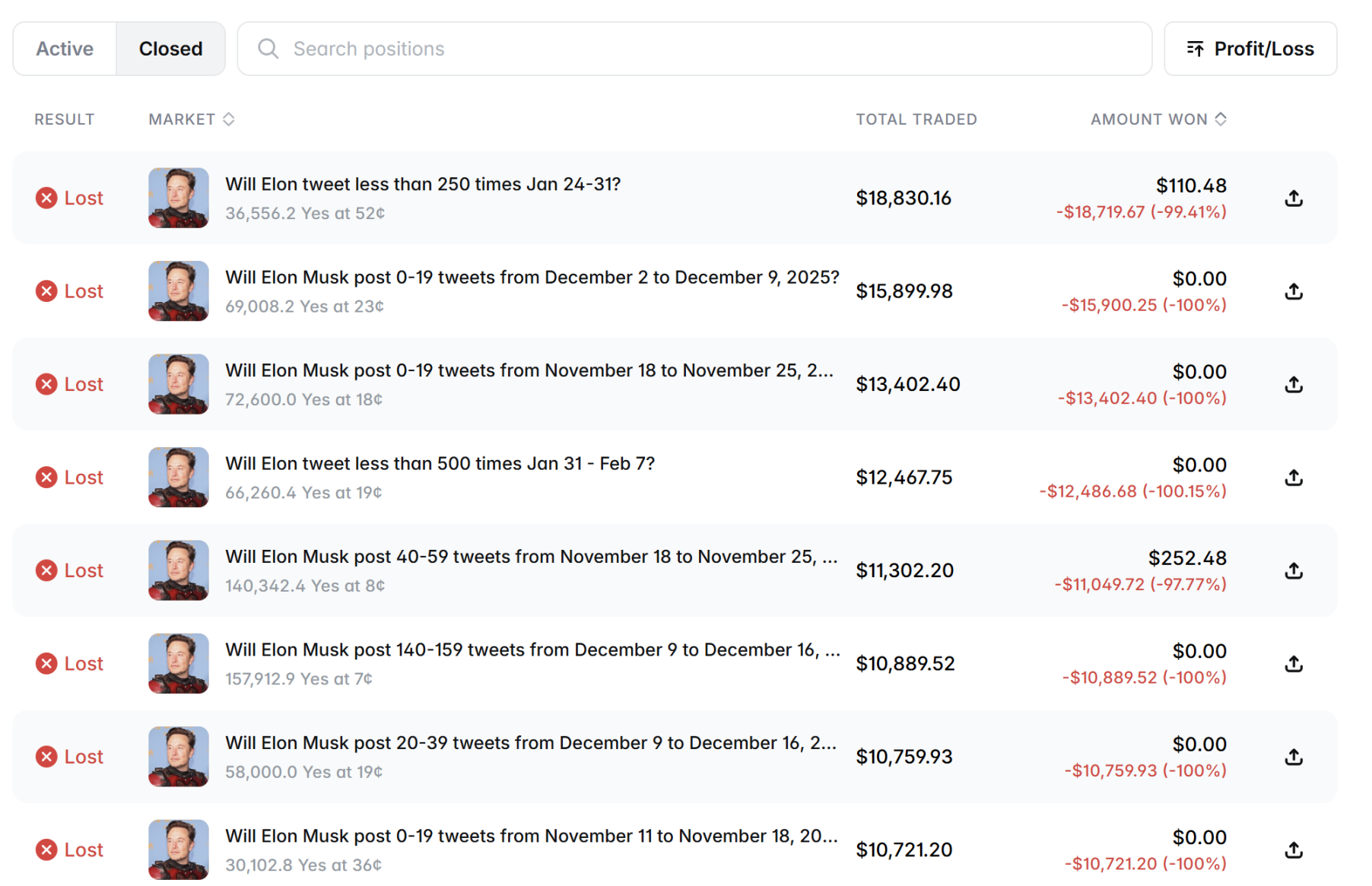
Second, it requires extreme execution. Only go big when the advantage is greater than 10x, treat small losses as tuition, and let big wins compound. Most critically, market inefficiencies persist.
From noovd, what ordinary people can truly learn is to stop fantasizing about conquering all markets. First, find an extremely narrow, repeatable signal and study it thoroughly. Depth always beats breadth, as long as your edge is real. Abandon feelings entirely; speak with numbers and data. Making spreadsheets, scraping data, and running regressions are ten thousand times more reliable than relying on "a feeling that Musk will go crazy this week."
2 cents with a 20% real probability is far better than 50 cents with only a 5% edge. Most people do the exact opposite. In a casino where everyone shouts about 100x returns, the quietest and fiercest wealth was made by someone who could count tweets better than anyone else.
Now, new intervals for predicting Musk's weekly tweet count are still opening regularly. The only question is, very few can turn it into their own money printer.
Twitter:https://twitter.com/BitpushNewsCN
Bitpush TG Discussion Group:https://t.me/BitPushCommunity
Bitpush TG Subscription: https://t.me/bitpush