Wall Street Morning Report: Microsoft Eases 'AI Cash Burn' Concerns, Tech Stocks Stage Strong Rebound, Storage ETF DRAM and Philadelphia Semiconductor Index Soar 17% and 8%

marsbitPublié le 2026-07-31Dernière mise à jour le 2026-07-31

Résumé

Wall Street rebounds sharply after Microsoft's strong earnings alleviate "AI cash burn" concerns. The Nasdaq 100 surges 3.36%, its third-biggest gain this year, and the Philadelphia Semiconductor Index soars 8.19%. Microsoft's stock jumps 15.51%, adding $450 billion in market value, driven by Azure cloud revenue growth of 43% and a pledge for positive free cash flow in FY2027. This reignites confidence in AI investments. The memory sector rallies, with the Roundhill Memory ETF surging nearly 17%. However, market breadth is weak, with over 70% of S&P 500 stocks declining, creating a rare divergence from the index's gain. In currencies, the US dollar tumbles 0.9% amid suspected coordinated intervention by Japan and South Korea. Oil prices dip ahead of an OPEC+ meeting where a modest output increase is expected. Key earnings saw Amazon rise on strong AWS results, while Apple fell due to a disappointing revenue forecast and Meta dropped on capital expenditure worries. Upcoming focuses include the US AI regulatory framework deadline, OPEC+ decisions, and key economic data from South Korea.

Every Monday to Friday morning, focusing on macro trends, US stocks, AI, precious metals, and crude oil, using data to review the market and trends to seize opportunities. Produced by PANews.
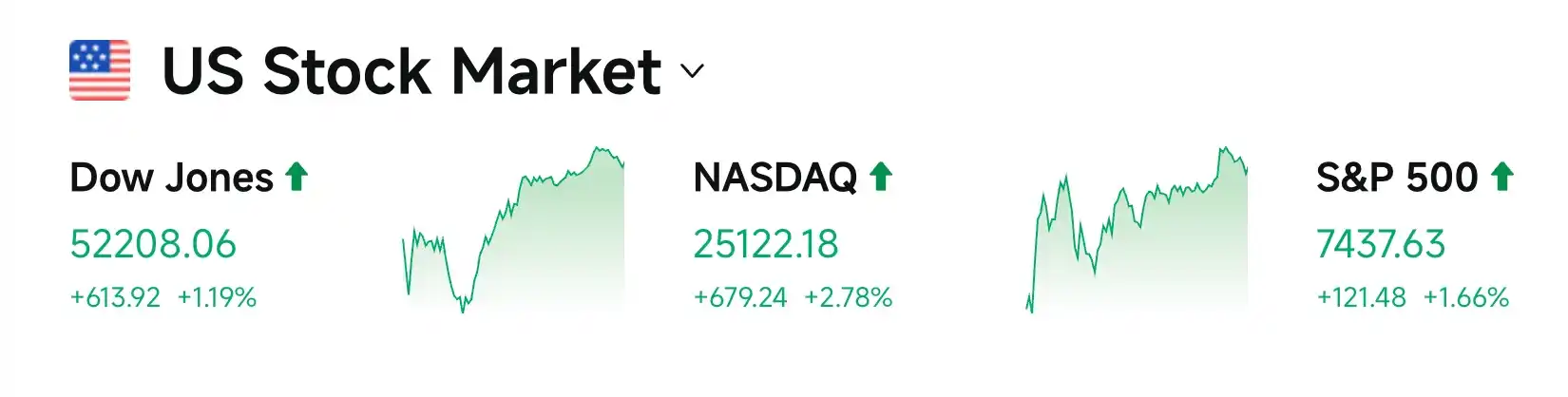
Following a sharp sell-off in the previous session, Wall Street experienced a fierce rebound. A far better-than-expected earnings report from Microsoft reignited confidence in AI investment, triggering a broad-based capital flow back into the technology sector. The Dow Jones Industrial Average rose 1.19%, the S&P 500 gained 1.66%, the Nasdaq Composite surged 2.78%, and the Nasdaq 100 jumped 3.36%, marking its third-largest one-day gain of the year. The VIX fear index plummeted 17.33% to 17.08.

Against Backdrop of Peace Headlines, Market Bets on OPEC+ Meeting

The geopolitical situation in the Middle East saw a dramatic turn. Former President Trump announced that Hamas has agreed in principle to a complete disarmament, with Israel gradually withdrawing troops as the agreement progresses. If finalized, this would represent the most significant political breakthrough since the outbreak of the Gaza conflict. However, the deal still requires formal signing, and significant differences remain among Israel, Hamas, Iran, and other parties. The market continues to watch for implementation risks.

Meanwhile, Iran announced a drone attack on a US military air base in Bahrain, claiming damage to the facility; Saudi Arabia, along with 43 countries, is promoting the establishment of a maritime defense alliance to enhance shipping security in the Red Sea, the Bab el-Mandeb Strait, and the Gulf of Aden. While diplomatic breakthroughs have emerged in the Middle East, military risks have not completely dissipated.

Oil prices edged lower, with WTI falling about 2% to $80.5 per barrel. The market is focused on the upcoming OPEC+ meeting, with traders wary of compliance with any output increase. ING strategists noted that the biggest uncertainty for oil before 2027 remains the direction of OPEC+ policy and whether member states will resist production quotas. The market expects OPEC+ may announce a production increase of 188,000 barrels per day in September, keeping bulls temporarily on the sidelines.

Dollar Slammed by 'Joint Effort from Japan and Korea', Yen Surges 3.3% During Session

On Thursday, the US Dollar Index plunged 0.9%, marking its biggest one-day drop since the beginning of the year, erasing all gains accumulated after Chairman Wash's first public appearance.

Notably, the market suspects Japan and Korea conducted synchronized currency interventions.

Nikkei reported that the Japanese government and the Bank of Japan likely intervened by buying yen and selling dollars, with US monetary authorities also conducting "rate checks" ahead of the intervention. South Korea was also reportedly selling dollars unusually aggressively. The Korean won appreciated 2% against the dollar, hitting a nine-month high; the Japanese yen surged as much as 3.3% against the dollar during the session, its largest intraday gain since December 2023.

Microsoft Earnings Reverse AI Cash Burn Doubts, Philadelphia Semiconductor Index Surges 8% in Biggest Jump in Four Months

Microsoft's earnings report became the key turning point reversing doubts about the 'cash burn' in the AI sector. Microsoft's Azure cloud business grew 43% at constant currency, not only far exceeding analyst expectations of 39.6%-40% but also helping its annual Azure revenue surpass $100 billion for the first time, making it the second cloud service provider after Amazon AWS to achieve this milestone.

Crucially, Microsoft's capital expenditure came in below expectations, and the company committed to maintaining positive free cash flow in fiscal year 2027, directly shattering prior market concerns about the sustainability of AI investments. Boosted by this, Microsoft's stock price soared 15.51%, adding about $450 billion in market value in a single day, surpassing Nvidia's previous record of a $440 billion single-day market cap increase and marking the largest single-day market value gain for an individual stock in US market history.

The semiconductor and storage sectors became the strongest beta plays in this rebound. The Philadelphia Semiconductor Index surged 8.19%, its largest single-day gain in recent months, and the Roundhill Memory ETF skyrocketed nearly 17%. SanDisk, Micron, SK Hynix, Western Digital, Seagate, and others rallied sharply as the market bet on sustained expansion in demand for HBM, NAND, and DRAM from AI data centers. Additionally, the "AI Stock God" Leopold's "Situational Awareness" fund, which had leveraged bets on AI, faced margin calls and was forced to sell about $16 billion in secondary market holdings. Citadel stepped in within 24 hours, not only averting a cascading sell-off risk but also triggering mechanical short covering, further fueling the market rebound.

Despite the tech sector's gain of over 5%, market breadth remained weak. Over 70% of the S&P 500 constituents closed lower, and the S&P 500 Equal Weight Index actually declined, showing a rare divergence of over 75 basis points from the benchmark index. Bloomberg strategists pointed out that since 1990, such a divergence has only occurred twice before, with the other instance happening on June 30, 2000, just before the peak of the Nasdaq tech stock cycle. SpotGamma also warned that the S&P 500 remains in a negative Gamma regime, with resistance at 7450 and support at 7300. A break below 7300 would reveal a near-vacuum of 0DTE option positive Gamma support down to 7000, suggesting this rally stems more from a squeeze in positioning than a genuine return of risk appetite. Investors need to be wary of concentration risks.

Specific Company Actions and Stock Price Movements:
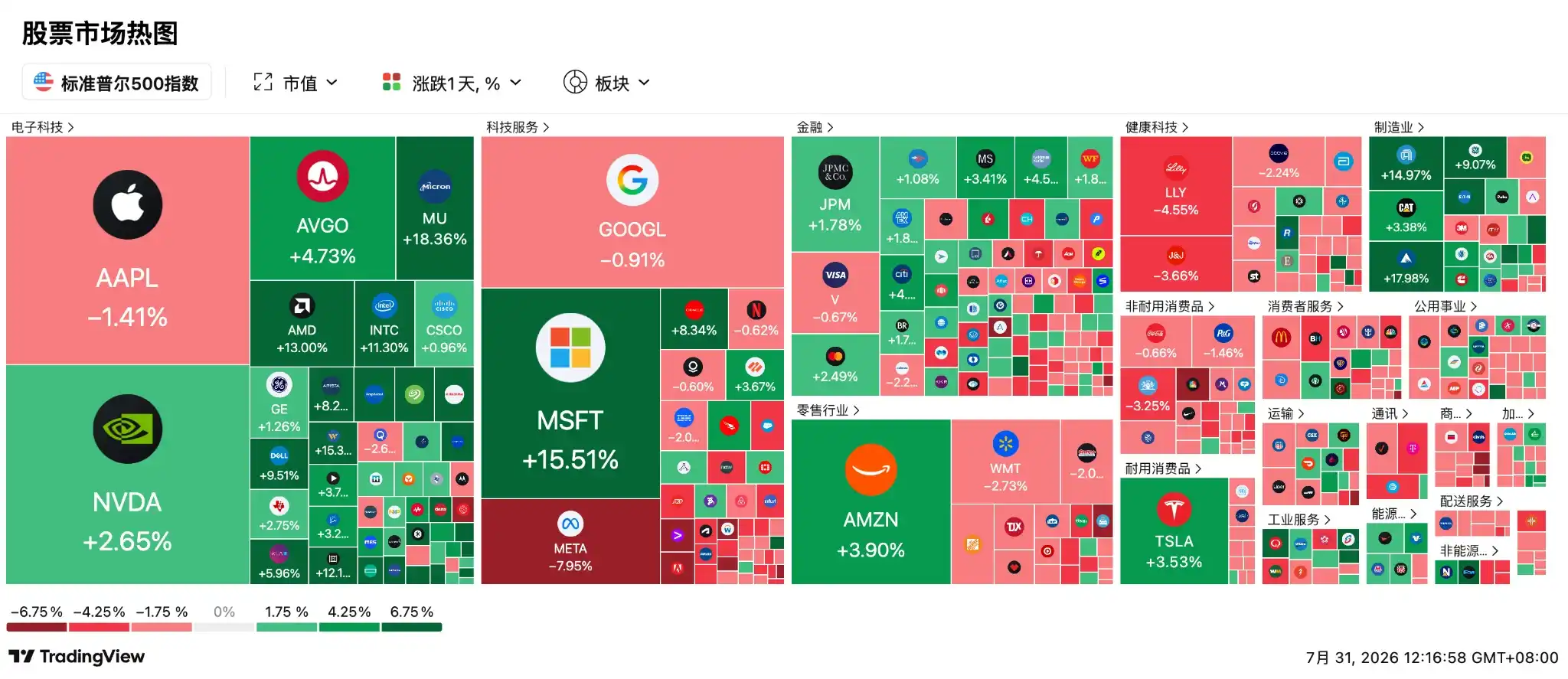
  • Microsoft surged 15.51%, its biggest one-day gain in 18 years: Market cap soared by $450 billion in a single day, a historical record. The company's Q4 Azure cloud revenue growth reached 43%, far exceeding expectations, and provided optimistic guidance on restrained capital expenditure and positive free cash flow for the new fiscal year. The Magnificent 7 Index rose 2.28%. Nvidia gained 2.65%, Amazon rose 3.90%, Tesla climbed 3.53%, but Meta fell 7.95%, Apple declined 1.41%, and Google Class A slipped 0.91%.

  • Cloud Computing sector rallied: New cloud service provider NEBIUS skyrocketed 27.13%, CoreWeave jumped 21.51%, Oracle rose 8.34%, Amazon gained 3.9%.

  • Semiconductor/Storage sector staged a violent rebound: Philadelphia Semiconductor Index up 8.19%, Semiconductor ETF up 6.88%, Roundhill Memory ETF up nearly 17%. Micron Technology soared 18.32%, SanDisk surged 25.99%, SK Hynix gained 17.52%, Western Digital rose over 15%, Seagate Technology climbed over 11%. Lam Research jumped 18.36%, Astera Labs up 20%, Applied Materials up 17.98%, AMD rose 13%, Intel gained 11.3%, TSMC was said to be developing advanced packaging technology similar to Intel's EMIB, Arm rose over 7%, TSMC ADR up 7.64%, Marvell Technology rose over 12%.

  • Optical Communications stocks followed the rebound: Applied Optoelectronics up nearly 18%, Lumentum up over 15%, Credo up over 13%, Coherent up over 12%, Corning up 9%.

  • Meta bucked the trend, falling 7.95%: Despite a future spending commitment of nearly $700 billion, high capital expenditure and cash flow pressures worried investors, and growth avenues beyond advertising remain to be proven.

  • Amazon closed up 3.90%, up over 10% after hours: AWS cloud revenue surged 37% in the quarter to $42.2 billion, hitting an 18-quarter high. CEO Andy Jassy stated AWS is entering a new growth cycle, with AI services, in-house Trainium chips, and enterprise AI applications becoming core future growth drivers. AWS has become a significant profit source for Amazon, and its AI infrastructure layout is gaining market recognition. However, Amazon still faces capital expenditure pressure, having raised its full-year capex plan. The market will continue to watch whether AI investments can be sustainably converted into profit growth.

  • Apple closed down 1.41%, down nearly 7% after hours: Cook bids farewell to the earnings report with 'beating earnings but missing expectations'. Quarterly revenue reached $109.417 billion, up 16% YoY, and EPS was $2.02, both exceeding estimates. However, citing "supply constraints," the CFO projected Q4 revenue growth of only 9%-11%, well below market expectations of 12.1%. Additionally, Greater China revenue missed expectations. Cook admitted on the conference call that soaring memory chip costs and advanced node capacity bottlenecks are eroding gross margins, and the company is struggling with a constrained supply chain.

  • Bloom Energy up 26.49%: The company had been questioned by short-seller Hunterbrook about its supply chain and capacity, particularly its reliance on scandium and the uncertainty of large order fulfillment. Bloom responded that the report was false and misleading, emphasizing supply chain diversification and minimal scandium usage.

What to Watch Next:

  • August 1 Deadline for Trump Administration AI Regulatory Framework: The draft has been sent to companies like OpenAI, Google, and Anthropic. The market will watch whether the US government strengthens regulations on large model safety, export controls, computing power oversight, and government procurement rules. If regulations lean strict, valuations of AI platform companies and cloud providers may face pressure; if the framework emphasizes innovation priority, the AI software and infrastructure chain may continue to receive risk premiums.

  • August 1 Microsoft Xbox Price Hike Takes Effect: Limited financial impact on Microsoft overall, but the market will observe whether consumer hardware price increases are absorbed by demand, also reflecting on the pricing power of Apple, Sony, Nintendo, and other consumer electronics chains.

  • August 1 South Korea July Export Data (YoY): The market is watching South Korea's semiconductor, storage, automobile, and electronics export performance. If exports continue strong growth, it will reinforce the AI hardware cycle recovery narrative, benefiting memory, foundry, and Asian tech stocks; if the data falls short, last night's semiconductor rebound in US stocks might be viewed as short-term short covering rather than a fundamental reversal.

  • August 2 OPEC+ Meeting: The market expects OPEC+ may announce a production increase of 188,000 barrels per day in September. If the increase materializes, upside pressure on oil prices will intensify, helping to moderate inflation expectations; if the increase is postponed due to escalating Middle East tensions, oil risk premiums may quickly return, pushing long-term US bond yields and inflation trades higher again.


Questions liées

QAccording to the article, what was the primary catalyst that triggered the rebound in tech stocks and how did it address a key market concern?

AThe primary catalyst was Microsoft's quarterly earnings report. It addressed the key market concern of 'AI burning money' by showing that Microsoft's capital expenditures were lower than expected and the company pledged to maintain positive free cash flow in the 2027 fiscal year. This demonstrated the sustainability of AI investments, reigniting confidence in the AI sector.

QWhat significant event contributed to the weakness in crude oil prices (WTI), and what major event are traders focusing on next regarding oil supply?

AA significant event was a diplomatic breakthrough in the Middle East where Hamas reportedly agreed in principle to a disarmament deal with Israel. Traders are now focusing on the upcoming OPEC+ meeting, where the market expects a potential production increase of 188,000 barrels per day in September, which has made bulls cautious.

QThe article states the Japanese Yen and Korean Won experienced sharp gains. What is suspected to be the main reason for this significant movement against the US Dollar?

AThe main suspected reason is coordinated foreign exchange intervention. Japanese authorities are suspected of buying Yen and selling Dollars, while Korean authorities were also reported to have sold Dollars, leading to a 3.3% intraday surge for the Yen and the Won hitting a nine-month high.

QBeyond Microsoft, which two sectors were highlighted as the strongest performers during the market rebound, and name one specific ETF that surged nearly 17%.

AThe semiconductor and memory/storage sectors were highlighted as the strongest performers. The Roundhill Memory ETF (ticker likely MEM) surged nearly 17%.

QDespite the strong gains in major indices, the article points out a concerning market breadth indicator. What was this indicator, and what historical period does the current pattern recall?

AThe concerning indicator was that over 70% of S&P 500 constituents closed lower, causing the equal-weight S&P 500 index to fall while the cap-weighted benchmark rose—a rare divergence of more than 75 basis points. According to the article, a similar pattern occurred only once before since 1990: on June 30, 2000, near the peak of the Nasdaq tech bubble.

Lectures associées

Le marché boursier sud-coréen rebondit fortement après une dévalorisation violente, SK Hynix progresse de 30%

Le 31 juillet, la Bourse sud-coréenne a connu un rebond historique, avec l'indice KOSPI en hausse de 18,27%. SK Hynix a bondi de 30%, et Samsung Electronics a progressé de plus de 28%. Ce rallye fait suite à une chute violente de près de 40% du KOSPI en un peu plus d'un mois, amplifiée par un effet de spirale mortelle lié aux ETF à effet de levier. Trois facteurs principaux ont déclenché ce rebond : des résultats solides et des perspectives optimistes des géants du cloud nord-américains (Microsoft, Amazon) concernant la demande en IA ; l'achat symbolique d'actions SK Hynix par le président du groupe SK, interprété comme un signal de confiance ; et l'annonce par le gouvernement sud-coréen d'un plan d'investissement de 20 000 milliards de wons dans l'IA. Face aux risques systémiques révélés par la crise, les autorités sud-coréennes resserrent activement la réglementation des ETF à effet de levier, avec des mesures comme l'augmentation des marges de dépôt obligatoires pour les investisseurs particuliers. Les analystes estiment que cette correction brutale représente une transition nécessaire du marché, passant d'une dynamique guidée par la liquidité à une logique plus fondamentale. Si des signes comme le ralentissement des ventes par les investisseurs étrangers sont encourageants, la pérennité de la reprise dépendra des dépenses d'investissement futures des géants technologiques mondiaux et de l'évolution des prix des puces mémoire.

marsbitIl y a 15 mins

Le marché boursier sud-coréen rebondit fortement après une dévalorisation violente, SK Hynix progresse de 30%

marsbitIl y a 15 mins

La société de cryptomonnaie Wintermute émet des déclarations pessimistes quant à la hausse attendue des altcoins ! Voici les détails

La société de cryptomonnaie Wintermute a émis des déclarations pessimistes concernant la croissance attendue des altcoins. Selon leur analyse récente, le comportement des investisseurs institutionnels évolue, avec une concentration croissante du capital sur un nombre restreint de tokens. Au premier semestre 2026, 72% du volume de leurs transactions de gré à gré (OTC) provenaient de clients institutionnels, un record. Les données montrent que l'activité des institutions diminue rapidement après un pic de prix, tandis que celle des investisseurs particuliers persiste plus longtemps, indiquant une approche plus sélective des institutions. Wintermute estime que le traditionnel « altseason », caractérisé par une hausse généralisée, pourrait laisser place à un cycle où seuls les projets ayant des cas d'utilisation solides, une liquidité élevée et un intérêt institutionnel se démarqueront. Ce constat est corroboré par d'autres analyses. CryptoQuant rapporte que le volume des paires d'altcoins contre le Bitcoin est près de son plus bas depuis 2021, et que les 10 premiers altcoins (hors stablecoins) représentent environ 80,5% de la capitalisation totale du segment. De même, Kaiko observe que 63% du volume des altcoins est concentré sur les 10 principaux, contre 50% il y a quelques mois. Les analystes concluent que, dans un environnement où les institutions sont plus prudentes, un éventuel nouveau marché haussier des altcoins pourrait être moins étendu. Les bénéfices pourraient se concentrer sur un nombre limité de projets prometteurs dotés de technologies avancées, d'une bonne liquidité et d'un écosystème durable.

cryptonews.ruIl y a 18 mins

La société de cryptomonnaie Wintermute émet des déclarations pessimistes quant à la hausse attendue des altcoins ! Voici les détails

cryptonews.ruIl y a 18 mins

La prime de «risque zéro» des obligations américaines est en train de disparaître

L'article analyse la disparition progressive de la prime de « risque zéro » traditionnellement associée aux obligations du Trésor américain, un pilier de la tarification des actifs mondiaux. Il démontre que la courbe des taux entière s'est déplacée vers le haut depuis 2024, avec une prime de durée structurelle particulièrement marquée sur le segment long (20 ans), signalant une réévaluation de la crédité souveraine américaine plutôt qu'un simple cycle de taux. En comparaison globale, l'écart américain (taux 10 ans - taux directeur) se situe désormais au niveau de l'Allemagne, et son court terme est aligné sur celui de pays comme l'Inde. Le marché applique encore un « discount de monnaie de réserve » aux États-Unis, mais une normalisation vers la moyenne des pays du G10 pourrait ajouter environ 50 points de base aux rendements longs. Les marchés d'options prix une distribution bimodale des risques, avec des tensions fiscales dans la queue de distribution. Historiquement, les résolutions ont oscillé entre l'assainissement budgétaire, l'inflation/subordination monétaire ou un choc disciplinaire externe. L'administration Trump agit comme un accélérateur, non comme la cause originelle, d'une dynamique bipartisane de déficits. Pour les marchés émergents, le choc se manifeste par des réajustements violents (ex: Corée du Sud, dépendante de l'IA) et l'inefficacité des couvertures obligataires traditionnelles. La conclusion invite à surveiller des indicateurs clés comme les primes de durée, les écarts de skew actions, les flux de capitaux et la digestion des émissions du Trésor pour anticiper l'évolution de cette réévaluation fondamentale.

marsbitIl y a 20 mins

La prime de «risque zéro» des obligations américaines est en train de disparaître

marsbitIl y a 20 mins

UNI active le commutateur des frais : Uniswap complète sa première démonstration commerciale, le premier test attendu en septembre

Le 30 juillet, le prix du token UNI de l'échange décentralisé Uniswap a augmenté de plus de 10%, porté par l'activation du « Fee Switch » (interrupteur de frais) sur Uniswap V4 le 27 juillet. Ce mécanisme permet désormais au protocole de prélever une partie des frais de transaction, générant des revenus explosifs. Les revenus quotidiens moyens sont passés d'environ 118 000 $ à plus de 318 000 $, la Robinhood Chain contribuant à elle seule à plus de 50% de cette somme grâce à un volume d'échange élevé, largement alimenté par le trading de memecoins. Le système, piloté par des incitations économiques on-chain, crée un « effet flywheel » : les frais sont collectés dans un contrat (TokenJar), incitant des arbitragistes à acheter et brûler des UNI pour les récupérer, réduisant l'offre et soutenant potentiellement la valeur du token. Cependant, cette croissance soulève des inquiétudes. La dépendance aux volumes de la Robinhood Chain est fragile, car ceux-ci reposent sur une bulle de memecoins et des subventions couvrant les frais de transaction (Gas). Ces subventions devant expirer fin septembre, un ralentissement brutal est anticipé. De plus, la valorisation d'Uniswap (ratio P/E proche de 100) semble anticiper une croissance très forte. Enfin, bien que le fondateur Hayden Adams affirme que les frais du protocole s'ajoutent à ceux des fournisseurs de liquidité (LP) sans les réduire, la question de savoir si la hausse des coûts totaux pour les traders pourrait indirectement nuire aux LP reste en suspens. Uniswap a réussi son entrée en « commercialisation », mais sa pérennité dépendra de sa capacité à s'appuyer sur des flux d'activité plus durables et diversifiés.

marsbitIl y a 25 mins

UNI active le commutateur des frais : Uniswap complète sa première démonstration commerciale, le premier test attendu en septembre

marsbitIl y a 25 mins

Trading

Spot
活动图片