Goldman Sachs Report Deconstructs the Competitive Landscape of China's AI Large Models: Who Will Be the Long-Term Winner?

marsbitPubblicato 2026-07-11Pubblicato ultima volta 2026-07-11

Introduzione

Goldman Sachs analyzes China's AI large language model (LLM) landscape, identifying key players and a strategic shift towards efficiency and global expansion. The report highlights that Chinese open-source/open-weight models are closing the performance gap with top global proprietary models at significantly lower cost, driven by architectural innovations like MoE. This enables a "two-tier" market: a high-end segment (e.g., GLM5.2, Qwen3.7 Max) with pricing at ~$1 per million tokens, and a low-end, price-sensitive global segment. Open-source strategies aid adoption but limit monetization, as deployments via third-party platforms (e.g., AWS Bedrock, Alibaba Cloud) may not generate direct revenue for model creators. The industry is thus moving towards "open-weight + community license" models with revenue-sharing to improve unit economics. Internationally, the focus is shifting from "token maximization" to ROI-driven enterprise adoption, particularly in non-U.S. markets. Major cloud platforms are integrating Chinese models (e.g., DeepSeek, MiniMax). Using a competitive framework based on pricing power, cost advantage, and financial strength, Goldman Sachs identifies **Zhipu AI** and **DeepSeek** as leaders in foundational text models, and **ByteDance** (with Seedance) leading in multimodal/video generation. **MiniMax** and **Kuaishou** are also rated favorably. The firm forecasts China's AI model API/subscription revenue growing from ~RMB 35bn (2026E) to RMB 879bn by 2030.

Author: Wall Street Insights, Bu Shuqing

Original Title: Goldman Sachs In-Depth Report: Who Will Be the Long-Term Winner in China's AI Large Model Industry?

China's AI large models are standing at a historic inflection point. Goldman Sachs believes that the intelligence performance of China's open-source/open-weight large models is approaching that of the world's top proprietary models, and adoption scale by domestic enterprises and global SMEs is rapidly expanding, thereby forming a data flywheel effect that will further drive model iteration and upgrades.

According to Zhui Feng Trading Desk, the latest Goldman Sachs report points out that this evolution trajectory can be summarized as 'from DeepSeek's cost-efficiency moment last year to Zhipu GLM's model intelligence moment this year'. The team led by Goldman Sachs analyst Ronald Keung systematically evaluates four core questions in this 50-page report: how Chinese AI models achieve high performance at low cost, why they choose the open-source route and how to monetize, where the core addressable market is, and who will be the long-term winners.

In assessing the competitive landscape, Goldman Sachs introduced a "competitive positioning framework" based on pricing power, cost advantage, and financial strength. Based on this, it determines that in the foundational text model field, Zhipu (initially covered) and DeepSeek (unlisted) have the strongest positioning; in the multimodal field, ByteDance (unlisted) is leading. Goldman Sachs also maintains Buy ratings on MiniMax and Kuaishou.
Small but Mighty, Efficiency Wins

The core reason Chinese large models can achieve performance close to their US counterparts at significantly lower cost lies in dual breakthroughs in architectural innovation and parameter efficiency.

The Goldman Sachs report points out that the parameter scale of Chinese open-source models is generally between 200 billion and 1.6 trillion, only 2% to 10% of the world's top models, primarily due to limited access to high-end computing power. Meanwhile, innovations like Mixture of Experts (MoE) architecture and sparse attention mechanisms have reduced the proportion of actually activated parameters to total parameters to only 3% to 5%, significantly lowering training and inference costs.

At the specific model level, DeepSeek V4 Pro has 1.6 trillion parameters, Zhipu GLM5.2 has 0.7 trillion, and MiniMax M3 has 0.4 trillion.

Goldman Sachs attributes the recent leap in Chinese models' coding capabilities to the synergistic effects of data curation, reinforcement learning fine-tuning, and other factors. On June 27th, DeepSeek launched the speculative decoding framework DSpark, already deployed in the online services of V4-Flash and V4 Pro, boosting per-user generation speed by 60% to 85% (V4-Flash) and 57% to 78% (V4 Pro) without altering model weights or output quality.

Meituan's LongCat 2.0 released on June 30th is viewed by Goldman Sachs as a major milestone in the localization of China's AI infrastructure—this is China's first fully open-source 1.6-trillion-parameter MoE model trained and deployed entirely on 50,000 domestic compute cards. Goldman Sachs believes this proves the feasibility of a localized hardware stack during the compute-intensive pre-training phase, holding profound significance for China's AI models to reduce dependence on foreign high-end chips.

A Two-Tiered Market, the Strong Get Stronger

Goldman Sachs describes the Chinese AI model market as an emerging "two-tiered structure" and identifies two ARR-maximizing quadrants.

In the high-end market, top models represented by Zhipu GLM5.2 and Alibaba's Qwen3.7 Max are priced at approximately $1 per million tokens, five times that of low-end models, with an estimated inference gross margin of about 10% to 20% (Goldman Sachs estimate). In comparison, top US models are priced at $4 to $8 per million tokens. Chinese high-end models are only 10% to 25% of that price, but can still maintain positive gross margins due to their lower activated parameter ratio.

In the low-end market, models targeting agent tasks are priced as low as $0.06 to $0.2 per million tokens, opening up markets for price-sensitive global SMEs and individual users. MiniMax derives 60% to 70% of its revenue from overseas. Notably, DeepSeek has announced the introduction of peak/off-peak pricing for its V4 series from mid-July, with peak rates being twice the off-peak rate, resulting in a blended price of approximately $0.35 per million tokens (V4 Pro) and $0.12 per million tokens (V4 Flash).

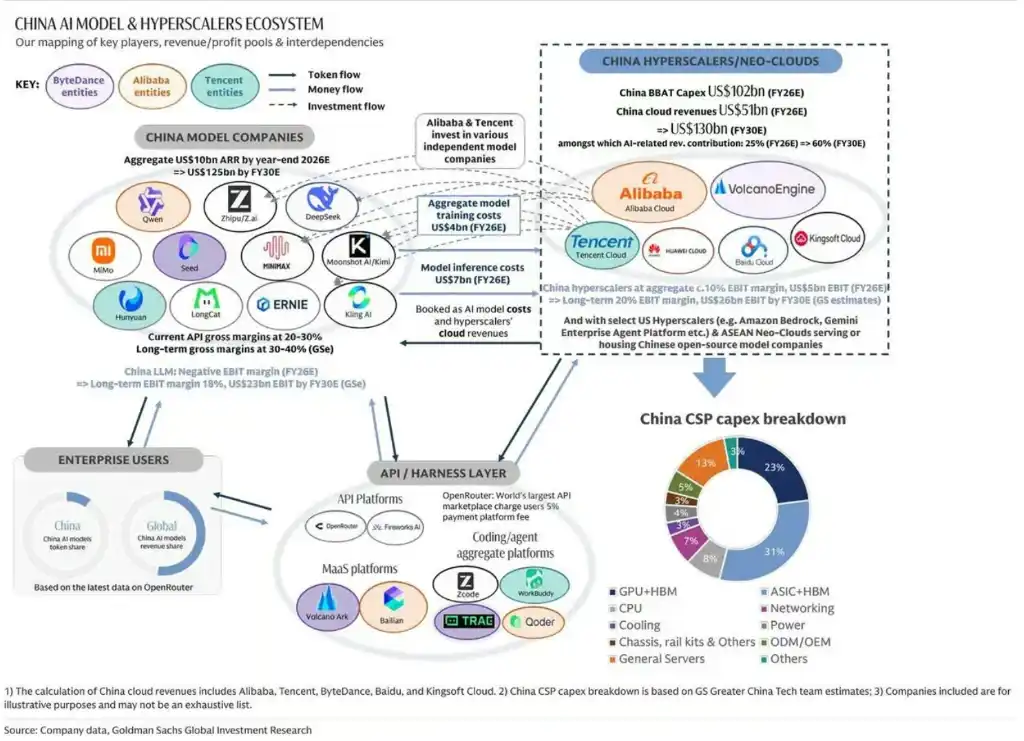
Goldman Sachs predicts that API and subscription revenue from Chinese AI models will grow from an estimated 35 billion RMB in 2026 to 879 billion RMB in 2030, corresponding to daily token consumption increasing from 350 trillion to 4.6 quadrillion tokens, a roughly 25-fold increase.

Open-Source Strategy: Broad Penetration, Monetization Paths Await Upgrade

The Goldman Sachs report details the strategic logic behind the prevalent open-source/open-weight approach among Chinese AI models and its monetization limitations.

The core advantages of the open-source strategy are deployment flexibility and community ecosystem. Alibaba's Qwen series, DeepSeek, Zhipu GLM, and MiniMax M3 all adopt open-source or open-weight approaches, with ByteDance's Seed model being a major exception, taking a fully closed, proprietary route. The open-source model allows flexible deployment both within and outside mainland China and accelerates iteration through community feedback.

However, Goldman Sachs points out that the ARR numbers disclosed by open-source model companies likely severely underestimate the actual deployment scale and revenue potential. Taking Zhipu as an example, its ARR target for the end of 2026 is $1 billion, but the actual global deployment volume of GLM5.2 will far exceed the token volume and revenue from Zhipu's own API channels—Alibaba Cloud's Bailian MaaS platform can directly host the GLM5.2 open-source model without paying any fees to Zhipu.

Goldman Sachs expects the industry to gradually migrate from pure open-source (MIT license, completely free) to an "open-weight + community license" model—where commercial use requires signing a revenue-sharing agreement with the model company. The MiniMax M series has already adopted this model. Goldman Sachs believes this shift will significantly improve the unit economics for AI model companies, as they can benefit from revenue-sharing agreements with platforms like AWS Bedrock and Alibaba Cloud Bailian without bearing the inference compute costs themselves.

From "Token Maximization" to ROI Priority

Goldman Sachs characterizes international market expansion as the most important upside for Chinese AI models, especially in non-US markets.

Goldman Sachs' US research team estimates that by 2030, agent AI will drive a 24-fold increase in global token consumption to 120 quintillion tokens per month, with enterprise agents contributing a 55-fold increase and consumer agents a 12-fold increase. In global (non-China) markets, Chinese AI models have already achieved significant token share growth leveraging performance improvements and price advantages.

The Goldman Sachs report notes that the AI usage paradigm for global enterprises is undergoing a fundamental shift from "token maximization" to "ROI priority." The former prevailed from late 2025 to early 2026, where companies equated high token consumption with organizational productivity; the latter focuses more on clear task boundaries, daily active agent count, backend process automation, and tangible output. Data from a Jellyfish AI Engineering Trends study shows that heavy AI users in enterprises consume 10x the tokens but only achieve a 2x increase in output.

On the channel front, Alphabet's Gemini Enterprise Agent Platform and Amazon's AWS Bedrock already offer hosting services for Chinese AI models like DeepSeek, MiniMax, Moonshot, GLM, and Qwen. According to The Wall Street Journal, Microsoft's CEO recently stated that Microsoft is considering hosting a version of DeepSeek on Copilot as an optional low-cost model, emphasizing that if DeepSeek were hosted, the model would run within Microsoft's cloud ecosystem, ensuring customer data remains within Azure.

Who Are the Long-Term Winners?

Goldman Sachs constructed a three-dimensional competitive positioning framework, using quantitative metrics to assess each player's long-term winning probability. The core formula is: ARR Scale × Gross Margin Advantage + Financial Strength.

The pricing power dimension examines release speed (compared to previous generation and peer models), LMArena Arena ranking (based on large-scale blind user evaluation), and blended price per million tokens.

The cost advantage dimension examines throughput (tokens per second), cache hit rate, activated parameter ratio, and inference gross margin. The financial strength dimension examines cash on hand, net cash as a percentage of total assets, and valuation multiples.

In the foundational text model field, Goldman Sachs identifies Zhipu (initially covered, Neutral rating, target valuation $110 billion) and DeepSeek (unlisted) as having the strongest positioning, with both showing outstanding performance in pricing power and cost advantage. The aggregate implied valuation of independent AI model companies exceeds $200 billion.

In the multimodal/video generation field, ByteDance leads with Seedance. According to LatePost and 36Kr reports, Seedance has a gross margin as high as 70%, and its ARR run rate already exceeds $2 billion. Kuaishou's Kling and MiniMax's Hailuo/upcoming H3 model are also viewed favorably by Goldman Sachs, expected to benefit in the second half of 2026 from functional breakthroughs in video generation and LLM integration, as well as healthy pricing driven by supply tightness.

Goldman Sachs maintains a Buy rating on MiniMax with a target price of HK$860, citing its M3 model's position in the ARR-maximizing quadrant of high token volume and attractive pricing, and its current valuation of only 13x 2026 year-end ARR, representing a significant discount compared to valuation multiples of Chinese and global peers, with a risk-reward skewed to the upside.


Crypto di tendenza

Domande pertinenti

QAccording to Goldman Sachs' report, what is the core competitive advantage of Chinese AI models in terms of cost and performance?

AThe core advantage is achieving performance close to global top-tier models at significantly lower cost. This stems from architectural innovations (like Mixture of Experts - MoE) and parameter efficiency, which result in a low parameter activation ratio (3%-5%). Chinese models typically have 2%-10% the parameter count of top global models but maintain competitive performance.

QHow does Goldman Sachs describe the evolving pricing structure in the Chinese AI model market?

AGoldman Sachs describes a forming 'two-layer structure' with two ARR maximization quadrants. The high-end market (e.g., GLM5.2, Qwen3.7 Max) prices around $1 per million tokens. The low-end market, targeting price-sensitive users, sees prices as low as $0.06-$0.2 per million tokens for agent-focused models.

QWhat is a key strategic limitation of the open-source/open-weight approach adopted by many Chinese AI model companies, as highlighted by Goldman Sachs?

AA key limitation is that reported ARR figures likely 'materially understate' actual deployment scale and revenue potential. For example, GLM5.2 can be directly hosted on platforms like Alibaba Cloud's Bailian MaaS without the model creator (e.g., Zhipu AI) receiving any revenue, as the model is fully open-source under a permissive license.

QWhich companies does Goldman Sachs identify as having the strongest positioning in the foundational text model and multimodal/video generation sectors respectively?

AFor foundational text models, Goldman Sachs identifies Zhipu AI (GLM) and DeepSeek as having the strongest positioning. In the multimodal/video generation sector, ByteDance (with its Seed model) is identified as the leader.

QWhat global market shift in AI usage paradigm does the Goldman Sachs report discuss, and what does it entail?

AThe report discusses a shift from 'Token Maximization' to 'ROI First.' The earlier 'Token Maximization' phase equated high token consumption with productivity. The emerging 'ROI First' paradigm focuses more on defined task boundaries, daily active agents, backend process automation, and tangible output, prioritizing return on investment over sheer token volume.

Letture associate

Tiger Research: Zuckerberg Begins Betting on Prediction Markets, While Asian Nations Still View Them as Gambling

This article examines the rise of prediction markets, contrasting their growing institutional acceptance in the West with their restrictive regulation in Asia. It details how prediction markets, which originated from informal political betting and academic experiments like the Iowa Electronic Market, aggregate crowd wisdom into probabilistic prices through binary contracts. Their growth accelerated around 2020, reaching over $14 billion in monthly volume. A key driver is the "skin in the game" principle, where users risk their own capital, leading to high accuracy in predicting events like Fed rate decisions and elections, as demonstrated by platforms like Polymarket. Meta's entry, with Mark Zuckerberg reportedly leading the development of the Arena app, signals the market's maturation. In the U.S., court rulings have distinguished prediction markets from gambling, facilitating entry by traditional financial institutions. However, most Asian jurisdictions still classify them as gambling, focusing on social control rather than financial innovation. The article argues this stance creates three problems for Asia: 1) regulatory arbitrage pushes users to riskier offshore platforms, 2) loss of sovereign information infrastructure as valuable social sentiment data accumulates abroad, and 3) abandonment of user protection. It concludes that Asia needs a policy shift from prohibition to constructive regulation, integrating these markets into the formal system to harness their data as a national asset, as initiatives like Limitless Research are beginning to do.

marsbit5 min fa

Tiger Research: Zuckerberg Begins Betting on Prediction Markets, While Asian Nations Still View Them as Gambling

marsbit5 min fa

Ethereum's Next Decade in the Eyes of Vitalik

"Lean Ethereum" Long-Term Roadmap Unveiled by Vitalik Buterin On July 5, 2026, Vitalik Buterin published the "Lean Ethereum" roadmap, positioning it as Ethereum's third major evolution following the Merge. This multi-year, multi-phase upgrade aims to fundamentally transform Ethereum's core protocol through staged network upgrades extending to 2029. Key goals include achieving 1 gigagas per second L1 throughput (a massive increase from the current ~32 TPS), near-instant finality, and quantum-resistant cryptography. The plan involves transitioning Ethereum's security model from full transaction re-execution by all nodes to native verification via recursive STARK proofs. A major proposed change is replacing the EVM with a proof-friendly architecture like RISC-V or leanISA, though this remains a point of contention, especially with L2s like Arbitrum favoring alternatives like WASM. Other planned upgrades include a restructured state model with a large, cheap "warehouse" storage layer to drastically reduce fees for migrated applications, multi-dimensional gas pricing, and a new focus on making privacy a first-class, native protocol feature. While the roadmap significantly raises Ethereum's long-term technical ceiling, analysts note it does not directly address ETH's mid-term token economics or value capture. The plan's multi-year timeline means near-term price impact will likely depend on observable progress milestones, such as the successful deployment of the upcoming Glamsterdam gas limit increase, growth in L2 activity and blob usage, and trends in L1 fee revenue and ETH burn.

链捕手1 h fa

Ethereum's Next Decade in the Eyes of Vitalik

链捕手1 h fa

In Just 11 Days, Claude Rewrote Millions of Lines of Code, an Epic AI Engineering Feat Sparks Fury

In just 11 days, Bun's founder Jarred Sumner used Anthropic's Claude AI models to rewrite its million lines of code from Zig to Rust. This move sparked significant controversy, particularly from Zig's creator, Andrew Kelley, who publicly criticized Sumner's engineering practices and the decision to use AI for such a massive rewrite. Bun, a high-performance JavaScript/TypeScript runtime and rival to Node.js, was originally written in Zig. After Anthropic acquired Bun, the team encountered persistent stability and memory safety bugs in the Zig codebase. These issues, combined with Zig's strict policy against LLM-generated code, led to the decision to rewrite in Rust. The rewrite was executed using Claude AI tools at an estimated API cost of $165,000, dramatically reducing the expected time and financial cost. Andrew Kelley's response was scathing. He blamed the original bugs on poor engineering habits, calling Bun's Zig code a collection of "hacks on top of hacks." He expressed relief that Bun was no longer associated with Zig, fearing it would misrepresent the language and attract low-quality, AI-generated contributions. The tech community is divided; some view Kelley's critique as unprofessional, while others see it as a defense of engineering integrity. A major concern about the AI-driven rewrite is the resulting code quality. The translation from Zig left approximately 27,000 lines of unsafe Rust code, raising fears about long-term maintainability and technical debt. The debate centers on whether this project is a milestone in AI-assisted development or a future maintenance nightmare.

marsbit2 h fa

In Just 11 Days, Claude Rewrote Millions of Lines of Code, an Epic AI Engineering Feat Sparks Fury

marsbit2 h fa

From Auto Finance to Bitcoin to AI Engines: An Analysis of Cango's 'What Not to Do' Strategy

From Auto Finance to Bitcoin and Now AI: Cango's "What Not to Do" Strategy Cango, a Chinese auto finance platform that went public on the NYSE in 2018, is undergoing its third major transformation. After selling its entire auto business in 2024, it pivoted to become a large-scale Bitcoin miner, acquiring 50 exahash of mining rigs from Bitmain. However, its true goal was never Bitcoin, but owning and controlling energy infrastructure. Now, Cango is pivoting again. While most listed Bitcoin miners are leasing power to giant hyperscalers for AI training clusters, Cango is taking the opposite path. It has launched an AI inference subsidiary called EcoHash, focusing not on training but on distributed inference. The company's strategy hinges on the insight that over 70% of mining industry power is controlled by small, independent sites (10-50 MW), which are too small for hyperscalers but ideal for low-latency AI inference. Cango aims to partner with these small operators, providing the AI technology, customers, and financing through its EcoLink software layer, which can distribute workloads across sites for reliability. Cango maintains a hybrid model, running roughly 31.7 EH/s of Bitcoin mining for cash flow while aggressively cleaning its balance sheet—slashing long-term debt by 94.5% to $30.6 million and raising $75 million for its AI venture. Its first AI deployment will be at a 50 MW site in Georgia. The strategy faces skepticism, given the high costs of converting mining sites and the potential for an AI bubble. However, Cango's leadership believes discipline around "what not to do"—avoiding direct competition with hyperscalers in training—positions it to capture the long-tail demand for distributed AI inference power.

Foresight News2 h fa

From Auto Finance to Bitcoin to AI Engines: An Analysis of Cango's 'What Not to Do' Strategy

Foresight News2 h fa

Trading

Spot

Articoli Popolari

Cosa è $S$

Comprendere SPERO: Una Panoramica Completa Introduzione a SPERO Mentre il panorama dell'innovazione continua a evolversi, l'emergere delle tecnologie web3 e dei progetti di criptovaluta gioca un ruolo fondamentale nel plasmare il futuro digitale. Un progetto che ha attirato l'attenzione in questo campo dinamico è SPERO, denotato come SPERO,$$s$. Questo articolo mira a raccogliere e presentare informazioni dettagliate su SPERO, per aiutare gli appassionati e gli investitori a comprendere le sue basi, obiettivi e innovazioni nei domini web3 e crypto. Che cos'è SPERO,$$s$? SPERO,$$s$ è un progetto unico all'interno dello spazio crypto che cerca di sfruttare i principi della decentralizzazione e della tecnologia blockchain per creare un ecosistema che promuove l'impegno, l'utilità e l'inclusione finanziaria. Il progetto è progettato per facilitare interazioni peer-to-peer in modi nuovi, fornendo agli utenti soluzioni e servizi finanziari innovativi. Al suo interno, SPERO,$$s$ mira a responsabilizzare gli individui fornendo strumenti e piattaforme che migliorano l'esperienza dell'utente nello spazio delle criptovalute. Questo include la possibilità di metodi di transazione più flessibili, la promozione di iniziative guidate dalla comunità e la creazione di percorsi per opportunità finanziarie attraverso applicazioni decentralizzate (dApps). La visione sottostante di SPERO,$$s$ ruota attorno all'inclusività, cercando di colmare le lacune all'interno della finanza tradizionale mentre sfrutta i vantaggi della tecnologia blockchain. Chi è il Creatore di SPERO,$$s$? L'identità del creatore di SPERO,$$s$ rimane piuttosto oscura, poiché ci sono risorse pubblicamente disponibili limitate che forniscono informazioni dettagliate sul suo fondatore o fondatori. Questa mancanza di trasparenza può derivare dall'impegno del progetto per la decentralizzazione—un ethos che molti progetti web3 condividono, dando priorità ai contributi collettivi rispetto al riconoscimento individuale. Centrando le discussioni attorno alla comunità e ai suoi obiettivi collettivi, SPERO,$$s$ incarna l'essenza dell'empowerment senza mettere in evidenza individui specifici. Pertanto, comprendere l'etica e la missione di SPERO rimane più importante che identificare un creatore singolo. Chi sono gli Investitori di SPERO,$$s$? SPERO,$$s$ è supportato da una varietà di investitori che vanno dai capitalisti di rischio agli investitori angelici dedicati a promuovere l'innovazione nel settore crypto. Il focus di questi investitori generalmente si allinea con la missione di SPERO—dando priorità a progetti che promettono avanzamenti tecnologici sociali, inclusività finanziaria e governance decentralizzata. Queste fondazioni di investitori sono tipicamente interessate a progetti che non solo offrono prodotti innovativi, ma contribuiscono anche positivamente alla comunità blockchain e ai suoi ecosistemi. Il supporto di questi investitori rafforza SPERO,$$s$ come un concorrente degno di nota nel dominio in rapida evoluzione dei progetti crypto. Come Funziona SPERO,$$s$? SPERO,$$s$ impiega un framework multifunzionale che lo distingue dai progetti di criptovaluta convenzionali. Ecco alcune delle caratteristiche chiave che sottolineano la sua unicità e innovazione: Governance Decentralizzata: SPERO,$$s$ integra modelli di governance decentralizzati, responsabilizzando gli utenti a partecipare attivamente ai processi decisionali riguardanti il futuro del progetto. Questo approccio favorisce un senso di proprietà e responsabilità tra i membri della comunità. Utilità del Token: SPERO,$$s$ utilizza il proprio token di criptovaluta, progettato per servire varie funzioni all'interno dell'ecosistema. Questi token abilitano transazioni, premi e la facilitazione dei servizi offerti sulla piattaforma, migliorando l'impegno e l'utilità complessivi. Architettura Stratificata: L'architettura tecnica di SPERO,$$s$ supporta la modularità e la scalabilità, consentendo un'integrazione fluida di funzionalità e applicazioni aggiuntive man mano che il progetto evolve. Questa adattabilità è fondamentale per mantenere la rilevanza nel panorama crypto in continua evoluzione. Coinvolgimento della Comunità: Il progetto enfatizza iniziative guidate dalla comunità, impiegando meccanismi che incentivano la collaborazione e il feedback. Nutrendo una comunità forte, SPERO,$$s$ può affrontare meglio le esigenze degli utenti e adattarsi alle tendenze di mercato. Focus sull'Inclusione: Offrendo basse commissioni di transazione e interfacce user-friendly, SPERO,$$s$ mira ad attrarre una base utenti diversificata, inclusi individui che potrebbero non aver precedentemente interagito nello spazio crypto. Questo impegno per l'inclusione si allinea con la sua missione generale di empowerment attraverso l'accessibilità. Cronologia di SPERO,$$s$ Comprendere la storia di un progetto fornisce preziose intuizioni sulla sua traiettoria di sviluppo e sui traguardi. Di seguito è riportata una cronologia suggerita che mappa eventi significativi nell'evoluzione di SPERO,$$s$: Fase di Concettualizzazione e Ideazione: Le idee iniziali che formano la base di SPERO,$$s$ sono state concepite, allineandosi strettamente con i principi di decentralizzazione e focus sulla comunità all'interno dell'industria blockchain. Lancio del Whitepaper del Progetto: Dopo la fase concettuale, è stato rilasciato un whitepaper completo che dettaglia la visione, gli obiettivi e l'infrastruttura tecnologica di SPERO,$$s$ per suscitare interesse e feedback dalla comunità. Costruzione della Comunità e Prime Interazioni: Sono stati effettuati sforzi attivi di outreach per costruire una comunità di early adopters e potenziali investitori, facilitando discussioni attorno agli obiettivi del progetto e ottenendo supporto. Evento di Generazione del Token: SPERO,$$s$ ha condotto un evento di generazione del token (TGE) per distribuire i propri token nativi ai primi sostenitori e stabilire una liquidità iniziale all'interno dell'ecosistema. Lancio della Prima dApp: La prima applicazione decentralizzata (dApp) associata a SPERO,$$s$ è stata attivata, consentendo agli utenti di interagire con le funzionalità principali della piattaforma. Sviluppo Continuo e Partnership: Aggiornamenti e miglioramenti continui alle offerte del progetto, inclusi partnership strategiche con altri attori nello spazio blockchain, hanno plasmato SPERO,$$s$ in un concorrente competitivo e in evoluzione nel mercato crypto. Conclusione SPERO,$$s$ rappresenta una testimonianza del potenziale del web3 e delle criptovalute di rivoluzionare i sistemi finanziari e responsabilizzare gli individui. Con un impegno per la governance decentralizzata, il coinvolgimento della comunità e funzionalità progettate in modo innovativo, apre la strada verso un panorama finanziario più inclusivo. Come per qualsiasi investimento nello spazio crypto in rapida evoluzione, si incoraggiano potenziali investitori e utenti a ricercare approfonditamente e a impegnarsi in modo riflessivo con gli sviluppi in corso all'interno di SPERO,$$s$. Il progetto mostra lo spirito innovativo dell'industria crypto, invitando a ulteriori esplorazioni delle sue innumerevoli possibilità. Mentre il percorso di SPERO,$$s$ è ancora in fase di sviluppo, i suoi principi fondamentali potrebbero effettivamente influenzare il futuro di come interagiamo con la tecnologia, la finanza e tra di noi in ecosistemi digitali interconnessi.

116 Totale visualizzazioniPubblicato il 2024.12.17Aggiornato il 2024.12.17

Cosa è $S$

Cosa è AGENT S

Agent S: Il Futuro dell'Interazione Autonoma in Web3 Introduzione Nel panorama in continua evoluzione di Web3 e criptovalute, le innovazioni stanno costantemente ridefinendo il modo in cui gli individui interagiscono con le piattaforme digitali. Uno di questi progetti pionieristici, Agent S, promette di rivoluzionare l'interazione uomo-computer attraverso il suo framework agentico aperto. Aprendo la strada a interazioni autonome, Agent S mira a semplificare compiti complessi, offrendo applicazioni trasformative nell'intelligenza artificiale (AI). Questa esplorazione dettagliata approfondirà le complessità del progetto, le sue caratteristiche uniche e le implicazioni per il dominio delle criptovalute. Cos'è Agent S? Agent S si presenta come un innovativo framework agentico aperto, progettato specificamente per affrontare tre sfide fondamentali nell'automazione dei compiti informatici: Acquisizione di Conoscenze Specifiche del Dominio: Il framework apprende in modo intelligente da varie fonti di conoscenza esterne ed esperienze interne. Questo approccio duale gli consente di costruire un ricco repository di conoscenze specifiche del dominio, migliorando le sue prestazioni nell'esecuzione dei compiti. Pianificazione su Lungo Orizzonte di Compiti: Agent S impiega una pianificazione gerarchica potenziata dall'esperienza, un approccio strategico che facilita la suddivisione e l'esecuzione efficiente di compiti complessi. Questa caratteristica migliora significativamente la sua capacità di gestire più sottocompiti in modo efficiente ed efficace. Gestione di Interfacce Dinamiche e Non Uniformi: Il progetto introduce l'Interfaccia Agente-Computer (ACI), una soluzione innovativa che migliora l'interazione tra agenti e utenti. Utilizzando Modelli Linguistici Multimodali di Grandi Dimensioni (MLLM), Agent S può navigare e manipolare senza sforzo diverse interfacce grafiche utente. Attraverso queste caratteristiche pionieristiche, Agent S fornisce un framework robusto che affronta le complessità coinvolte nell'automazione dell'interazione umana con le macchine, preparando il terreno per innumerevoli applicazioni nell'AI e oltre. Chi è il Creatore di Agent S? Sebbene il concetto di Agent S sia fondamentalmente innovativo, informazioni specifiche sul suo creatore rimangono elusive. Il creatore è attualmente sconosciuto, il che evidenzia sia la fase embrionale del progetto sia la scelta strategica di mantenere i membri fondatori sotto anonimato. Indipendentemente dall'anonimato, l'attenzione rimane sulle capacità e sul potenziale del framework. Chi sono gli Investitori di Agent S? Poiché Agent S è relativamente nuovo nell'ecosistema crittografico, informazioni dettagliate riguardanti i suoi investitori e sostenitori finanziari non sono documentate esplicitamente. La mancanza di approfondimenti pubblicamente disponibili sulle fondazioni di investimento o sulle organizzazioni che supportano il progetto solleva interrogativi sulla sua struttura di finanziamento e sulla roadmap di sviluppo. Comprendere il supporto è cruciale per valutare la sostenibilità del progetto e il suo potenziale impatto sul mercato. Come Funziona Agent S? Al centro di Agent S si trova una tecnologia all'avanguardia che gli consente di funzionare efficacemente in contesti diversi. Il suo modello operativo è costruito attorno a diverse caratteristiche chiave: Interazione Uomo-Computer Simile a Quella Umana: Il framework offre una pianificazione AI avanzata, cercando di rendere le interazioni con i computer più intuitive. Mimando il comportamento umano nell'esecuzione dei compiti, promette di elevare le esperienze degli utenti. Memoria Narrativa: Utilizzata per sfruttare esperienze di alto livello, Agent S utilizza la memoria narrativa per tenere traccia delle storie dei compiti, migliorando così i suoi processi decisionali. Memoria Episodica: Questa caratteristica fornisce agli utenti una guida passo-passo, consentendo al framework di offrire supporto contestuale mentre i compiti si sviluppano. Supporto per OpenACI: Con la capacità di funzionare localmente, Agent S consente agli utenti di mantenere il controllo sulle proprie interazioni e flussi di lavoro, allineandosi con l'etica decentralizzata di Web3. Facile Integrazione con API Esterne: La sua versatilità e compatibilità con varie piattaforme AI garantiscono che Agent S possa adattarsi senza problemi agli ecosistemi tecnologici esistenti, rendendolo una scelta attraente per sviluppatori e organizzazioni. Queste funzionalità contribuiscono collettivamente alla posizione unica di Agent S all'interno dello spazio crittografico, poiché automatizza compiti complessi e multi-fase con un intervento umano minimo. Man mano che il progetto evolve, le sue potenziali applicazioni in Web3 potrebbero ridefinire il modo in cui si svolgono le interazioni digitali. Cronologia di Agent S Lo sviluppo e le tappe di Agent S possono essere riassunti in una cronologia che evidenzia i suoi eventi significativi: 27 Settembre 2024: Il concetto di Agent S è stato lanciato in un documento di ricerca completo intitolato “Un Framework Agentico Aperto che Usa i Computer Come un Umano”, mostrando le basi per il progetto. 10 Ottobre 2024: Il documento di ricerca è stato reso pubblicamente disponibile su arXiv, offrendo un'esplorazione approfondita del framework e della sua valutazione delle prestazioni basata sul benchmark OSWorld. 12 Ottobre 2024: È stata rilasciata una presentazione video, fornendo un'idea visiva delle capacità e delle caratteristiche di Agent S, coinvolgendo ulteriormente potenziali utenti e investitori. Questi indicatori nella cronologia non solo illustrano i progressi di Agent S, ma indicano anche il suo impegno per la trasparenza e il coinvolgimento della comunità. Punti Chiave su Agent S Man mano che il framework Agent S continua a evolversi, diversi attributi chiave si distinguono, sottolineando la sua natura innovativa e il potenziale: Framework Innovativo: Progettato per fornire un uso intuitivo dei computer simile all'interazione umana, Agent S porta un approccio nuovo all'automazione dei compiti. Interazione Autonoma: La capacità di interagire autonomamente con i computer attraverso GUI segna un passo avanti verso soluzioni informatiche più intelligenti ed efficienti. Automazione di Compiti Complessi: Con la sua metodologia robusta, può automatizzare compiti complessi e multi-fase, rendendo i processi più veloci e meno soggetti a errori. Miglioramento Continuo: I meccanismi di apprendimento consentono ad Agent S di migliorare dalle esperienze passate, migliorando continuamente le sue prestazioni e la sua efficacia. Versatilità: La sua adattabilità attraverso diversi ambienti operativi come OSWorld e WindowsAgentArena garantisce che possa servire un'ampia gamma di applicazioni. Man mano che Agent S si posiziona nel panorama di Web3 e delle criptovalute, il suo potenziale per migliorare le capacità di interazione e automatizzare i processi segna un significativo avanzamento nelle tecnologie AI. Attraverso il suo framework innovativo, Agent S esemplifica il futuro delle interazioni digitali, promettendo un'esperienza più fluida ed efficiente per gli utenti in vari settori. Conclusione Agent S rappresenta un audace passo avanti nell'unione tra AI e Web3, con la capacità di ridefinire il modo in cui interagiamo con la tecnologia. Sebbene sia ancora nelle sue fasi iniziali, le possibilità per la sua applicazione sono vaste e coinvolgenti. Attraverso il suo framework completo che affronta sfide critiche, Agent S mira a portare le interazioni autonome al centro dell'esperienza digitale. Man mano che ci addentriamo nei regni delle criptovalute e della decentralizzazione, progetti come Agent S giocheranno senza dubbio un ruolo cruciale nel plasmare il futuro della tecnologia e della collaborazione uomo-computer.

571 Totale visualizzazioniPubblicato il 2025.01.14Aggiornato il 2025.01.14

Cosa è AGENT S

Come comprare S

Benvenuto in HTX.com! Abbiamo reso l'acquisto di Sonic (S) semplice e conveniente. Segui la nostra guida passo passo per intraprendere il tuo viaggio nel mondo delle criptovalute.Step 1: Crea il tuo Account HTXUsa la tua email o numero di telefono per registrarti il tuo account gratuito su HTX. Vivi un'esperienza facile e sblocca tutte le funzionalità,Crea il mio accountStep 2: Vai in Acquista crypto e seleziona il tuo metodo di pagamentoCarta di credito/debito: utilizza la tua Visa o Mastercard per acquistare immediatamente SonicS.Bilancio: Usa i fondi dal bilancio del tuo account HTX per fare trading senza problemi.Terze parti: abbiamo aggiunto metodi di pagamento molto utilizzati come Google Pay e Apple Pay per maggiore comodità.P2P: Fai trading direttamente con altri utenti HTX.Over-the-Counter (OTC): Offriamo servizi su misura e tassi di cambio competitivi per i trader.Step 3: Conserva Sonic (S)Dopo aver acquistato Sonic (S), conserva nel tuo account HTX. In alternativa, puoi inviare tramite trasferimento blockchain o scambiare per altre criptovalute.Step 4: Scambia Sonic (S)Scambia facilmente Sonic (S) nel mercato spot di HTX. Accedi al tuo account, seleziona la tua coppia di trading, esegui le tue operazioni e monitora in tempo reale. Offriamo un'esperienza user-friendly sia per chi ha appena iniziato che per i trader più esperti.

1.1k Totale visualizzazioniPubblicato il 2025.01.15Aggiornato il 2026.06.02

Come comprare S

Discussioni

Benvenuto nella Community HTX. Qui puoi rimanere informato sugli ultimi sviluppi della piattaforma e accedere ad approfondimenti esperti sul mercato. Le opinioni degli utenti sul prezzo di S S sono presentate come di seguito.

活动图片