Tiger Research: Zuckerberg Begins Betting on Prediction Markets, While Asian Nations Still View Them as Gambling

marsbitPubblicato 2026-07-11Pubblicato ultima volta 2026-07-11

Introduzione

This article examines the rise of prediction markets, contrasting their growing institutional acceptance in the West with their restrictive regulation in Asia. It details how prediction markets, which originated from informal political betting and academic experiments like the Iowa Electronic Market, aggregate crowd wisdom into probabilistic prices through binary contracts. Their growth accelerated around 2020, reaching over $14 billion in monthly volume. A key driver is the "skin in the game" principle, where users risk their own capital, leading to high accuracy in predicting events like Fed rate decisions and elections, as demonstrated by platforms like Polymarket. Meta's entry, with Mark Zuckerberg reportedly leading the development of the Arena app, signals the market's maturation. In the U.S., court rulings have distinguished prediction markets from gambling, facilitating entry by traditional financial institutions. However, most Asian jurisdictions still classify them as gambling, focusing on social control rather than financial innovation. The article argues this stance creates three problems for Asia: 1) regulatory arbitrage pushes users to riskier offshore platforms, 2) loss of sovereign information infrastructure as valuable social sentiment data accumulates abroad, and 3) abandonment of user protection. It concludes that Asia needs a policy shift from prohibition to constructive regulation, integrating these markets into the formal system to harness their data a...

Prediction markets have largely remained conceptual for years. Circa 2020, the situation began to change. A few small-scale projects started accumulating significant trading volume and broke through regulatory hurdles one by one, marking the formal formation of prediction markets as an industry.
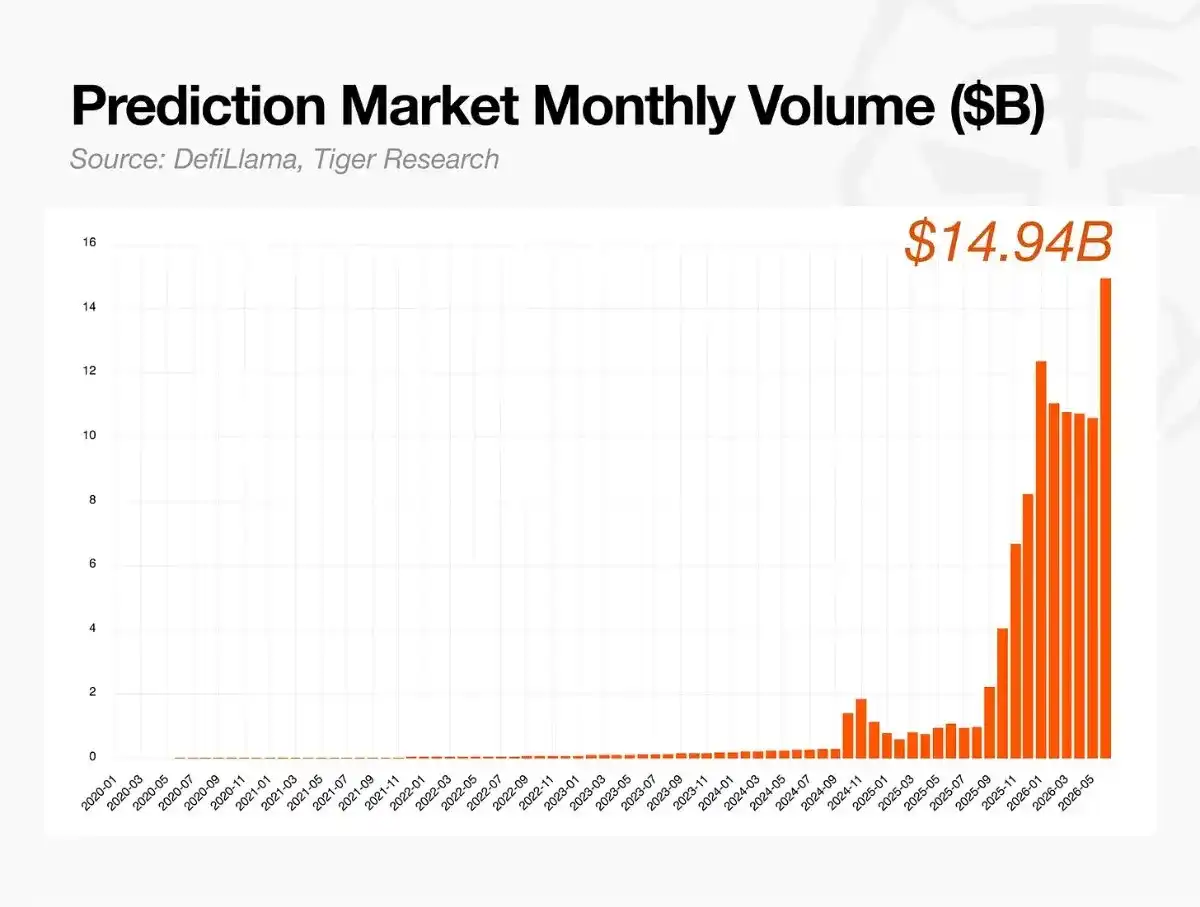
Since then, growth has accelerated. Current monthly trading volume exceeds $14 billion, and the combined valuation of major platforms is approximately $40 billion.

Meta's entry further proves it has moved beyond the early stage. A recent report by The New York Times revealed that Mark Zuckerberg personally leads a team developing a prediction market application called Arena. The dedication of such resources by a major tech company indicates this industry has left the experimental phase and established a proven business model.

Where Did Prediction Markets Originate?

Prediction markets are not a new phenomenon. They have been used informally in academia and finance for decades before blockchain technology brought them to the masses and helped them form an industry.

Informal Use

The term "prediction markets" itself emerged later than its history. By the 1980s, this concept went by various names such as information markets, decision markets, until a 2004 economics paper solidified it as "prediction markets."

However, the underlying practice predates the name. The earliest form was political betting on election outcomes. In 18th-century London coffee houses, people placed bets on parliamentary scandals and prime ministerial changes, with the resulting odds sometimes appearing in newspapers. In 19th-century New York, informal futures markets predicting presidential election outcomes were active in over-the-counter markets near Wall Street.

Academic Use
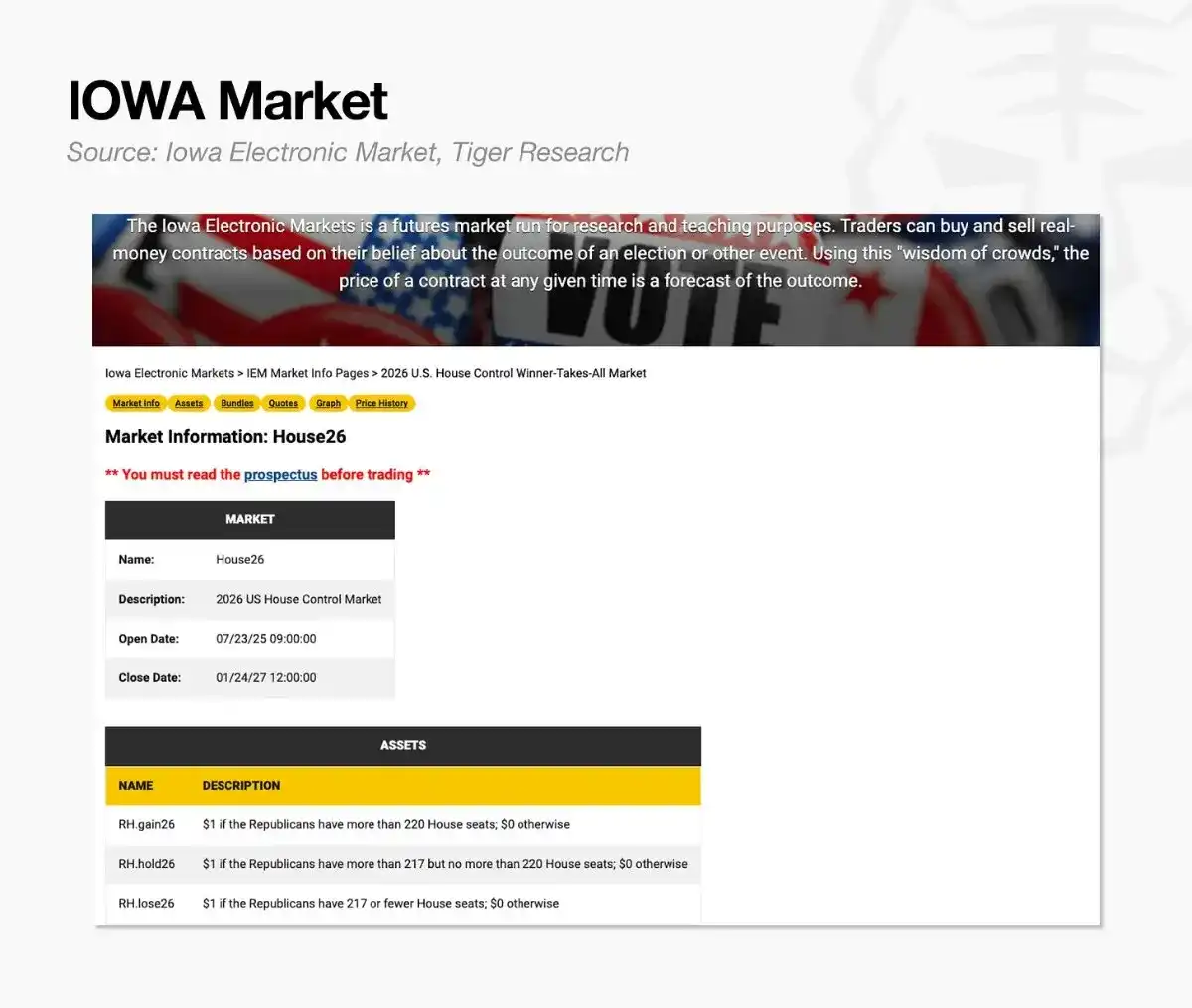
The academic starting point was three economists at the University of Iowa in 1988. Puzzled by polls failing to predict Jesse Jackson's win in the Michigan primary, they designed a market where people could directly trade election outcomes. This later became the Iowa Electronic Market (IEM).

In 1992 and 1993, the IEM received approval from the Commodity Futures Trading Commission (CFTC) for research purposes. Anyone could participate with $5. From 1988 to 2004, the IEM outperformed traditional polls about three-quarters of the time, serving as a laboratory for aggregating collective judgment into prices. Nonetheless, there was no regulatory framework at the time to allow its operation as a public market.

Binary Options

These early prediction markets closely resembled binary options in financial markets: contracts that are yes-or-no bets on whether a price would breach a certain threshold within a specified time. Their structure—settling at 1 if the event occurs, otherwise 0—is completely consistent with the logic of prediction markets.

Binary options also entered regulated exchanges. Examples include the Fixed Return Options by the American Stock Exchange in 2007 and S&P 500-based binary options by the Chicago Board Options Exchange in 2008. However, frequent fraud by offshore platforms led to bans on selling such products to retail investors in several major jurisdictions between 2017 and 2021. Despite this, this basic yes-or-no binary betting structure remains the logical foundation for how prediction markets operate today.

How Are Prediction Markets Traded Today?

Today, prediction markets cover topics encompassing almost any imaginable event.

Sports events account for the largest trading volume, benefiting from continuous schedules of leagues and global tournaments. The ongoing World Cup has further heightened the heat. Politics, geopolitics, and macroeconomics have expanded from indicators like inflation data to predictions on private company valuations, turning information itself into a tradable asset. Cryptocurrency and stock prices, along with some gossip-driven events, collectively form a complete spectrum from mass interest to professional information demand.
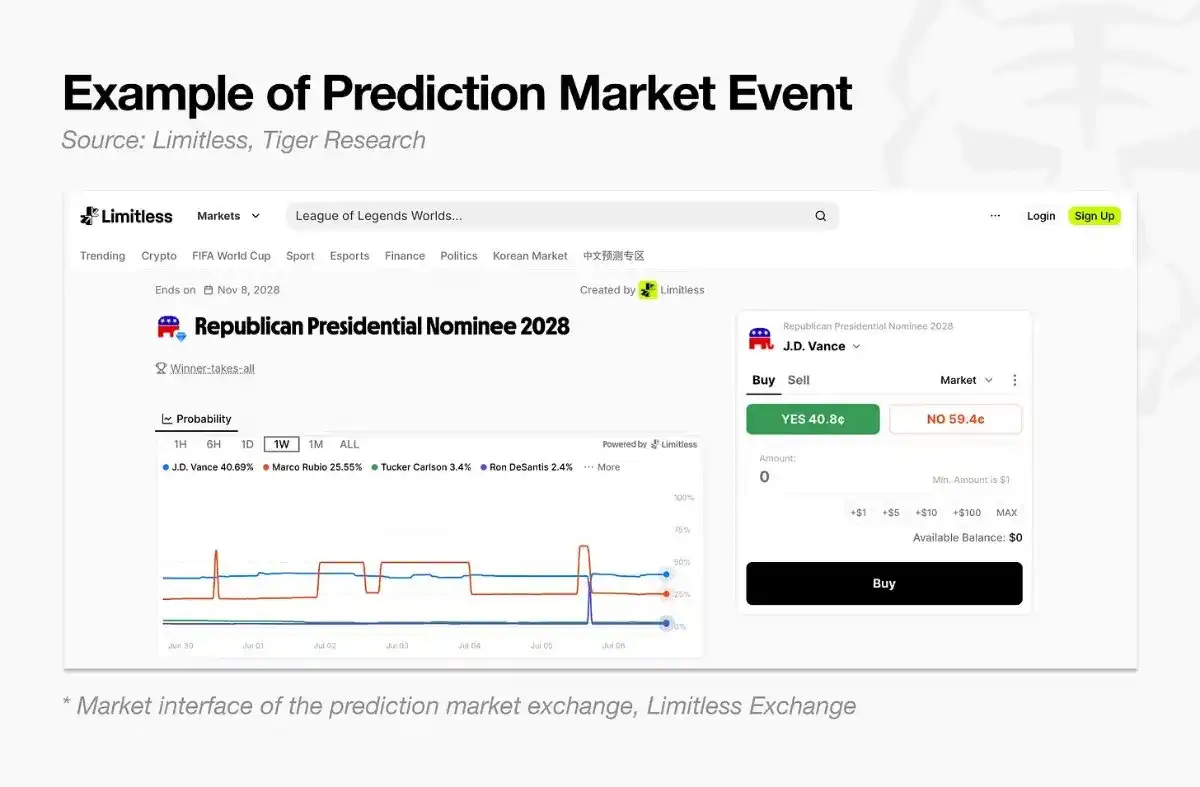
Each contract settles in a binary yes-or-no manner. Taking "Will J.D. Vance be the Republican presidential nominee in 2028?" as an example: If Vance is confirmed as the nominee, contracts betting "Yes" pay $1; otherwise, contracts betting "No" pay $1.

The simplest way to understand this structure is to think of $1 as 100%. A contract pays $1 (100%) if the event occurs, otherwise $0, so the intermediate trading price naturally reflects probability. A contract at 40 cents represents 40% of that dollar, meaning the market perceives a 40% probability of the event occurring. The cent value can be directly read as a percentage (ignoring bid-ask spreads and transaction costs).

Prices are formed through order books, not determined by any central party. Buy orders (e.g., buy at 39 cents) and sell orders (e.g., sell at 40 cents) accumulate at various price levels, with trades executed where both sides match. The price (and thus the implied probability) is generated in real-time by the interplay of funds from numerous participants. Traders can also sell their positions before expiration to lock in profits or cut losses, essentially exchanging their view on an event for cash.

Outcomes are recorded by oracles. No matter how precise a contract's price, someone still needs to determine "Yes" or "No" after the event concludes. Oracles are the mechanisms responsible for this judgment.
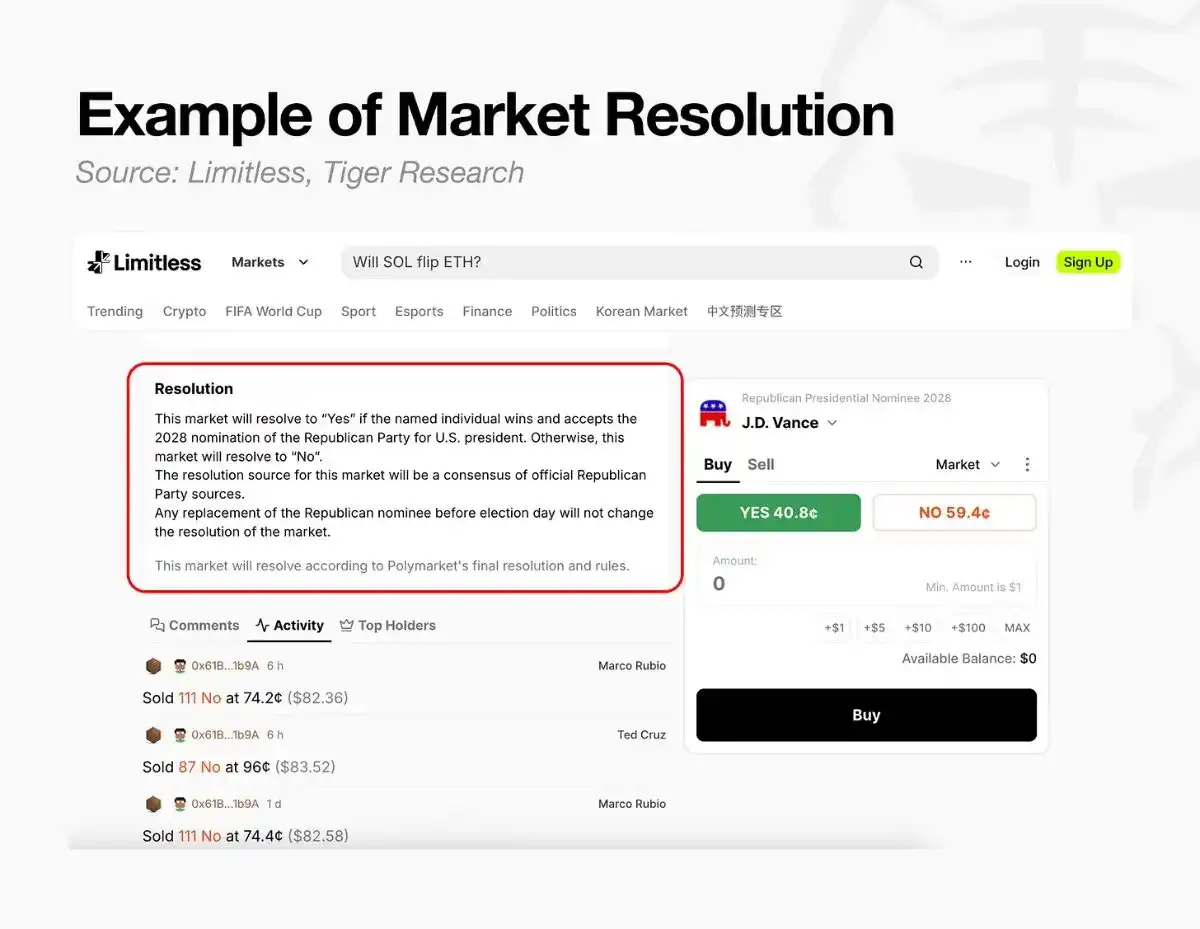
Oracles operate in two main ways:

  • Decentralized Oracles: Proposers stake collateral and submit a proposed outcome. If unchallenged within a set period, it becomes the final result. If challenged, a re-proposal process begins, and only after further challenges does it proceed to voting.
  • Centralized: Judgment criteria are set in advance. After the event concludes, the exchange directly applies the official result and immediately settles the market. This approach vests judgment authority entirely in a single exchange.

For example, on the Limitless platform, once a deadline passes, results are finalized according to preset rules. Reporting of real-world outcomes to the blockchain is completed by oracle services: most markets tracking crypto or stock prices report automatically via the Pyth Network, while custom markets for sports or politics are judged manually by an operations team within 24 to 72 hours.

At its core, a prediction market is an information system. It compresses the views of a large number of participants into a single number reflected in the price and, after the event, judges whether the prediction was correct based on preset rules.

The Evolution from Game to Information Finance

Prediction markets have evolved beyond simple betting platforms to become core infrastructure for information finance—turning future uncertainties into real-time price information. Their fundamental difference from traditional polls or expert forecasts lies in the "skin in the game" mechanism, where participants back their positions with their own capital.

In traditional methods, experts face little reputational cost for being wrong, and polls cannot filter out respondents' indifference or strategic misrepresentation. Prediction market prices carry a real cost for error—mistaken positions lose money—forcing participants to verify their beliefs with the most objective, up-to-date information. This willingness to bear a cost translates directly into market reliability.

This mechanism's performance is evident in multiple areas of real-world data:

Accuracy in Financial & Monetary Policy Predictions: Research by a Federal Reserve economist in February 2026 explains why. Since 2022, prediction market expectations for interest rates ahead of FOMC meetings have shown a statistically high degree of consistency with actual outcomes, outperforming federal funds futures and Bloomberg consensus. The reason is that participants immediately lose money if they are wrong, prompting stricter analysis of available information and pricing accordingly.

Transparent Probability Estimates for Politics & Elections: In South Korea's local elections in June 2026, Polymarket correctly predicted the winners in 14 out of 16 major cities and provinces. Where exit polls could only say "too close to call," prediction markets offered real-time probabilities backed by participants' real money, representing the aggregated judgment of numerous participants synthesizing multiple variables, not a simple forecast.

Responsiveness to Market Events & Company Valuations: When the issue of a stablecoin interest income cap emerged in March 2026, prediction markets immediately priced the probability of a Coinbase stock drop at 97.6%, serving as a real-time risk indicator rather than post-hoc analysis, demonstrating participants' sensitive response when their own capital is at risk. Academic research has reached similar conclusions: a 2015 study on internal prediction markets at companies like Google and Ford found prediction errors reduced by up to 25% compared to official forecast models, indicating prediction accuracy improves when insider knowledge is combined with capital at risk.

Information asymmetry remains a limitation. The Venezuela case in January 2026, where someone used confidential information for insider trading, exposed a real weakness. However, this attempt to distort prices was identified and prosecuted as a crime, also proving that markets aim to operate with transparency and accountability.

In areas where information is widely distributed, prediction markets are precision analytical tools; in areas where information is concentrated in few hands, they are monitoring mechanisms capable of identifying that concentration. Because participants' capital is genuinely at risk, the prices generated by these markets constitute objective information for assessing the value of financial assets.

The Absence of Prediction Markets in Asian Policy Discussions

The nature and trajectory of prediction markets vary greatly depending on national regulatory frameworks. The United States incorporated them into the regulated financial system through judicial rulings, while major jurisdictions in Asia still largely categorize them as traditional gambling.

In the U.S., litigation resolved much of the regulatory uncertainty. The CFTC attempted to classify Kalshi's election prediction contracts as gambling and sanction the platform, but courts ruled election prediction is not a game of chance, and regulators lacked the authority to ban it. This ruling shifted the regulatory stance, serving as a decisive catalyst for the entry of traditional financial institutions including ICE, Robinhood, and CME.

In contrast, in major Asian jurisdictions, the mainstream view still equates the binary settlement structure of prediction markets with traditional gambling. The dominant regulatory perspective is gambling control and public order, not financial policy. While approaches differ by country, prediction markets largely remain outside formal policy discussions in the region, with India and Indonesia being exceptions.

This divergence in treatment ultimately boils down to whether regulators view the market as a financial innovation or a social control issue.

Prediction Markets at a Crossroads: Regulatory Dilemma and Institutionalization

Prediction markets have become a core part of global financial and information infrastructure. A significant gap has emerged between the global trend and the rigid stance of Asian regulators. In an era where technological and financial boundaries have largely dissolved, attempts to confine new markets within old regulatory frameworks have inherent limitations. The current regulatory approach in major Asian jurisdictions faces three major problems.

The first is the paradox of regulatory arbitrage.

Prediction markets operate on borderless digital networks. Blocking platforms or restricting users in one country does not eliminate underlying demand. Users migrate to unregulated offshore platforms, assuming greater risks. This leads to capital outflow from the jurisdiction, with regulators losing both market oversight and associated tax revenue, weakening regional financial competitiveness in the long run.

The second is the loss of national information infrastructure sovereignty.

Prediction markets are advanced information infrastructure that translates complex social questions into precise numerical estimates, not merely betting venues. Recent elections in Asia have shown prediction markets reading public sentiment faster and more accurately than traditional polls. When excluded under the guise of regulation, the data that best reflects a society's mood accumulates on foreign servers. The result is that foreign media and institutions gain clearer insights into local societies than domestic analysts.

The third is the abandonment of user protection.

Users are in a blind spot, with no institutional safeguards. Policies that simply deny the market's existence without sufficient prior discussion only expose users to risk and push them outside the system.

The focus of discussion needs a fundamental shift.

The question is no longer how to block this market, but how to healthily utilize this data within the formal system. This shift in perspective requires dedicated study, yet related discussions remain limited.

In this field, Limitless Research is filling the gap, processing prediction data from Asian markets like South Korea and Japan into information assets. More participants are needed in the future to take on the role of building a healthy data ecosystem.

Regulation should not be a dam blocking the flow of water, but a channel to guide it correctly.

What Asia needs now is not stricter enforcement, but to initiate forward-looking discussions in response to this shift. Pushing transactions that are already happening into the shadows is the worst policy. It requires sustained effort to bring them into the formal system through constructive discussion, establish transparent oversight mechanisms, and return the data generated in the process as assets for the nation and society.


Crypto di tendenza

Domande pertinenti

QWhat is the key milestone that signals the prediction market industry has moved beyond its conceptual phase and is now a verified business model?

AThe entry of a major tech company like Meta, with Mark Zuckerberg personally leading the development of a prediction market app called Arena, serves as the key milestone indicating the industry has moved beyond experimentation and established a verified business model.

QHow is the probability of an event reflected in the trading price of a prediction market contract?

AThe trading price directly reflects the implied probability. A contract price of 40 cents, for example, represents 40% of the $1 maximum payout, meaning the market assesses a 40% probability of the event occurring. The cent value can be read directly as a percentage probability.

QWhat is the fundamental mechanism that distinguishes prediction markets from traditional polling or expert forecasts in terms of accuracy?

AThe fundamental mechanism is 'skin in the game,' where participants risk their own capital. This creates a real financial cost for being wrong, forcing participants to use the most objective and up-to-date information to validate their beliefs, which translates directly into market reliability and superior accuracy compared to methods without financial accountability.

QHow does the regulatory approach to prediction markets differ between the United States and most major Asian jurisdictions?

AIn the United States, legal rulings have integrated prediction markets into the regulated financial system (e.g., a court ruled election prediction is not gambling). In contrast, most major Asian jurisdictions still classify them as traditional gambling, focusing on gambling control and public order rather than financial policy innovation.

QWhat are the three main problems identified with the current restrictive regulatory stance of major Asian jurisdictions towards prediction markets?

AThe three main problems are: 1) The paradox of regulatory arbitrage, where users migrate to riskier offshore platforms, causing capital flight and loss of oversight. 2) The loss of national information infrastructure sovereignty, as valuable social sentiment data accumulates on foreign servers. 3) The abdication of user protection, as users are pushed into unregulated spaces without institutional safeguards.

Letture associate

Ethereum's Next Decade in the Eyes of Vitalik

"Lean Ethereum" Long-Term Roadmap Unveiled by Vitalik Buterin On July 5, 2026, Vitalik Buterin published the "Lean Ethereum" roadmap, positioning it as Ethereum's third major evolution following the Merge. This multi-year, multi-phase upgrade aims to fundamentally transform Ethereum's core protocol through staged network upgrades extending to 2029. Key goals include achieving 1 gigagas per second L1 throughput (a massive increase from the current ~32 TPS), near-instant finality, and quantum-resistant cryptography. The plan involves transitioning Ethereum's security model from full transaction re-execution by all nodes to native verification via recursive STARK proofs. A major proposed change is replacing the EVM with a proof-friendly architecture like RISC-V or leanISA, though this remains a point of contention, especially with L2s like Arbitrum favoring alternatives like WASM. Other planned upgrades include a restructured state model with a large, cheap "warehouse" storage layer to drastically reduce fees for migrated applications, multi-dimensional gas pricing, and a new focus on making privacy a first-class, native protocol feature. While the roadmap significantly raises Ethereum's long-term technical ceiling, analysts note it does not directly address ETH's mid-term token economics or value capture. The plan's multi-year timeline means near-term price impact will likely depend on observable progress milestones, such as the successful deployment of the upcoming Glamsterdam gas limit increase, growth in L2 activity and blob usage, and trends in L1 fee revenue and ETH burn.

链捕手2 h fa

Ethereum's Next Decade in the Eyes of Vitalik

链捕手2 h fa

In Just 11 Days, Claude Rewrote Millions of Lines of Code, an Epic AI Engineering Feat Sparks Fury

In just 11 days, Bun's founder Jarred Sumner used Anthropic's Claude AI models to rewrite its million lines of code from Zig to Rust. This move sparked significant controversy, particularly from Zig's creator, Andrew Kelley, who publicly criticized Sumner's engineering practices and the decision to use AI for such a massive rewrite. Bun, a high-performance JavaScript/TypeScript runtime and rival to Node.js, was originally written in Zig. After Anthropic acquired Bun, the team encountered persistent stability and memory safety bugs in the Zig codebase. These issues, combined with Zig's strict policy against LLM-generated code, led to the decision to rewrite in Rust. The rewrite was executed using Claude AI tools at an estimated API cost of $165,000, dramatically reducing the expected time and financial cost. Andrew Kelley's response was scathing. He blamed the original bugs on poor engineering habits, calling Bun's Zig code a collection of "hacks on top of hacks." He expressed relief that Bun was no longer associated with Zig, fearing it would misrepresent the language and attract low-quality, AI-generated contributions. The tech community is divided; some view Kelley's critique as unprofessional, while others see it as a defense of engineering integrity. A major concern about the AI-driven rewrite is the resulting code quality. The translation from Zig left approximately 27,000 lines of unsafe Rust code, raising fears about long-term maintainability and technical debt. The debate centers on whether this project is a milestone in AI-assisted development or a future maintenance nightmare.

marsbit3 h fa

In Just 11 Days, Claude Rewrote Millions of Lines of Code, an Epic AI Engineering Feat Sparks Fury

marsbit3 h fa

From Auto Finance to Bitcoin to AI Engines: An Analysis of Cango's 'What Not to Do' Strategy

From Auto Finance to Bitcoin and Now AI: Cango's "What Not to Do" Strategy Cango, a Chinese auto finance platform that went public on the NYSE in 2018, is undergoing its third major transformation. After selling its entire auto business in 2024, it pivoted to become a large-scale Bitcoin miner, acquiring 50 exahash of mining rigs from Bitmain. However, its true goal was never Bitcoin, but owning and controlling energy infrastructure. Now, Cango is pivoting again. While most listed Bitcoin miners are leasing power to giant hyperscalers for AI training clusters, Cango is taking the opposite path. It has launched an AI inference subsidiary called EcoHash, focusing not on training but on distributed inference. The company's strategy hinges on the insight that over 70% of mining industry power is controlled by small, independent sites (10-50 MW), which are too small for hyperscalers but ideal for low-latency AI inference. Cango aims to partner with these small operators, providing the AI technology, customers, and financing through its EcoLink software layer, which can distribute workloads across sites for reliability. Cango maintains a hybrid model, running roughly 31.7 EH/s of Bitcoin mining for cash flow while aggressively cleaning its balance sheet—slashing long-term debt by 94.5% to $30.6 million and raising $75 million for its AI venture. Its first AI deployment will be at a 50 MW site in Georgia. The strategy faces skepticism, given the high costs of converting mining sites and the potential for an AI bubble. However, Cango's leadership believes discipline around "what not to do"—avoiding direct competition with hyperscalers in training—positions it to capture the long-tail demand for distributed AI inference power.

Foresight News4 h fa

From Auto Finance to Bitcoin to AI Engines: An Analysis of Cango's 'What Not to Do' Strategy

Foresight News4 h fa

Strategy's Bitcoin Sales Cap Far Exceeds $1.25 Billion: A Detail the Market Overlooked

The article discusses how MicroStrategy's potential Bitcoin sales go far beyond the announced $1.25 billion "reserve-building capacity." It clarifies a key distinction in the company's "BTC Monetization Program": selling Bitcoin to *build* a new dollar reserve (the $1.25B cap) versus selling to *replenish* the existing USD Reserve after it's used for expenses like preferred share dividends. The recent $216M BTC sale for dividend payments was a "replenishment," leaving the headline $1.25B building quota untouched. The plan actually outlines three potential funding pools from BTC sales: 1) Building the reserve ($1.25B cap), 2) Covering preferred share/ debt costs (no specified cap), and 3) Funding buyback programs (up to $20B). This means the structured sales potential exceeds $30 billion, not including uncapped replenishment sales. The piece argues this marks MicroStrategy's shift from a passive "buy-and-hold" Bitcoin proxy to an actively managed entity using BTC as a balance-sheet tool to manage its complex capital structure (common stock, preferred shares, debt, reserve). This creates new dynamics and potential conflicts, as actions benefiting one part (e.g., selling BTC to pay dividends) may pressure another (e.g., undermining the "never sell" narrative). Investors must now parse the company's specific terminology ("build" vs. "replenish") to understand the true scope of future BTC sales, which is significantly larger than the market initially perceived.

marsbit4 h fa

Strategy's Bitcoin Sales Cap Far Exceeds $1.25 Billion: A Detail the Market Overlooked

marsbit4 h fa

Trading

Spot

Articoli Popolari

Cosa è $S$

Comprendere SPERO: Una Panoramica Completa Introduzione a SPERO Mentre il panorama dell'innovazione continua a evolversi, l'emergere delle tecnologie web3 e dei progetti di criptovaluta gioca un ruolo fondamentale nel plasmare il futuro digitale. Un progetto che ha attirato l'attenzione in questo campo dinamico è SPERO, denotato come SPERO,$$s$. Questo articolo mira a raccogliere e presentare informazioni dettagliate su SPERO, per aiutare gli appassionati e gli investitori a comprendere le sue basi, obiettivi e innovazioni nei domini web3 e crypto. Che cos'è SPERO,$$s$? SPERO,$$s$ è un progetto unico all'interno dello spazio crypto che cerca di sfruttare i principi della decentralizzazione e della tecnologia blockchain per creare un ecosistema che promuove l'impegno, l'utilità e l'inclusione finanziaria. Il progetto è progettato per facilitare interazioni peer-to-peer in modi nuovi, fornendo agli utenti soluzioni e servizi finanziari innovativi. Al suo interno, SPERO,$$s$ mira a responsabilizzare gli individui fornendo strumenti e piattaforme che migliorano l'esperienza dell'utente nello spazio delle criptovalute. Questo include la possibilità di metodi di transazione più flessibili, la promozione di iniziative guidate dalla comunità e la creazione di percorsi per opportunità finanziarie attraverso applicazioni decentralizzate (dApps). La visione sottostante di SPERO,$$s$ ruota attorno all'inclusività, cercando di colmare le lacune all'interno della finanza tradizionale mentre sfrutta i vantaggi della tecnologia blockchain. Chi è il Creatore di SPERO,$$s$? L'identità del creatore di SPERO,$$s$ rimane piuttosto oscura, poiché ci sono risorse pubblicamente disponibili limitate che forniscono informazioni dettagliate sul suo fondatore o fondatori. Questa mancanza di trasparenza può derivare dall'impegno del progetto per la decentralizzazione—un ethos che molti progetti web3 condividono, dando priorità ai contributi collettivi rispetto al riconoscimento individuale. Centrando le discussioni attorno alla comunità e ai suoi obiettivi collettivi, SPERO,$$s$ incarna l'essenza dell'empowerment senza mettere in evidenza individui specifici. Pertanto, comprendere l'etica e la missione di SPERO rimane più importante che identificare un creatore singolo. Chi sono gli Investitori di SPERO,$$s$? SPERO,$$s$ è supportato da una varietà di investitori che vanno dai capitalisti di rischio agli investitori angelici dedicati a promuovere l'innovazione nel settore crypto. Il focus di questi investitori generalmente si allinea con la missione di SPERO—dando priorità a progetti che promettono avanzamenti tecnologici sociali, inclusività finanziaria e governance decentralizzata. Queste fondazioni di investitori sono tipicamente interessate a progetti che non solo offrono prodotti innovativi, ma contribuiscono anche positivamente alla comunità blockchain e ai suoi ecosistemi. Il supporto di questi investitori rafforza SPERO,$$s$ come un concorrente degno di nota nel dominio in rapida evoluzione dei progetti crypto. Come Funziona SPERO,$$s$? SPERO,$$s$ impiega un framework multifunzionale che lo distingue dai progetti di criptovaluta convenzionali. Ecco alcune delle caratteristiche chiave che sottolineano la sua unicità e innovazione: Governance Decentralizzata: SPERO,$$s$ integra modelli di governance decentralizzati, responsabilizzando gli utenti a partecipare attivamente ai processi decisionali riguardanti il futuro del progetto. Questo approccio favorisce un senso di proprietà e responsabilità tra i membri della comunità. Utilità del Token: SPERO,$$s$ utilizza il proprio token di criptovaluta, progettato per servire varie funzioni all'interno dell'ecosistema. Questi token abilitano transazioni, premi e la facilitazione dei servizi offerti sulla piattaforma, migliorando l'impegno e l'utilità complessivi. Architettura Stratificata: L'architettura tecnica di SPERO,$$s$ supporta la modularità e la scalabilità, consentendo un'integrazione fluida di funzionalità e applicazioni aggiuntive man mano che il progetto evolve. Questa adattabilità è fondamentale per mantenere la rilevanza nel panorama crypto in continua evoluzione. Coinvolgimento della Comunità: Il progetto enfatizza iniziative guidate dalla comunità, impiegando meccanismi che incentivano la collaborazione e il feedback. Nutrendo una comunità forte, SPERO,$$s$ può affrontare meglio le esigenze degli utenti e adattarsi alle tendenze di mercato. Focus sull'Inclusione: Offrendo basse commissioni di transazione e interfacce user-friendly, SPERO,$$s$ mira ad attrarre una base utenti diversificata, inclusi individui che potrebbero non aver precedentemente interagito nello spazio crypto. Questo impegno per l'inclusione si allinea con la sua missione generale di empowerment attraverso l'accessibilità. Cronologia di SPERO,$$s$ Comprendere la storia di un progetto fornisce preziose intuizioni sulla sua traiettoria di sviluppo e sui traguardi. Di seguito è riportata una cronologia suggerita che mappa eventi significativi nell'evoluzione di SPERO,$$s$: Fase di Concettualizzazione e Ideazione: Le idee iniziali che formano la base di SPERO,$$s$ sono state concepite, allineandosi strettamente con i principi di decentralizzazione e focus sulla comunità all'interno dell'industria blockchain. Lancio del Whitepaper del Progetto: Dopo la fase concettuale, è stato rilasciato un whitepaper completo che dettaglia la visione, gli obiettivi e l'infrastruttura tecnologica di SPERO,$$s$ per suscitare interesse e feedback dalla comunità. Costruzione della Comunità e Prime Interazioni: Sono stati effettuati sforzi attivi di outreach per costruire una comunità di early adopters e potenziali investitori, facilitando discussioni attorno agli obiettivi del progetto e ottenendo supporto. Evento di Generazione del Token: SPERO,$$s$ ha condotto un evento di generazione del token (TGE) per distribuire i propri token nativi ai primi sostenitori e stabilire una liquidità iniziale all'interno dell'ecosistema. Lancio della Prima dApp: La prima applicazione decentralizzata (dApp) associata a SPERO,$$s$ è stata attivata, consentendo agli utenti di interagire con le funzionalità principali della piattaforma. Sviluppo Continuo e Partnership: Aggiornamenti e miglioramenti continui alle offerte del progetto, inclusi partnership strategiche con altri attori nello spazio blockchain, hanno plasmato SPERO,$$s$ in un concorrente competitivo e in evoluzione nel mercato crypto. Conclusione SPERO,$$s$ rappresenta una testimonianza del potenziale del web3 e delle criptovalute di rivoluzionare i sistemi finanziari e responsabilizzare gli individui. Con un impegno per la governance decentralizzata, il coinvolgimento della comunità e funzionalità progettate in modo innovativo, apre la strada verso un panorama finanziario più inclusivo. Come per qualsiasi investimento nello spazio crypto in rapida evoluzione, si incoraggiano potenziali investitori e utenti a ricercare approfonditamente e a impegnarsi in modo riflessivo con gli sviluppi in corso all'interno di SPERO,$$s$. Il progetto mostra lo spirito innovativo dell'industria crypto, invitando a ulteriori esplorazioni delle sue innumerevoli possibilità. Mentre il percorso di SPERO,$$s$ è ancora in fase di sviluppo, i suoi principi fondamentali potrebbero effettivamente influenzare il futuro di come interagiamo con la tecnologia, la finanza e tra di noi in ecosistemi digitali interconnessi.

116 Totale visualizzazioniPubblicato il 2024.12.17Aggiornato il 2024.12.17

Cosa è $S$

Cosa è AGENT S

Agent S: Il Futuro dell'Interazione Autonoma in Web3 Introduzione Nel panorama in continua evoluzione di Web3 e criptovalute, le innovazioni stanno costantemente ridefinendo il modo in cui gli individui interagiscono con le piattaforme digitali. Uno di questi progetti pionieristici, Agent S, promette di rivoluzionare l'interazione uomo-computer attraverso il suo framework agentico aperto. Aprendo la strada a interazioni autonome, Agent S mira a semplificare compiti complessi, offrendo applicazioni trasformative nell'intelligenza artificiale (AI). Questa esplorazione dettagliata approfondirà le complessità del progetto, le sue caratteristiche uniche e le implicazioni per il dominio delle criptovalute. Cos'è Agent S? Agent S si presenta come un innovativo framework agentico aperto, progettato specificamente per affrontare tre sfide fondamentali nell'automazione dei compiti informatici: Acquisizione di Conoscenze Specifiche del Dominio: Il framework apprende in modo intelligente da varie fonti di conoscenza esterne ed esperienze interne. Questo approccio duale gli consente di costruire un ricco repository di conoscenze specifiche del dominio, migliorando le sue prestazioni nell'esecuzione dei compiti. Pianificazione su Lungo Orizzonte di Compiti: Agent S impiega una pianificazione gerarchica potenziata dall'esperienza, un approccio strategico che facilita la suddivisione e l'esecuzione efficiente di compiti complessi. Questa caratteristica migliora significativamente la sua capacità di gestire più sottocompiti in modo efficiente ed efficace. Gestione di Interfacce Dinamiche e Non Uniformi: Il progetto introduce l'Interfaccia Agente-Computer (ACI), una soluzione innovativa che migliora l'interazione tra agenti e utenti. Utilizzando Modelli Linguistici Multimodali di Grandi Dimensioni (MLLM), Agent S può navigare e manipolare senza sforzo diverse interfacce grafiche utente. Attraverso queste caratteristiche pionieristiche, Agent S fornisce un framework robusto che affronta le complessità coinvolte nell'automazione dell'interazione umana con le macchine, preparando il terreno per innumerevoli applicazioni nell'AI e oltre. Chi è il Creatore di Agent S? Sebbene il concetto di Agent S sia fondamentalmente innovativo, informazioni specifiche sul suo creatore rimangono elusive. Il creatore è attualmente sconosciuto, il che evidenzia sia la fase embrionale del progetto sia la scelta strategica di mantenere i membri fondatori sotto anonimato. Indipendentemente dall'anonimato, l'attenzione rimane sulle capacità e sul potenziale del framework. Chi sono gli Investitori di Agent S? Poiché Agent S è relativamente nuovo nell'ecosistema crittografico, informazioni dettagliate riguardanti i suoi investitori e sostenitori finanziari non sono documentate esplicitamente. La mancanza di approfondimenti pubblicamente disponibili sulle fondazioni di investimento o sulle organizzazioni che supportano il progetto solleva interrogativi sulla sua struttura di finanziamento e sulla roadmap di sviluppo. Comprendere il supporto è cruciale per valutare la sostenibilità del progetto e il suo potenziale impatto sul mercato. Come Funziona Agent S? Al centro di Agent S si trova una tecnologia all'avanguardia che gli consente di funzionare efficacemente in contesti diversi. Il suo modello operativo è costruito attorno a diverse caratteristiche chiave: Interazione Uomo-Computer Simile a Quella Umana: Il framework offre una pianificazione AI avanzata, cercando di rendere le interazioni con i computer più intuitive. Mimando il comportamento umano nell'esecuzione dei compiti, promette di elevare le esperienze degli utenti. Memoria Narrativa: Utilizzata per sfruttare esperienze di alto livello, Agent S utilizza la memoria narrativa per tenere traccia delle storie dei compiti, migliorando così i suoi processi decisionali. Memoria Episodica: Questa caratteristica fornisce agli utenti una guida passo-passo, consentendo al framework di offrire supporto contestuale mentre i compiti si sviluppano. Supporto per OpenACI: Con la capacità di funzionare localmente, Agent S consente agli utenti di mantenere il controllo sulle proprie interazioni e flussi di lavoro, allineandosi con l'etica decentralizzata di Web3. Facile Integrazione con API Esterne: La sua versatilità e compatibilità con varie piattaforme AI garantiscono che Agent S possa adattarsi senza problemi agli ecosistemi tecnologici esistenti, rendendolo una scelta attraente per sviluppatori e organizzazioni. Queste funzionalità contribuiscono collettivamente alla posizione unica di Agent S all'interno dello spazio crittografico, poiché automatizza compiti complessi e multi-fase con un intervento umano minimo. Man mano che il progetto evolve, le sue potenziali applicazioni in Web3 potrebbero ridefinire il modo in cui si svolgono le interazioni digitali. Cronologia di Agent S Lo sviluppo e le tappe di Agent S possono essere riassunti in una cronologia che evidenzia i suoi eventi significativi: 27 Settembre 2024: Il concetto di Agent S è stato lanciato in un documento di ricerca completo intitolato “Un Framework Agentico Aperto che Usa i Computer Come un Umano”, mostrando le basi per il progetto. 10 Ottobre 2024: Il documento di ricerca è stato reso pubblicamente disponibile su arXiv, offrendo un'esplorazione approfondita del framework e della sua valutazione delle prestazioni basata sul benchmark OSWorld. 12 Ottobre 2024: È stata rilasciata una presentazione video, fornendo un'idea visiva delle capacità e delle caratteristiche di Agent S, coinvolgendo ulteriormente potenziali utenti e investitori. Questi indicatori nella cronologia non solo illustrano i progressi di Agent S, ma indicano anche il suo impegno per la trasparenza e il coinvolgimento della comunità. Punti Chiave su Agent S Man mano che il framework Agent S continua a evolversi, diversi attributi chiave si distinguono, sottolineando la sua natura innovativa e il potenziale: Framework Innovativo: Progettato per fornire un uso intuitivo dei computer simile all'interazione umana, Agent S porta un approccio nuovo all'automazione dei compiti. Interazione Autonoma: La capacità di interagire autonomamente con i computer attraverso GUI segna un passo avanti verso soluzioni informatiche più intelligenti ed efficienti. Automazione di Compiti Complessi: Con la sua metodologia robusta, può automatizzare compiti complessi e multi-fase, rendendo i processi più veloci e meno soggetti a errori. Miglioramento Continuo: I meccanismi di apprendimento consentono ad Agent S di migliorare dalle esperienze passate, migliorando continuamente le sue prestazioni e la sua efficacia. Versatilità: La sua adattabilità attraverso diversi ambienti operativi come OSWorld e WindowsAgentArena garantisce che possa servire un'ampia gamma di applicazioni. Man mano che Agent S si posiziona nel panorama di Web3 e delle criptovalute, il suo potenziale per migliorare le capacità di interazione e automatizzare i processi segna un significativo avanzamento nelle tecnologie AI. Attraverso il suo framework innovativo, Agent S esemplifica il futuro delle interazioni digitali, promettendo un'esperienza più fluida ed efficiente per gli utenti in vari settori. Conclusione Agent S rappresenta un audace passo avanti nell'unione tra AI e Web3, con la capacità di ridefinire il modo in cui interagiamo con la tecnologia. Sebbene sia ancora nelle sue fasi iniziali, le possibilità per la sua applicazione sono vaste e coinvolgenti. Attraverso il suo framework completo che affronta sfide critiche, Agent S mira a portare le interazioni autonome al centro dell'esperienza digitale. Man mano che ci addentriamo nei regni delle criptovalute e della decentralizzazione, progetti come Agent S giocheranno senza dubbio un ruolo cruciale nel plasmare il futuro della tecnologia e della collaborazione uomo-computer.

571 Totale visualizzazioniPubblicato il 2025.01.14Aggiornato il 2025.01.14

Cosa è AGENT S

Come comprare S

Benvenuto in HTX.com! Abbiamo reso l'acquisto di Sonic (S) semplice e conveniente. Segui la nostra guida passo passo per intraprendere il tuo viaggio nel mondo delle criptovalute.Step 1: Crea il tuo Account HTXUsa la tua email o numero di telefono per registrarti il tuo account gratuito su HTX. Vivi un'esperienza facile e sblocca tutte le funzionalità,Crea il mio accountStep 2: Vai in Acquista crypto e seleziona il tuo metodo di pagamentoCarta di credito/debito: utilizza la tua Visa o Mastercard per acquistare immediatamente SonicS.Bilancio: Usa i fondi dal bilancio del tuo account HTX per fare trading senza problemi.Terze parti: abbiamo aggiunto metodi di pagamento molto utilizzati come Google Pay e Apple Pay per maggiore comodità.P2P: Fai trading direttamente con altri utenti HTX.Over-the-Counter (OTC): Offriamo servizi su misura e tassi di cambio competitivi per i trader.Step 3: Conserva Sonic (S)Dopo aver acquistato Sonic (S), conserva nel tuo account HTX. In alternativa, puoi inviare tramite trasferimento blockchain o scambiare per altre criptovalute.Step 4: Scambia Sonic (S)Scambia facilmente Sonic (S) nel mercato spot di HTX. Accedi al tuo account, seleziona la tua coppia di trading, esegui le tue operazioni e monitora in tempo reale. Offriamo un'esperienza user-friendly sia per chi ha appena iniziato che per i trader più esperti.

1.1k Totale visualizzazioniPubblicato il 2025.01.15Aggiornato il 2026.06.02

Come comprare S

Discussioni

Benvenuto nella Community HTX. Qui puoi rimanere informato sugli ultimi sviluppi della piattaforma e accedere ad approfondimenti esperti sul mercato. Le opinioni degli utenti sul prezzo di S S sono presentate come di seguito.

活动图片